 Add to Chrome
 Add to Firefox
 Add to Edge
AgentOmnia: Scaling Agentic Models for Full-Scenario Applications
Jul 25, 2026
Large language model agents have advanced rapidly, yet progress remains fragmented across domains, capabilities, task difficulty, and interaction settings. We frame this as full-scenario agentic scaling and present AgentOmnia, a framework coordinating task-space definition, data synthesis, post-training, evaluation, and improvement across To-Consumer (ToC), To-Business (ToB), and To-Employee (ToE) applications. An extensible Domain x Capability x Atomic Difficulty taxonomy aligns these stages and enables fine-grained diagnosis with OmniaBench. AgentOmnia combines bidirectional environment-task synthesis with tool-dependency, program-structured, and solver-based pipelines, constructing 5,018 stateful environments with 255,375 tools and 52,361 tasks. Programs, solvers, and verifiers provide correctness signals, while supervised fine-tuning, online agentic reinforcement learning, and a rollback curriculum support post-training. Evaluation failures translate into Product Requirement Documents (PRDs) for targeted self-evolution. Starting from Qwen3-30B-A3B-Thinking-2507, AgentOmnia raises the pass rate on the OmniaBench challenging subset from 9.16% to 37.11% and the macro-average across OmniaBench, $τ^2$-Bench, DeepPlanning, and VitaBench from 22.86% to 41.69%. Under a unified protocol,it leads the evaluated agentic post-trained baselines on OmniaBench and retains the highest four-benchmark macro-average. It also surpasses Qwen3-235B-A22B-Thinking-2507 on all four benchmarks and exceeds Qwen3.5-35B-A3B on the macro-average. Gains span three application splits, ten capability dimensions, eight atomic-difficulty factors, and 76 of 90 level-1 domains, indicating broad rather than category-specific improvement. A one-round study provides initial evidence for PRD-guided self-evolution, motivating validation at larger scales and in industrial settings.

OmniaBench: Benchmarking General AI Agents Across Diverse Scenarios
Jul 16, 2026Large language models are increasingly evolving from text generators into general agents capable of understanding user requests, invoking external tools, and completing complex tasks through interaction. However, existing agent benchmarks often focus on limited scenarios, tool ecosystems, or interaction formats, making it difficult to systematically characterize model capabilities across heterogeneous application settings. We introduce OmniaBench, a benchmark for evaluating general agents across diverse scenarios with explicit state spaces. We derive application-oriented scenario knowledge from app stores, product documents, industry resources, Web retrieval, and human refinement, forming a hierarchical taxonomy that spans ToC, ToB and ToE with 90 level-1 and 354 level-2 domains. Based on this taxonomy, we construct executable environments and synthesize single-turn and multi-turn tasks through four complementary routes: DAG, DAG-S, Solver, and Program. OmniaBench further introduces a ten-dimensional capability taxonomy and eight compositional atomic difficulty factors to support fine-grained evaluation and analysis. The resulting dataset contains 1,431 tasks, together with a challenging subset of 644 tasks designed to reduce evaluation cost and mitigate potential contamination of the full set after public release. The bench presents substantial challenges to current frontier models, with even Claude-Sonnet-5 and GPT-5.6-Sol achieving Overall Pass@1 scores of only 58.54 and 57.14, respectively. Further analyses reveal clear differences across domains and capabilities, as well as persistent limitations in planning, constraint maintenance, and adaptive correction. OmniaBench provides a broad and diagnostic benchmark for characterizing the capability boundaries of general agents.
Entropy-Guided Reasoning Compression
Nov 18, 2025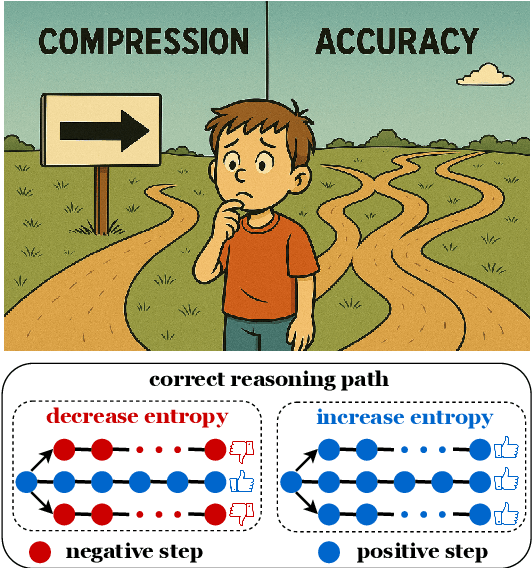
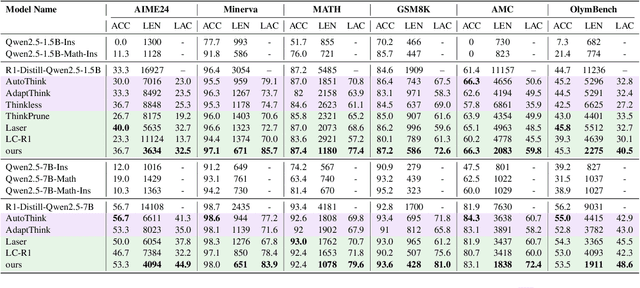
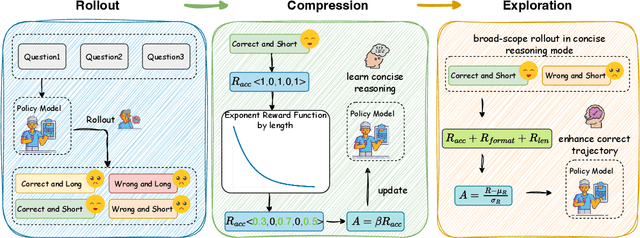
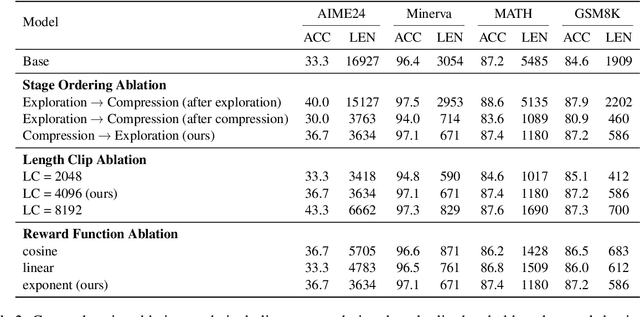
Large reasoning models have demonstrated remarkable performance on complex reasoning tasks, yet the excessive length of their chain-of-thought outputs remains a major practical bottleneck due to high computation cost and poor deployability. Existing compression methods have achieved partial success but overlook a crucial phenomenon in the training process -- the entropy conflict. During compression training, entropy decreases, leading to shorter reasoning but limited exploration, while accuracy-oriented objectives increase entropy, lengthening reasoning chains. This can cause the model to get stuck in a local dilemma. Our analysis further reveals the origin of the entropy conflict: many high-entropy tokens are logical connectors that receive larger gradients and are encouraged under the performance objective, while the compression objective simultaneously penalizes these potentially redundant connectors. This opposing pressure creates a direct source of entropy conflict. To address these issues, we adopt an entropy-guided training framework. As entropy descends, the model is guided toward efficient reasoning by encouraging concise thought steps; as entropy rises, exploration is reinforced under the compact reasoning mode to improve robustness. Experiments on six mathematical benchmarks show that our method compresses reasoning length to 20% of the original while maintaining or even surpassing baseline accuracy. Code and models will be released publicly.