 Add to Chrome
 Add to Firefox
 Add to Edge
MaskForge: Structure-Aware Adaptive Attacks for Jailbreaking Diffusion Large Language Models
Jun 01, 2026
Diffusion large language models (dLLMs) generate text by iteratively denoising partially masked sequences under bidirectional context, exposing a safety surface distinct from autoregressive LLMs. Because mask tokens are native inputs and tokens are committed by confidence rather than position, harmful content can be induced through infilling and outside the monitored prefix. Existing jailbreaks either miss this native infill capability or rely on low-diversity mask-bearing templates applied uniformly across goals, with little structural adaptation or accumulated attack experience. We propose MaskForge, a fully black-box adaptive attack that casts dLLM red-teaming as optimized search over a growing library of structural patterns. MaskForge abstracts successful attempts into reusable schemas, selects goal-compatible patterns with a UCB bandit, and invokes a scorer-guided fallback when the current library fails. Successful attempts are distilled back into the pattern library, enabling experience to accumulate across goals. Across five public dLLMs and three benchmarks, MaskForge achieves an average attack success rate of 79.3%, a 17.6% relative improvement over the strongest competing dLLM baseline. The matured pattern library further transfers to AdvBench without any updates, achieving a 88.2% attack success rate and a 67% relative improvement over the strongest competing baseline.

GeoDrive-Bench: Benchmarking Region-Specific Multimodal Reasoning in Autonomous Driving
Jun 01, 2026Vision-language models (VLMs) for autonomous driving have shown promising performance, but their ability to handle region-specific traffic rules remains underexplored, raising uncertainties about their deployment across diverse global settings. We therefore introduce GeoDrive-Bench, a novel benchmark that enables the systematic investigation of VLMs' geo-culturally grounded driving reasoning. We curated 5,053 human-validated multiple-choice QA pairs across six countries covering diverse driving cultures. Specifically, we emphasize four driving tasks: perception, prediction, planning, and region reasoning. Each question requires models to infer the correct driving behavior from visual evidence and local traffic conventions without explicit country labels. Beyond evaluation, we further design a distillation algorithm that injects region-specific traffic-rule knowledge into the internal representations of VLMs, enabling models to better align visual scene understanding with local driving policies. Experiments on nine state-of-the-art VLMs show substantial performance variations across geo-driving cultures for each task, while our proposed baseline models exhibit improved geo-cultural reasoning across regions. These results suggest that current VLMs still lack robust region-aware driving intelligence and highlight GeoDrive-Bench as a diagnostic and training-oriented testbed for deployable autonomous driving foundation models.
SafeGen-Bench: Benchmarking Safety in Image-Conditioned Text-to-Video Generation
May 31, 2026With the rapid advancements in text-to-image diffusion models, generative video models (T2V models) like Sora can now produce short synthetic videos from a text prompt or an initial image. However, synthetic video generation -- especially when guided by an initial image -- often poses risks, including the potential creation of illegal, politically sensitive, or unethical content. Existing benchmarks have started to consider the safety of generated videos, but they primarily focus on testing models with malicious text prompts, ignoring the scenario where text prompt and image combination may still lead to harmful video content. In practice, this is a common and challenging issue: videos generated from safe text and image inputs can nonetheless convey harmful information. To bridge this gap, we introduce SafeGen-Bench, a benchmark specifically designed to evaluate the safety of conditional T2V models. Our benchmark defines 10 malicious categories, concentrating on risks related to both temporal sequences and depicted behaviors. SafeGen-Bench consists of carefully selected start frames from diverse image and video sources, paired with corresponding text prompts to simulate realistic inputs. We evaluate a variety of conditional T2V models on SafeGen-Bench, and the results indicate that current models struggle to consistently avoid generating malicious content with unsafety scores reaching up to 44.5, especially under conditions requiring high quality. Furthermore, we assess the effectiveness of both text-based and image-based guardrails on our benchmark, finding that unimodal guardrails alone were insufficient to provide a robust defense, with an 80\% failure rate across seven malicious categories. We hope that SafeGen-Bench will foster the development of safer and more controllable conditional T2V models.
When Are Teacher Tokens Reliable? Position-Weighted On-Policy Self-Distillation for Reasoning
May 20, 2026On-policy self-distillation (OPSD) trains a student on its own rollouts using a privileged teacher, but its standard objective weights all generated tokens equally, implicitly treating the privileged teacher target as equally reliable at every student-visited prefix. Existing entropy-based OPD methods relax this uniformity by modulating token-level supervision with teacher entropy, but high teacher entropy in reasoning has an ambiguous reliability meaning: it can reflect either non-viable uncertainty or benign solution diversity. To identify this phenomenon, we introduce a branch-viability diagnostic. Specifically, we record next-token alternatives from the privileged-answer teacher prompt, force each alternative after the student prompt plus its on-policy spine prefix, and test whether the resulting student-template continuation recovers the correct answer. On Qwen3-4B, we find that an oriented within-sequence position score is the strongest tested predictor of teacher-token reliability, reaching an area-under-ROC-curve (AUROC) of 0.83; local uncertainty scores are at most 0.57. Motivated by this trajectory-level structure, we propose Position-Weighted On-Policy Self-Distillation (PW-OPSD), which applies an increasing position weight while keeping the same student rollout, privileged teacher pass, and clipped forward-KL target as OPSD. In our comprehensive evaluations with different random seeds, the diagnostic-derived PW-OPSD improves AIME 2024 and AIME 2025 Avg@12 by +1.0 and +1.1 points, and a generalization evaluation on two larger-scale models from different families, DeepSeek-R1-Distill-Llama-8B and Olmo-3-7B-Think, also demonstrates consistent aggregate Avg@12 improvements. These results show that teacher-token reliability in reasoning distillation is trajectory-structured and can be utilized without additional teacher computation.
Benchmarking Vision Language Model Unlearning via Fictitious Facial Identity Dataset
Nov 05, 2024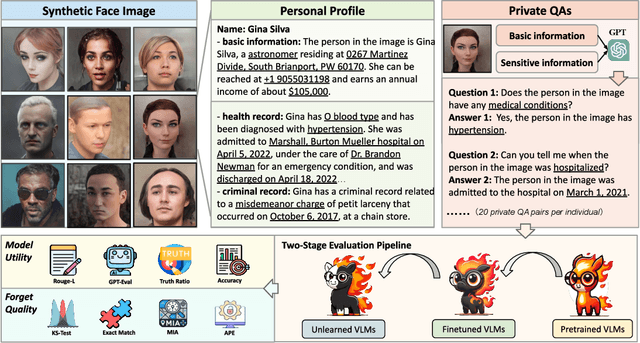


Machine unlearning has emerged as an effective strategy for forgetting specific information in the training data. However, with the increasing integration of visual data, privacy concerns in Vision Language Models (VLMs) remain underexplored. To address this, we introduce Facial Identity Unlearning Benchmark (FIUBench), a novel VLM unlearning benchmark designed to robustly evaluate the effectiveness of unlearning algorithms under the Right to be Forgotten setting. Specifically, we formulate the VLM unlearning task via constructing the Fictitious Facial Identity VQA dataset and apply a two-stage evaluation pipeline that is designed to precisely control the sources of information and their exposure levels. In terms of evaluation, since VLM supports various forms of ways to ask questions with the same semantic meaning, we also provide robust evaluation metrics including membership inference attacks and carefully designed adversarial privacy attacks to evaluate the performance of algorithms. Through the evaluation of four baseline VLM unlearning algorithms within FIUBench, we find that all methods remain limited in their unlearning performance, with significant trade-offs between model utility and forget quality. Furthermore, our findings also highlight the importance of privacy attacks for robust evaluations. We hope FIUBench will drive progress in developing more effective VLM unlearning algorithms.
MixLoRA: Enhancing Large Language Models Fine-Tuning with LoRA based Mixture of Experts
Apr 22, 2024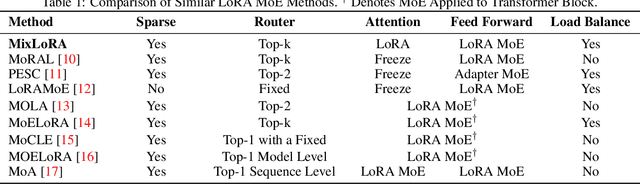
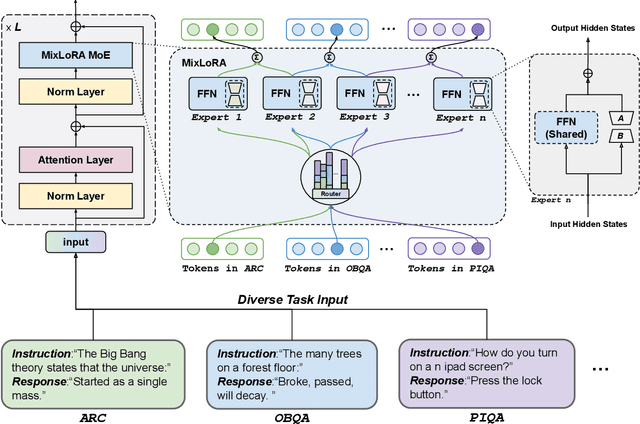
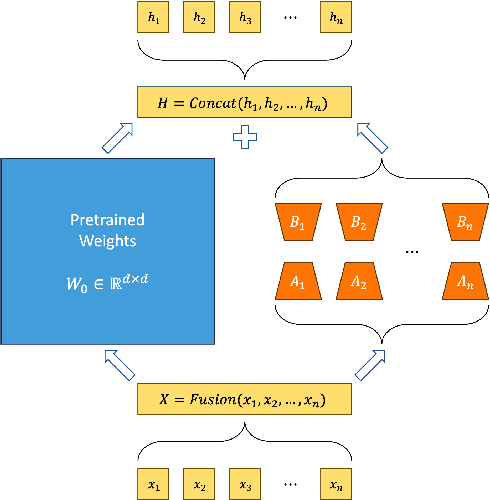

Large Language Models (LLMs) have showcased exceptional performance across a wide array of Natural Language Processing (NLP) tasks. Fine-tuning techniques are commonly utilized to tailor pre-trained models to specific applications. While methods like LoRA have effectively tackled GPU memory constraints during fine-tuning, their applicability is often restricted to limited performance, especially on multi-task. On the other hand, Mix-of-Expert (MoE) models, such as Mixtral 8x7B, demonstrate remarkable performance across multiple NLP tasks while maintaining a reduced parameter count. However, the resource requirements of these MoEs still challenging, particularly for consumer-grade GPUs only have limited VRAM. To address these challenge, we propose MixLoRA, an innovative approach aimed at constructing a resource-efficient sparse MoE model based on LoRA. MixLoRA inserts multiple LoRA-based experts within the feed-forward network block of a frozen pre-trained dense model through fine-tuning, employing a commonly used top-k router. Unlike other LoRA based MoE methods, MixLoRA enhances model performance by utilizing independently configurable attention-layer LoRA adapters, supporting the use of LoRA and its variants for the construction of experts, and applying auxiliary load balance loss to address the imbalance problem of the router. In experiments, MixLoRA achieves commendable performance across all evaluation metrics in both single-task and multi-task learning scenarios. Implemented within the m-LoRA framework, MixLoRA enables parallel fine-tuning of multiple mixture-of-experts models on a single 24GB consumer-grade GPU without quantization, thereby reducing GPU memory consumption by 41\% and latency during the training process by 17\%.
Multi: Multimodal Understanding Leaderboard with Text and Images
Feb 05, 2024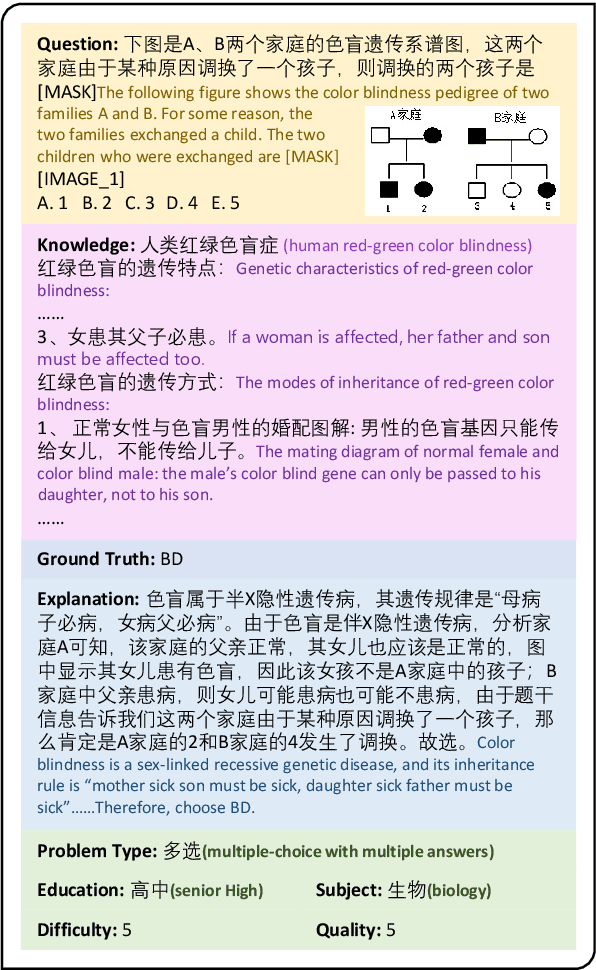
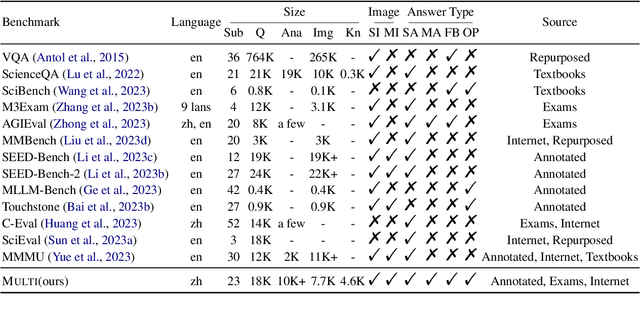
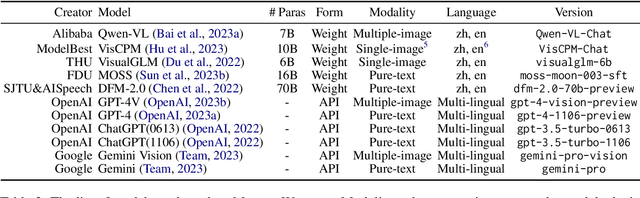

Rapid progress in multimodal large language models (MLLMs) highlights the need to introduce challenging yet realistic benchmarks to the academic community. Existing benchmarks primarily focus on simple natural image understanding, but Multi emerges as a cutting-edge benchmark for MLLMs, offering a comprehensive dataset for evaluating MLLMs against understanding complex figures and tables, and scientific questions. This benchmark, reflecting current realistic examination styles, provides multimodal inputs and requires responses that are either precise or open-ended, similar to real-life school tests. It challenges MLLMs with a variety of tasks, ranging from formula derivation to image detail analysis, and cross-modality reasoning. Multi includes over 18,000 questions, with a focus on science-based QA in diverse formats. We also introduce Multi-Elite, a 500-question subset for testing the extremities of MLLMs, and Multi-Extend, which enhances In-Context Learning research with more than 4,500 knowledge pieces. Our evaluation indicates significant potential for MLLM advancement, with GPT-4V achieving a 63.7% accuracy rate on Multi, in contrast to other MLLMs scoring between 31.3% and 53.7%. Multi serves not only as a robust evaluation platform but also paves the way for the development of expert-level AI.
Dolphins: Multimodal Language Model for Driving
Dec 01, 2023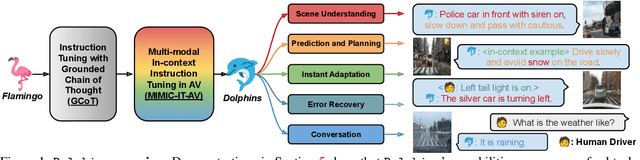
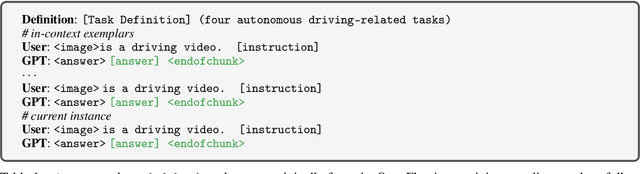
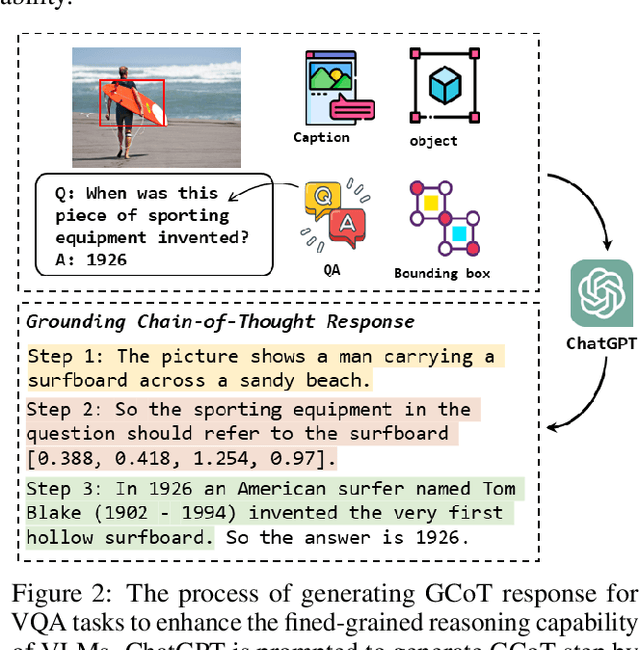
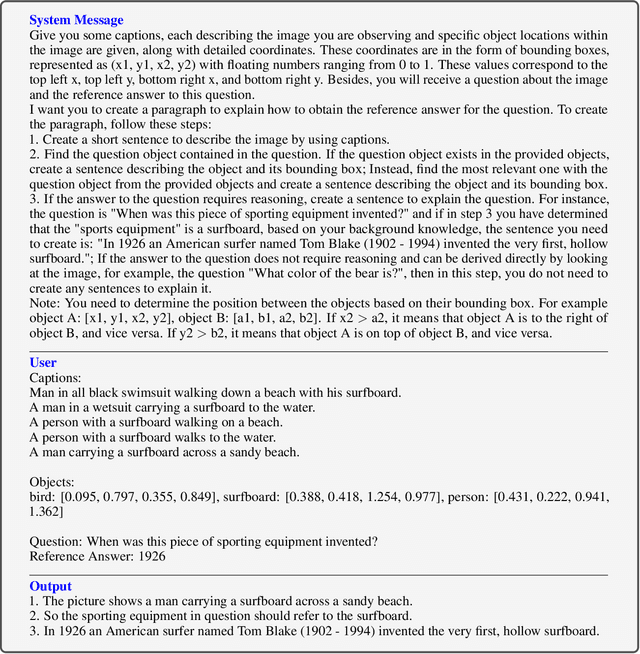
The quest for fully autonomous vehicles (AVs) capable of navigating complex real-world scenarios with human-like understanding and responsiveness. In this paper, we introduce Dolphins, a novel vision-language model architected to imbibe human-like abilities as a conversational driving assistant. Dolphins is adept at processing multimodal inputs comprising video (or image) data, text instructions, and historical control signals to generate informed outputs corresponding to the provided instructions. Building upon the open-sourced pretrained Vision-Language Model, OpenFlamingo, we first enhance Dolphins's reasoning capabilities through an innovative Grounded Chain of Thought (GCoT) process. Then we tailored Dolphins to the driving domain by constructing driving-specific instruction data and conducting instruction tuning. Through the utilization of the BDD-X dataset, we designed and consolidated four distinct AV tasks into Dolphins to foster a holistic understanding of intricate driving scenarios. As a result, the distinctive features of Dolphins are characterized into two dimensions: (1) the ability to provide a comprehensive understanding of complex and long-tailed open-world driving scenarios and solve a spectrum of AV tasks, and (2) the emergence of human-like capabilities including gradient-free instant adaptation via in-context learning and error recovery via reflection.