 Add to Chrome
 Add to Firefox
 Add to Edge
The First EgoCross Challenge at EgoVis 2026: Cross-Domain Egocentric Video Question Answering
Aug 05, 2026
EgoCross is a cross-domain egocentric video question answering benchmark designed to evaluate whether multimodal large language models can generalize beyond common daily-life scenarios. The first EgoCross Challenge was hosted at the Third EgoVis Workshop at CVPR 2026 and evaluated models on first-person videos from four target domains: surgery, industrial assembly, extreme sports, and animal perspectives. Each test example consists of an egocentric video clip, a question, and four candidate answers, from which the model must select the correct option. This technical report introduces the challenge task, benchmark resources, and two official Codabench tracks. The Source-Limited Track restricts participants to the official baseline model and a small support set, whereas the Open-Source Track permits broader choices of models and training data under rules that prohibit the manual construction of target-domain training data. In total, the challenge received more than 1,500 submissions from over 130 participants, with 19 teams participating in the Open-Source Track and 38 teams in the Source-Limited Track. We further present the official leaderboard results and summarize the winning solutions from both tracks. We hope that this report will serve as a useful technical reference for advancing cross-domain egocentric video understanding. All resources, including the challenge data, baseline implementation, and code released by the winning teams, are made publicly available.

CASTLE2026 Team WDL Technical Report
May 30, 2026The CASTLE Challenge @ EgoVis 2026 evaluates long-form egocentric video question answering over 600+ hours of multi-perspective recordings. Each four-choice question requires evidence from videos, transcripts, auxiliary photos, people, days, rooms, and temporal context. We propose an evidence-aware multimodal reasoning pipeline based on Qwen. Our system parses question hints, retrieves ASR chunks, attaches auxiliary images, samples candidate video frames, and routes questions into static visual, speech/text, temporal, and mixed types with specialized prompts. Multiple inference passes are aggregated by confidence-weighted voting and converted into the official Codabench format. In ablation, LoRA improves the score from 0.21 to 0.50, and more sampled frames further raise it to 0.58. Our final system ranks first in the CASTLE Challenge @ EgoVis 2026.
LoViF 2026 The First Challenge on Holistic Quality Assessment for 4D World Model (PhyScore)
May 06, 2026This paper reports on the LoViF 2026 PhyScore challenge, a competition on holistic quality assessment of world-model-generated videos across both 2D and 4D generation settings. The challenge is motivated by a central gap in current evaluation practice: perceptual quality alone is insufficient to judge whether generated dynamics are physically plausible, temporally coherent, and consistent with input conditions. Participants are required to build a metric that jointly predicts four dimensions, i.e., Video Quality, Physical Realism, Condition-Video Alignment, and Temporal Consistency. Depart from that, participants also need to localize physical anomaly timestamps for fine-grained diagnosis. The benchmark dataset contains 1,554 videos generated by seven representative world generative models, organized into three tracks (text-2D, image-to-4D, and video-to-4D) and spanning 26 categories. These categories explicitly cover physics-relevant scenarios, including dynamics, optics, and thermodynamics, together with diverse real-world and creative content. To ensure label reliability, scores and anomaly timestamps are produced through trained human annotation with an additional automated quality-control pass. Evaluation is based on both score prediction and anomaly localization, with a composite protocol that combines TimeStamp_IOU and SRCC/PLCC. This report summarizes the challenge design and provides method-level insights from submitted solutions.
MARS2 2025 Challenge on Multimodal Reasoning: Datasets, Methods, Results, Discussion, and Outlook
Sep 17, 2025
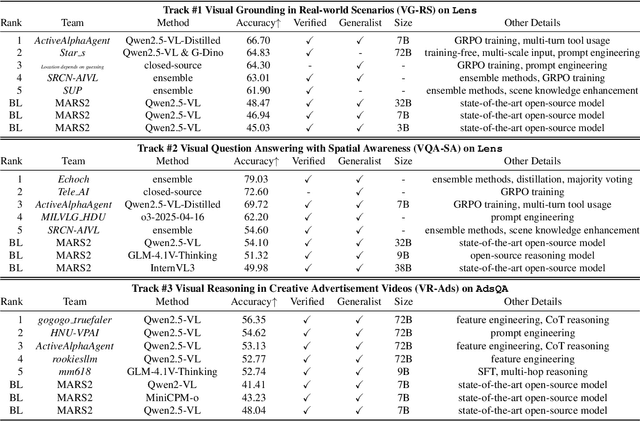

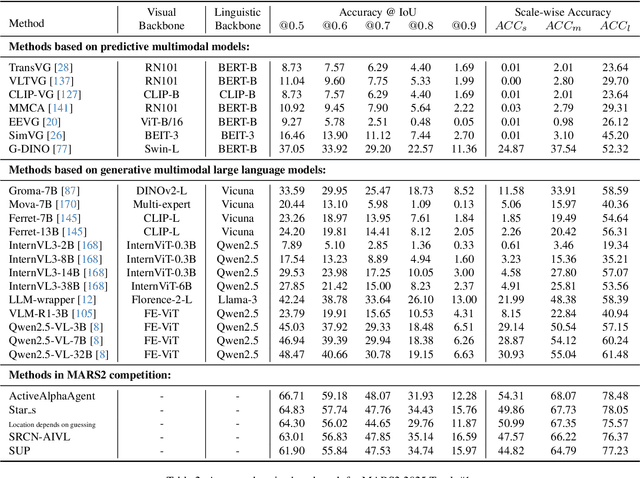
This paper reviews the MARS2 2025 Challenge on Multimodal Reasoning. We aim to bring together different approaches in multimodal machine learning and LLMs via a large benchmark. We hope it better allows researchers to follow the state-of-the-art in this very dynamic area. Meanwhile, a growing number of testbeds have boosted the evolution of general-purpose large language models. Thus, this year's MARS2 focuses on real-world and specialized scenarios to broaden the multimodal reasoning applications of MLLMs. Our organizing team released two tailored datasets Lens and AdsQA as test sets, which support general reasoning in 12 daily scenarios and domain-specific reasoning in advertisement videos, respectively. We evaluated 40+ baselines that include both generalist MLLMs and task-specific models, and opened up three competition tracks, i.e., Visual Grounding in Real-world Scenarios (VG-RS), Visual Question Answering with Spatial Awareness (VQA-SA), and Visual Reasoning in Creative Advertisement Videos (VR-Ads). Finally, 76 teams from the renowned academic and industrial institutions have registered and 40+ valid submissions (out of 1200+) have been included in our ranking lists. Our datasets, code sets (40+ baselines and 15+ participants' methods), and rankings are publicly available on the MARS2 workshop website and our GitHub organization page https://github.com/mars2workshop/, where our updates and announcements of upcoming events will be continuously provided.