 Add to Chrome
 Add to Firefox
 Add to Edge
EmoLat: Text-driven Image Sentiment Transfer via Emotion Latent Space
Jan 17, 2026
We propose EmoLat, a novel emotion latent space that enables fine-grained, text-driven image sentiment transfer by modeling cross-modal correlations between textual semantics and visual emotion features. Within EmoLat, an emotion semantic graph is constructed to capture the relational structure among emotions, objects, and visual attributes. To enhance the discriminability and transferability of emotion representations, we employ adversarial regularization, aligning the latent emotion distributions across modalities. Building upon EmoLat, a cross-modal sentiment transfer framework is proposed to manipulate image sentiment via joint embedding of text and EmoLat features. The network is optimized using a multi-objective loss incorporating semantic consistency, emotion alignment, and adversarial regularization. To support effective modeling, we construct EmoSpace Set, a large-scale benchmark dataset comprising images with dense annotations on emotions, object semantics, and visual attributes. Extensive experiments on EmoSpace Set demonstrate that our approach significantly outperforms existing state-of-the-art methods in both quantitative metrics and qualitative transfer fidelity, establishing a new paradigm for controllable image sentiment editing guided by textual input. The EmoSpace Set and all the code are available at http://github.com/JingVIPLab/EmoLat.

Bridging Semantic Understanding and Popularity Bias with LLMs
Jan 15, 2026Semantic understanding of popularity bias is a crucial yet underexplored challenge in recommender systems, where popular items are often favored at the expense of niche content. Most existing debiasing methods treat the semantic understanding of popularity bias as a matter of diversity enhancement or long-tail coverage, neglecting the deeper semantic layer that embodies the causal origins of the bias itself. Consequently, such shallow interpretations limit both their debiasing effectiveness and recommendation accuracy. In this paper, we propose FairLRM, a novel framework that bridges the gap in the semantic understanding of popularity bias with Recommendation via Large Language Model (RecLLM). FairLRM decomposes popularity bias into item-side and user-side components, using structured instruction-based prompts to enhance the model's comprehension of both global item distributions and individual user preferences. Unlike traditional methods that rely on surface-level features such as "diversity" or "debiasing", FairLRM improves the model's ability to semantically interpret and address the underlying bias. Through empirical evaluation, we show that FairLRM significantly enhances both fairness and recommendation accuracy, providing a more semantically aware and trustworthy approach to enhance the semantic understanding of popularity bias. The implementation is available at https://github.com/LuoRenqiang/FairLRM.
RovoDev Code Reviewer: A Large-Scale Online Evaluation of LLM-based Code Review Automation at Atlassian
Jan 03, 2026Large Language Models (LLMs)-powered code review automation has the potential to transform code review workflows. Despite the advances of LLM-powered code review comment generation approaches, several practical challenges remain for designing enterprise-grade code review automation tools. In particular, this paper aims at answering the practical question: how can we design a review-guided, context-aware, quality-checked code review comment generation without fine-tuning? In this paper, we present RovoDev Code Reviewer, an enterprise-grade LLM-based code review automation tool designed and deployed at scale within Atlassian's development ecosystem with seamless integration into Atlassian's Bitbucket. Through the offline, online, user feedback evaluations over a one-year period, we conclude that RovoDev Code Reviewer is (1) effective in generating code review comments that could lead to code resolution for 38.70% (i.e., comments that triggered code changes in the subsequent commits); and (2) offers the promise of accelerating feedback cycles (i.e., decreasing the PR cycle time by 30.8%), alleviating reviewer workload (i.e., reducing the number of human-written comments by 35.6%), and improving overall software quality (i.e., finding errors with actionable suggestions).
PathFound: An Agentic Multimodal Model Activating Evidence-seeking Pathological Diagnosis
Dec 29, 2025Recent pathological foundation models have substantially advanced visual representation learning and multimodal interaction. However, most models still rely on a static inference paradigm in which whole-slide images are processed once to produce predictions, without reassessment or targeted evidence acquisition under ambiguous diagnoses. This contrasts with clinical diagnostic workflows that refine hypotheses through repeated slide observations and further examination requests. We propose PathFound, an agentic multimodal model designed to support evidence-seeking inference in pathological diagnosis. PathFound integrates the power of pathological visual foundation models, vision-language models, and reasoning models trained with reinforcement learning to perform proactive information acquisition and diagnosis refinement by progressing through the initial diagnosis, evidence-seeking, and final decision stages. Across several large multimodal models, adopting this strategy consistently improves diagnostic accuracy, indicating the effectiveness of evidence-seeking workflows in computational pathology. Among these models, PathFound achieves state-of-the-art diagnostic performance across diverse clinical scenarios and demonstrates strong potential to discover subtle details, such as nuclear features and local invasions.
AirGS: Real-Time 4D Gaussian Streaming for Free-Viewpoint Video Experiences
Dec 24, 2025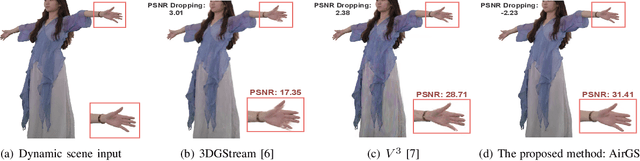
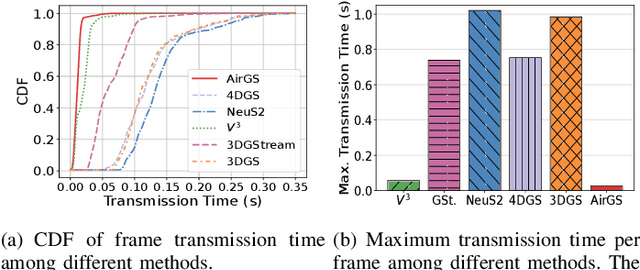
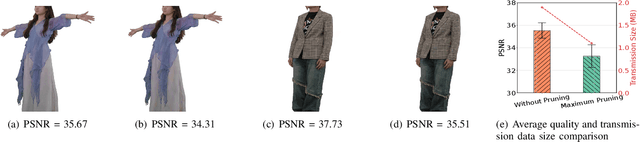
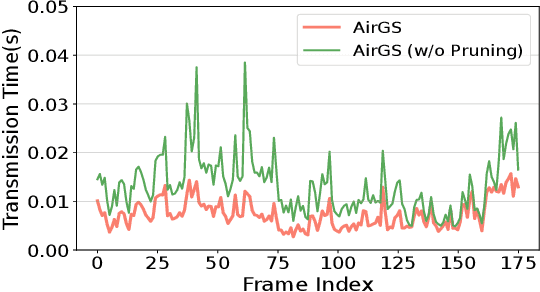
Free-viewpoint video (FVV) enables immersive viewing experiences by allowing users to view scenes from arbitrary perspectives. As a prominent reconstruction technique for FVV generation, 4D Gaussian Splatting (4DGS) models dynamic scenes with time-varying 3D Gaussian ellipsoids and achieves high-quality rendering via fast rasterization. However, existing 4DGS approaches suffer from quality degradation over long sequences and impose substantial bandwidth and storage overhead, limiting their applicability in real-time and wide-scale deployments. Therefore, we present AirGS, a streaming-optimized 4DGS framework that rearchitects the training and delivery pipeline to enable high-quality, low-latency FVV experiences. AirGS converts Gaussian video streams into multi-channel 2D formats and intelligently identifies keyframes to enhance frame reconstruction quality. It further combines temporal coherence with inflation loss to reduce training time and representation size. To support communication-efficient transmission, AirGS models 4DGS delivery as an integer linear programming problem and design a lightweight pruning level selection algorithm to adaptively prune the Gaussian updates to be transmitted, balancing reconstruction quality and bandwidth consumption. Extensive experiments demonstrate that AirGS reduces quality deviation in PSNR by more than 20% when scene changes, maintains frame-level PSNR consistently above 30, accelerates training by 6 times, reduces per-frame transmission size by nearly 50% compared to the SOTA 4DGS approaches.
CS3D: An Efficient Facial Expression Recognition via Event Vision
Dec 10, 2025Responsive and accurate facial expression recognition is crucial to human-robot interaction for daily service robots. Nowadays, event cameras are becoming more widely adopted as they surpass RGB cameras in capturing facial expression changes due to their high temporal resolution, low latency, computational efficiency, and robustness in low-light conditions. Despite these advantages, event-based approaches still encounter practical challenges, particularly in adopting mainstream deep learning models. Traditional deep learning methods for facial expression analysis are energy-intensive, making them difficult to deploy on edge computing devices and thereby increasing costs, especially for high-frequency, dynamic, event vision-based approaches. To address this challenging issue, we proposed the CS3D framework by decomposing the Convolutional 3D method to reduce the computational complexity and energy consumption. Additionally, by utilizing soft spiking neurons and a spatial-temporal attention mechanism, the ability to retain information is enhanced, thus improving the accuracy of facial expression detection. Experimental results indicate that our proposed CS3D method attains higher accuracy on multiple datasets compared to architectures such as the RNN, Transformer, and C3D, while the energy consumption of the CS3D method is just 21.97\% of the original C3D required on the same device.
LEMUR: Large scale End-to-end MUltimodal Recommendation
Nov 17, 2025Traditional ID-based recommender systems often struggle with cold-start and generalization challenges. Multimodal recommendation systems, which leverage textual and visual data, offer a promising solution to mitigate these issues. However, existing industrial approaches typically adopt a two-stage training paradigm: first pretraining a multimodal model, then applying its frozen representations to train the recommendation model. This decoupled framework suffers from misalignment between multimodal learning and recommendation objectives, as well as an inability to adapt dynamically to new data. To address these limitations, we propose LEMUR, the first large-scale multimodal recommender system trained end-to-end from raw data. By jointly optimizing both the multimodal and recommendation components, LEMUR ensures tighter alignment with downstream objectives while enabling real-time parameter updates. Constructing multimodal sequential representations from user history often entails prohibitively high computational costs. To alleviate this bottleneck, we propose a novel memory bank mechanism that incrementally accumulates historical multimodal representations throughout the training process. After one month of deployment in Douyin Search, LEMUR has led to a 0.843% reduction in query change rate decay and a 0.81% improvement in QAUC. Additionally, LEMUR has shown significant gains across key offline metrics for Douyin Advertisement. Our results validate the superiority of end-to-end multimodal recommendation in real-world industrial scenarios.
Live-SWE-agent: Can Software Engineering Agents Self-Evolve on the Fly?
Nov 17, 2025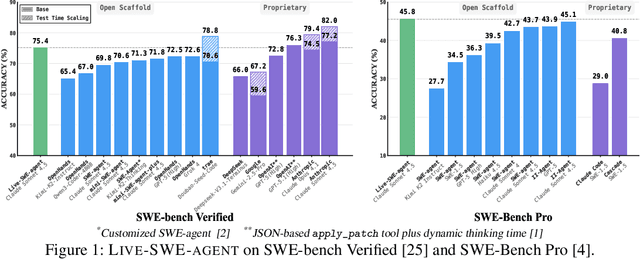
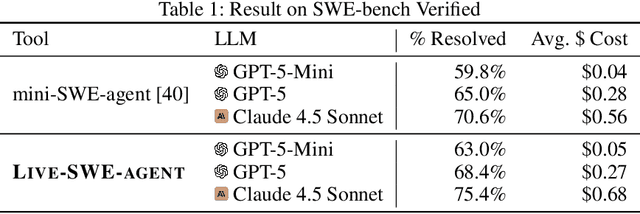
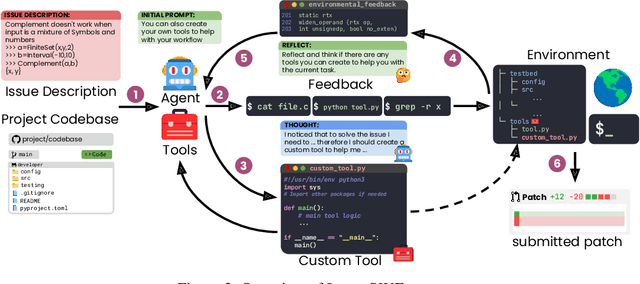
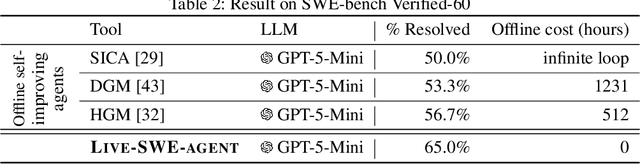
Large Language Models (LLMs) are reshaping almost all industries, including software engineering. In recent years, a number of LLM agents have been proposed to solve real-world software problems. Such software agents are typically equipped with a suite of coding tools and can autonomously decide the next actions to form complete trajectories to solve end-to-end software tasks. While promising, they typically require dedicated design and may still be suboptimal, since it can be extremely challenging and costly to exhaust the entire agent scaffold design space. Recognizing that software agents are inherently software themselves that can be further refined/modified, researchers have proposed a number of self-improving software agents recently, including the Darwin-Gödel Machine (DGM). Meanwhile, such self-improving agents require costly offline training on specific benchmarks and may not generalize well across different LLMs or benchmarks. In this paper, we propose Live-SWE-agent, the first live software agent that can autonomously and continuously evolve itself on-the-fly during runtime when solving real-world software problems. More specifically, Live-SWE-agent starts with the most basic agent scaffold with only access to bash tools (e.g., mini-SWE-agent), and autonomously evolves its own scaffold implementation while solving real-world software problems. Our evaluation on the widely studied SWE-bench Verified benchmark shows that Live-SWE-agent can achieve an impressive solve rate of 75.4% without test-time scaling, outperforming all existing open-source software agents and approaching the performance of the best proprietary solution. Moreover, Live-SWE-agent outperforms state-of-the-art manually crafted software agents on the recent SWE-Bench Pro benchmark, achieving the best-known solve rate of 45.8%.
MoRE: 3D Visual Geometry Reconstruction Meets Mixture-of-Experts
Oct 31, 2025Recent advances in language and vision have demonstrated that scaling up model capacity consistently improves performance across diverse tasks. In 3D visual geometry reconstruction, large-scale training has likewise proven effective for learning versatile representations. However, further scaling of 3D models is challenging due to the complexity of geometric supervision and the diversity of 3D data. To overcome these limitations, we propose MoRE, a dense 3D visual foundation model based on a Mixture-of-Experts (MoE) architecture that dynamically routes features to task-specific experts, allowing them to specialize in complementary data aspects and enhance both scalability and adaptability. Aiming to improve robustness under real-world conditions, MoRE incorporates a confidence-based depth refinement module that stabilizes and refines geometric estimation. In addition, it integrates dense semantic features with globally aligned 3D backbone representations for high-fidelity surface normal prediction. MoRE is further optimized with tailored loss functions to ensure robust learning across diverse inputs and multiple geometric tasks. Extensive experiments demonstrate that MoRE achieves state-of-the-art performance across multiple benchmarks and supports effective downstream applications without extra computation.
BAPFL: Exploring Backdoor Attacks Against Prototype-based Federated Learning
Sep 16, 2025Prototype-based federated learning (PFL) has emerged as a promising paradigm to address data heterogeneity problems in federated learning, as it leverages mean feature vectors as prototypes to enhance model generalization. However, its robustness against backdoor attacks remains largely unexplored. In this paper, we identify that PFL is inherently resistant to existing backdoor attacks due to its unique prototype learning mechanism and local data heterogeneity. To further explore the security of PFL, we propose BAPFL, the first backdoor attack method specifically designed for PFL frameworks. BAPFL integrates a prototype poisoning strategy with a trigger optimization mechanism. The prototype poisoning strategy manipulates the trajectories of global prototypes to mislead the prototype training of benign clients, pushing their local prototypes of clean samples away from the prototypes of trigger-embedded samples. Meanwhile, the trigger optimization mechanism learns a unique and stealthy trigger for each potential target label, and guides the prototypes of trigger-embedded samples to align closely with the global prototype of the target label. Experimental results across multiple datasets and PFL variants demonstrate that BAPFL achieves a 35\%-75\% improvement in attack success rate compared to traditional backdoor attacks, while preserving main task accuracy. These results highlight the effectiveness, stealthiness, and adaptability of BAPFL in PFL.