 Add to Chrome
 Add to Firefox
 Add to Edge
RovoDev Code Reviewer: A Large-Scale Online Evaluation of LLM-based Code Review Automation at Atlassian
Jan 03, 2026
Large Language Models (LLMs)-powered code review automation has the potential to transform code review workflows. Despite the advances of LLM-powered code review comment generation approaches, several practical challenges remain for designing enterprise-grade code review automation tools. In particular, this paper aims at answering the practical question: how can we design a review-guided, context-aware, quality-checked code review comment generation without fine-tuning? In this paper, we present RovoDev Code Reviewer, an enterprise-grade LLM-based code review automation tool designed and deployed at scale within Atlassian's development ecosystem with seamless integration into Atlassian's Bitbucket. Through the offline, online, user feedback evaluations over a one-year period, we conclude that RovoDev Code Reviewer is (1) effective in generating code review comments that could lead to code resolution for 38.70% (i.e., comments that triggered code changes in the subsequent commits); and (2) offers the promise of accelerating feedback cycles (i.e., decreasing the PR cycle time by 30.8%), alleviating reviewer workload (i.e., reducing the number of human-written comments by 35.6%), and improving overall software quality (i.e., finding errors with actionable suggestions).

Winoground: Probing Vision and Language Models for Visio-Linguistic Compositionality
Apr 07, 2022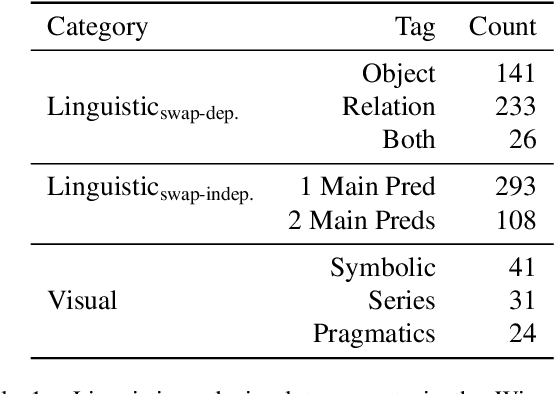
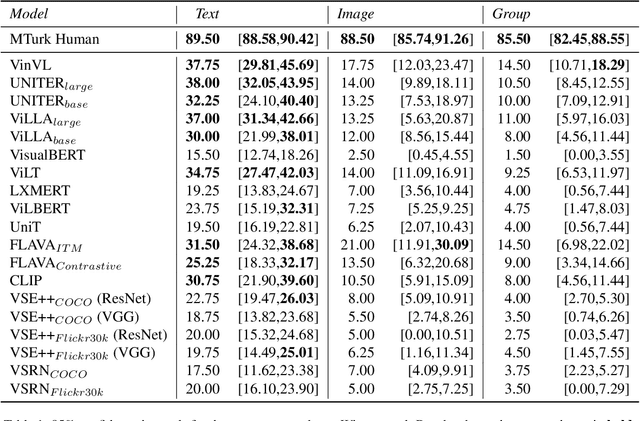
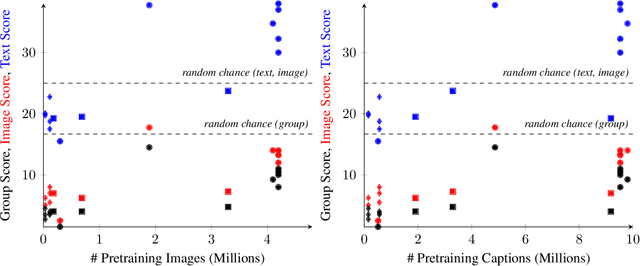
We present a novel task and dataset for evaluating the ability of vision and language models to conduct visio-linguistic compositional reasoning, which we call Winoground. Given two images and two captions, the goal is to match them correctly - but crucially, both captions contain a completely identical set of words, only in a different order. The dataset was carefully hand-curated by expert annotators and is labeled with a rich set of fine-grained tags to assist in analyzing model performance. We probe a diverse range of state-of-the-art vision and language models and find that, surprisingly, none of them do much better than chance. Evidently, these models are not as skilled at visio-linguistic compositional reasoning as we might have hoped. We perform an extensive analysis to obtain insights into how future work might try to mitigate these models' shortcomings. We aim for Winoground to serve as a useful evaluation set for advancing the state of the art and driving further progress in the field. The dataset is available at https://huggingface.co/datasets/facebook/winoground.