 Add to Chrome
 Add to Firefox
 Add to Edge
ALIVE: Animate Your World with Lifelike Audio-Video Generation
Feb 09, 2026
Video generation is rapidly evolving towards unified audio-video generation. In this paper, we present ALIVE, a generation model that adapts a pretrained Text-to-Video (T2V) model to Sora-style audio-video generation and animation. In particular, the model unlocks the Text-to-Video&Audio (T2VA) and Reference-to-Video&Audio (animation) capabilities compared to the T2V foundation models. To support the audio-visual synchronization and reference animation, we augment the popular MMDiT architecture with a joint audio-video branch which includes TA-CrossAttn for temporally-aligned cross-modal fusion and UniTemp-RoPE for precise audio-visual alignment. Meanwhile, a comprehensive data pipeline consisting of audio-video captioning, quality control, etc., is carefully designed to collect high-quality finetuning data. Additionally, we introduce a new benchmark to perform a comprehensive model test and comparison. After continue pretraining and finetuning on million-level high-quality data, ALIVE demonstrates outstanding performance, consistently outperforming open-source models and matching or surpassing state-of-the-art commercial solutions. With detailed recipes and benchmarks, we hope ALIVE helps the community develop audio-video generation models more efficiently. Official page: https://github.com/FoundationVision/Alive.

VC-LLM: Automated Advertisement Video Creation from Raw Footage using Multi-modal LLMs
Apr 08, 2025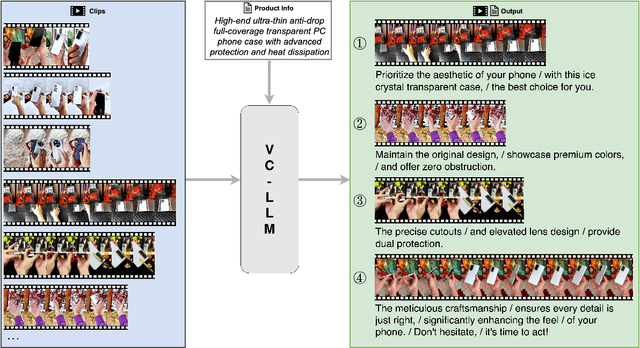
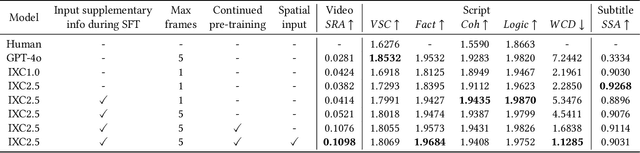
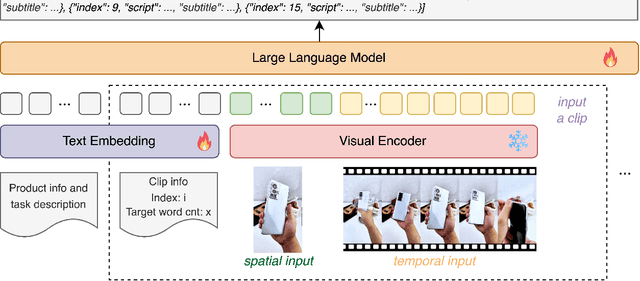

As short videos have risen in popularity, the role of video content in advertising has become increasingly significant. Typically, advertisers record a large amount of raw footage about the product and then create numerous different short-form advertisement videos based on this raw footage. Creating such videos mainly involves editing raw footage and writing advertisement scripts, which requires a certain level of creative ability. It is usually challenging to create many different video contents for the same product, and manual efficiency is often low. In this paper, we present VC-LLM, a framework powered by Large Language Models for the automatic creation of high-quality short-form advertisement videos. Our approach leverages high-resolution spatial input and low-resolution temporal input to represent video clips more effectively, capturing both fine-grained visual details and broader temporal dynamics. In addition, during training, we incorporate supplementary information generated by rewriting the ground truth text, ensuring that all key output information can be directly traced back to the input, thereby reducing model hallucinations. We also designed a benchmark to evaluate the quality of the created videos. Experiments show that VC-LLM based on GPT-4o can produce videos comparable to those created by humans. Furthermore, we collected numerous high-quality short advertisement videos to create a pre-training dataset and manually cleaned a portion of the data to construct a high-quality fine-tuning dataset. Experiments indicate that, on the benchmark, the VC-LLM based on fine-tuned LLM can produce videos with superior narrative logic compared to those created by the VC-LLM based on GPT-4o.