 Add to Chrome
 Add to Firefox
 Add to Edge
NextFlow: Unified Sequential Modeling Activates Multimodal Understanding and Generation
Jan 05, 2026
We present NextFlow, a unified decoder-only autoregressive transformer trained on 6 trillion interleaved text-image discrete tokens. By leveraging a unified vision representation within a unified autoregressive architecture, NextFlow natively activates multimodal understanding and generation capabilities, unlocking abilities of image editing, interleaved content and video generation. Motivated by the distinct nature of modalities - where text is strictly sequential and images are inherently hierarchical - we retain next-token prediction for text but adopt next-scale prediction for visual generation. This departs from traditional raster-scan methods, enabling the generation of 1024x1024 images in just 5 seconds - orders of magnitude faster than comparable AR models. We address the instabilities of multi-scale generation through a robust training recipe. Furthermore, we introduce a prefix-tuning strategy for reinforcement learning. Experiments demonstrate that NextFlow achieves state-of-the-art performance among unified models and rivals specialized diffusion baselines in visual quality.

VAR RL Done Right: Tackling Asynchronous Policy Conflicts in Visual Autoregressive Generation
Jan 05, 2026Visual generation is dominated by three paradigms: AutoRegressive (AR), diffusion, and Visual AutoRegressive (VAR) models. Unlike AR and diffusion, VARs operate on heterogeneous input structures across their generation steps, which creates severe asynchronous policy conflicts. This issue becomes particularly acute in reinforcement learning (RL) scenarios, leading to unstable training and suboptimal alignment. To resolve this, we propose a novel framework to enhance Group Relative Policy Optimization (GRPO) by explicitly managing these conflicts. Our method integrates three synergistic components: 1) a stabilizing intermediate reward to guide early-stage generation; 2) a dynamic time-step reweighting scheme for precise credit assignment; and 3) a novel mask propagation algorithm, derived from principles of Reward Feedback Learning (ReFL), designed to isolate optimization effects both spatially and temporally. Our approach demonstrates significant improvements in sample quality and objective alignment over the vanilla GRPO baseline, enabling robust and effective optimization for VAR models.
Cost-efficient Active Illumination Camera For Hyper-spectral Reconstruction
Jun 27, 2024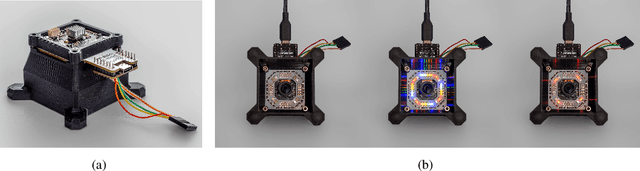
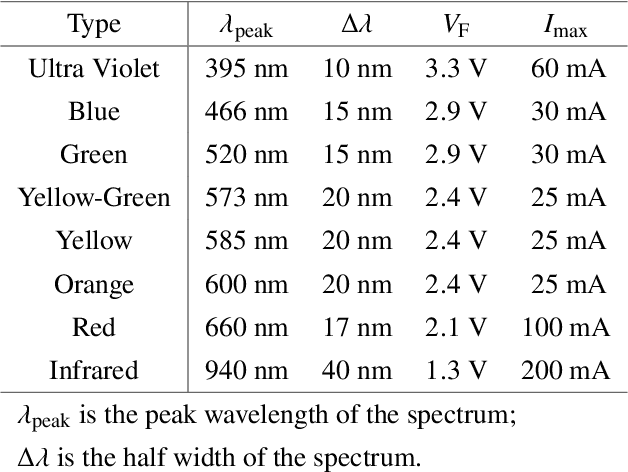
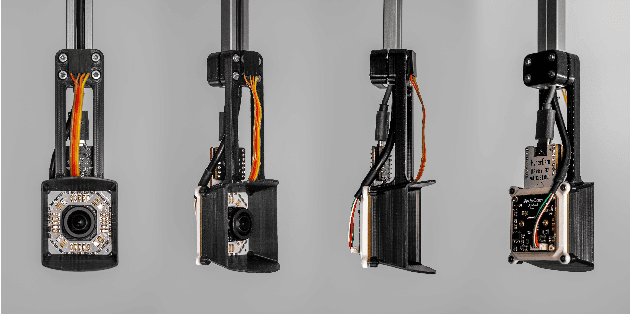
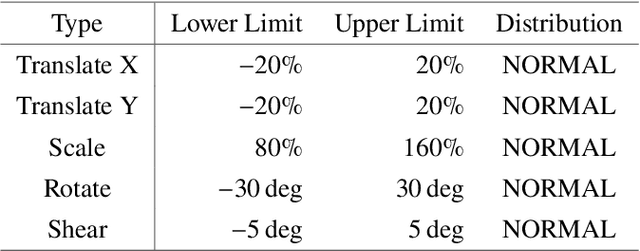
Hyper-spectral imaging has recently gained increasing attention for use in different applications, including agricultural investigation, ground tracking, remote sensing and many other. However, the high cost, large physical size and complicated operation process stop hyperspectral cameras from being employed for various applications and research fields. In this paper, we introduce a cost-efficient, compact and easy to use active illumination camera that may benefit many applications. We developed a fully functional prototype of such camera. With the hope of helping with agricultural research, we tested our camera for plant root imaging. In addition, a U-Net model for spectral reconstruction was trained by using a reference hyperspectral camera's data as ground truth and our camera's data as input. We demonstrated our camera's ability to obtain additional information over a typical RGB camera. In addition, the ability to reconstruct hyperspectral data from multi-spectral input makes our device compatible to models and algorithms developed for hyperspectral applications with no modifications required.
PhotoVerse: Tuning-Free Image Customization with Text-to-Image Diffusion Models
Sep 11, 2023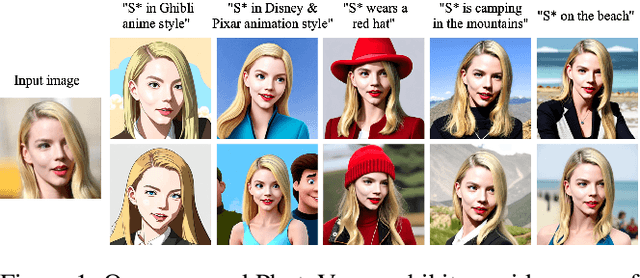


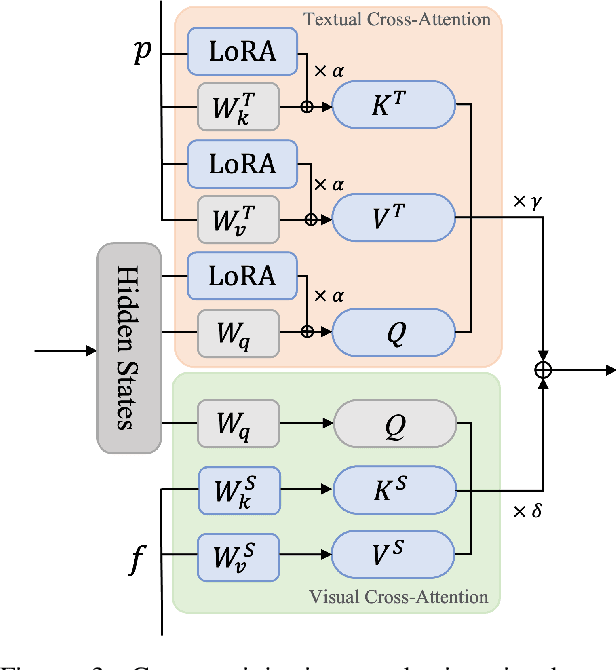
Personalized text-to-image generation has emerged as a powerful and sought-after tool, empowering users to create customized images based on their specific concepts and prompts. However, existing approaches to personalization encounter multiple challenges, including long tuning times, large storage requirements, the necessity for multiple input images per identity, and limitations in preserving identity and editability. To address these obstacles, we present PhotoVerse, an innovative methodology that incorporates a dual-branch conditioning mechanism in both text and image domains, providing effective control over the image generation process. Furthermore, we introduce facial identity loss as a novel component to enhance the preservation of identity during training. Remarkably, our proposed PhotoVerse eliminates the need for test time tuning and relies solely on a single facial photo of the target identity, significantly reducing the resource cost associated with image generation. After a single training phase, our approach enables generating high-quality images within only a few seconds. Moreover, our method can produce diverse images that encompass various scenes and styles. The extensive evaluation demonstrates the superior performance of our approach, which achieves the dual objectives of preserving identity and facilitating editability. Project page: https://photoverse2d.github.io/