 Add to Chrome
 Add to Firefox
 Add to Edge
SIRIUS-SQL: Anchoring Multi-Candidate Text-to-SQL in Execution Feedback
May 31, 2026
Text-to-SQL on complex schemas is unreliable on a single pass, so recent systems generate multiple SQL candidates and let voting filter out errors. Yet voting alone is not enough, because the multi-candidate recipe has three coupled weaknesses: 1) sampling more from a single generator produces increasingly redundant candidates, 2) existing pipelines apply one generic correction to every non-clean execution result, while runtime errors, timeouts, and empty results each indicate a different distance from correctness, and 3) existing selectors rely on a single angle such as result-majority voting or pairwise SQL comparison, missing what other angles would have caught. We present SIRIUS-SQL, which addresses all three weaknesses. A difficulty-smoothing RL recipe trains SIRIUS-32B to generate diverse executable SQL candidates, paired with a generalist LLM that fills in gaps left by the specialist. An execution-grounded lifecycle classifies each outcome and applies targeted repair before candidates re-enter the pool. A confidence-gated hybrid selector combines execution-result agreement with pairwise SQL-form judgment, escalating only near-tied cases to a deterministic structural check. SIRIUS-SQL reaches 75.88% on BIRD dev and 91.20% on SPIDER test. Two of three generalist pairings surpass Agentar-Scale-SQL, the strongest published multi-candidate system on BIRD dev.

Efficient Agentic Reinforcement Learning with On-Policy Intrinsic Knowledge Boundary Enhancement
May 26, 2026Agentic reinforcement learning (RL) has proven effective for training LLM-based agents with external tool-use capabilities. However, we identify that agentic RL training induces increasing redundant tool calls and blurs the model's intrinsic knowledge boundary, where the model fails to distinguish when tools are needed versus when parametric knowledge suffices. Existing solutions based on reward shaping create coarse-grained optimization targets that tend to incentivize indiscriminate tool-call suppression, leading to reward hacking. In this paper, we propose AKBE (Agentic Knowledge Boundary Enhancement), an on-policy method that dynamically probes the model's intrinsic knowledge boundary through dual-path (with-tool and no-tool) rollouts during training. We define the knowledge boundary as the per-instance determination of whether tools are required and the minimum tool calls necessary. By comparing correctness across paths, AKBE categorizes trajectories and constructs targeted supervisory signals that guide efficient tool-use patterns for each question. These signals are integrated seamlessly into the agentic RL training loop. Experiments on seven QA benchmarks demonstrate that AKBE improves task accuracy by +1.85 on average and reduces tool calls by 18% over standard agentic RL, yielding 25% higher tool productivity without any accuracy-efficiency trade-off. Further analysis suggests its plug-and-play compatibility across different RL algorithms and the mechanism of each signal category. Our code is available at https://github.com/CuSO4-Chen/AKBE.
A$^2$TGPO: Agentic Turn-Group Policy Optimization with Adaptive Turn-level Clipping
May 07, 2026Reinforcement learning for agentic large language models (LLMs) typically relies on a sparse, trajectory-level outcome reward, making it difficult to evaluate the contribution of individual tool-calls within multi-turn interactions. Existing approaches to such process credit assignment either depend on separate external process reward models that introduce additional consumption, or tree-based structural rollout that merely redistributes the outcome signal while constraining trajectory diversity. A promising alternative leverages the per-turn change in the policy's predicted probability of the ground-truth, termed Information Gain (IG), as an intrinsic process signal without an external evaluator. However, prior work on leveraging IG signals within the RL training loop faces three systematic challenges: normalizing across turns that face heterogeneous positional contexts can distort the relative standing of individual turns, accumulating a variable number of terms causes advantage magnitudes to drift with trajectory depth, and a fixed clipping range governs policy updates identically for turns with vastly different IG signals. In this paper, we propose A$^2$TGPO (Agentic Turn-Group Policy Optimization with Adaptive Turn-level Clipping), which retains IG as the intrinsic signal but re-designs how it is normalized, accumulated, and consumed: (i) turn-group normalization: normalizes IG within each (prompt, turn-index) group so that each turn is compared only against peers at the same interaction depth; (ii) variance-rescaled discounted accumulation: divides cumulative normalized IG by square root of accumulated terms to keep advantage magnitudes comparable across turn positions; and (iii) adaptive turn-level clipping: modulates each turn's clipping range based on its normalized IG, widening the update region for informative turns and narrowing it for uninformative ones.
Finding RELIEF: Shaping Reasoning Behavior without Reasoning Supervision via Belief Engineering
Jan 20, 2026Large reasoning models (LRMs) have achieved remarkable success in complex problem-solving, yet they often suffer from computational redundancy or reasoning unfaithfulness. Current methods for shaping LRM behavior typically rely on reinforcement learning or fine-tuning with gold-standard reasoning traces, a paradigm that is both computationally expensive and difficult to scale. In this paper, we reveal that LRMs possess latent \textit{reasoning beliefs} that internally track their own reasoning traits, which can be captured through simple logit probing. Building upon this insight, we propose Reasoning Belief Engineering (RELIEF), a simple yet effective framework that shapes LRM behavior by aligning the model's self-concept with a target belief blueprint. Crucially, RELIEF completely bypasses the need for reasoning-trace supervision. It internalizes desired traits by fine-tuning on synthesized, self-reflective question-answering pairs that affirm the target belief. Extensive experiments on efficiency and faithfulness tasks demonstrate that RELIEF matches or outperforms behavior-supervised and preference-based baselines while requiring lower training costs. Further analysis validates that shifting a model's reasoning belief effectively shapes its actual behavior.
AT$^2$PO: Agentic Turn-based Policy Optimization via Tree Search
Jan 08, 2026LLM agents have emerged as powerful systems for tackling multi-turn tasks by interleaving internal reasoning and external tool interactions. Agentic Reinforcement Learning has recently drawn significant research attention as a critical post-training paradigm to further refine these capabilities. In this paper, we present AT$^2$PO (Agentic Turn-based Policy Optimization via Tree Search), a unified framework for multi-turn agentic RL that addresses three core challenges: limited exploration diversity, sparse credit assignment, and misaligned policy optimization. AT$^2$PO introduces a turn-level tree structure that jointly enables Entropy-Guided Tree Expansion for strategic exploration and Turn-wise Credit Assignment for fine-grained reward propagation from sparse outcomes. Complementing this, we propose Agentic Turn-based Policy Optimization, a turn-level learning objective that aligns policy updates with the natural decision granularity of agentic interactions. ATPO is orthogonal to tree search and can be readily integrated into any multi-turn RL pipeline. Experiments across seven benchmarks demonstrate consistent improvements over the state-of-the-art baseline by up to 1.84 percentage points in average, with ablation studies validating the effectiveness of each component. Our code is available at https://github.com/zzfoutofspace/ATPO.
ChARM: Character-based Act-adaptive Reward Modeling for Advanced Role-Playing Language Agents
May 29, 2025
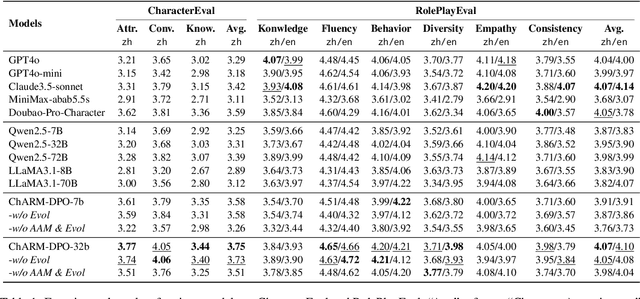
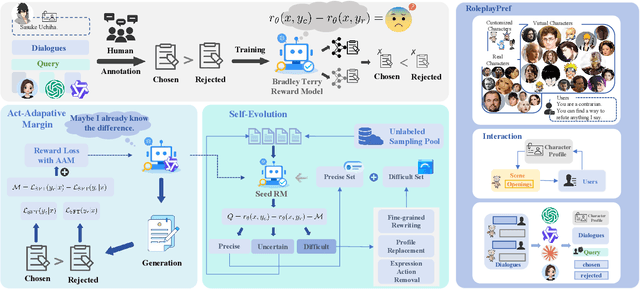
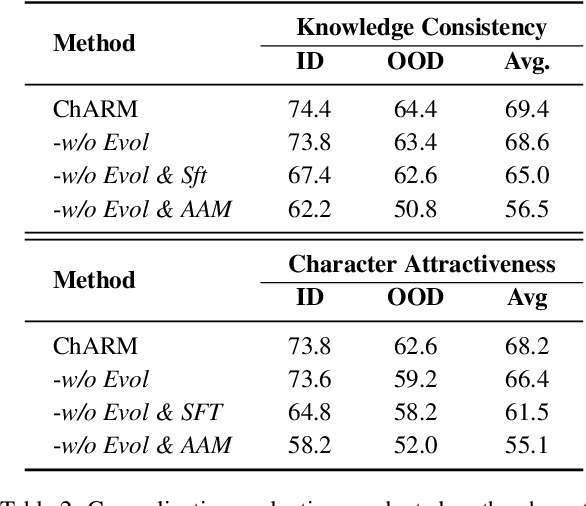
Role-Playing Language Agents (RPLAs) aim to simulate characters for realistic and engaging human-computer interactions. However, traditional reward models often struggle with scalability and adapting to subjective conversational preferences. We propose ChARM, a Character-based Act-adaptive Reward Model, addressing these challenges through two innovations: (1) an act-adaptive margin that significantly enhances learning efficiency and generalizability, and (2) a self-evolution mechanism leveraging large-scale unlabeled data to improve training coverage. Additionally, we introduce RoleplayPref, the first large-scale preference dataset specifically for RPLAs, featuring 1,108 characters, 13 subcategories, and 16,888 bilingual dialogues, alongside RoleplayEval, a dedicated evaluation benchmark. Experimental results show a 13% improvement over the conventional Bradley-Terry model in preference rankings. Furthermore, applying ChARM-generated rewards to preference learning techniques (e.g., direct preference optimization) achieves state-of-the-art results on CharacterEval and RoleplayEval. Code and dataset are available at https://github.com/calubkk/ChARM.
Lower Layer Matters: Alleviating Hallucination via Multi-Layer Fusion Contrastive Decoding with Truthfulness Refocused
Aug 16, 2024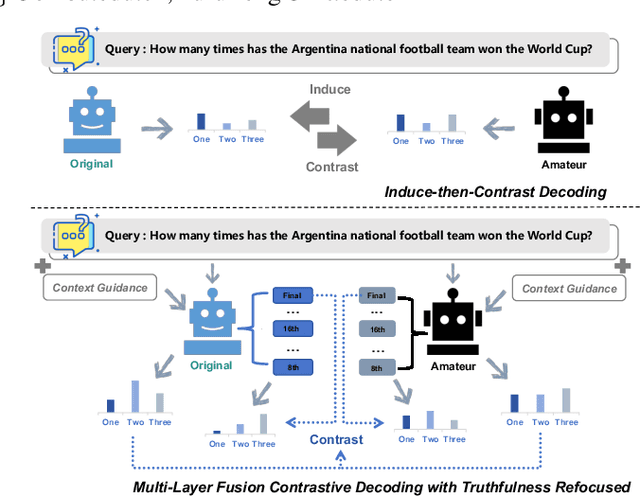

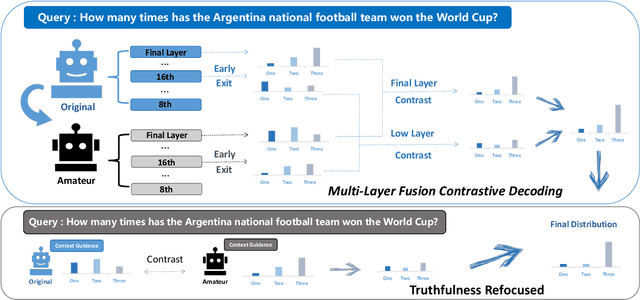
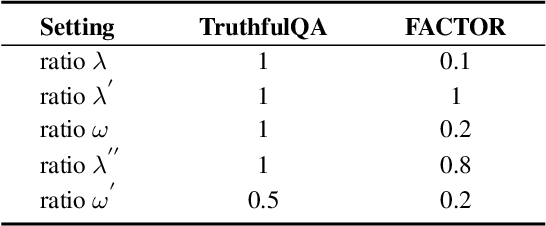
Large Language Models (LLMs) have demonstrated exceptional performance across various natural language processing tasks, yet they occasionally tend to yield content that factually inaccurate or discordant with the expected output, a phenomenon empirically referred to as "hallucination". To tackle this issue, recent works have investigated contrastive decoding between the original model and an amateur model with induced hallucination, which has shown promising results. Nonetheless, this method may undermine the output distribution of the original LLM caused by its coarse contrast and simplistic subtraction operation, potentially leading to errors in certain cases. In this paper, we introduce a novel contrastive decoding framework termed LOL (LOwer Layer Matters). Our approach involves concatenating the contrastive decoding of both the final and lower layers between the original model and the amateur model, thereby achieving multi-layer fusion to aid in the mitigation of hallucination. Additionally, we incorporate a truthfulness refocused module that leverages contextual guidance to enhance factual encoding, further capturing truthfulness during contrastive decoding. Extensive experiments conducted on two publicly available datasets illustrate that our proposed LOL framework can substantially alleviate hallucination while surpassing existing baselines in most cases. Compared with the best baseline, we improve by average 4.5 points on all metrics of TruthfulQA. The source code is coming soon.
Forgetting before Learning: Utilizing Parametric Arithmetic for Knowledge Updating in Large Language Models
Nov 14, 2023Recently Large Language Models (LLMs) have demonstrated their amazing text understanding and generation capabilities. However, even stronger LLMs may still learn incorrect knowledge from the training corpus, as well as some knowledge that is outdated over time. Direct secondary fine-tuning with data containing new knowledge may be ineffective in updating knowledge due to the conflict between old and new knowledge. In this paper, we propose a new paradigm for fine-tuning called F-Learning (Forgetting before Learning), which is based on parametric arithmetic to achieve forgetting of old knowledge and learning of new knowledge. Experimental results on two publicly available datasets demonstrate that our proposed F-Learning can obviously improve the knowledge updating performance of both full fine-tuning and LoRA fine-tuning. Moreover, we have also discovered that forgetting old knowledge by subtracting the parameters of LoRA can achieve a similar effect to subtracting the parameters of full fine-tuning, and sometimes even surpass it significantly.