 Add to Chrome
 Add to Firefox
 Add to Edge
OPD-IAD: From Language Judgment to Industrial Anomaly Detection via On-Policy Self-Distillation
Jul 21, 2026
Large vision-language models (LVLMs) have recently shown strong potential for industrial anomaly detection (IAD) by providing image-level anomaly judgments and interpretable defect reasoning. However, current LVLM-based IAD methods still struggle to produce precise pixel-level anomaly maps from generated language judgments. We aim to achieve precise pixel-level localization while using language as guidance rather than letting it dominate the visual response. Specifically, we propose \textbf{OPD-IAD}, an evidence-privileged dense on-policy self-distillation framework for LVLM-based IAD. OPD-IAD distills privileged defect evidence onto the model's own on-policy judgment trajectory, enabling the final generated judgment to be learned under dense supervision rather than treated only as a textual answer. The resulting judgment serves as a semantic condition for dense anomaly perception. To turn this condition into dense visual evidence, we introduce \textbf{Language-guided Visual Anchoring}, which uses a judgment reforward to re-encode the image and question under the final-judgment condition into semantic anchors and contrasts them with dense visual features through a contrastive heatmap head to generate anomaly maps. The language judgment therefore provides compact semantic guidance, while dense visual features remain the basis for pixel-level scoring, allowing language to guide anomaly localization without letting language quality directly dictate the pixel-level response. Extensive experiments show that OPD-IAD achieves the best overall performance among LVLM-based IAD methods, leading on most image-level, pixel-level, and QA metrics.

Reflect-R1: Evidence-Driven Reflection for Self-Correction in Long Video Understanding
Jun 30, 2026Current multimodal reflection mechanisms for long video understanding predominantly rely on closed-loop self-reflection within internal parameters. Lacking objective external evidence, models are frequently trapped in blind confidence and often fail to correct errors. Furthermore, applying reinforcement learning to multi-stage reflection pipelines introduces severe policy coupling, which is exacerbated by a critical scarcity of dedicated training data. To address these limitations, this work proposes Reflect-R1, the first Evidence-Driven self-correction framework for long video understanding. The framework constructs a three-stage pipeline consisting of intuition, verification, and arbitration. By dynamically retrieving objective visual evidence to verify initial intuitions and autonomously executing multiple temporal searches to resolve conflicts, it completely breaks the hallucination loop. To overcome policy coupling, we design a stage-decoupled reinforcement learning algorithm named SD-GRPO that independently computes advantage functions across different reasoning stages. Concurrently, we construct a dataset of 120K samples to bridge the training data gap. Extensive experiments on benchmarks such as VideoMME and LongVideoBench demonstrate that Reflect-R1 achieves state-of-the-art performance. Our method significantly improves the genuine rectification rate and enables authentic self-correction strictly grounded in objective evidence.
OmniOPSD: Rationale-Privileged On-Policy Self-Distillation for Affective Computing
Jun 14, 2026Reinforcement learning for multimodal large language models (MLLMs) is often hindered by severe reward sparsity in complex reasoning tasks. This challenge is particularly pronounced in human-centered scenarios involving states, emotions, intentions, and behaviors, where heterogeneous multimodal signals and subjective human factors make high-quality chain-of-thought (CoT) annotations expensive and difficult to obtain. Although many multimodal datasets provide expert-annotated ground-truth labels, directly using these labels for supervised fine-tuning may encourage shortcut learning in multimodal perception and provides limited transparency for safety-critical human--AI interaction. To address these limitations, we propose OmniOPSD, a Rationale-Privileged On-Policy Self-Distillation framework that uses frontier-generated rationales as teacher-side privileged evidence rather than student imitation targets. OmniOPSD uses frontier-generated evidence-aware rationales only as training-time privileged evidence context for a local teacher. The student samples its own rollout from the original multimodal input, while the rationale-privileged teacher scores the same tokens and provides dense token-level supervision. Thus, the student learns on its own trajectory distribution without directly imitating frontier-model completions, and inference requires no labels, rationales, CoT annotations, or closed-source model access. Experiments on MER-UniBench show that OmniOPSD achieves state-of-the-art performance with an average score of $84.19$, and ablations further support the value of rationale-privileged teacher guidance.
EmoTrans: A Benchmark for Understanding, Reasoning, and Predicting Emotion Transitions in Multimodal LLMs
Apr 25, 2026Recent multimodal large language models (MLLMs) have shown strong capabilities in perception, reasoning, and generation, and are increasingly used in applications such as social robots and human-computer interaction, where understanding human emotions is essential. However, existing benchmarks mainly formulate emotion understanding as a static recognition problem, leaving it largely unclear whether current MLLMs can understand emotion as a dynamic process that evolves, shifts between states, and unfolds across diverse social contexts. To bridge this gap, we present EmoTrans, a benchmark for evaluating emotion dynamics understanding in multimodal videos. EmoTrans contains 1,000 carefully collected and manually annotated video clips, covering 12 real-world scenarios, and further provides over 3,000 task-specific question-answer (QA) pairs for fine-grained evaluation. The benchmark introduces four tasks, namely Emotion Change Detection (ECD), Emotion State Identification (ESI), Emotion Transition Reasoning (ETR), and Next Emotion Prediction (NEP), forming a progressive evaluation framework from coarse-grained detection to deeper reasoning and prediction. We conduct a comprehensive evaluation of 18 state-of-the-art MLLMs on EmoTrans and obtain two main findings. First, although current MLLMs show relatively stronger performance on coarse-grained emotion change detection, they still struggle with fine-grained emotion dynamics modeling. Second, socially complex settings, especially multi-person scenarios, remain substantially challenging, while reasoning-oriented variants do not consistently yield clear improvements. To facilitate future research, we publicly release the benchmark, evaluation protocol, and code at https://github.com/Emo-gml/EmoTrans.
Emotion-LLaMAv2 and MMEVerse: A New Framework and Benchmark for Multimodal Emotion Understanding
Jan 23, 2026Understanding human emotions from multimodal signals poses a significant challenge in affective computing and human-robot interaction. While multimodal large language models (MLLMs) have excelled in general vision-language tasks, their capabilities in emotional reasoning remain limited. The field currently suffers from a scarcity of large-scale datasets with high-quality, descriptive emotion annotations and lacks standardized benchmarks for evaluation. Our preliminary framework, Emotion-LLaMA, pioneered instruction-tuned multimodal learning for emotion reasoning but was restricted by explicit face detectors, implicit fusion strategies, and low-quality training data with limited scale. To address these limitations, we present Emotion-LLaMAv2 and the MMEVerse benchmark, establishing an end-to-end pipeline together with a standardized evaluation setting for emotion recognition and reasoning. Emotion-LLaMAv2 introduces three key advances. First, an end-to-end multiview encoder eliminates external face detection and captures nuanced emotional cues via richer spatial and temporal multiview tokens. Second, a Conv Attention pre-fusion module is designed to enable simultaneous local and global multimodal feature interactions external to the LLM backbone. Third, a perception-to-cognition curriculum instruction tuning scheme within the LLaMA2 backbone unifies emotion recognition and free-form emotion reasoning. To support large-scale training and reproducible evaluation, MMEVerse aggregates twelve publicly available emotion datasets, including IEMOCAP, MELD, DFEW, and MAFW, into a unified multimodal instruction format. The data are re-annotated via a multi-agent pipeline involving Qwen2 Audio, Qwen2.5 VL, and GPT 4o, producing 130k training clips and 36k testing clips across 18 evaluation benchmarks.
Emotion-Qwen: Training Hybrid Experts for Unified Emotion and General Vision-Language Understanding
May 10, 2025Emotion understanding in videos aims to accurately recognize and interpret individuals' emotional states by integrating contextual, visual, textual, and auditory cues. While Large Multimodal Models (LMMs) have demonstrated significant progress in general vision-language (VL) tasks, their performance in emotion-specific scenarios remains limited. Moreover, fine-tuning LMMs on emotion-related tasks often leads to catastrophic forgetting, hindering their ability to generalize across diverse tasks. To address these challenges, we present Emotion-Qwen, a tailored multimodal framework designed to enhance both emotion understanding and general VL reasoning. Emotion-Qwen incorporates a sophisticated Hybrid Compressor based on the Mixture of Experts (MoE) paradigm, which dynamically routes inputs to balance emotion-specific and general-purpose processing. The model is pre-trained in a three-stage pipeline on large-scale general and emotional image datasets to support robust multimodal representations. Furthermore, we construct the Video Emotion Reasoning (VER) dataset, comprising more than 40K bilingual video clips with fine-grained descriptive annotations, to further enrich Emotion-Qwen's emotional reasoning capability. Experimental results demonstrate that Emotion-Qwen achieves state-of-the-art performance on multiple emotion recognition benchmarks, while maintaining competitive results on general VL tasks. Code and models are available at https://anonymous.4open.science/r/Emotion-Qwen-Anonymous.
Why We Feel: Breaking Boundaries in Emotional Reasoning with Multimodal Large Language Models
Apr 10, 2025Most existing emotion analysis emphasizes which emotion arises (e.g., happy, sad, angry) but neglects the deeper why. We propose Emotion Interpretation (EI), focusing on causal factors-whether explicit (e.g., observable objects, interpersonal interactions) or implicit (e.g., cultural context, off-screen events)-that drive emotional responses. Unlike traditional emotion recognition, EI tasks require reasoning about triggers instead of mere labeling. To facilitate EI research, we present EIBench, a large-scale benchmark encompassing 1,615 basic EI samples and 50 complex EI samples featuring multifaceted emotions. Each instance demands rationale-based explanations rather than straightforward categorization. We further propose a Coarse-to-Fine Self-Ask (CFSA) annotation pipeline, which guides Vision-Language Models (VLLMs) through iterative question-answer rounds to yield high-quality labels at scale. Extensive evaluations on open-source and proprietary large language models under four experimental settings reveal consistent performance gaps-especially for more intricate scenarios-underscoring EI's potential to enrich empathetic, context-aware AI applications. Our benchmark and methods are publicly available at: https://github.com/Lum1104/EIBench, offering a foundation for advanced multimodal causal analysis and next-generation affective computing.
HA-VLN: A Benchmark for Human-Aware Navigation in Discrete-Continuous Environments with Dynamic Multi-Human Interactions, Real-World Validation, and an Open Leaderboard
Mar 18, 2025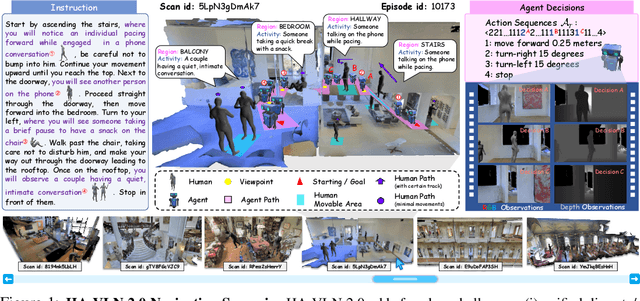
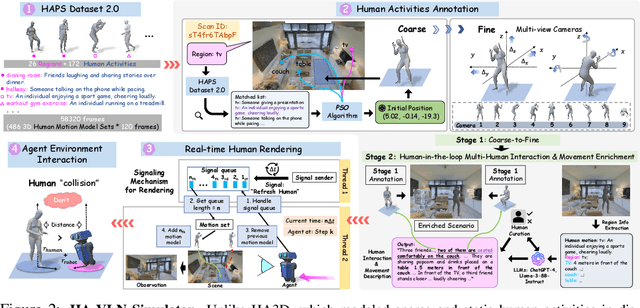
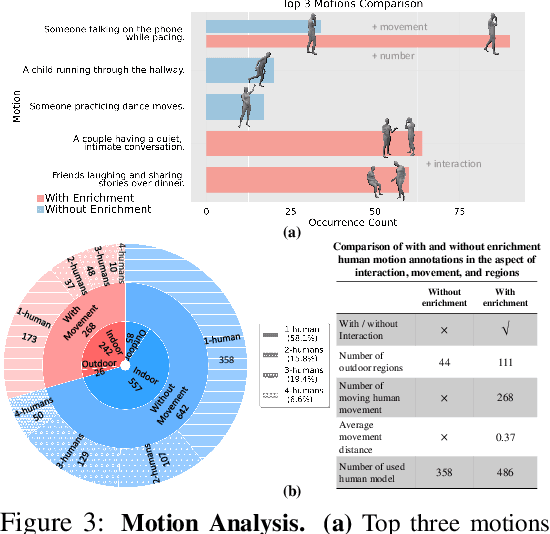

Vision-and-Language Navigation (VLN) systems often focus on either discrete (panoramic) or continuous (free-motion) paradigms alone, overlooking the complexities of human-populated, dynamic environments. We introduce a unified Human-Aware VLN (HA-VLN) benchmark that merges these paradigms under explicit social-awareness constraints. Our contributions include: 1. A standardized task definition that balances discrete-continuous navigation with personal-space requirements; 2. An enhanced human motion dataset (HAPS 2.0) and upgraded simulators capturing realistic multi-human interactions, outdoor contexts, and refined motion-language alignment; 3. Extensive benchmarking on 16,844 human-centric instructions, revealing how multi-human dynamics and partial observability pose substantial challenges for leading VLN agents; 4. Real-world robot tests validating sim-to-real transfer in crowded indoor spaces; and 5. A public leaderboard supporting transparent comparisons across discrete and continuous tasks. Empirical results show improved navigation success and fewer collisions when social context is integrated, underscoring the need for human-centric design. By releasing all datasets, simulators, agent code, and evaluation tools, we aim to advance safer, more capable, and socially responsible VLN research.
Multimodal Multi-turn Conversation Stance Detection: A Challenge Dataset and Effective Model
Sep 01, 2024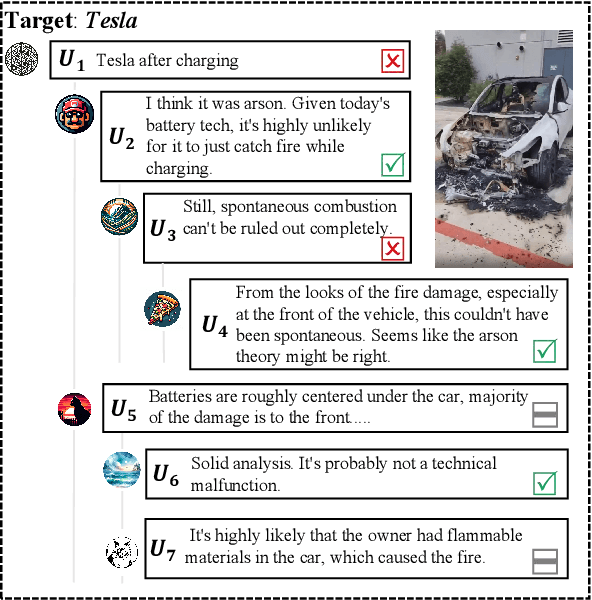
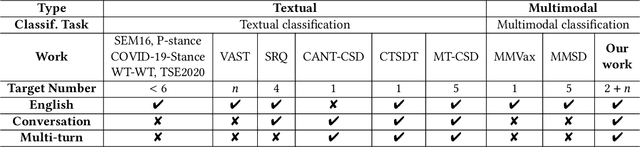
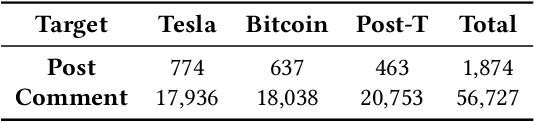
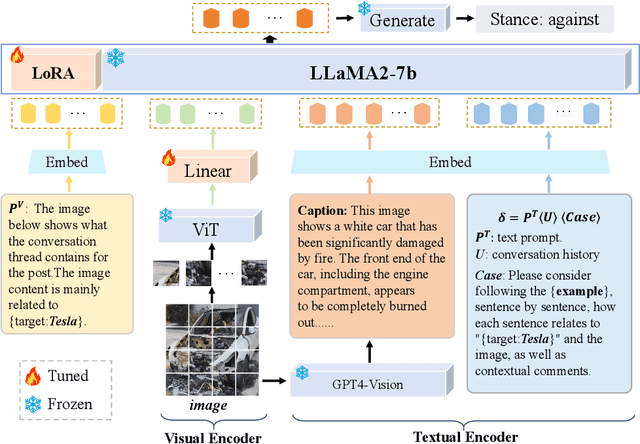
Stance detection, which aims to identify public opinion towards specific targets using social media data, is an important yet challenging task. With the proliferation of diverse multimodal social media content including text, and images multimodal stance detection (MSD) has become a crucial research area. However, existing MSD studies have focused on modeling stance within individual text-image pairs, overlooking the multi-party conversational contexts that naturally occur on social media. This limitation stems from a lack of datasets that authentically capture such conversational scenarios, hindering progress in conversational MSD. To address this, we introduce a new multimodal multi-turn conversational stance detection dataset (called MmMtCSD). To derive stances from this challenging dataset, we propose a novel multimodal large language model stance detection framework (MLLM-SD), that learns joint stance representations from textual and visual modalities. Experiments on MmMtCSD show state-of-the-art performance of our proposed MLLM-SD approach for multimodal stance detection. We believe that MmMtCSD will contribute to advancing real-world applications of stance detection research.
SZTU-CMU at MER2024: Improving Emotion-LLaMA with Conv-Attention for Multimodal Emotion Recognition
Aug 21, 2024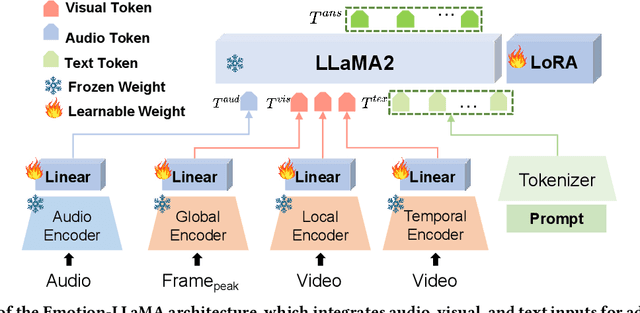
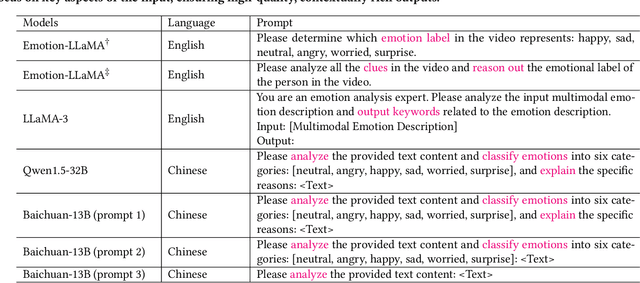
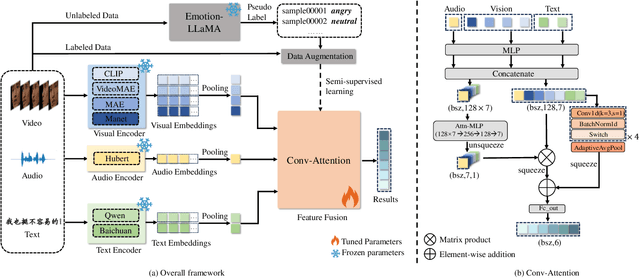
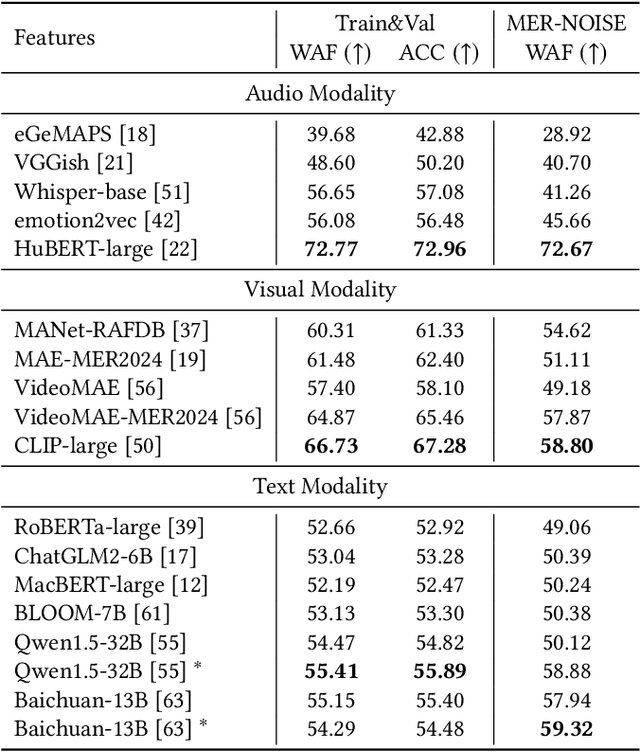
This paper presents our winning approach for the MER-NOISE and MER-OV tracks of the MER2024 Challenge on multimodal emotion recognition. Our system leverages the advanced emotional understanding capabilities of Emotion-LLaMA to generate high-quality annotations for unlabeled samples, addressing the challenge of limited labeled data. To enhance multimodal fusion while mitigating modality-specific noise, we introduce Conv-Attention, a lightweight and efficient hybrid framework. Extensive experimentation vali-dates the effectiveness of our approach. In the MER-NOISE track, our system achieves a state-of-the-art weighted average F-score of 85.30%, surpassing the second and third-place teams by 1.47% and 1.65%, respectively. For the MER-OV track, our utilization of Emotion-LLaMA for open-vocabulary annotation yields an 8.52% improvement in average accuracy and recall compared to GPT-4V, securing the highest score among all participating large multimodal models. The code and model for Emotion-LLaMA are available at https://github.com/ZebangCheng/Emotion-LLaMA.