 Add to Chrome
 Add to Firefox
 Add to Edge
Latent Reward Registers for Diffusion Preference Alignment
Aug 05, 2026
Aligning diffusion models with human preferences usually relies on a sparse terminal reward evaluated on the final generated samples, presenting a severe temporal credit-assignment challenge across the multi-step denoising process. We propose Latent Reward Registers, a mechanism that estimates terminal preference directly from intermediate noisy latents by prepending learnable, position-free register tokens to the input sequence of a frozen Diffusion Transformer (DiT). This independent readout mechanism extracts latent reward evidence without altering the generator's hidden states or velocity field. The resulting dense, differentiable reward signal throughout the full denoising process facilitates two alignment strategies. For training, Reward-Gradient On-Policy Distillation (RG-OPD) distills reward-guided updates along on-policy trajectories, bypassing the computationally expensive rollouts of standard policy gradients. For inference, Reward-Guided Sampling (RGS) steers trajectories via magnitude-matched reward gradients without parameter updates. Empirically, at high noise levels (u = 0.8), the registers reach the highest pairwise accuracy among the evaluated latent reward models. Furthermore, RG-OPD outperforms online reinforcement learning baselines while reducing GPU hours by up to 33x, and RGS establishes a new state-of-the-art among training-free methods, strictly enhancing both alignment and perceptual metrics. Code and weights are available at https://github.com/Guanys-dar/latent-reward-register

Reflect-R1: Evidence-Driven Reflection for Self-Correction in Long Video Understanding
Jun 30, 2026Current multimodal reflection mechanisms for long video understanding predominantly rely on closed-loop self-reflection within internal parameters. Lacking objective external evidence, models are frequently trapped in blind confidence and often fail to correct errors. Furthermore, applying reinforcement learning to multi-stage reflection pipelines introduces severe policy coupling, which is exacerbated by a critical scarcity of dedicated training data. To address these limitations, this work proposes Reflect-R1, the first Evidence-Driven self-correction framework for long video understanding. The framework constructs a three-stage pipeline consisting of intuition, verification, and arbitration. By dynamically retrieving objective visual evidence to verify initial intuitions and autonomously executing multiple temporal searches to resolve conflicts, it completely breaks the hallucination loop. To overcome policy coupling, we design a stage-decoupled reinforcement learning algorithm named SD-GRPO that independently computes advantage functions across different reasoning stages. Concurrently, we construct a dataset of 120K samples to bridge the training data gap. Extensive experiments on benchmarks such as VideoMME and LongVideoBench demonstrate that Reflect-R1 achieves state-of-the-art performance. Our method significantly improves the genuine rectification rate and enables authentic self-correction strictly grounded in objective evidence.
OmniOPSD: Rationale-Privileged On-Policy Self-Distillation for Affective Computing
Jun 14, 2026Reinforcement learning for multimodal large language models (MLLMs) is often hindered by severe reward sparsity in complex reasoning tasks. This challenge is particularly pronounced in human-centered scenarios involving states, emotions, intentions, and behaviors, where heterogeneous multimodal signals and subjective human factors make high-quality chain-of-thought (CoT) annotations expensive and difficult to obtain. Although many multimodal datasets provide expert-annotated ground-truth labels, directly using these labels for supervised fine-tuning may encourage shortcut learning in multimodal perception and provides limited transparency for safety-critical human--AI interaction. To address these limitations, we propose OmniOPSD, a Rationale-Privileged On-Policy Self-Distillation framework that uses frontier-generated rationales as teacher-side privileged evidence rather than student imitation targets. OmniOPSD uses frontier-generated evidence-aware rationales only as training-time privileged evidence context for a local teacher. The student samples its own rollout from the original multimodal input, while the rationale-privileged teacher scores the same tokens and provides dense token-level supervision. Thus, the student learns on its own trajectory distribution without directly imitating frontier-model completions, and inference requires no labels, rationales, CoT annotations, or closed-source model access. Experiments on MER-UniBench show that OmniOPSD achieves state-of-the-art performance with an average score of $84.19$, and ablations further support the value of rationale-privileged teacher guidance.
Diffusion-Promoted HDR Video Reconstruction
Jun 12, 2024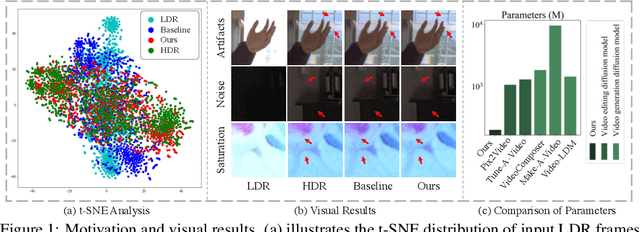
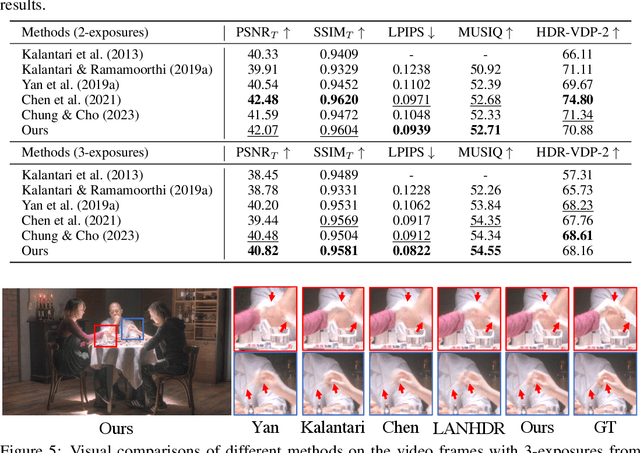
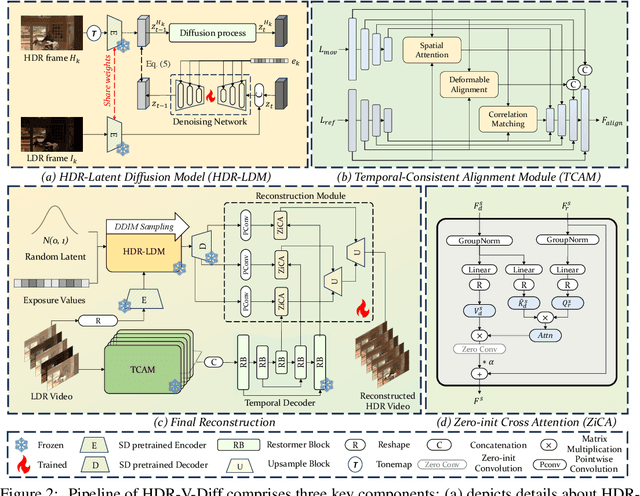
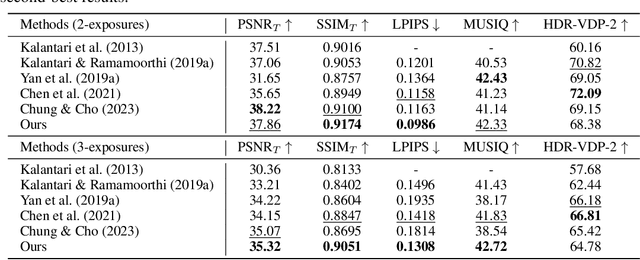
High dynamic range (HDR) video reconstruction aims to generate HDR videos from low dynamic range (LDR) frames captured with alternating exposures. Most existing works solely rely on the regression-based paradigm, leading to adverse effects such as ghosting artifacts and missing details in saturated regions. In this paper, we propose a diffusion-promoted method for HDR video reconstruction, termed HDR-V-Diff, which incorporates a diffusion model to capture the HDR distribution. As such, HDR-V-Diff can reconstruct HDR videos with realistic details while alleviating ghosting artifacts. However, the direct introduction of video diffusion models would impose massive computational burden. Instead, to alleviate this burden, we first propose an HDR Latent Diffusion Model (HDR-LDM) to learn the distribution prior of single HDR frames. Specifically, HDR-LDM incorporates a tonemapping strategy to compress HDR frames into the latent space and a novel exposure embedding to aggregate the exposure information into the diffusion process. We then propose a Temporal-Consistent Alignment Module (TCAM) to learn the temporal information as a complement for HDR-LDM, which conducts coarse-to-fine feature alignment at different scales among video frames. Finally, we design a Zero-Init Cross-Attention (ZiCA) mechanism to effectively integrate the learned distribution prior and temporal information for generating HDR frames. Extensive experiments validate that HDR-V-Diff achieves state-of-the-art results on several representative datasets.
Neural Degradation Representation Learning for All-In-One Image Restoration
Oct 19, 2023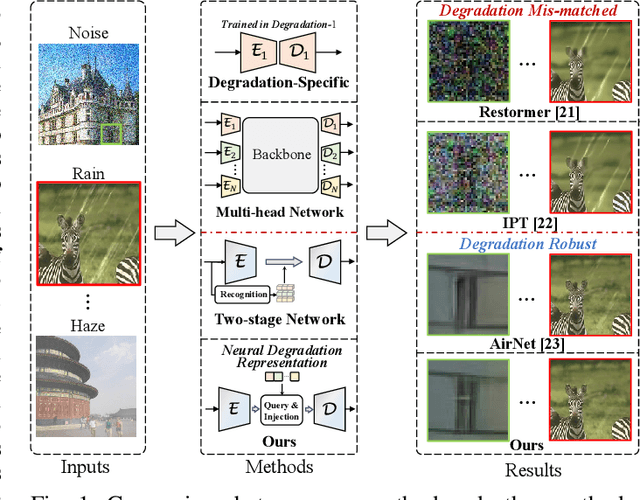
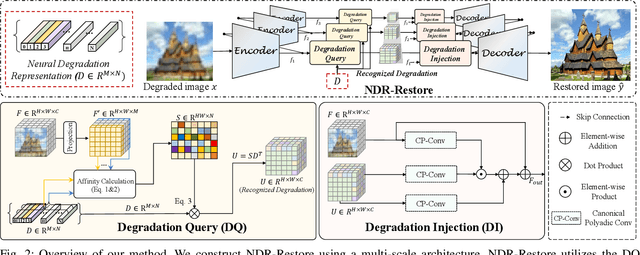
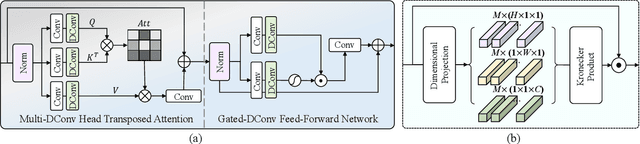
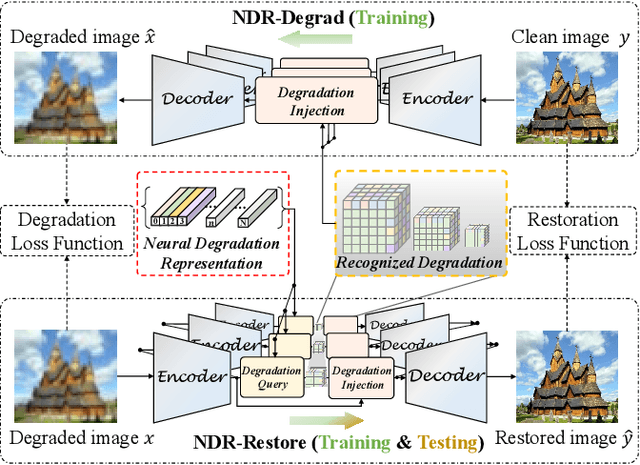
Existing methods have demonstrated effective performance on a single degradation type. In practical applications, however, the degradation is often unknown, and the mismatch between the model and the degradation will result in a severe performance drop. In this paper, we propose an all-in-one image restoration network that tackles multiple degradations. Due to the heterogeneous nature of different types of degradations, it is difficult to process multiple degradations in a single network. To this end, we propose to learn a neural degradation representation (NDR) that captures the underlying characteristics of various degradations. The learned NDR decomposes different types of degradations adaptively, similar to a neural dictionary that represents basic degradation components. Subsequently, we develop a degradation query module and a degradation injection module to effectively recognize and utilize the specific degradation based on NDR, enabling the all-in-one restoration ability for multiple degradations. Moreover, we propose a bidirectional optimization strategy to effectively drive NDR to learn the degradation representation by optimizing the degradation and restoration processes alternately. Comprehensive experiments on representative types of degradations (including noise, haze, rain, and downsampling) demonstrate the effectiveness and generalization capability of our method.
Mutual-Guided Dynamic Network for Image Fusion
Sep 01, 2023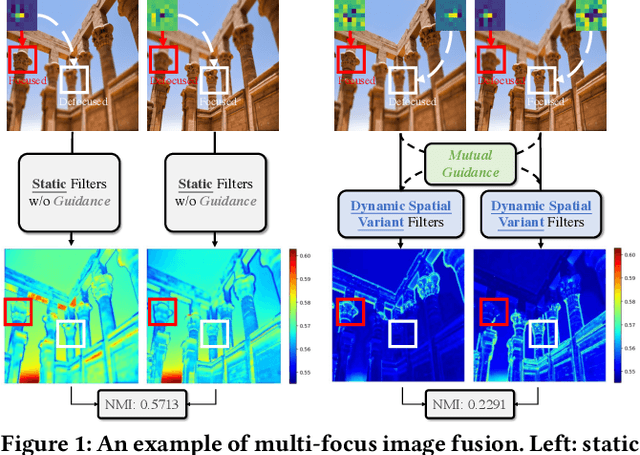


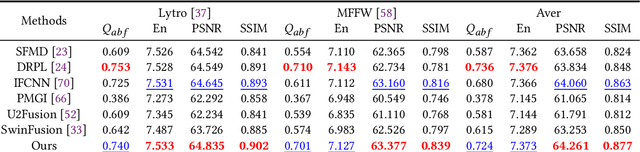
Image fusion aims to generate a high-quality image from multiple images captured under varying conditions. The key problem of this task is to preserve complementary information while filtering out irrelevant information for the fused result. However, existing methods address this problem by leveraging static convolutional neural networks (CNNs), suffering two inherent limitations during feature extraction, i.e., being unable to handle spatial-variant contents and lacking guidance from multiple inputs. In this paper, we propose a novel mutual-guided dynamic network (MGDN) for image fusion, which allows for effective information utilization across different locations and inputs. Specifically, we design a mutual-guided dynamic filter (MGDF) for adaptive feature extraction, composed of a mutual-guided cross-attention (MGCA) module and a dynamic filter predictor, where the former incorporates additional guidance from different inputs and the latter generates spatial-variant kernels for different locations. In addition, we introduce a parallel feature fusion (PFF) module to effectively fuse local and global information of the extracted features. To further reduce the redundancy among the extracted features while simultaneously preserving their shared structural information, we devise a novel loss function that combines the minimization of normalized mutual information (NMI) with an estimated gradient mask. Experimental results on five benchmark datasets demonstrate that our proposed method outperforms existing methods on four image fusion tasks. The code and model are publicly available at: https://github.com/Guanys-dar/MGDN.