 Add to Chrome
 Add to Firefox
 Add to Edge
SkillMemo: Expert-guided Skill Memory Framework for Compositional Embodied Manipulation
Aug 06, 2026
Embodied visuomotor models, including Diffusion Policy (DP) and Vision-Language-Action (VLA) models, have demonstrated promising performance on robotic manipulation benchmarks. However, their potential remains fundamentally constrained by the scarcity of large-scale embodied trajectory datasets, leading to insufficient compositional generalization in out-of-distribution (OOD) scenarios with limited capability to capture reusable skill structures. To address this limitation, we propose Skill-Based Memory (SkillMemo) framework that implicitly decomposes long-horizon demonstrations into latent atomic skills and integrates skill-level features into a dynamic episodic memory bank for solving compositional tasks. Specifically, we first introduce an expert-guided trajectory segmentation module built upon a Mixture-of-Experts (MoE) architecture, which implicitly partitions trajectories into distinct skill primitives represented by learned gating coefficients. We further design a skill-level episodic memory architecture that stores compact skill representations as retrievable key-value pairs. During inference, the memory bank retrieves the most relevant skill primitives which are subsequently fused with the model's current gating distribution, providing a robust contextual prior to refine action predictions. Extensive experiments on the simulation benchmark and real-world manipulation tasks demonstrate that SkillMemo consistently enhances both DP and VLA backbones, achieving state-of-the-art performance and outperforming $π_{0.5}$, while exhibiting strong compositional generalization to unseen task configurations.

GigaWorld-Policy-0.5: A Faster and Stronger WAM Empowered by AutoResearch
Jul 16, 2026World Action Models (WAMs) improve robot policy learning by jointly modeling actions and future visual observations, using future scene evolution as dense supervision for physically grounded action generation. However, a common design in existing WAMs is to explicitly generate future videos at inference time, incurring substantial computational overhead and hindering real-time closed-loop deployment. GigaWorld-Policy addresses this issue with an action-centered formulation, where future visual dynamics are used during training while action-only decoding is used at inference time. Building upon this framework, we present GigaWorld-Policy-0.5, an enhanced action-centered WAM designed for more efficient robot control. During pretraining, GigaWorld-Policy-0.5 adopts a mixed Action-Conditioned World Modeling (AC-WM) and WAM training strategy. This strengthens the coupling between visual dynamics and robot actions and improves the transferability of action representations for downstream policy learning. For efficient inference, GigaWorld-Policy-0.5 introduces a Mixture-of-Transformers architecture that separates visual dynamics modeling and action generation into specialized experts, reducing active computation during action-only inference and achieving 85 ms inference latency on a local RTX 4090 setup. In addition, we employ an agent-based AutoResearch pipeline to systematically search training configurations, enabling more efficient identification of optimal experimental setups while reducing the time and manual intervention required for hyperparameter tuning. Experiments and ablations show that GigaWorld-Policy-0.5 preserves the training benefits of future visual dynamics while improving inference efficiency for robot control.
GigaWorld-1: A Roadmap to Build World Models for Robot Policy Evaluation
Jul 02, 2026Evaluating embodied robot foundation models remains a critical bottleneck; unlike large language models efficiently assessed via digital benchmarks, robotic policies require slow, costly real-world rollouts limited by hardware and human supervision, which has driven interest in world models as surrogate policy evaluators, yet the key properties that make a world model reliable for policy assessment remain poorly understood. This work presents a systematic study of world models for robotic policy evaluation and introduces WMBench, a benchmark constructed from real-robot teleoperation data and matched policy rollouts covering diverse manipulation tasks to enable controlled comparisons across model families, action encodings, rollout horizons, and evaluation metrics. Using WMBench, we analyze 7 video world models, 4 action representation schemes, and over 324,000 simulated policy rollouts paired with real robot executions, further enriching our analysis with large-scale community submissions from the CVPR 2026 GigaBrain Challenge, curated synthetic trajectories, and a training videos spanning more than 12,000 hours. Our experiments deliver three core insights: evaluator quality is dominated by long-horizon, action-faithful rollout consistency rather than short-term visual realism; pretraining gains stem not only from data scale but from balancing general world knowledge with robot-specific controllability; and architectural choices including action encoding, memory design, and evaluator-focused post-training strongly determine alignment with real-world robot behavior. Drawing on these results, we derive a practical design roadmap and realize it in \textit{GigaWorld-1}, a world model specially optimized for policy evaluation, and we fully release our code, models, datasets, and toolkits to advance scalable evaluation research for embodied foundation models.
R2RDreamer: 3D-aware Data Augmentation for Spatially-generalized 2D Manipulation Policies
Jun 15, 2026Spatial generalization is critical for imitation-learned manipulation policies, but achieving it typically requires scaling demonstrations across diverse object poses, robot configurations, and camera viewpoints. Data augmentation from a few source demonstrations offers a practical alternative to costly real-world collection. Simulation-based augmentation can create controllable variation, but requires complex environment and object setup and may introduce a sim-to-real gap. Recent real-to-real methods avoid these issues by jointly editing 3D observations and action trajectories from real demonstrations, yet they still rely on strong 3D scene parsing and geometry completion, and often produce observations tailored to 3D pointcloud policies rather than RGB-based 2D policies. We propose R2RDreamer, a real-to-real demonstration augmentation framework that preserves the geometric consistency of 3D action-observation editing while moving visual completion to 2D video space. Specifically, R2RDreamer first performs lightweight 3D augmentation by editing incomplete object pointclouds and end-effector trajectories in a shared 3D frame; it then projects the edited scene into masked image-space control videos with occlusion-aware reasoning and uses a dense-control image-to-video model to complete temporally coherent RGB observations. Experiments on spatially shifted manipulation tasks with both 2D diffusion-style policies and vision-language-action policies show that R2RDreamer improves spatial generalization from limited source demonstrations, with analyses validating the contributions of 3D editing, occlusion-aware projection, and video completion.
F2F-AP: Flow-to-Future Asynchronous Policy for Real-time Dynamic Manipulation
Apr 02, 2026Asynchronous inference has emerged as a prevalent paradigm in robotic manipulation, achieving significant progress in ensuring trajectory smoothness and efficiency. However, a systemic challenge remains unresolved, as inherent latency causes generated actions to inevitably lag behind the real-time environment. This issue is particularly exacerbated in dynamic scenarios, where such temporal misalignment severely compromises the policy's ability to interpret and react to rapidly evolving surroundings. In this paper, we propose a novel framework that leverages predicted object flow to synthesize future observations, incorporating a flow-based contrastive learning objective to align the visual feature representations of predicted observations with ground-truth future states. Empowered by this anticipated visual context, our asynchronous policy gains the capacity for proactive planning and motion, enabling it to explicitly compensate for latency and robustly execute manipulation tasks involving actively moving objects. Experimental results demonstrate that our approach significantly enhances responsiveness and success rates in complex dynamic manipulation tasks.
REMAC: Self-Reflective and Self-Evolving Multi-Agent Collaboration for Long-Horizon Robot Manipulation
Mar 28, 2025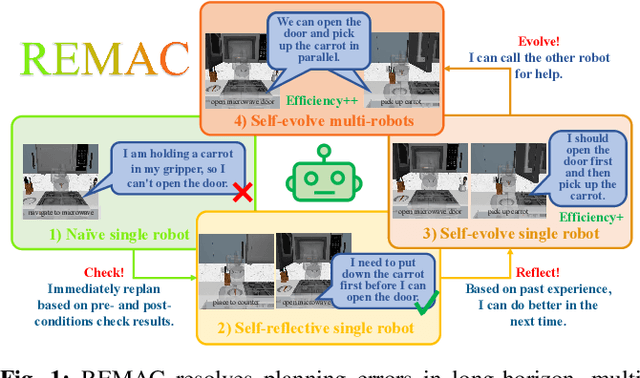
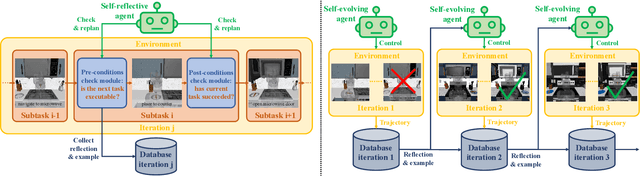
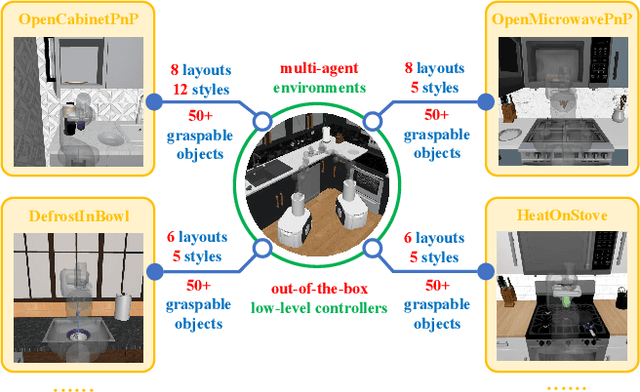
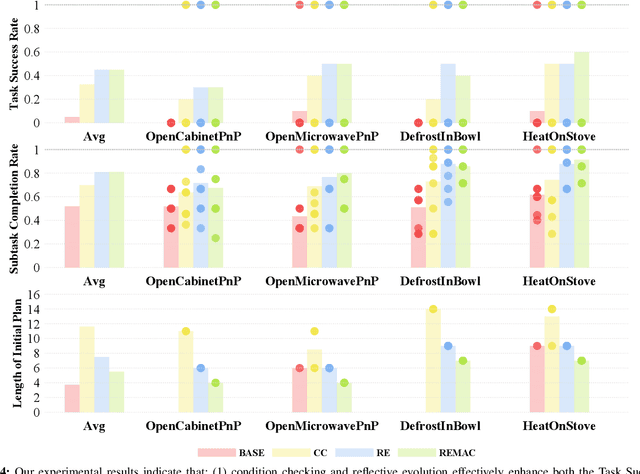
Vision-language models (VLMs) have demonstrated remarkable capabilities in robotic planning, particularly for long-horizon tasks that require a holistic understanding of the environment for task decomposition. Existing methods typically rely on prior environmental knowledge or carefully designed task-specific prompts, making them struggle with dynamic scene changes or unexpected task conditions, e.g., a robot attempting to put a carrot in the microwave but finds the door was closed. Such challenges underscore two critical issues: adaptability and efficiency. To address them, in this work, we propose an adaptive multi-agent planning framework, termed REMAC, that enables efficient, scene-agnostic multi-robot long-horizon task planning and execution through continuous reflection and self-evolution. REMAC incorporates two key modules: a self-reflection module performing pre-condition and post-condition checks in the loop to evaluate progress and refine plans, and a self-evolvement module dynamically adapting plans based on scene-specific reasoning. It offers several appealing benefits: 1) Robots can initially explore and reason about the environment without complex prompt design. 2) Robots can keep reflecting on potential planning errors and adapting the plan based on task-specific insights. 3) After iterations, a robot can call another one to coordinate tasks in parallel, maximizing the task execution efficiency. To validate REMAC's effectiveness, we build a multi-agent environment for long-horizon robot manipulation and navigation based on RoboCasa, featuring 4 task categories with 27 task styles and 50+ different objects. Based on it, we further benchmark state-of-the-art reasoning models, including DeepSeek-R1, o3-mini, QwQ, and Grok3, demonstrating REMAC's superiority by boosting average success rates by 40% and execution efficiency by 52.7% over the single robot baseline.