 Add to Chrome
 Add to Firefox
 Add to Edge
SemAnCorr: Semantic Anchored Correspondence for Zero-Shot Manipulation Skill Transfer
Jul 30, 2026
Transferring manipulation skills across object instances that share functionality but differ in geometry remains a fundamental challenge in robot learning. While recent correspondence methods leverage dense visual descriptors and 3D feature fields, nearest-neighbor feature matching often produces spatially incoherent correspondences that fail to recover the local geometric frames required for reliable skill transfer. We introduce SemAnCorr, a training-free framework that establishes dense correspondence by selecting semantically consistent anchor regions through joint pose-correspondence optimization and propagating these constraints over the object surface using functional maps. The resulting correspondences preserve both semantic consistency and geometric coherence, enabling object-centric manipulation skills to transfer across geometrically diverse instances. We evaluate SemAnCorr on a dense correspondence benchmark built on PartNet-Mobility, achieving 90.8% semantic accuracy in our benchmark evaluation while improving geometric coherence over recent state-of-the-art baselines. Finally, we show that these improvements translate directly into real-world manipulation performance: using a single demonstration, SemAnCorr enables substantially more reliable zero-shot manipulation skill transfer to previously unseen objects than existing correspondence methods. Videos and additional visualizations are available at [https://semancorr.github.io](https://semancorr.github.io) .

GaP: A Graph-as-Policy Multi-Agent Self-Learning Harness For Variational Automation Tasks
Jul 06, 2026For robots to work reliably in commercial and industrial applications, can recent advances in agentic coding systems combine interpretable robot programming with the open-world adaptability of model-free policies? We focus on "Variational Automation" (VA), a class of tasks that have larger variations in object geometry and pose than fixed automation. Model-free policies often struggle to close the reliability gap for VA tasks, which must be executed persistently and reliably in commercial and industrial applications. Motivated by prior work on Task and Motion Planning (TAMP) and the Robot Operating System (ROS), we introduce Graph-as-Policy (GaP), a multi-agent coding harness that generates directed computation graphs with perception, planning, and control nodes from a Modular Open Robot Skill Library (MORSL). GaP then generates an internal simulation environment to rehearse task instances with different graphs in parallel to iteratively refine the graph structure and parameters to improve success rates and throughput. Evaluation with 8 new open VA task benchmarks, 4 in-simulation and 4 in real-world, suggests that GaP can achieve success rates that significantly outperform baselines. Details, code, and data can be found online: https://graph-robots.github.io/gap
VibeAct: Vibration to Actions for Contact-Rich Reactive Robot Dexterity
Jun 25, 2026Dexterous manipulation depends on contact events that are fast, local, and often visually occluded. Piezoelectric microphones offer a compact and high-bandwidth way to sense these interactions, but the resulting vibro-acoustic signals are difficult to simulate faithfully enough for end-to-end sim-to-real policy learning on dexterous robot hands. We propose VibeAct, a framework that bridges real vibrotactile sensing and simulation-based reinforcement learning through a shared physical representation of contact and slip. In the real world, we embed piezoelectric microphones into a dexterous robot hand and collect vibro-acoustic data through teleoperation, then replay the recordings in a calibrated digital clone to automatically label per-finger contact and slip. A tactile estimator learns to predict contact and slip from real microphone waveforms, while manipulation policies are trained in simulation on the same representation computed directly from simulated contacts. This decoupling lets policies exploit rapid tactile feedback without simulating raw audio. Across five contact-rich tasks spanning regrasping, in-hand reorientation, and insertion, VibeAct consistently outperforms a proprioception-and-point-cloud baseline in simulation, with the largest gains on tasks requiring sustained reactive control, where the continuous slip-magnitude channel proves the most informative observation. The learned policies transfer to a physical dexterous hand-arm platform, improving success rates on deployed tasks. Project videos and additional details are at https://vibeact.github.io/.
A-SLIP: Acoustic Sensing for Continuous In-hand Slip Estimation
Apr 09, 2026Reliable in-hand manipulation requires accurate real-time estimation of slip between a gripper and a grasped object. Existing tactile sensing approaches based on vision, capacitance, or force-torque measurements face fundamental trade-offs in form factor, durability, and their ability to jointly estimate slip direction and magnitude. We present A-SLIP, a multi-channel acoustic sensing system integrated into a parallel-jaw gripper for estimating continuous slip in the grasp plane. The A-SLIP sensor consists of piezoelectric microphones positioned behind a textured silicone contact pad to capture structured contact-induced vibrations. The A-SLIP model processes synchronized multi-channel audio as log-mel spectrograms using a lightweight convolutional network, jointly predicting the presence, direction, and magnitude of slip. Across experiments with robot- and externally induced slip conditions, the fine-tuned four-microphone configuration achieves a mean absolute directional error of 14.1 degrees, outperforms baselines by up to 12 percent in detection accuracy, and reduces directional error by 32 percent. Compared with single-microphone configurations, the multi-channel design reduces directional error by 64 percent and magnitude error by 68 percent, underscoring the importance of spatial acoustic sensing in resolving slip direction ambiguity. We further evaluate A-SLIP in closed-loop reactive control and find that it enables reliable, low-cost, real-time estimation of in-hand slip. Project videos and additional details are available at https://a-slip.github.io.
Functional Force-Aware Retargeting from Virtual Human Demos to Soft Robot Policies
Apr 01, 2026We introduce SoftAct, a framework for teaching soft robot hands to perform human-like manipulation skills by explicitly reasoning about contact forces. Leveraging immersive virtual reality, our system captures rich human demonstrations, including hand kinematics, object motion, dense contact patches, and detailed contact force information. Unlike conventional approaches that retarget human joint trajectories, SoftAct employs a two-stage, force-aware retargeting algorithm. The first stage attributes demonstrated contact forces to individual human fingers and allocates robot fingers proportionally, establishing a force-balanced mapping between human and robot hands. The second stage performs online retargeting by combining baseline end-effector pose tracking with geodesic-weighted contact refinements, using contact geometry and force magnitude to adjust robot fingertip targets in real time. This formulation enables soft robotic hands to reproduce the functional intent of human demonstrations while naturally accommodating extreme embodiment mismatch and nonlinear compliance. We evaluate SoftAct on a suite of contact-rich manipulation tasks using a custom non-anthropomorphic pneumatic soft robot hand. SoftAct's controller reduces fingertip trajectory tracking RMSE by up to 55 percent and reduces tracking variance by up to 69 percent compared to kinematic and learning-based baselines. At the policy level, SoftAct achieves consistently higher success in zero-shot real-world deployment and in simulation. These results demonstrate that explicitly modeling contact geometry and force distribution is essential for effective skill transfer to soft robotic hands, and cannot be recovered through kinematic imitation alone. Project videos and additional details are available at https://soft-act.github.io/.
SOFTMAP: Sim2Real Soft Robot Forward Modeling via Topological Mesh Alignment and Physics Prior
Mar 19, 2026While soft robot manipulators offer compelling advantages over rigid counterparts, including inherent compliance, safe human-robot interaction, and the ability to conform to complex geometries, accurate forward modeling from low-dimensional actuation commands remains an open challenge due to nonlinear material phenomena such as hysteresis and manufacturing variability. We present SOFTMAP, a sim-to-real learning framework for real-time 3D forward modeling of tendon-actuated soft finger manipulators. SOFTMAP combines four components: (1) As-Rigid-As-Possible (ARAP)-based topological alignment that projects simulated and real point clouds into a shared, topologically consistent vertex space; (2) a lightweight MLP forward model pretrained on simulation data to map servo commands to full 3D finger geometry; (3) a residual correction network trained on a small set of real observations to predict per-vertex displacement fields that compensate for sim-to-real discrepancies; and (4) a closed-form linear actuation calibration layer enabling real-time inference at 30 FPS. We evaluate SOFTMAP on both simulated and physical hardware, achieving state-of-the-art shape prediction accuracy with a Chamfer distance of 0.389 mm in simulation and 3.786 mm on hardware, millimeter-level fingertip trajectory tracking across multiple target paths, and a 36.5% improvement in teleoperation task success over the baseline. Our results show that SOFTMAP provides a data-efficient approach for 3D forward modeling and control of soft manipulators.
Modeling Personalized Difficulty of Rehabilitation Exercises Using Causal Trees
May 07, 2025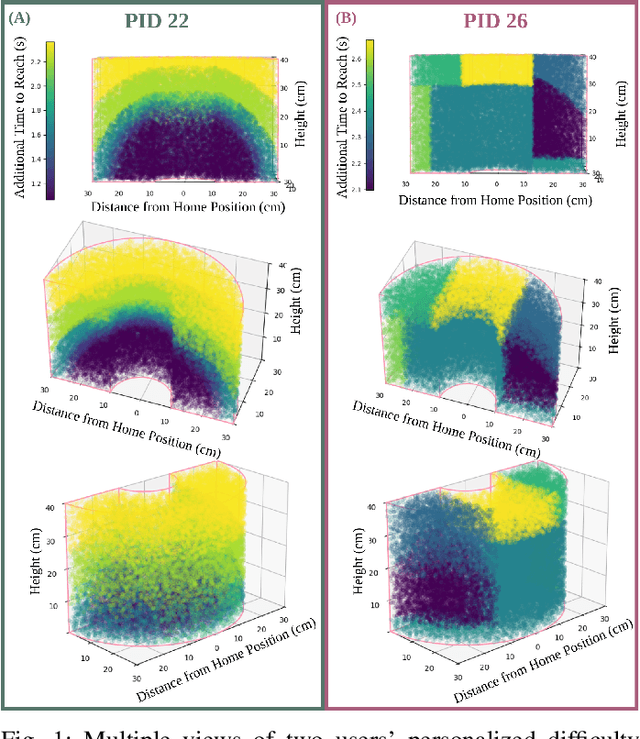
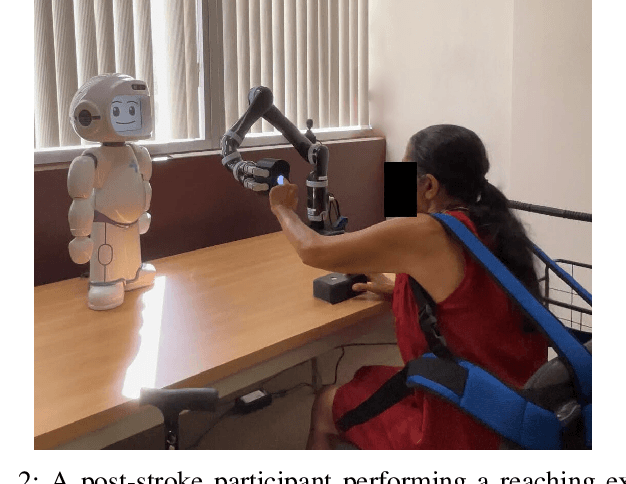
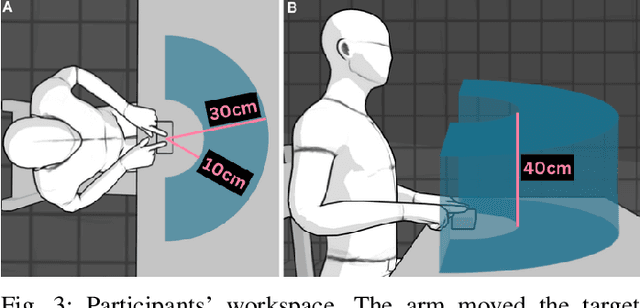
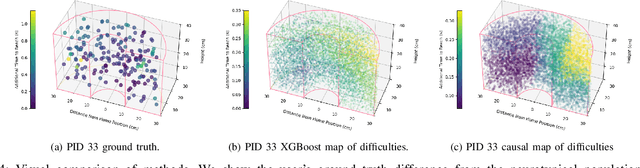
Rehabilitation robots are often used in game-like interactions for rehabilitation to increase a person's motivation to complete rehabilitation exercises. By adjusting exercise difficulty for a specific user throughout the exercise interaction, robots can maximize both the user's rehabilitation outcomes and the their motivation throughout the exercise. Previous approaches have assumed exercises have generic difficulty values that apply to all users equally, however, we identified that stroke survivors have varied and unique perceptions of exercise difficulty. For example, some stroke survivors found reaching vertically more difficult than reaching farther but lower while others found reaching farther more challenging than reaching vertically. In this paper, we formulate a causal tree-based method to calculate exercise difficulty based on the user's performance. We find that this approach accurately models exercise difficulty and provides a readily interpretable model of why that exercise is difficult for both users and caretakers.
KineSoft: Learning Proprioceptive Manipulation Policies with Soft Robot Hands
Mar 03, 2025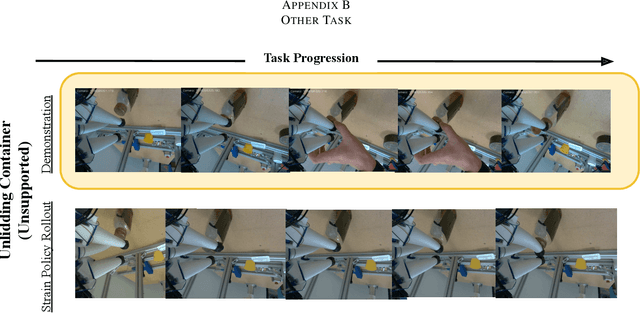
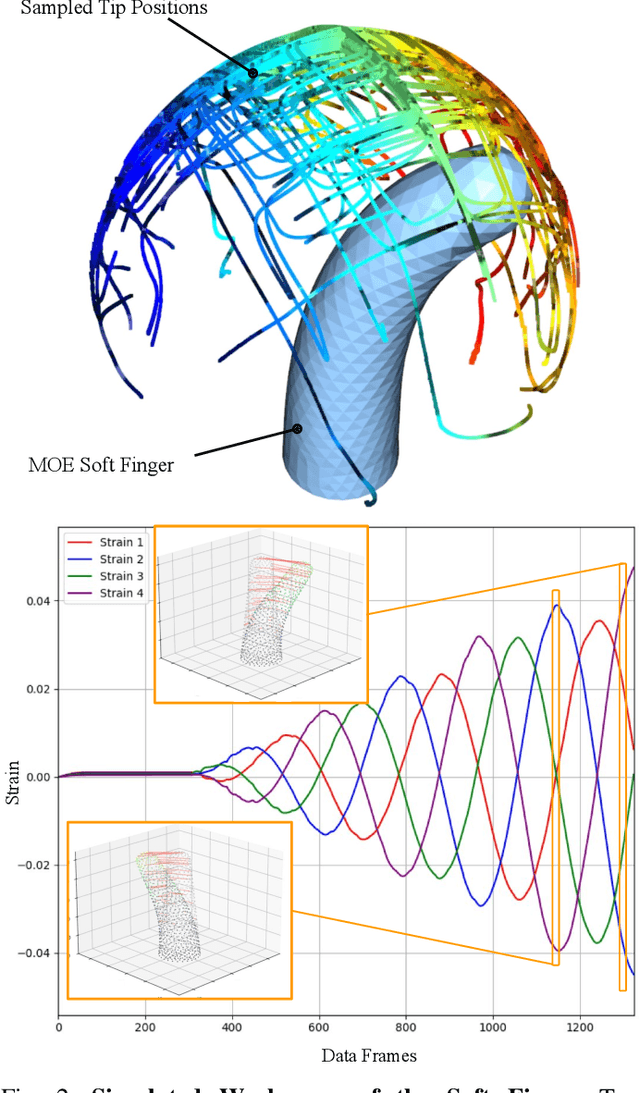
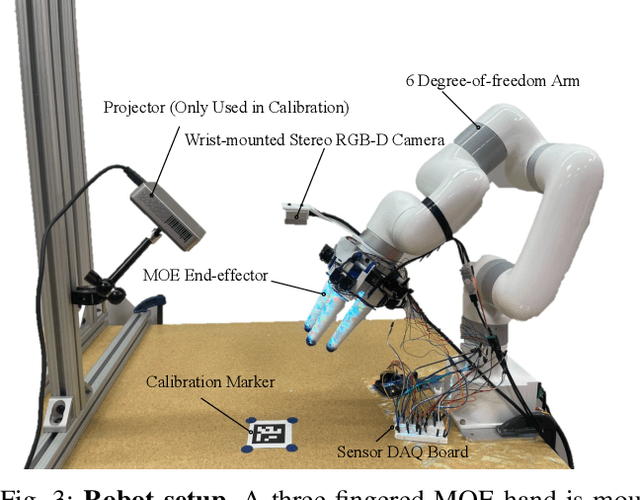
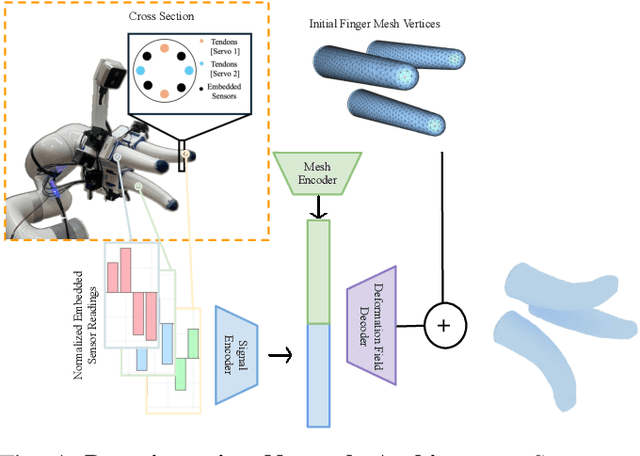
Underactuated soft robot hands offer inherent safety and adaptability advantages over rigid systems, but developing dexterous manipulation skills remains challenging. While imitation learning shows promise for complex manipulation tasks, traditional approaches struggle with soft systems due to demonstration collection challenges and ineffective state representations. We present KineSoft, a framework enabling direct kinesthetic teaching of soft robotic hands by leveraging their natural compliance as a skill teaching advantage rather than only as a control challenge. KineSoft makes two key contributions: (1) an internal strain sensing array providing occlusion-free proprioceptive shape estimation, and (2) a shape-based imitation learning framework that uses proprioceptive feedback with a low-level shape-conditioned controller to ground diffusion-based policies. This enables human demonstrators to physically guide the robot while the system learns to associate proprioceptive patterns with successful manipulation strategies. We validate KineSoft through physical experiments, demonstrating superior shape estimation accuracy compared to baseline methods, precise shape-trajectory tracking, and higher task success rates compared to baseline imitation learning approaches.
Soft and Compliant Contact-Rich Hair Manipulation and Care
Jan 05, 2025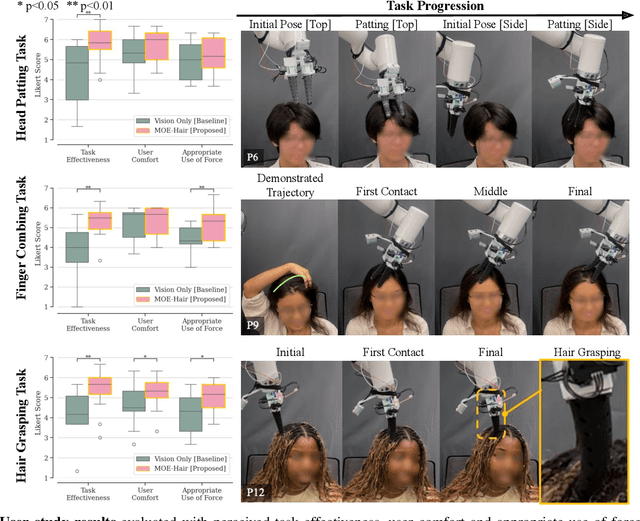
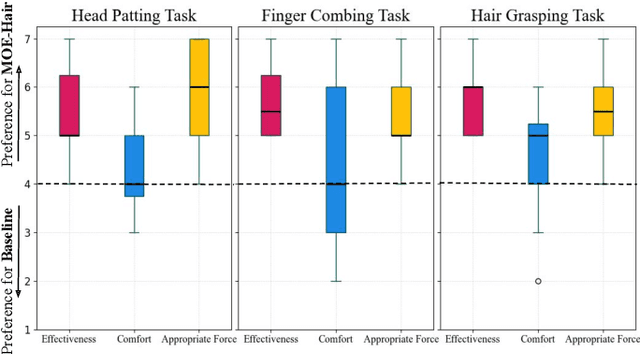
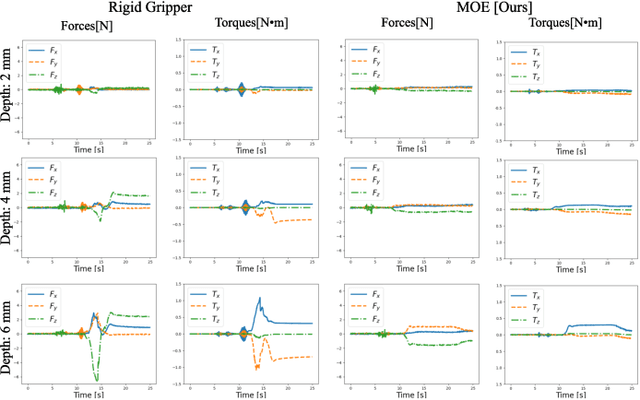
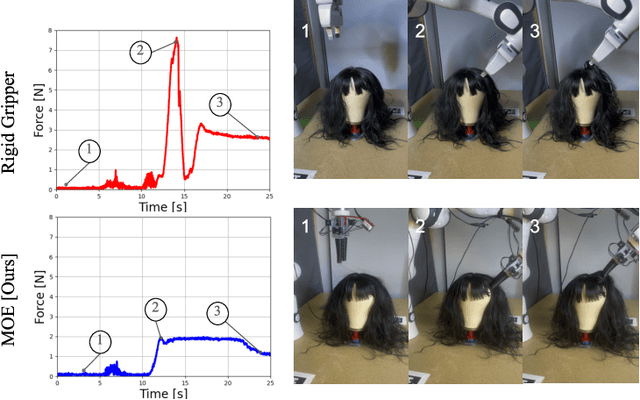
Hair care robots can help address labor shortages in elderly care while enabling those with limited mobility to maintain their hair-related identity. We present MOE-Hair, a soft robot system that performs three hair-care tasks: head patting, finger combing, and hair grasping. The system features a tendon-driven soft robot end-effector (MOE) with a wrist-mounted RGBD camera, leveraging both mechanical compliance for safety and visual force sensing through deformation. In testing with a force-sensorized mannequin head, MOE achieved comparable hair-grasping effectiveness while applying significantly less force than rigid grippers. Our novel force estimation method combines visual deformation data and tendon tensions from actuators to infer applied forces, reducing sensing errors by up to 60.1% and 20.3% compared to actuator current load-only and depth image-only baselines, respectively. A user study with 12 participants demonstrated statistically significant preferences for MOE-Hair over a baseline system in terms of comfort, effectiveness, and appropriate force application. These results demonstrate the unique advantages of soft robots in contact-rich hair-care tasks, while highlighting the importance of precise force control despite the inherent compliance of the system.
SonicBoom: Contact Localization Using Array of Microphones
Dec 13, 2024


In cluttered environments where visual sensors encounter heavy occlusion, such as in agricultural settings, tactile signals can provide crucial spatial information for the robot to locate rigid objects and maneuver around them. We introduce SonicBoom, a holistic hardware and learning pipeline that enables contact localization through an array of contact microphones. While conventional sound source localization methods effectively triangulate sources in air, localization through solid media with irregular geometry and structure presents challenges that are difficult to model analytically. We address this challenge through a feature engineering and learning based approach, autonomously collecting 18,000 robot interaction sound pairs to learn a mapping between acoustic signals and collision locations on the robot end effector link. By leveraging relative features between microphones, SonicBoom achieves localization errors of 0.42cm for in distribution interactions and maintains robust performance of 2.22cm error even with novel objects and contact conditions. We demonstrate the system's practical utility through haptic mapping of occluded branches in mock canopy settings, showing that acoustic based sensing can enable reliable robot navigation in visually challenging environments.