 Add to Chrome
 Add to Firefox
 Add to Edge
Grounding-IQA: Multimodal Language Grounding Model for Image Quality Assessment
Nov 26, 2024
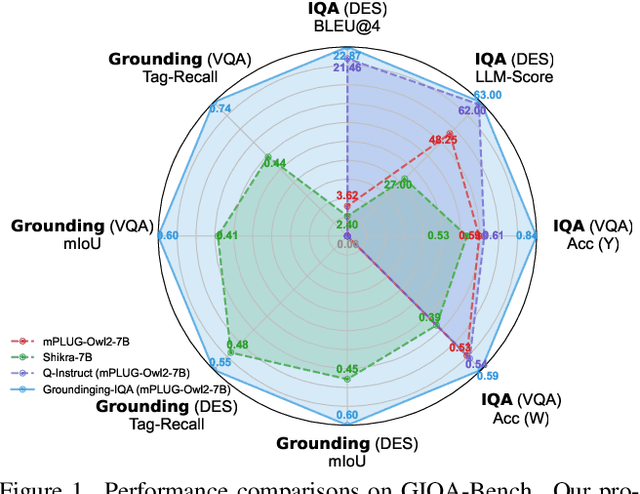
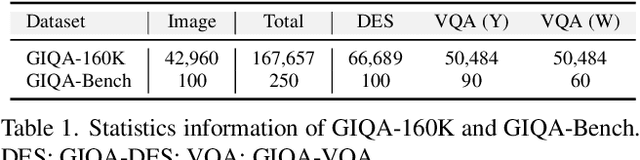
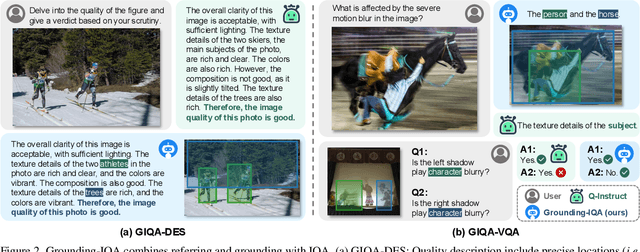
The development of multimodal large language models (MLLMs) enables the evaluation of image quality through natural language descriptions. This advancement allows for more detailed assessments. However, these MLLM-based IQA methods primarily rely on general contextual descriptions, sometimes limiting fine-grained quality assessment. To address this limitation, we introduce a new image quality assessment (IQA) task paradigm, grounding-IQA. This paradigm integrates multimodal referring and grounding with IQA to realize more fine-grained quality perception. Specifically, grounding-IQA comprises two subtasks: grounding-IQA-description (GIQA-DES) and visual question answering (GIQA-VQA). GIQA-DES involves detailed descriptions with precise locations (e.g., bounding boxes), while GIQA-VQA focuses on quality QA for local regions. To realize grounding-IQA, we construct a corresponding dataset, GIQA-160K, through our proposed automated annotation pipeline. Furthermore, we develop a well-designed benchmark, GIQA-Bench. The benchmark comprehensively evaluates the model grounding-IQA performance from three perspectives: description quality, VQA accuracy, and grounding precision. Experiments demonstrate that our proposed task paradigm, dataset, and benchmark facilitate the more fine-grained IQA application. Code: https://github.com/zhengchen1999/Grounding-IQA.

PassionSR: Post-Training Quantization with Adaptive Scale in One-Step Diffusion based Image Super-Resolution
Nov 26, 2024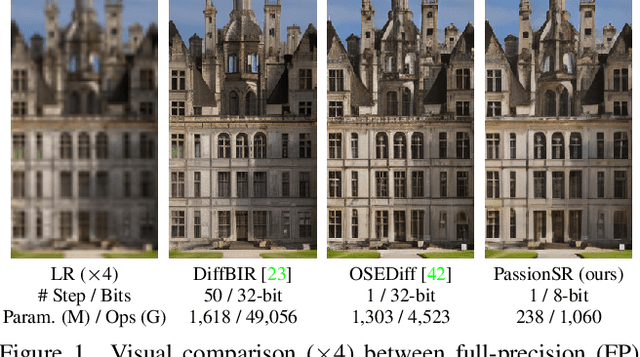

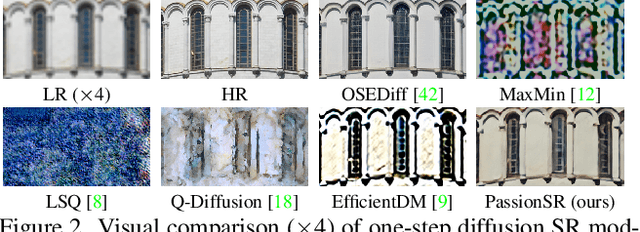
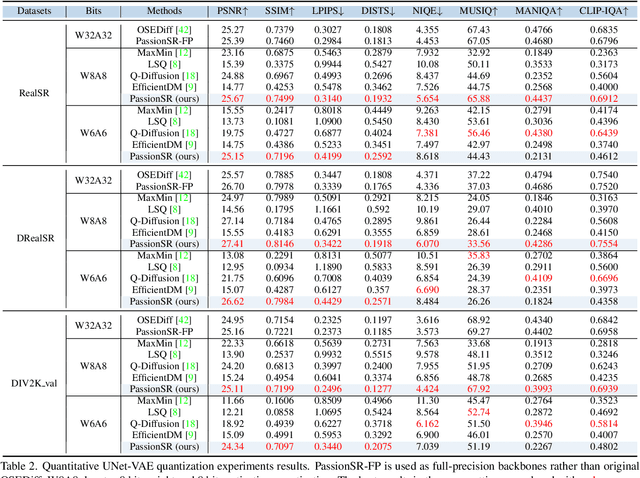
Diffusion-based image super-resolution (SR) models have shown superior performance at the cost of multiple denoising steps. However, even though the denoising step has been reduced to one, they require high computational costs and storage requirements, making it difficult for deployment on hardware devices. To address these issues, we propose a novel post-training quantization approach with adaptive scale in one-step diffusion (OSD) image SR, PassionSR. First, we simplify OSD model to two core components, UNet and Variational Autoencoder (VAE) by removing the CLIPEncoder. Secondly, we propose Learnable Boundary Quantizer (LBQ) and Learnable Equivalent Transformation (LET) to optimize the quantization process and manipulate activation distributions for better quantization. Finally, we design a Distributed Quantization Calibration (DQC) strategy that stabilizes the training of quantized parameters for rapid convergence. Comprehensive experiments demonstrate that PassionSR with 8-bit and 6-bit obtains comparable visual results with full-precision model. Moreover, our PassionSR achieves significant advantages over recent leading low-bit quantization methods for image SR. Our code will be at https://github.com/libozhu03/PassionSR.
MambaIRv2: Attentive State Space Restoration
Nov 22, 2024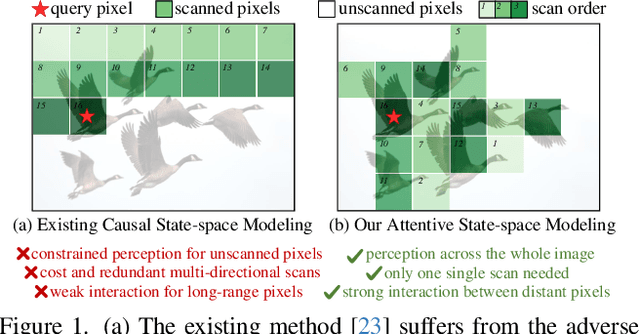


The Mamba-based image restoration backbones have recently demonstrated significant potential in balancing global reception and computational efficiency. However, the inherent causal modeling limitation of Mamba, where each token depends solely on its predecessors in the scanned sequence, restricts the full utilization of pixels across the image and thus presents new challenges in image restoration. In this work, we propose MambaIRv2, which equips Mamba with the non-causal modeling ability similar to ViTs to reach the attentive state space restoration model. Specifically, the proposed attentive state-space equation allows to attend beyond the scanned sequence and facilitate image unfolding with just one single scan. Moreover, we further introduce a semantic-guided neighboring mechanism to encourage interaction between distant but similar pixels. Extensive experiments show our MambaIRv2 outperforms SRFormer by \textbf{even 0.35dB} PSNR for lightweight SR even with \textbf{9.3\% less} parameters and suppresses HAT on classic SR by \textbf{up to 0.29dB}. Code is available at \url{https://github.com/csguoh/MambaIR}.
BiDense: Binarization for Dense Prediction
Nov 15, 2024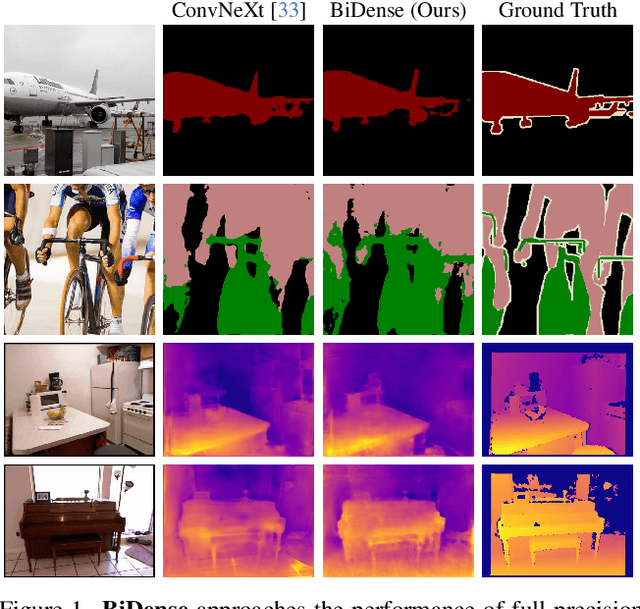

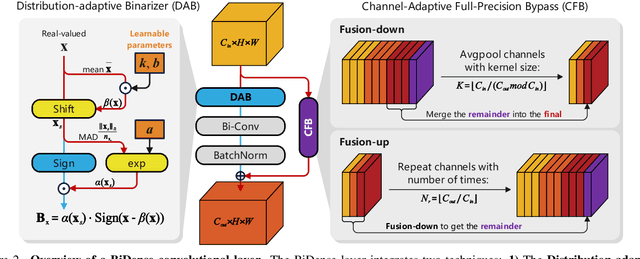

Dense prediction is a critical task in computer vision. However, previous methods often require extensive computational resources, which hinders their real-world application. In this paper, we propose BiDense, a generalized binary neural network (BNN) designed for efficient and accurate dense prediction tasks. BiDense incorporates two key techniques: the Distribution-adaptive Binarizer (DAB) and the Channel-adaptive Full-precision Bypass (CFB). The DAB adaptively calculates thresholds and scaling factors for binarization, effectively retaining more information within BNNs. Meanwhile, the CFB facilitates full-precision bypassing for binary convolutional layers undergoing various channel size transformations, which enhances the propagation of real-valued signals and minimizes information loss. By leveraging these techniques, BiDense preserves more real-valued information, enabling more accurate and detailed dense predictions in BNNs. Extensive experiments demonstrate that our framework achieves performance levels comparable to full-precision models while significantly reducing memory usage and computational costs.
ECMamba: Consolidating Selective State Space Model with Retinex Guidance for Efficient Multiple Exposure Correction
Oct 28, 2024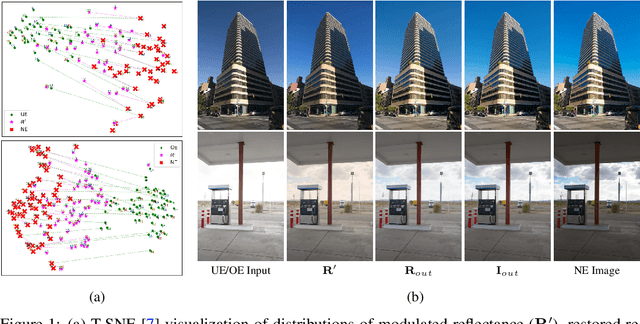
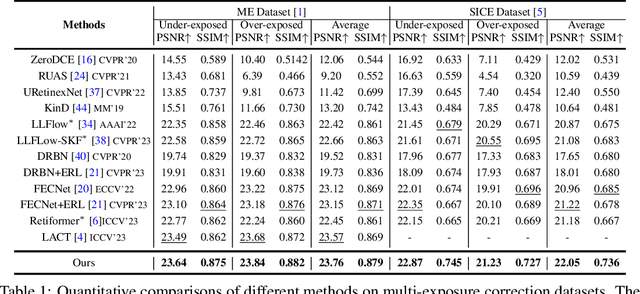
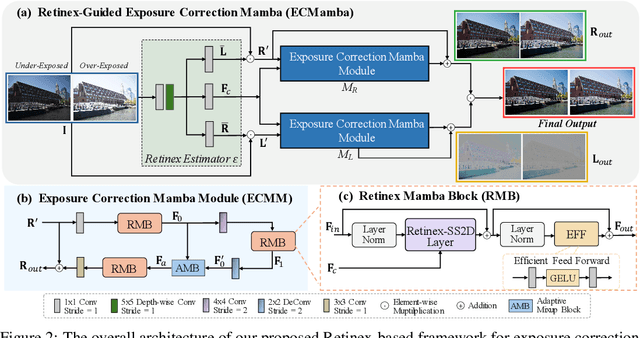
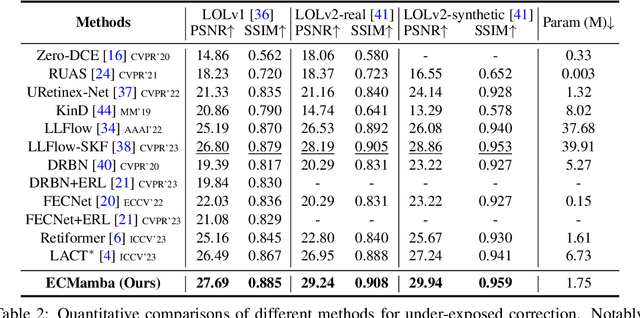
Exposure Correction (EC) aims to recover proper exposure conditions for images captured under over-exposure or under-exposure scenarios. While existing deep learning models have shown promising results, few have fully embedded Retinex theory into their architecture, highlighting a gap in current methodologies. Additionally, the balance between high performance and efficiency remains an under-explored problem for exposure correction task. Inspired by Mamba which demonstrates powerful and highly efficient sequence modeling, we introduce a novel framework based on Mamba for Exposure Correction (ECMamba) with dual pathways, each dedicated to the restoration of reflectance and illumination map, respectively. Specifically, we firstly derive the Retinex theory and we train a Retinex estimator capable of mapping inputs into two intermediary spaces, each approximating the target reflectance and illumination map, respectively. This setup facilitates the refined restoration process of the subsequent Exposure Correction Mamba Module (ECMM). Moreover, we develop a novel 2D Selective State-space layer guided by Retinex information (Retinex-SS2D) as the core operator of ECMM. This architecture incorporates an innovative 2D scanning strategy based on deformable feature aggregation, thereby enhancing both efficiency and effectiveness. Extensive experiment results and comprehensive ablation studies demonstrate the outstanding performance and the importance of each component of our proposed ECMamba. Code is available at https://github.com/LowlevelAI/ECMamba.
Hi-Mamba: Hierarchical Mamba for Efficient Image Super-Resolution
Oct 14, 2024
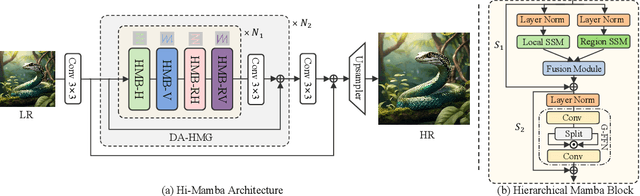
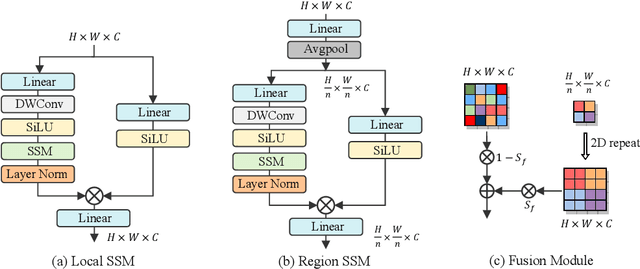

State Space Models (SSM), such as Mamba, have shown strong representation ability in modeling long-range dependency with linear complexity, achieving successful applications from high-level to low-level vision tasks. However, SSM's sequential nature necessitates multiple scans in different directions to compensate for the loss of spatial dependency when unfolding the image into a 1D sequence. This multi-direction scanning strategy significantly increases the computation overhead and is unbearable for high-resolution image processing. To address this problem, we propose a novel Hierarchical Mamba network, namely, Hi-Mamba, for image super-resolution (SR). Hi-Mamba consists of two key designs: (1) The Hierarchical Mamba Block (HMB) assembled by a Local SSM (L-SSM) and a Region SSM (R-SSM) both with the single-direction scanning, aggregates multi-scale representations to enhance the context modeling ability. (2) The Direction Alternation Hierarchical Mamba Group (DA-HMG) allocates the isomeric single-direction scanning into cascading HMBs to enrich the spatial relationship modeling. Extensive experiments demonstrate the superiority of Hi-Mamba across five benchmark datasets for efficient SR. For example, Hi-Mamba achieves a significant PSNR improvement of 0.29 dB on Manga109 for $\times3$ SR, compared to the strong lightweight MambaIR.
Distillation-Free One-Step Diffusion for Real-World Image Super-Resolution
Oct 05, 2024Diffusion models have been achieving excellent performance for real-world image super-resolution (Real-ISR) with considerable computational costs. Current approaches are trying to derive one-step diffusion models from multi-step counterparts through knowledge distillation. However, these methods incur substantial training costs and may constrain the performance of the student model by the teacher's limitations. To tackle these issues, we propose DFOSD, a Distillation-Free One-Step Diffusion model. Specifically, we propose a noise-aware discriminator (NAD) to participate in adversarial training, further enhancing the authenticity of the generated content. Additionally, we improve the perceptual loss with edge-aware DISTS (EA-DISTS) to enhance the model's ability to generate fine details. Our experiments demonstrate that, compared with previous diffusion-based methods requiring dozens or even hundreds of steps, our DFOSD attains comparable or even superior results in both quantitative metrics and qualitative evaluations. Our DFOSD also abtains higher performance and efficiency compared with other one-step diffusion methods. We will release code and models at \url{https://github.com/JianzeLi-114/DFOSD}.
Overcoming False Illusions in Real-World Face Restoration with Multi-Modal Guided Diffusion Model
Oct 05, 2024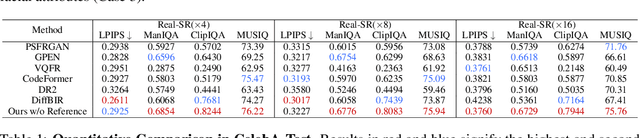

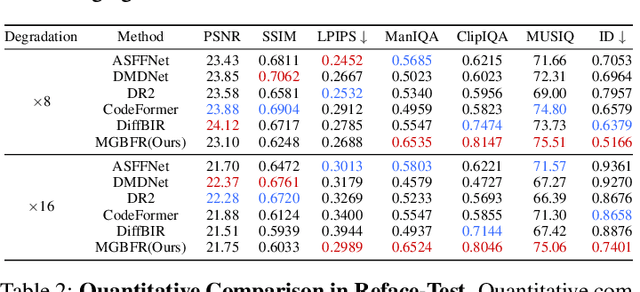
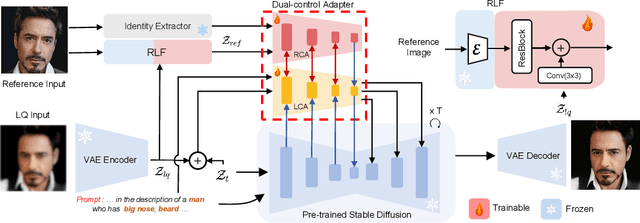
We introduce a novel Multi-modal Guided Real-World Face Restoration (MGFR) technique designed to improve the quality of facial image restoration from low-quality inputs. Leveraging a blend of attribute text prompts, high-quality reference images, and identity information, MGFR can mitigate the generation of false facial attributes and identities often associated with generative face restoration methods. By incorporating a dual-control adapter and a two-stage training strategy, our method effectively utilizes multi-modal prior information for targeted restoration tasks. We also present the Reface-HQ dataset, comprising over 23,000 high-resolution facial images across 5,000 identities, to address the need for reference face training images. Our approach achieves superior visual quality in restoring facial details under severe degradation and allows for controlled restoration processes, enhancing the accuracy of identity preservation and attribute correction. Including negative quality samples and attribute prompts in the training further refines the model's ability to generate detailed and perceptually accurate images.
Gap Preserving Distillation by Building Bidirectional Mappings with A Dynamic Teacher
Oct 05, 2024
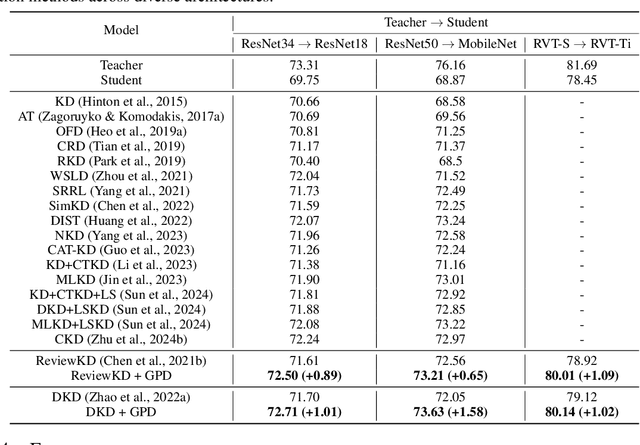
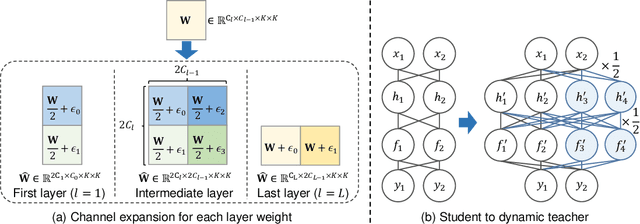

Knowledge distillation aims to transfer knowledge from a large teacher model to a compact student counterpart, often coming with a significant performance gap between them. We find that a too-large performance gap can hamper the training process, which is also verified in recent studies. To address this, we propose a Gap Preserving Distillation (GPD) method that trains an additional dynamic teacher model from scratch along with training the student to bridge this gap. In this way, it becomes possible to maintain a reasonable performance gap between teacher and student during the whole distillation process. To further strengthen distillation from the dynamic teacher to the student, we develop a hard strategy by enforcing them to share parameters and encouraging parameter inheritance. Besides hard strategy, we also build the soft bidirectional mappings between them which are built on an Inverse Reparameterization (IR) method and a Channel-Branch Reparameterization (CBR) strategy. We highlight that our IR is able to initialize a larger dynamic teacher with an arbitrary expansion ratio, while preserving exactly the same accuracy as the given student model. In this way, it guarantees that the dynamic teacher and student start from the same point and avoid a too large gap in early stage of training. As for our CBR, with parameter-sharing, it directly extracts an effective student model from the well-learned dynamic teacher without any post-training, making our method highly flexible for model deployment. In the experiments, GPD significantly outperforms existing distillation methods on top of both CNNs and transformers architectures, achieving up to 1.58% accuracy improvement. Interestingly, GPD also generalizes well to the scenarios without a pre-trained teacher, including training from scratch and fine-tuning, yielding a large improvement of 1.80% and 0.89% on ResNet18, respectively.
ARB-LLM: Alternating Refined Binarizations for Large Language Models
Oct 04, 2024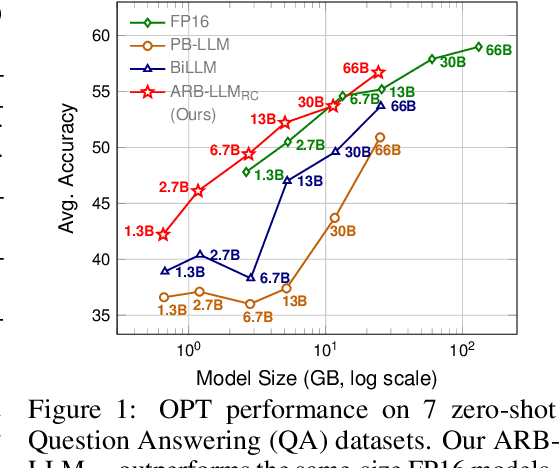
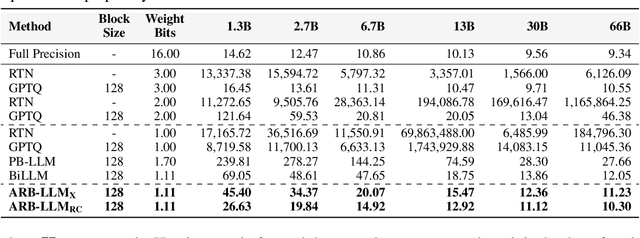
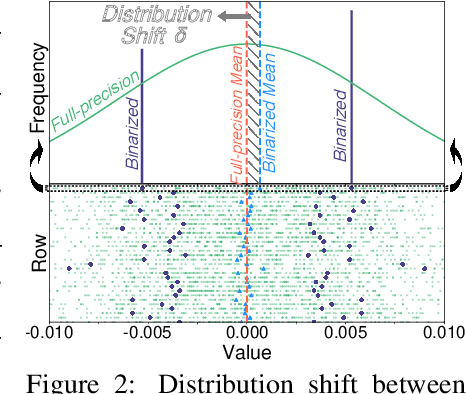
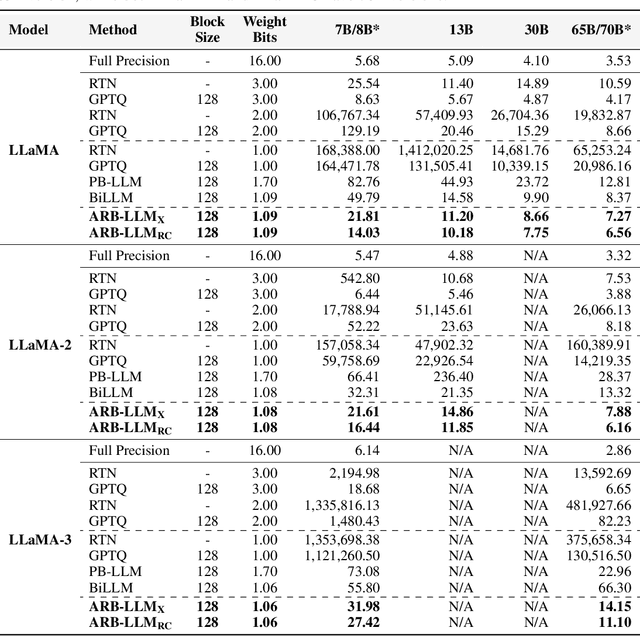
Large Language Models (LLMs) have greatly pushed forward advancements in natural language processing, yet their high memory and computational demands hinder practical deployment. Binarization, as an effective compression technique, can shrink model weights to just 1 bit, significantly reducing the high demands on computation and memory. However, current binarization methods struggle to narrow the distribution gap between binarized and full-precision weights, while also overlooking the column deviation in LLM weight distribution. To tackle these issues, we propose ARB-LLM, a novel 1-bit post-training quantization (PTQ) technique tailored for LLMs. To narrow the distribution shift between binarized and full-precision weights, we first design an alternating refined binarization (ARB) algorithm to progressively update the binarization parameters, which significantly reduces the quantization error. Moreover, considering the pivot role of calibration data and the column deviation in LLM weights, we further extend ARB to ARB-X and ARB-RC. In addition, we refine the weight partition strategy with column-group bitmap (CGB), which further enhance performance. Equipping ARB-X and ARB-RC with CGB, we obtain ARB-LLM$_\text{X}$ and ARB-LLM$_\text{RC}$ respectively, which significantly outperform state-of-the-art (SOTA) binarization methods for LLMs. As a binary PTQ method, our ARB-LLM$_\text{RC}$ is the first to surpass FP16 models of the same size. The code and models will be available at https://github.com/ZHITENGLI/ARB-LLM.