 Add to Chrome
 Add to Firefox
 Add to Edge
Need to Know: Contextual-Integrity-Grounded Query Rewriting for Privacy-Conscious LLM Delegation
Jun 02, 2026
As LLMs become increasingly woven into everyday workflows, user queries sent to cloud hosted LLMs routinely mix task-essential content with task non-essential sensitive disclosures, yet type based PII redaction is context agnostic and may raise two issues: over disclosing untyped sensitive context and over removing answer bearing spans. We recast privacy preserving query rewriting under Contextual Integrity: a span should be forwarded only if it is necessary for the task. We introduce DelegateCI-Bench, the first task based Contextual Integrity benchmark for privacy-conscious delegation, comprising 3,167 samples that combine high quality synthetic data spanning 11 tasks and 20 task types, WildChat based real user queries, and a medical challenge set with dense sensitive information. Building on this benchmark, we propose a CI-guided reinforcement learning framework that converts essential and non-essential sensitive spans into verifiable optimization signals, and train a query rewriter to preserve task critical information while suppressing unnecessary sensitive disclosure. Experiments show that our learned rewriter achieves the best privacy-utility tradeoff, achieving up to +10.1 average utility over on-device baselines.

Harmonizing Dense and Sparse Signals in Multi-turn RL: Dual-Horizon Credit Assignment for Industrial Sales Agents
Mar 02, 2026Optimizing large language models for industrial sales requires balancing long-term commercial objectives (e.g., conversion rate) with immediate linguistic constraints such as fluency and compliance. Conventional reinforcement learning often merges these heterogeneous goals into a single reward, causing high-magnitude session-level rewards to overwhelm subtler turn-level signals, which leads to unstable training or reward hacking. To address this issue, we propose Dual-Horizon Credit Assignment (DuCA), a framework that disentangles optimization across time scales. Its core, Horizon-Independent Advantage Normalization (HIAN), separately normalizes advantages from turn-level and session-level rewards before fusion, ensuring balanced gradient contributions from both immediate and long-term objectives to the policy update. Extensive experiments with a high-fidelity user simulator show DuCA outperforms the state-of-the-art GRPO baseline, achieving a 6.82% relative improvement in conversion rate, reducing inter-sentence repetition by 82.28%, and lowering identity detection rate by 27.35%, indicating a substantial improvement for an industrial sales scenario that effectively balances the dual demands of strategic performance and naturalistic language generation.
Optical Inversion and Spectral Unmixing of Spectroscopic Photoacoustic Images with Physics-Informed Neural Networks
Feb 18, 2026Accurate estimation of the relative concentrations of chromophores in a spectroscopic photoacoustic (sPA) image can reveal immense structural, functional, and molecular information about physiological processes. However, due to nonlinearities and ill-posedness inherent to sPA imaging, concentration estimation is intractable. The Spectroscopic Photoacoustic Optical Inversion Autoencoder (SPOI-AE) aims to address the sPA optical inversion and spectral unmixing problems without assuming linearity. Herein, SPOI-AE was trained and tested on \textit{in vivo} mouse lymph node sPA images with unknown ground truth chromophore concentrations. SPOI-AE better reconstructs input sPA pixels than conventional algorithms while providing biologically coherent estimates for optical parameters, chromophore concentrations, and the percent oxygen saturation of tissue. SPOI-AE's unmixing accuracy was validated using a simulated mouse lymph node phantom ground truth.
Consensus Entropy: Harnessing Multi-VLM Agreement for Self-Verifying and Self-Improving OCR
Apr 16, 2025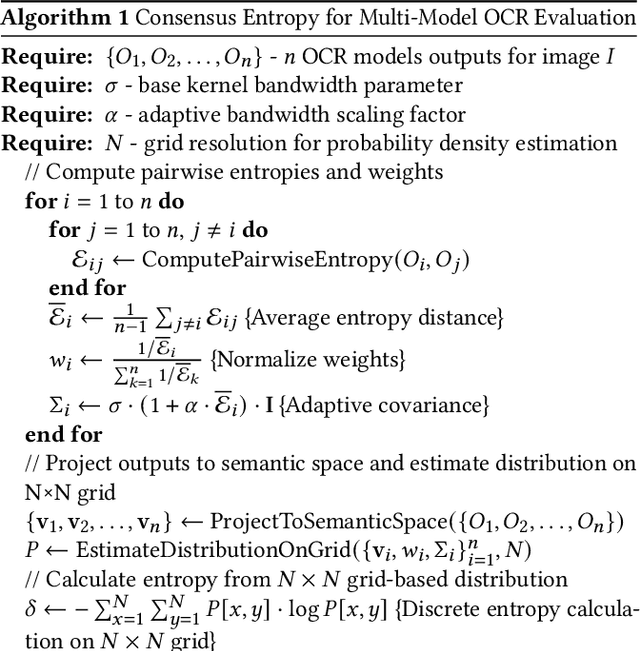
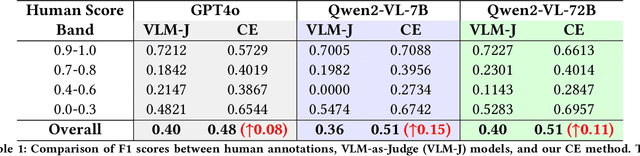
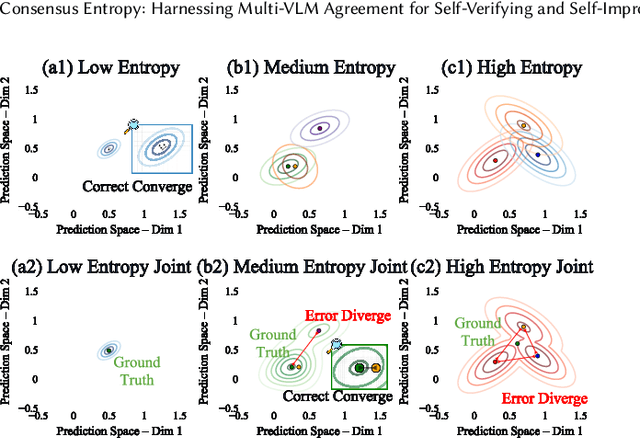

The Optical Character Recognition (OCR) task is important for evaluating Vision-Language Models (VLMs) and providing high-quality data sources for LLM training data. While state-of-the-art VLMs show improved average OCR accuracy, they still struggle with sample-level quality degradation and lack reliable automatic detection of low-quality outputs. We introduce Consensus Entropy (CE), a training-free post-inference method that quantifies OCR uncertainty by aggregating outputs from multiple VLMs. Our approach exploits a key insight: correct VLM OCR predictions converge in output space while errors diverge. We develop a lightweight multi-model framework that effectively identifies problematic samples, selects the best outputs and combines model strengths. Experiments across multiple OCR benchmarks and VLMs demonstrate that CE outperforms VLM-as-judge approaches and single-model baselines at the same cost and achieves state-of-the-art results across multiple metrics. For instance, our solution demonstrates: achieving 15.2% higher F1 scores than VLM-as-judge methods in quality verification, delivering 6.0% accuracy gains on mathematical calculation tasks, and requiring rephrasing only 7.3% of inputs while maintaining overall performance. Notably, the entire process requires neither training nor supervision while maintaining plug-and-play functionality throughout.
Conflict-driven Structural Learning Towards Higher Coverage Rate in ATPG
Mar 04, 2023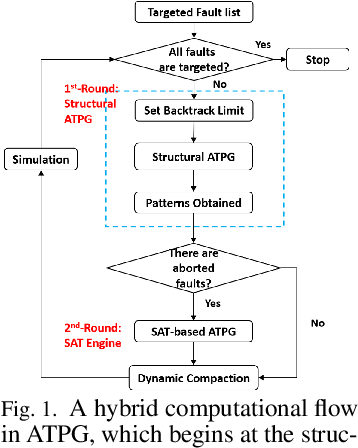
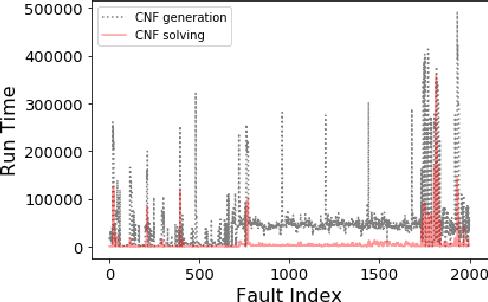
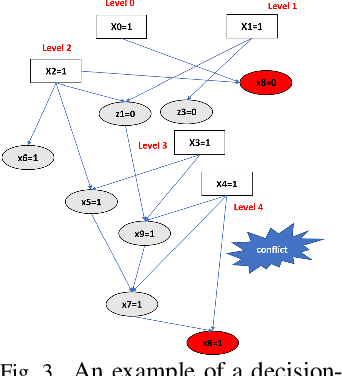
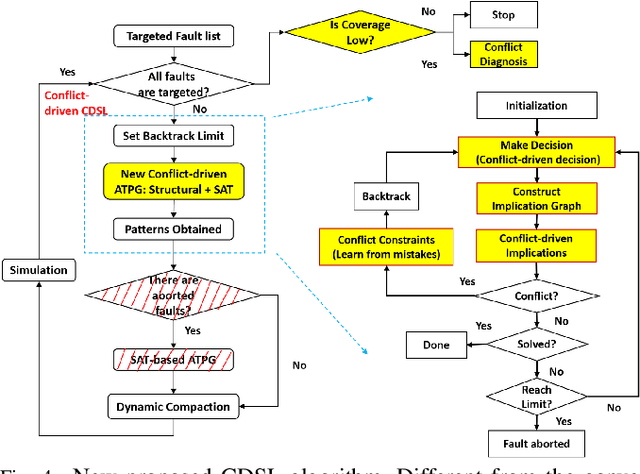
Due to the increasing challenges posed by the relentless rise in the design complexity of integrated circuits, Boolean Satisfiability (SAT) has emerged as a robust alternative to structural APTG techniques. However, the high cost of transforming a circuit testing problem to a Conjunctive Normal Form (CNF) limits the application of SAT in industrial ATPG scenarios, resulting in a loss of test coverage. In Order to address this problem, this paper proposes a conflict-driven structural learning (CDSL) ATPG algorithm firstly, in which the conflict-driven heuristic methods in modern SAT solver are implemented on the logic cone of fault propagation and activation directly. The proposed CDSL algorithm is composed of three parts: (1) According to the implication graph, various conflict constraints have been learned to prune search space. (2) Conflict-driven implication and justification have been applied to increase decision accuracy and solving efficiency. (3) A conflict-based diagnosis method is further proposed in the case of low coverage debug, leading to making the aborted faults testable by relaxing or modifying some constraints on primary inputs. Extensive experimental results on industrial circuits demonstrate the effectiveness and efficiency of the proposed CDSL algorithm. It is shown that compared with the SAT-based ATPG, the proposed CDSL can on average decrease $25.6\%$ aborted faults with $94.51\%$ less run time. With a two-stage computational flow, it has shown that the proposed CDSL can lead to $46.37\%$ less aborted faults than a one-stage structural algorithm, further with the $3.19\%$ improvement on fault coverage. In addition, the conflict diagnosis can lead to $8.89\%$ less aborted faults on average, and $0.271\%$ improvement in fault coverage rate.