 Add to Chrome
 Add to Firefox
 Add to Edge
SCOPE: Score-Isolated Agentic Optimization for Video World Models
Aug 15, 2026
Video world models are increasingly used as simulators for planning and embodied decision making, yet improving them at inference time introduces a subtle evaluation problem: prompts, samplers, verifiers, and selectors may evolve together, making it difficult to attribute gains or prevent held-out feedback from shaping the final policy. We introduce \scope (\emph{\scopefullname}), a framework for auditable inference-time adaptation of frozen video world models. \scope represents external controls as a typed state, updates this state only through bounded changes supported by development evidence, and freezes the resulting policy before held-out evaluation. On Physics-IQ benchmark, \scope improves over the exact frozen base by $+14.24$ (95\% CI $[+8.10,+21.23]$). Controlled ablations further identify gains from scene specification, sampling, and learned selection, while the margin over the strongest matched agentic baseline remains unresolved. Cross-backbone and prospective evaluations reveal a complementary result: useful inference-time updates exist, but their benefits do not transfer uniformly across models and settings. Together, these findings suggest that reliable inference-time adaptation requires not only better proposals, but also a principled mechanism for deciding which updates should become part of the deployed system. Code is available at https://github.com/YuhuaJiang2002/SCOPE.

Unified Noise Steering for Efficient Human-Guided VLA Adaptation
May 11, 2026Diffusion-based vision-language-action (VLA) models have emerged as strong priors for robotic manipulation, yet adapting them to real-world distributions remains challenging. In particular, on-robot reinforcement learning (RL) is expensive and time-consuming, so effective adaptation depends on efficient policy improvement within a limited budget of real-world interactions. Noise-space RL lowers the cost by keeping the pretrained VLA fixed as a denoising generator while updating only a lightweight actor that predicts the noise. However, its performance is still limited due to inefficient autonomous exploration. Human corrective interventions can reduce this exploration burden, but they are naturally provided in action space, whereas noise-space finetuning requires supervision over noise variables. To address these challenges, we propose UniSteer, a Unified Noise Steering framework that combines human corrective guidance with noise-space RL through approximate action-to-noise inversion. Given a human corrective action, UniSteer inverts the frozen flow-matching decoder to recover a noise target, which provides supervised guidance for the same noise actor that is simultaneously optimized via reinforcement learning. Real-world experiments on diverse manipulation tasks show that UniSteer adapts more efficiently than strong noise-space RL and action-space human-in-the-loop baselines, improving the success rate from 20% to 90% in 66 minutes on average across four real-world adaptation tasks.
CKT-WAM: Parameter-Efficient Context Knowledge Transfer Between World Action Models
May 07, 2026World action models (WAMs) provide a powerful generative framework for embodied control, yet transferring knowledge across heterogeneous WAMs remains challenging due to mismatched latent interfaces, high adaptation cost, and the rigidity of conventional distillation objectives. We propose \textbf{CKT-WAM}, a parameter-efficient \textbf{C}ontext \textbf{K}nowledge \textbf{T}ransfer framework that transfers teacher WAM's knowledge into a student WAM through a compact context in the text embedding space, rather than output imitation or dense hidden-state matching. Specifically, CKT-WAM extracts intermediate teacher hidden states, reduces the number of tokens via compressors' learnable-query cross attention (LQCA), and transforms them through an always-on generalized adapter, a lightweight router, and sparsely activated specialized adapters. The resulting context is then appended to the student's conditioning textual embeddings, thereby injecting the transferred knowledge into the student with minimal architectural modification. Experiments show that CKT-WAM consistently improves zero-shot generalization and achieves the best overall performance on LIBERO-Plus, reaching 86.1\% total success rate with only 1.17\% trainable parameters, while approaching full fine-tuning performance. Beyond simulation, CKT-WAM also demonstrates strong real-world long-horizon manipulation ability, achieving the best average success rate of 83.3\% across four multi-step and long-horizon tasks. Code is available at https://github.com/YuhuaJiang2002/CKT-WAM.
VLA-GSE: Boosting Parameter-Efficient Fine-Tuning in VLA with Generalized and Specialized Experts
May 07, 2026Vision-language-action (VLA) models inherit rich visual-semantic priors from pre-trained vision-language backbones, but adapting them to robotic control remains challenging. Full fine-tuning (FFT) is prone to overfitting on downstream robotic data and catastrophic forgetting of pretrained vision-language capabilities. Parameter-efficient fine-tuning (PEFT) better preserves pre-trained knowledge, yet existing PEFT methods still struggle to adapt effectively to robot control tasks. To address this gap, we propose VLA-GSE, a parameter-efficient VLA fine-tuning framework that improves control adaptation while retaining PEFT's knowledge preservation advantage. Specifically, VLA-GSE (Generalized and Specialized Experts) is initialized by spectrally decomposing the frozen backbone, assigning leading singular components to generalized experts (shared experts) and disjoint residual components to specialized experts (routed experts). This decomposition improves adaptation capacity under a fixed trainable-parameter budget. Under a comparable parameter budget, VLA-GSE updates only 2.51% of the full model parameters and consistently outperforms strong FFT and PEFT baselines. It achieves 81.2% average zero-shot success on LIBERO-Plus, preserves pre-trained VLM capability comparably to LoRA on multimodal understanding benchmarks, and improves real-world manipulation success under multiple distribution shifts. Code is available at: https://github.com/YuhuaJiang2002/VLA-GSE
GlobeDiff: State Diffusion Process for Partial Observability in Multi-Agent Systems
Feb 17, 2026In the realm of multi-agent systems, the challenge of \emph{partial observability} is a critical barrier to effective coordination and decision-making. Existing approaches, such as belief state estimation and inter-agent communication, often fall short. Belief-based methods are limited by their focus on past experiences without fully leveraging global information, while communication methods often lack a robust model to effectively utilize the auxiliary information they provide. To solve this issue, we propose Global State Diffusion Algorithm~(GlobeDiff) to infer the global state based on the local observations. By formulating the state inference process as a multi-modal diffusion process, GlobeDiff overcomes ambiguities in state estimation while simultaneously inferring the global state with high fidelity. We prove that the estimation error of GlobeDiff under both unimodal and multi-modal distributions can be bounded. Extensive experimental results demonstrate that GlobeDiff achieves superior performance and is capable of accurately inferring the global state.
SDAR-VL: Stable and Efficient Block-wise Diffusion for Vision-Language Understanding
Dec 16, 2025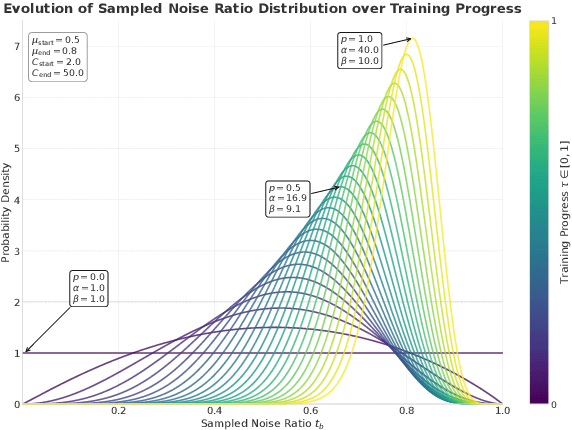
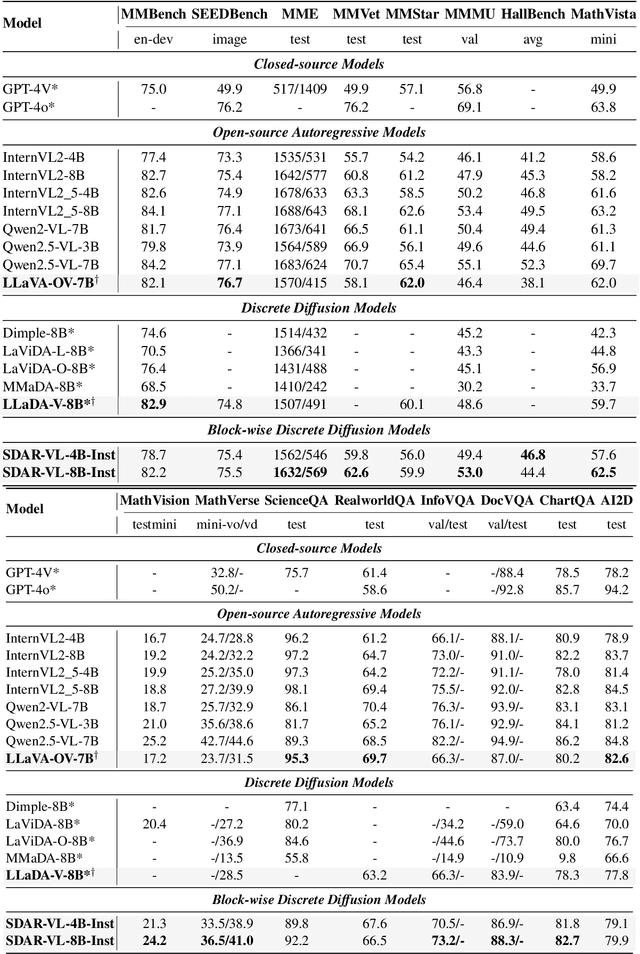
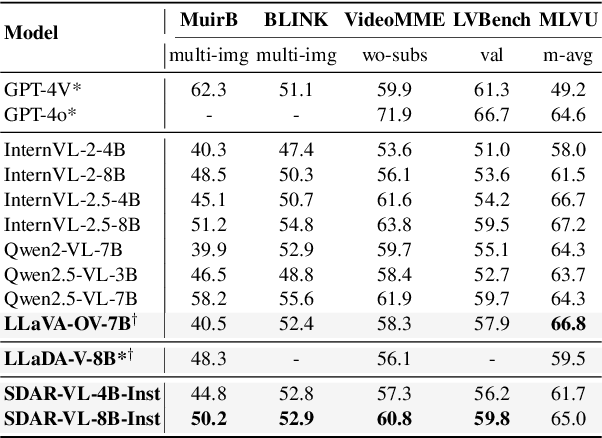
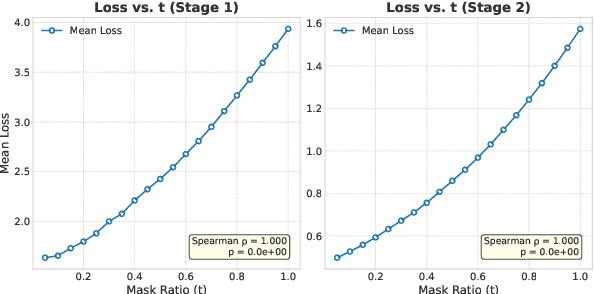
Block-wise discrete diffusion offers an attractive balance between parallel generation and causal dependency modeling, making it a promising backbone for vision-language modeling. However, its practical adoption has been limited by high training cost, slow convergence, and instability, which have so far kept it behind strong autoregressive (AR) baselines. We present \textbf{SDAR-VL}, the first systematic application of block-wise discrete diffusion to large-scale vision-language understanding (VLU), together with an \emph{integrated framework for efficient and stable training}. This framework unifies three components: (1) \textbf{Asynchronous Block-wise Noise Scheduling} to diversify supervision within each batch; (2) \textbf{Effective Mask Ratio Scaling} for unbiased loss normalization under stochastic masking; and (3) a \textbf{Progressive Beta Noise Curriculum} that increases effective mask coverage while preserving corruption diversity. Experiments on 21 single-image, multi-image, and video benchmarks show that SDAR-VL consistently improves \emph{training efficiency}, \emph{convergence stability}, and \emph{task performance} over conventional block diffusion. On this evaluation suite, SDAR-VL sets a new state of the art among diffusion-based vision-language models and, under matched settings, matches or surpasses strong AR baselines such as LLaVA-OneVision as well as the global diffusion baseline LLaDA-V, establishing block-wise diffusion as a practical backbone for VLU.
AsyncVLA: Asynchronous Flow Matching for Vision-Language-Action Models
Nov 18, 2025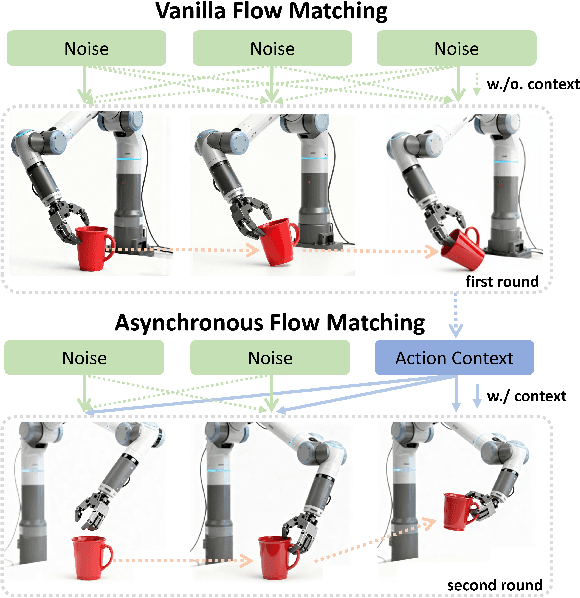
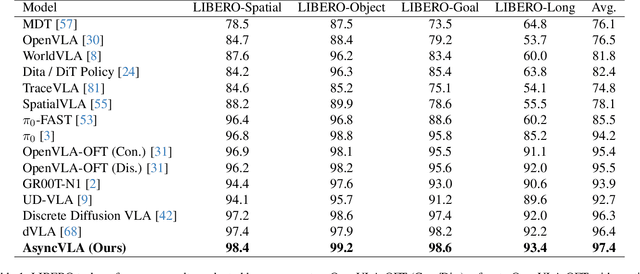
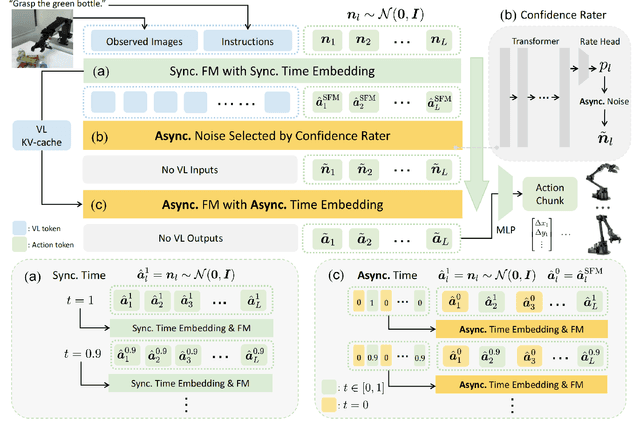
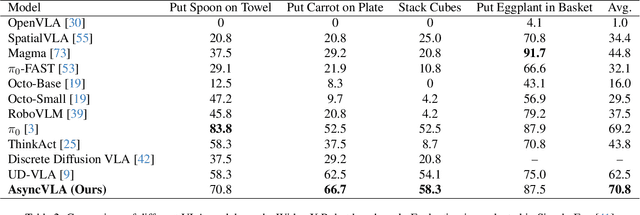
Vision-language-action (VLA) models have recently emerged as a powerful paradigm for building generalist robots. However, traditional VLA models that generate actions through flow matching (FM) typically rely on rigid and uniform time schedules, i.e., synchronous FM (SFM). Without action context awareness and asynchronous self-correction, SFM becomes unstable in long-horizon tasks, where a single action error can cascade into failure. In this work, we propose asynchronous flow matching VLA (AsyncVLA), a novel framework that introduces temporal flexibility in asynchronous FM (AFM) and enables self-correction in action generation. AsyncVLA breaks from the vanilla SFM in VLA models by generating the action tokens in a non-uniform time schedule with action context awareness. Besides, our method introduces the confidence rater to extract confidence of the initially generated actions, enabling the model to selectively refine inaccurate action tokens before execution. Moreover, we propose a unified training procedure for SFM and AFM that endows a single model with both modes, improving KV-cache utilization. Extensive experiments on robotic manipulation benchmarks demonstrate that AsyncVLA is data-efficient and exhibits self-correction ability. AsyncVLA achieves state-of-the-art results across general embodied evaluations due to its asynchronous generation in AFM. Our code is available at https://github.com/YuhuaJiang2002/AsyncVLA.
Nirvana: A Specialized Generalist Model With Task-Aware Memory Mechanism
Oct 30, 2025Specialized Generalist Models (SGMs) aim to preserve broad capabilities while achieving expert-level performance in target domains. However, traditional LLM structures including Transformer, Linear Attention, and hybrid models do not employ specialized memory mechanism guided by task information. In this paper, we present Nirvana, an SGM with specialized memory mechanism, linear time complexity, and test-time task information extraction. Besides, we propose the Task-Aware Memory Trigger ($\textit{Trigger}$) that flexibly adjusts memory mechanism based on the current task's requirements. In Trigger, each incoming sample is treated as a self-supervised fine-tuning task, enabling Nirvana to adapt its task-related parameters on the fly to domain shifts. We also design the Specialized Memory Updater ($\textit{Updater}$) that dynamically memorizes the context guided by Trigger. We conduct experiments on both general language tasks and specialized medical tasks. On a variety of natural language modeling benchmarks, Nirvana achieves competitive or superior results compared to the existing LLM structures. To prove the effectiveness of Trigger on specialized tasks, we test Nirvana's performance on a challenging medical task, i.e., Magnetic Resonance Imaging (MRI). We post-train frozen Nirvana backbone with lightweight codecs on paired electromagnetic signals and MRI images. Despite the frozen Nirvana backbone, Trigger guides the model to adapt to the MRI domain with the change of task-related parameters. Nirvana achieves higher-quality MRI reconstruction compared to conventional MRI models as well as the models with traditional LLMs' backbone, and can also generate accurate preliminary clinical reports accordingly.
DPMT: Dual Process Multi-scale Theory of Mind Framework for Real-time Human-AI Collaboration
Jul 18, 2025Real-time human-artificial intelligence (AI) collaboration is crucial yet challenging, especially when AI agents must adapt to diverse and unseen human behaviors in dynamic scenarios. Existing large language model (LLM) agents often fail to accurately model the complex human mental characteristics such as domain intentions, especially in the absence of direct communication. To address this limitation, we propose a novel dual process multi-scale theory of mind (DPMT) framework, drawing inspiration from cognitive science dual process theory. Our DPMT framework incorporates a multi-scale theory of mind (ToM) module to facilitate robust human partner modeling through mental characteristic reasoning. Experimental results demonstrate that DPMT significantly enhances human-AI collaboration, and ablation studies further validate the contributions of our multi-scale ToM in the slow system.
PAG: Multi-Turn Reinforced LLM Self-Correction with Policy as Generative Verifier
Jun 12, 2025Large Language Models (LLMs) have demonstrated impressive capabilities in complex reasoning tasks, yet they still struggle to reliably verify the correctness of their own outputs. Existing solutions to this verification challenge often depend on separate verifier models or require multi-stage self-correction training pipelines, which limit scalability. In this paper, we propose Policy as Generative Verifier (PAG), a simple and effective framework that empowers LLMs to self-correct by alternating between policy and verifier roles within a unified multi-turn reinforcement learning (RL) paradigm. Distinct from prior approaches that always generate a second attempt regardless of model confidence, PAG introduces a selective revision mechanism: the model revises its answer only when its own generative verification step detects an error. This verify-then-revise workflow not only alleviates model collapse but also jointly enhances both reasoning and verification abilities. Extensive experiments across diverse reasoning benchmarks highlight PAG's dual advancements: as a policy, it enhances direct generation and self-correction accuracy; as a verifier, its self-verification outperforms self-consistency.