 Add to Chrome
 Add to Firefox
 Add to Edge
GlobeDiff: State Diffusion Process for Partial Observability in Multi-Agent Systems
Feb 17, 2026
In the realm of multi-agent systems, the challenge of \emph{partial observability} is a critical barrier to effective coordination and decision-making. Existing approaches, such as belief state estimation and inter-agent communication, often fall short. Belief-based methods are limited by their focus on past experiences without fully leveraging global information, while communication methods often lack a robust model to effectively utilize the auxiliary information they provide. To solve this issue, we propose Global State Diffusion Algorithm~(GlobeDiff) to infer the global state based on the local observations. By formulating the state inference process as a multi-modal diffusion process, GlobeDiff overcomes ambiguities in state estimation while simultaneously inferring the global state with high fidelity. We prove that the estimation error of GlobeDiff under both unimodal and multi-modal distributions can be bounded. Extensive experimental results demonstrate that GlobeDiff achieves superior performance and is capable of accurately inferring the global state.

Fewer May Be Better: Enhancing Offline Reinforcement Learning with Reduced Dataset
Feb 26, 2025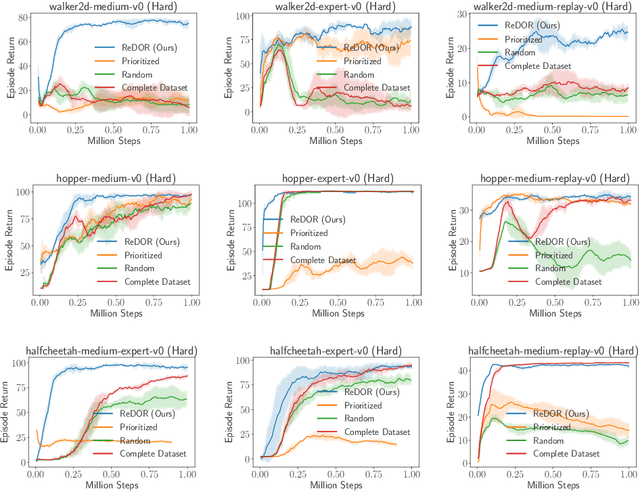
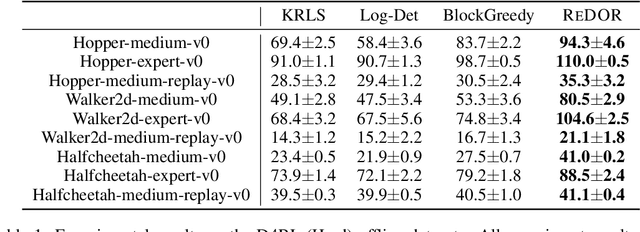

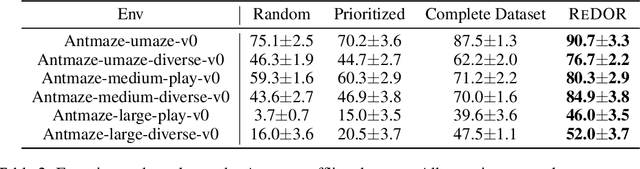
Offline reinforcement learning (RL) represents a significant shift in RL research, allowing agents to learn from pre-collected datasets without further interaction with the environment. A key, yet underexplored, challenge in offline RL is selecting an optimal subset of the offline dataset that enhances both algorithm performance and training efficiency. Reducing dataset size can also reveal the minimal data requirements necessary for solving similar problems. In response to this challenge, we introduce ReDOR (Reduced Datasets for Offline RL), a method that frames dataset selection as a gradient approximation optimization problem. We demonstrate that the widely used actor-critic framework in RL can be reformulated as a submodular optimization objective, enabling efficient subset selection. To achieve this, we adapt orthogonal matching pursuit (OMP), incorporating several novel modifications tailored for offline RL. Our experimental results show that the data subsets identified by ReDOR not only boost algorithm performance but also do so with significantly lower computational complexity.