 Add to Chrome
 Add to Firefox
 Add to Edge
MiDashengLM-Gen: Unified Audio Scene Generation via LLM-Driven Autoregressive Flow Matching
Aug 12, 2026
Generating coherent audio scenes that simultaneously blend speech, music, and sound effects remains a significant challenge. Current approaches typically rely on a disjointed pipeline where a frozen, decoupled text encoder feeds a separate audio decoder, limiting cross-modal optimization and leading to poor speech intelligibility. To overcome these limitations, we introduce MiDashengLM-Gen, an end-to-end framework that couples a pre-trained Large Language Model (LLM) with per-token conditional flow matching for autoregressive, variable-length mixed-audio scene generation. MiDashengLM-Gen represents a first approach for general text-to-audio generation with one end-to-end trained model. Empirical evaluations demonstrate that MiDashengLM-Gen drastically improves speech intelligibility over existing unified models. On the Seed-TTS benchmark, English Word Error Rate (WER) drops from 12.15% to 2.79%, approaching the performance of dedicated Text-to-Speech (TTS) systems (1.24%). Furthermore, the framework extends effectively to multilingual settings, yielding highly competitive multilingual WERs compared to existing baselines. Lastly, the model maintains competitive mixed-audio generation quality on the MECAT benchmark. Code and checkpoints are available at https://github.com/xiaomi-research/midashenglm-gen and https://huggingface.co/mispeech/midashenglm-gen, and the demo page is available at https://xingws.github.io/midashenglm-gen-demo/.

SemBridge: Semantic Token Anchoring for Continuous-Latent Autoregressive Speech Generation
Aug 07, 2026Continuous-latent autoregressive speech generation has emerged as a promising alternative to discrete-token modeling by avoiding quantization loss and preserving richer acoustic information. However, continuous acoustic targets do not ex- pose linguistic structure as explicit token-level prediction tar- gets. Consequently, the autoregressive language model (LM) must acquire linguistic structure indirectly through acous- tic prediction, which can compromise the content fidelity of generated speech. We propose SemBridge, a training-only semantic-token anchoring framework for continuous-latent autoregressive speech generation. SemBridge uses discrete se- mantic tokens to directly supervise autoregressive LM states and employs a Semantic-Aligned Acoustic VAE to organize the continuous target space under the same semantic refer- ence. The semantic supervision is used only during train- ing, while inference remains entirely continuous. We evalu- ate SemBridge on zero-shot text-to-speech (TTS) and score- conditioned singing voice synthesis (SVS). Across multi- ple benchmarks, SemBridge improves content accuracy, as measured by word and character error rates (WER/CER), while maintaining competitive speaker similarity and percep- tual quality. Experimental results demonstrate that explicit semantic-token supervision for autoregressive state learning is an effective and general direction for continuous speech generation. Speech samples are available.1 The model code and checkpoints will be available at https://github.com/ASLP- lab/SemBridge
MeanVC 2: Robust Low-Latency Streaming Zero-Shot Voice Conversion
Jun 08, 2026Streaming zero-shot voice conversion (VC) has become increasingly popular due to its potential for real-time applications. The recently proposed MeanVC achieves lightweight streaming zero-shot VC, but it has several limitations: its chunk-wise autoregressive denoising doubles the effective training sequence length, conversion quality degrades under small-chunk settings, and its timbre encoder directly relies on reference mel-spectrograms, making it sensitive to reference audio quality. To address these limitations we propose MeanVC 2. We introduce future-receptive chunking (FRC), which explicitly schedules past and future receptive fields across diffusion transformer decoder layers and removes clean-chunk teacher forcing. By incorporating bounded future context, FRC enables stable conversion with a 40 ms chunk size. We further introduce a universal timbre token encoder, which constructs a timbre representation from a global speaker embedding and retrieves fine-grained timbre cues via cross-attention, improving robustness to low-quality references and enhancing zero-shot speaker similarity. Experimental results show that MeanVC 2 significantly outperforms MeanVC, while reducing latency from 211 ms to 110 ms. Audio samples are publicly available. The source code will be publicly released.
MINT-Bench: A Comprehensive Multilingual Benchmark for Instruction-Following Text-to-Speech
Apr 20, 2026Instruction-following text-to-speech (TTS) has emerged as an important capability for controllable and expressive speech generation, yet its evaluation remains underdeveloped due to limited benchmark coverage, weak diagnostic granularity, and insufficient multilingual support. We present \textbf{MINT-Bench}, a comprehensive multilingual benchmark for instruction-following TTS. MINT-Bench is built upon a hierarchical multi-axis taxonomy, a scalable multi-stage data construction pipeline, and a hierarchical hybrid evaluation protocol that jointly assesses content consistency, instruction following, and perceptual quality. Experiments across ten languages show that current systems remain far from solved: frontier commercial systems lead overall, while leading open-source models become highly competitive and can even outperform commercial counterparts in localized settings such as Chinese. The benchmark further reveals that harder compositional and paralinguistic controls remain major bottlenecks for current systems. We release MINT-Bench together with the data construction and evaluation toolkit to support future research on controllable, multilingual, and diagnostically grounded TTS evaluation. The leaderboard and demo are available at https://longwaytog0.github.io/MINT-Bench/
YingMusic-Singer: Controllable Singing Voice Synthesis with Flexible Lyric Manipulation and Annotation-free Melody Guidance
Mar 25, 2026Regenerating singing voices with altered lyrics while preserving melody consistency remains challenging, as existing methods either offer limited controllability or require laborious manual alignment. We propose YingMusic-Singer, a fully diffusion-based model enabling melody-controllable singing voice synthesis with flexible lyric manipulation. The model takes three inputs: an optional timbre reference, a melody-providing singing clip, and modified lyrics, without manual alignment. Trained with curriculum learning and Group Relative Policy Optimization, YingMusic-Singer achieves stronger melody preservation and lyric adherence than Vevo2, the most comparable baseline supporting melody control without manual alignment. We also introduce LyricEditBench, the first benchmark for melody-preserving lyric modification evaluation. The code, weights, benchmark, and demos are publicly available at https://github.com/ASLP-lab/YingMusic-Singer.
DiffRhythm 2: Efficient and High Fidelity Song Generation via Block Flow Matching
Oct 27, 2025Generating full-length, high-quality songs is challenging, as it requires maintaining long-term coherence both across text and music modalities and within the music modality itself. Existing non-autoregressive (NAR) frameworks, while capable of producing high-quality songs, often struggle with the alignment between lyrics and vocal. Concurrently, catering to diverse musical preferences necessitates reinforcement learning from human feedback (RLHF). However, existing methods often rely on merging multiple models during multi-preference optimization, which results in significant performance degradation. To address these challenges, we introduce DiffRhythm 2, an end-to-end framework designed for high-fidelity, controllable song generation. To tackle the lyric alignment problem, DiffRhythm 2 employs a semi-autoregressive architecture based on block flow matching. This design enables faithful alignment of lyrics to singing vocals without relying on external labels and constraints, all while preserving the high generation quality and efficiency of NAR models. To make this framework computationally tractable for long sequences, we implement a music variational autoencoder (VAE) that achieves a low frame rate of 5 Hz while still enabling high-fidelity audio reconstruction. In addition, to overcome the limitations of multi-preference optimization in RLHF, we propose cross-pair preference optimization. This method effectively mitigates the performance drop typically associated with model merging, allowing for more robust optimization across diverse human preferences. We further enhance musicality and structural coherence by introducing stochastic block representation alignment loss.
REF-VC: Robust, Expressive and Fast Zero-Shot Voice Conversion with Diffusion Transformers
Aug 07, 2025In real-world voice conversion applications, environmental noise in source speech and user demands for expressive output pose critical challenges. Traditional ASR-based methods ensure noise robustness but suppress prosody, while SSL-based models improve expressiveness but suffer from timbre leakage and noise sensitivity. This paper proposes REF-VC, a noise-robust expressive voice conversion system. Key innovations include: (1) A random erasing strategy to mitigate the information redundancy inherent in SSL feature, enhancing noise robustness and expressiveness; (2) Implicit alignment inspired by E2TTS to suppress non-essential feature reconstruction; (3) Integration of Shortcut Models to accelerate flow matching inference, significantly reducing to 4 steps. Experimental results demonstrate that our model outperforms baselines such as Seed-VC in zero-shot scenarios on the noisy set, while also performing comparably to Seed-VC on the clean set. In addition, REF-VC can be compatible with singing voice conversion within one model.
SongEval: A Benchmark Dataset for Song Aesthetics Evaluation
May 16, 2025Aesthetics serve as an implicit and important criterion in song generation tasks that reflect human perception beyond objective metrics. However, evaluating the aesthetics of generated songs remains a fundamental challenge, as the appreciation of music is highly subjective. Existing evaluation metrics, such as embedding-based distances, are limited in reflecting the subjective and perceptual aspects that define musical appeal. To address this issue, we introduce SongEval, the first open-source, large-scale benchmark dataset for evaluating the aesthetics of full-length songs. SongEval includes over 2,399 songs in full length, summing up to more than 140 hours, with aesthetic ratings from 16 professional annotators with musical backgrounds. Each song is evaluated across five key dimensions: overall coherence, memorability, naturalness of vocal breathing and phrasing, clarity of song structure, and overall musicality. The dataset covers both English and Chinese songs, spanning nine mainstream genres. Moreover, to assess the effectiveness of song aesthetic evaluation, we conduct experiments using SongEval to predict aesthetic scores and demonstrate better performance than existing objective evaluation metrics in predicting human-perceived musical quality.
DiffRhythm: Blazingly Fast and Embarrassingly Simple End-to-End Full-Length Song Generation with Latent Diffusion
Mar 03, 2025Recent advancements in music generation have garnered significant attention, yet existing approaches face critical limitations. Some current generative models can only synthesize either the vocal track or the accompaniment track. While some models can generate combined vocal and accompaniment, they typically rely on meticulously designed multi-stage cascading architectures and intricate data pipelines, hindering scalability. Additionally, most systems are restricted to generating short musical segments rather than full-length songs. Furthermore, widely used language model-based methods suffer from slow inference speeds. To address these challenges, we propose DiffRhythm, the first latent diffusion-based song generation model capable of synthesizing complete songs with both vocal and accompaniment for durations of up to 4m45s in only ten seconds, maintaining high musicality and intelligibility. Despite its remarkable capabilities, DiffRhythm is designed to be simple and elegant: it eliminates the need for complex data preparation, employs a straightforward model structure, and requires only lyrics and a style prompt during inference. Additionally, its non-autoregressive structure ensures fast inference speeds. This simplicity guarantees the scalability of DiffRhythm. Moreover, we release the complete training code along with the pre-trained model on large-scale data to promote reproducibility and further research.
Drop the beat! Freestyler for Accompaniment Conditioned Rapping Voice Generation
Aug 28, 2024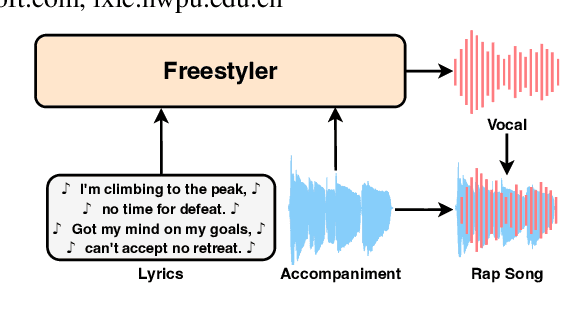
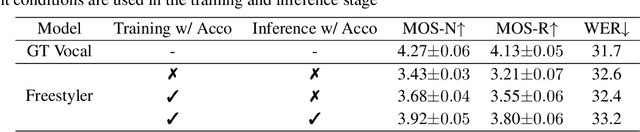
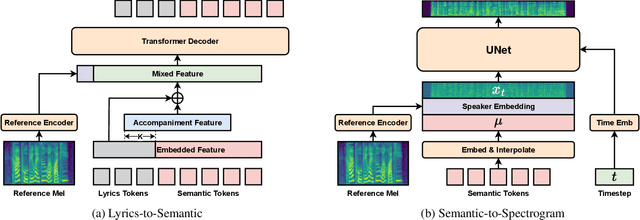
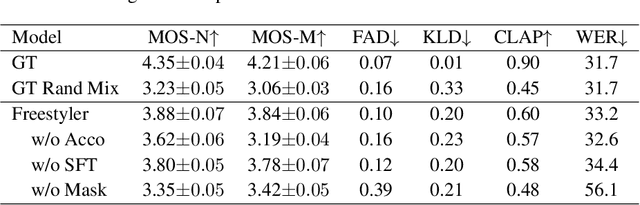
Rap, a prominent genre of vocal performance, remains underexplored in vocal generation. General vocal synthesis depends on precise note and duration inputs, requiring users to have related musical knowledge, which limits flexibility. In contrast, rap typically features simpler melodies, with a core focus on a strong rhythmic sense that harmonizes with accompanying beats. In this paper, we propose Freestyler, the first system that generates rapping vocals directly from lyrics and accompaniment inputs. Freestyler utilizes language model-based token generation, followed by a conditional flow matching model to produce spectrograms and a neural vocoder to restore audio. It allows a 3-second prompt to enable zero-shot timbre control. Due to the scarcity of publicly available rap datasets, we also present RapBank, a rap song dataset collected from the internet, alongside a meticulously designed processing pipeline. Experimental results show that Freestyler produces high-quality rapping voice generation with enhanced naturalness and strong alignment with accompanying beats, both stylistically and rhythmically.