 Add to Chrome
 Add to Firefox
 Add to Edge
A Continuous-Time Reinforcement Learning Framework for Fine-Tuning Discrete Diffusion Models
Jul 16, 2026
We formulate reinforcement learning (RL) in continuous time with discrete state spaces and possibly arbitrary action spaces via a stochastic control approach, where the state dynamics are modeled as a controlled continuous-time Markov chain (CTMC). We consider policy optimization problems and derive the corresponding policy gradient methods, leading to continuous-time variants of proximal policy optimization (PPO) and group relative policy optimization (GRPO). As a primary application, we develop a complete continuous-time RL framework for fine-tuning score-based discrete diffusion models. The proposed framework enables reward-driven optimization without requiring differentiability on the reward signals. In contrast to the existing GRPO-based approaches that only rely on terminal rewards, our formulation allows intermediate reward or advantage signals to be incorporated throughout the denoising trajectory. Importantly, when specialized to masked diffusion models (MDMs), our framework encompasses a rich class of policy parameterizations over the vocabulary simplex with analytically tractable probability ratios, providing a unified perspective on exploration and policy optimization in MDMs. For masked diffusion large language models (dLLMs), we further propose trajectory subsampling techniques to efficiently estimate computationally prohibitive trajectory likelihoods, reducing the computational cost of computing per-position probability ratios. We showcase the effectiveness of our methods on both low-dimensional entropy-regularized optimization problems and RL post-training of dLLMs on mathematical reasoning and coding tasks.

ART for Diffusion Sampling: Continuous-Time Control and Actor-Critic Learning
Jul 02, 2026We study timestep allocation for score-based diffusion sampling, where a learned reverse-time dynamics is discretized on a finite grid. Uniform and hand-crafted schedules are standard choices, but they rely on fixed prescriptions and can therefore be suboptimal. To address this limitation, we propose Adaptive Reparameterized Time (ART), a continuous-time control formulation that learns a time change by treating the speed of the sampling clock as the control, so that a uniform grid on the learned clock induces adaptive timesteps in the original diffusion time. Based on a leading-order Euler error surrogate, ART provides a principled objective for allocating timesteps along the sampling trajectory. To solve this deterministic control problem, we introduce ART-RL, an auxiliary randomized formulation with Gaussian policies that turns schedule learning into a continuous-time reinforcement learning problem. We prove that the randomized ART-RL formulation is equivalent to ART at the optimizer level, in the sense that its optimal Gaussian policy recovers the optimal ART time-warping rate through its mean. We further establish policy evaluation and policy improvement characterizations and derive trajectory-based moment identities that yield implementable actor--critic updates for learning the schedule. Across experiments ranging from controlled low-dimensional settings to image generation, ART-RL can be plugged into existing diffusion samplers by changing only the timestep grid, consistently improving sample quality over strong baseline schedules at matched budgets while leaving the rest of the sampling pipeline unchanged. The learned schedules also exhibit broad generalization, transferring without retraining across sampling budgets, datasets, solvers, pipelines, and representation spaces.
OPD+: Rethinking the Advantage Design for On-Policy Distillation
May 31, 2026On-policy distillation (OPD) is a widely used technique to transfer capabilities from capable teacher language models to the base student models, and can be formulated in a reinforcement learning style objective using student generated rollouts. Yet, despite the divergence reward being dependent on student model likelihood, existing works usually adopt a stop gradient design primarily for stability, which makes the resulting advantage estimation questionable. In this work, we provide a generic optimization framework based on f-divergence between the student and teacher, and mathematically revisit whether such design space is valid. We prove that general stop-gradient operation would lead to biased estimates of the reward objective and corresponding gradient for general divergence functions. We propose OPD+, the corrected version of OPD that demonstrates improved performance over the baseline KL approach and also supports the choice of various f-divergence. We validate our findings on mathematical reasoning and tool-use benchmarks.
Tweedie's Formulae and Diffusion Generative Models Beyond Gaussian
May 19, 2026Diffusion models have achieved remarkable success in generating samples from unknown data distributions. Most popular stochastic differential equation-based diffusion models perturb the target distribution by adding Gaussian noise, transforming it into a simple prior, and then use denoising score matching, a consequence of Tweedie's formula, to learn the score function and generate clean samples from noise. However, non-Gaussian diffusion models with state-dependent diffusion coefficient have been largely underexplored, as have the corresponding Tweedie's formulae. In this work, we extend Tweedie's formula to important non-Gaussian processes, including geometric Brownian motion (GBM), squared Bessel (BESQ) processes, and Cox-Ingersoll-Ross (CIR) processes, thereby yielding the corresponding denoising score-matching objectives. We then apply the derived formulae to image and financial time series generation using GBM- and CIR-based diffusion models, and to empirical Bayes estimation under the BESQ setting. The reported experimental results demonstrate the potential of non-Gaussian models.
Sample Complexity of Transfer Learning: An Optimal Transport Approach
May 19, 2026Transfer learning is an essential technique for many machine learning/AI models of complex structures such as large language models and generative AI. The essence of transfer learning is to leverage knowledge from resolved source tasks for a new target task, especially when the sample size $m$ of the training data for the latter is low. In this work, we rigorously analyze the potential benefit of transfer learning in terms of sample efficiency. Specifically, taking an optimal transport viewpoint of transfer learning, we find that when the data dimension $d$ is higher than $3$, the sample complexity for transfer learning is $O(m^{-(α+1)/d})$, with $α$ indicating the smoothness of the data distribution, as opposed to the $O(m^{-p/d})$ sample complexity for direct learning with $p$ indicating the smoothness of the optimal target model. Our finding theoretically supports a better sample efficiency for transfer learning, when the target task is optimizing over a family of not-so-smooth models (i.e., highly complex networks with the possible use of non-smooth activation functions). Using image classification as an example, we numerically demonstrate the sample efficiency for transfer learning, that is, in the data hungry regime, the model performance can be significantly improved by transfer learning.
Improved techniques for fine-tuning flow models via adjoint matching: a deterministic control pipeline
May 07, 2026We propose a deterministic adjoint matching framework that formulates human preference alignment for flow-based generative models as an optimal control problem over velocity fields. One can directly regress the control toward a value-gradient-induced target under the current policy, leading to a simple and stable training objective. Building on this perspective, we introduce a truncated adjoint scheme that focuses computation on the terminal portion of the trajectory, where reward-relevant signals concentrate, which yields substantial computational savings while preserving alignment quality. We further generalize the framework beyond standard KL-based regularization, allowing more flexible trade-offs between alignment strength and distributional preservation. Experiments on SiT-XL/2 and FLUX.2-Klein-4B demonstrate consistent gains across multiple alignment metrics, along with substantially improved diversity and mode preservation.
Conditional Diffusion Guidance under Hard Constraint: A Stochastic Analysis Approach
Feb 05, 2026We study conditional generation in diffusion models under hard constraints, where generated samples must satisfy prescribed events with probability one. Such constraints arise naturally in safety-critical applications and in rare-event simulation, where soft or reward-based guidance methods offer no guarantee of constraint satisfaction. Building on a probabilistic interpretation of diffusion models, we develop a principled conditional diffusion guidance framework based on Doob's h-transform, martingale representation and quadratic variation process. Specifically, the resulting guided dynamics augment a pretrained diffusion with an explicit drift correction involving the logarithmic gradient of a conditioning function, without modifying the pretrained score network. Leveraging martingale and quadratic-variation identities, we propose two novel off-policy learning algorithms based on a martingale loss and a martingale-covariation loss to estimate h and its gradient using only trajectories from the pretrained model. We provide non-asymptotic guarantees for the resulting conditional sampler in both total variation and Wasserstein distances, explicitly characterizing the impact of score approximation and guidance estimation errors. Numerical experiments demonstrate the effectiveness of the proposed methods in enforcing hard constraints and generating rare-event samples.
ART for Diffusion Sampling: A Reinforcement Learning Approach to Timestep Schedule
Jan 26, 2026We consider time discretization for score-based diffusion models to generate samples from a learned reverse-time dynamic on a finite grid. Uniform and hand-crafted grids can be suboptimal given a budget on the number of time steps. We introduce Adaptive Reparameterized Time (ART) that controls the clock speed of a reparameterized time variable, leading to a time change and uneven timesteps along the sampling trajectory while preserving the terminal time. The objective is to minimize the aggregate error arising from the discretized Euler scheme. We derive a randomized control companion, ART-RL, and formulate time change as a continuous-time reinforcement learning (RL) problem with Gaussian policies. We then prove that solving ART-RL recovers the optimal ART schedule, which in turn enables practical actor--critic updates to learn the latter in a data-driven way. Empirically, based on the official EDM pipeline, ART-RL improves Fréchet Inception Distance on CIFAR-10 over a wide range of budgets and transfers to AFHQv2, FFHQ, and ImageNet without the need of retraining.
DiFFPO: Training Diffusion LLMs to Reason Fast and Furious via Reinforcement Learning
Oct 02, 2025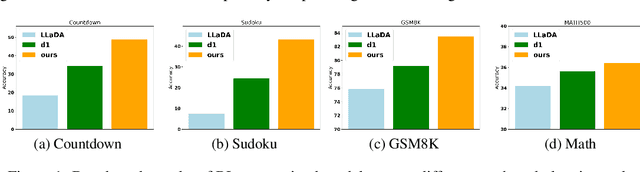

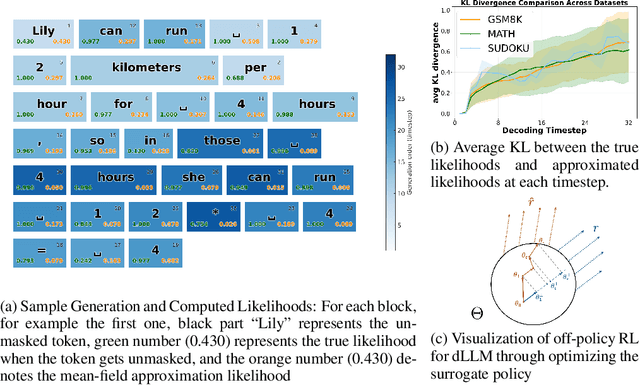

We propose DiFFPO, Diffusion Fast and Furious Policy Optimization, a unified framework for training masked diffusion large language models (dLLMs) to reason not only better (furious), but also faster via reinforcement learning (RL). We first unify the existing baseline approach such as d1 by proposing to train surrogate policies via off-policy RL, whose likelihood is much more tractable as an approximation to the true dLLM policy. This naturally motivates a more accurate and informative two-stage likelihood approximation combined with importance sampling correction, which leads to generalized RL algorithms with better sample efficiency and superior task performance. Second, we propose a new direction of joint training efficient samplers/controllers of dLLMs policy. Via RL, we incentivize dLLMs' natural multi-token prediction capabilities by letting the model learn to adaptively allocate an inference threshold for each prompt. By jointly training the sampler, we yield better accuracies with lower number of function evaluations (NFEs) compared to training the model only, obtaining the best performance in improving the Pareto frontier of the inference-time compute of dLLMs. We showcase the effectiveness of our pipeline by training open source large diffusion language models over benchmark math and planning tasks.
Diffusion Generative Models Meet Compressed Sensing, with Applications to Image Data and Financial Time Series
Sep 04, 2025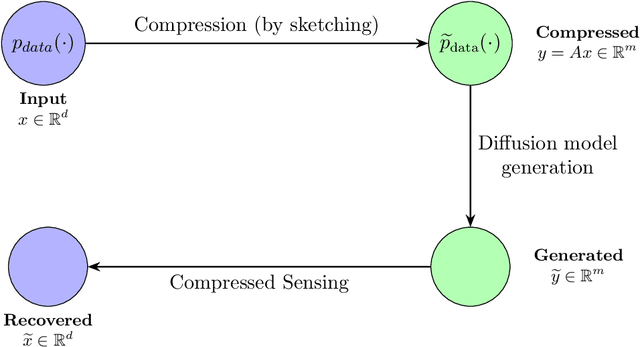


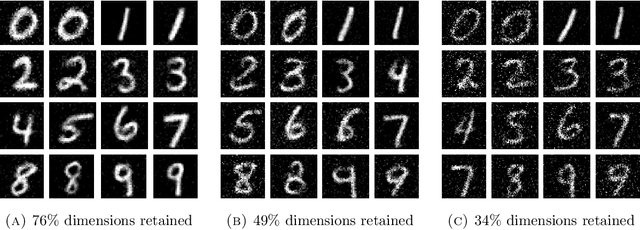
This paper develops dimension reduction techniques for accelerating diffusion model inference in the context of synthetic data generation. The idea is to integrate compressed sensing into diffusion models: (i) compress the data into a latent space, (ii) train a diffusion model in the latent space, and (iii) apply a compressed sensing algorithm to the samples generated in the latent space, facilitating the efficiency of both model training and inference. Under suitable sparsity assumptions on data, the proposed algorithm is proved to enjoy faster convergence by combining diffusion model inference with sparse recovery. As a byproduct, we obtain an optimal value for the latent space dimension. We also conduct numerical experiments on a range of datasets, including image data (handwritten digits, medical images, and climate data) and financial time series for stress testing.