 Add to Chrome
 Add to Firefox
 Add to Edge
CCD-Level and Load-Aware Thread Orchestration for In-Memory Vector ANNS on Multi-Core CPUs
May 11, 2026
Vector approximate nearest neighbor search (ANNS) underpins search engines, recommendation systems, and advertising services. Recent advances in ANNS indexes make CPU a cost-effective choice for serving million-scale, in-memory vector search, yet per-core throughput remains constrained by memory access latency of vector reading and the compute intensity of distance evaluations in production deployments. With the growing scale of the business and advances in hardware, modern CCD-based multi-core CPUs have been widely deployed for high throughput in our services. However, we find that simply increasing core counts does not yield optimal performance scaling. To improve the efficiency of more cores from the CCD-based architecture, we analyze the distributions of real-world requests in our production environments. We observe high access locality in vector search in our online services and low cache utilization, resulting from overlooking the multi-chiplet nature of CCD based CPUs. Hence, we propose a workload- and hardware-aware thread orchestration framework at CCD-level that (i) provides a uniform interface for both inter-query parallel HNSW search and intra-query parallel IVF search, (ii) achieves cache-friendly and workload-adaptive mapping of task dispatching, and (iii) employs CCD-aware task stealing to address load imbalance. Applied to real production workloads from search, recommendation, and advertising services of Xiaohongshu (RedNote), our approach delivers up to 3.7x higher throughput and 30-90% reductions in P50 and P999 latency. In detail, compared with the original framework, the cache-miss ratio decreases by 6-30%, and the total CPU stall is reduced by 20-80%.

LASER: An Efficient Target-Aware Segmented Attention Framework for End-to-End Long Sequence Modeling
Feb 12, 2026Modeling ultra-long user behavior sequences is pivotal for capturing evolving and lifelong interests in modern recommendation systems. However, deploying such models in real-time industrial environments faces a strict "Latency Wall", constrained by two distinct bottlenecks: the high I/O latency of retrieving massive user histories and the quadratic computational complexity of standard attention mechanisms. To break these bottlenecks, we present LASER, a full-stack optimization framework developed and deployed at Xiaohongshu (RedNote). Our approach tackles the challenges through two complementary innovations: (1) System efficiency: We introduce SeqVault, a unified schema-aware serving infrastructure for long user histories. By implementing a hybrid DRAM-SSD indexing strategy, SeqVault reduces retrieval latency by 50% and CPU usage by 75%, ensuring millisecond-level access to full real-time and life-cycle user histories. (2) Algorithmic efficiency: We propose a Segmented Target Attention (STA) mechanism to address the computational overhead. Motivated by the inherent sparsity of user interests, STA employs a sigmoid-based gating strategy that acts as a silence mechanism to filter out noisy items. Subsequently, a lightweight Global Stacked Target Attention (GSTA) module refines these compressed segments to capture cross-segment dependencies without incurring high computational costs. This design performs effective sequence compression, reducing the complexity of long-sequence modeling while preserving critical signals. Extensive offline evaluations demonstrate that LASER consistently outperforms state-of-the-art baselines. In large-scale online A/B testing serving over 100 million daily active users, LASER achieved a 2.36% lift in ADVV and a 2.08% lift in revenue, demonstrating its scalability and significant commercial impact.
Scalable Overload-Aware Graph-Based Index Construction for 10-Billion-Scale Vector Similarity Search
Feb 28, 2025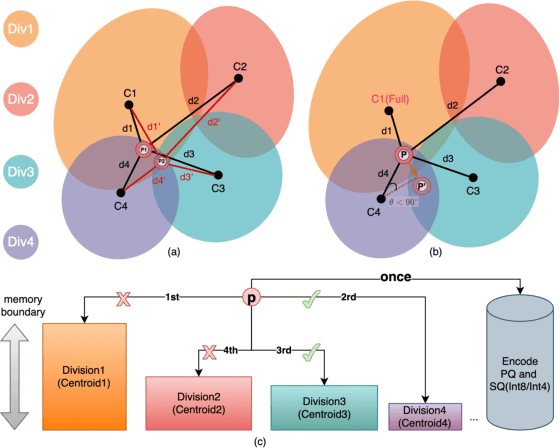
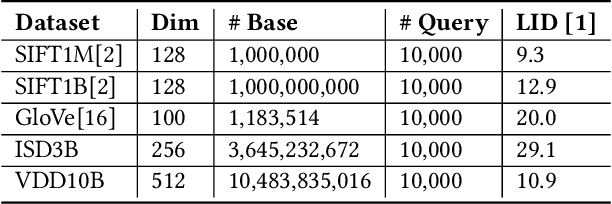
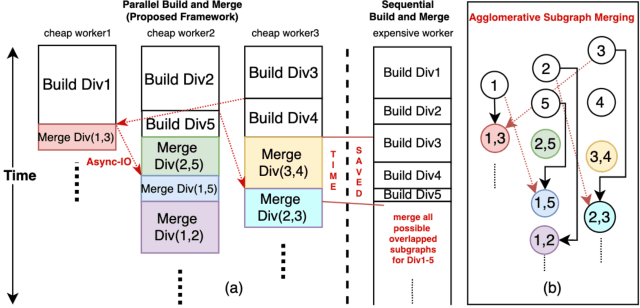
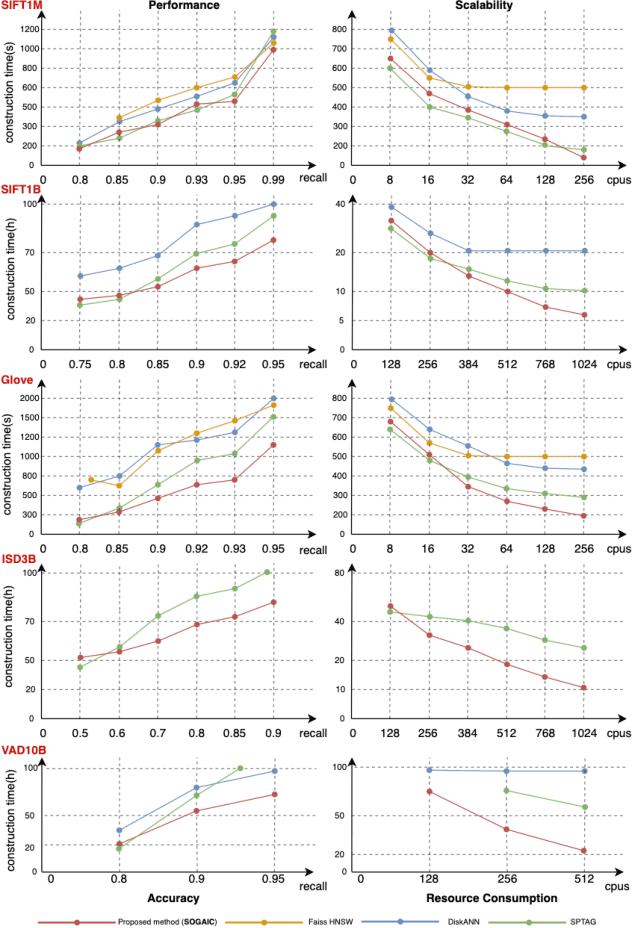
Approximate Nearest Neighbor Search (ANNS) is essential for modern data-driven applications that require efficient retrieval of top-k results from massive vector databases. Although existing graph-based ANNS algorithms achieve a high recall rate on billion-scale datasets, their slow construction speed and limited scalability hinder their applicability to large-scale industrial scenarios. In this paper, we introduce SOGAIC, the first Scalable Overload-Aware Graph-Based ANNS Index Construction system tailored for ultra-large-scale vector databases: 1) We propose a dynamic data partitioning algorithm with overload constraints that adaptively introduces overlaps among subsets; 2) To enable efficient distributed subgraph construction, we employ a load-balancing task scheduling framework combined with an agglomerative merging strategy; 3) Extensive experiments on various datasets demonstrate a reduction of 47.3% in average construction time compared to existing methods. The proposed method has also been successfully deployed in a real-world industrial search engine, managing over 10 billion daily updated vectors and serving hundreds of millions of users.