 Add to Chrome
 Add to Firefox
 Add to Edge
CRAFTS: Collaborative Role-Adaptive Fine-Tuning of LLM Agents for Chemical Process Simulation
Aug 02, 2026
Constructing an executable chemical-process model remains manually intensive. Chemical engineers translate underspecified requests into coupled decisions about unit operations, thermodynamics, streams, specifications, degrees of freedom (DoF), initialization, solver repair, and optimization; one error can invalidate the model. CRAFTS mirrors the staged workflow of chemical engineers by decomposing simulation building into bounded subtasks assigned to seven bounded roles, with deterministic IDAES/Pyomo gates between stages. Given a natural-language request, process flowsheet diagram (PFD) evidence, and curated chemical-engineering knowledge, Input Understanding and Intent recover requirements, constraints, and process semantics; visual, topology, and specification specialists translate them into typed simulator contracts; and Debug and Optimization support bounded repair and eligible optimization. Fine-tuning is applied to the three schema-critical visual, topology, and specification roles, while the remaining roles use untuned Qwen. The resulting VisualGraphIR, TopologyIR, SpecIR, BuildPlan, and SolveReport expose unit, port, thermodynamic, numerical, and execution decisions. Compatible constructors, property packages, and runners are attached only after semantic artifacts pass engineering gates. We introduce OpenIDAES-450, a 450-case IDAES process- simulation dataset, and evaluate the complete seven-role LangChain/LangGraph workflow through solve and eligible optimization on its frozen 82-case held-out split. CRAFTS completes the prescribed validation and execution contract for for 91.5% of cases and achieves unit, stream, and directed-connection F1 scores of 0.815, 0.791, and 0.782. These results demonstrate the effectiveness of role specialization, typed intermediate representations, and deterministic engineering gates for reliable automated process-model construction.

Energy-Efficient Resource Allocation for Six-Dimensional Movable Antenna Systems
Jul 17, 2026This paper investigates the energy-efficiency (EE) maximization problem for a multiuser wireless network equipped with six-dimensional movable antennas (6DMAs), where the three-dimensional (3D) positions and orientations of the antennas are jointly optimized to fully exploit the additional spatial degrees of freedom offered by dynamic channel reconfiguration. However, the practical operation of 6DMAs incurs non-negligible mechanical energy consumption. Moreover, orientation-dependent phase variations, together with the strong coupling among antenna positions, rotation angles, transmit beamforming, and time allocation, render the resulting problem highly non-convex and analytically challenging. To address this issue, we develop a block coordinate descent (BCD) optimization framework that integrates Dinkelbach's transformation with the majorization-minimization (MM) approach to efficiently obtain a high quality suboptimal solution with guaranteed convergence. Simulation results unveil that the proposed design achieves significant EE improvements over conventional benchmarks, thereby highlighting the critical importance of accounting for practical mechanical energy costs in 6DMA enabled systems. Furthermore, our results reveal a fundamental trade-off between throughput enhancement and mechanical overhead: although larger antenna reconfigurations can improve channel conditions, their EE gains gradually diminish due to the increased mechanical energy consumption.
Human Label Variation as Stable Signal: Learning Annotator-Specific Explanation Behavior via Cross-Annotator Preference Optimization
May 27, 2026Free-text explanations extend human label variation (HLV) beyond label disagreement by revealing the reasoning and preferences behind annotators' decisions. We study whether large language models (LLMs) can learn and reproduce such annotator-specific label-explanation behavior. Using two sentence-pair tasks with four annotators each -- natural language inference and paraphrase judgment -- we first analyze whether annotators exhibit stable individual patterns. We find that such patterns are weak at the single-annotation level due to strong input-content effects, but become detectable after input-content reduction and annotator-level aggregation. We then compare prompting and supervised fine-tuning (SFT) baselines and propose cross-annotator preference optimization (CAPO), which contrasts a target annotator's response with other valid but less target-specific annotations for the same input. Experiments show that prompting is limited and unstable, SFT better captures annotator-specific behavior, and CAPO further improves aggregation-aware imitation and judge-based attribution while preserving target-specific reasoning patterns under human validation. Overall, our results show that HLV can be learned as annotator-specific label-explanation behavior, suggesting a path toward scalable explanation-based annotation grounded in annotator histories rather than labels alone.
2D or 3D: Who Governs Salience in VLA Models? -- Tri-Stage Token Pruning Framework with Modality Salience Awareness
Apr 10, 2026Vision-Language-Action (VLA) models have emerged as the mainstream of embodied intelligence. Recent VLA models have expanded their input modalities from 2D-only to 2D+3D paradigms, forming multi-visual-modal VLA (MVLA) models. Despite achieving improved spatial perception, MVLA faces a greater acceleration demand due to the increased number of input tokens caused by modal expansion. Token pruning is an effective optimization methods tailored to MVLA models. However, existing token pruning schemes are designed for 2D-only VLA models, ignoring 2D/3D modality salience differences. In this paper, we follow the application process of multi-modal data in MVLA models and develop a tri-stage analysis to capture the discrepancy and dynamics of 2D/3D modality salience. Based on these, we propose a corresponding tri-stage token pruning framework for MVLA models to achieve optimal 2D/3D token selection and efficient pruning. Experiments show that our framework achieves up to a 2.55x inference speedup with minimal accuracy loss, while only costing 5.8% overhead. Our Code is coming soon.
FlowMind: Execute-Summarize for Structured Workflow Generation from LLM Reasoning
Feb 12, 2026LLMs can solve complex tasks through reasoning and tool use, but accurately translating these solutions into structured workflows remains challenging. We model workflows as sequences of tool use and reformulate the problem as designing a mechanism that can both solve tasks and reliably construct workflows. Prior approaches that build workflows during execution often suffer from inaccuracies due to interference between the two processes. We propose an Execute-Summarize(ES) framework that decouples task execution from workflow construction: the model first completes the task using available tools, then independently reconstructs a structured workflow from execution traces. This separation improves workflow accuracy and robustness. We introduce FlowBench and show through extensive experiments that our approach outperforms existing methods, providing a reliable paradigm for grounding free-form LLM reasoning into structured workflows.
From Off-Policy to On-Policy: Enhancing GUI Agents via Bi-level Expert-to-Policy Assimilation
Jan 09, 2026Vision-language models are increasingly deployed as computer-use agents (CUAs) that operate desktops and browsers. Top-performing CUAs are framework-based systems that decompose planning and execution, while end-to-end screenshot-to-action policies are easier to deploy but lag behind on benchmarks such as OSWorld-Verified. GUI datasets like OSWorld pose two bottlenecks: they expose only a few hundred interactive, verifiable tasks and environments, and expert trajectories must be gathered by interacting with these environments, making such data hard to scale. We therefore ask how reinforcement learning from verifiable rewards (RLVR) can best exploit a small pool of exist expert trajectories to train end-to-end policies. Naively mixing these off-policy traces into on-policy RLVR is brittle: even after format conversion, expert trajectories exhibit structural mismatch and distribution shift from the learner. We propose BEPA (Bi-Level Expert-to-Policy Assimilation), which turns static expert traces into policy-aligned guidance via self-rolled reachable trajectories under the base policy (LEVEL-1) and a per-task, dynamically updated cache used in RLVR (LEVEL-2). On OSWorld-Verified, BEPA improves UITARS1.5-7B success from 22.87% to 32.13% and raises a held-out split from 5.74% to 10.30%, with consistent gains on MMBench-GUI and Online-Mind2Web. Our code and data are available at: https://github.com/LEON-gittech/Verl_GUI.git
InfiniteWeb: Scalable Web Environment Synthesis for GUI Agent Training
Jan 08, 2026GUI agents that interact with graphical interfaces on behalf of users represent a promising direction for practical AI assistants. However, training such agents is hindered by the scarcity of suitable environments. We present InfiniteWeb, a system that automatically generates functional web environments at scale for GUI agent training. While LLMs perform well on generating a single webpage, building a realistic and functional website with many interconnected pages faces challenges. We address these challenges through unified specification, task-centric test-driven development, and a combination of website seed with reference design image to ensure diversity. Our system also generates verifiable task evaluators enabling dense reward signals for reinforcement learning. Experiments show that InfiniteWeb surpasses commercial coding agents at realistic website construction, and GUI agents trained on our generated environments achieve significant performance improvements on OSWorld and Online-Mind2Web, demonstrating the effectiveness of proposed system.
UI-Evol: Automatic Knowledge Evolving for Computer Use Agents
May 28, 2025
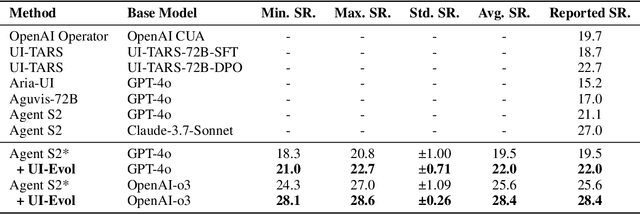
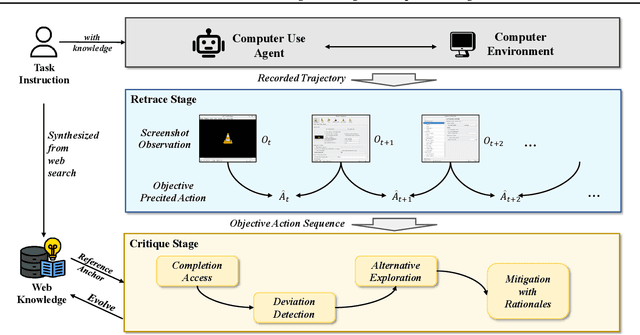

External knowledge has played a crucial role in the recent development of computer use agents. We identify a critical knowledge-execution gap: retrieved knowledge often fails to translate into effective real-world task execution. Our analysis shows even 90\% correct knowledge yields only 41\% execution success rate. To bridge this gap, we propose UI-Evol, a plug-and-play module for autonomous GUI knowledge evolution. UI-Evol consists of two stages: a Retrace Stage that extracts faithful objective action sequences from actual agent-environment interactions, and a Critique Stage that refines existing knowledge by comparing these sequences against external references. We conduct comprehensive experiments on the OSWorld benchmark with the state-of-the-art Agent S2. Our results demonstrate that UI-Evol not only significantly boosts task performance but also addresses a previously overlooked issue of high behavioral standard deviation in computer use agents, leading to superior performance on computer use tasks and substantially improved agent reliability.
UI-E2I-Synth: Advancing GUI Grounding with Large-Scale Instruction Synthesis
Apr 16, 2025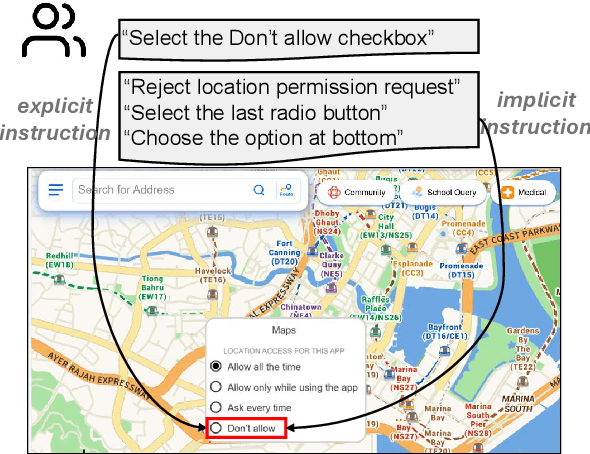

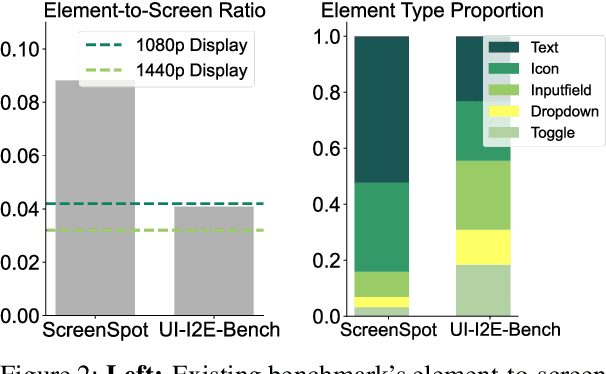
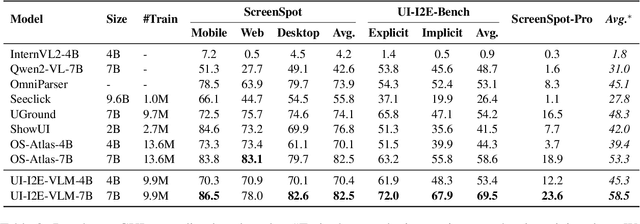
Recent advancements in Large Vision-Language Models are accelerating the development of Graphical User Interface (GUI) agents that utilize human-like vision perception capabilities to enhance productivity on digital devices. Compared to approaches predicated on GUI metadata, which are platform-dependent and vulnerable to implementation variations, vision-based approaches offer broader applicability. In this vision-based paradigm, the GUI instruction grounding, which maps user instruction to the location of corresponding element on the given screenshot, remains a critical challenge, particularly due to limited public training dataset and resource-intensive manual instruction data annotation. In this paper, we delve into unexplored challenges in this task including element-to-screen ratio, unbalanced element type, and implicit instruction. To address these challenges, we introduce a large-scale data synthesis pipeline UI-E2I-Synth for generating varying complex instruction datasets using GPT-4o instead of human annotators. Furthermore, we propose a new GUI instruction grounding benchmark UI-I2E-Bench, which is designed to address the limitations of existing benchmarks by incorporating diverse annotation aspects. Our model, trained on the synthesized data, achieves superior performance in GUI instruction grounding, demonstrating the advancements of proposed data synthesis pipeline. The proposed benchmark, accompanied by extensive analyses, provides practical insights for future research in GUI grounding. We will release corresponding artifacts at https://colmon46.github.io/i2e-bench-leaderboard/ .
Asymptotic Escape of Spurious Critical Points on the Low-rank Matrix Manifold
Jul 20, 2021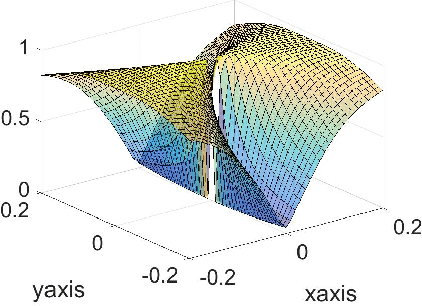
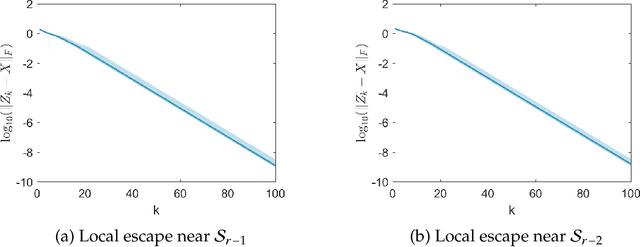
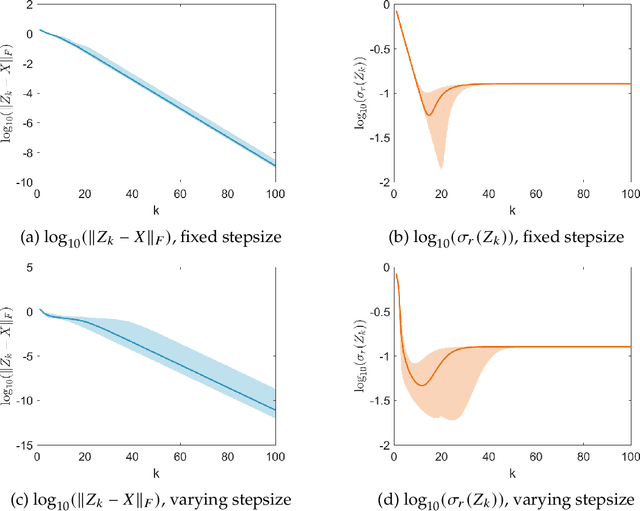
We show that the Riemannian gradient descent algorithm on the low-rank matrix manifold almost surely escapes some spurious critical points on the boundary of the manifold. Given that the low-rank matrix manifold is an incomplete set, this result is the first to overcome this difficulty and partially justify the global use of the Riemannian gradient descent on the manifold. The spurious critical points are some rank-deficient matrices that capture only part of the SVD components of the ground truth. They exhibit very singular behavior and evade the classical analysis of strict saddle points. We show that using the dynamical low-rank approximation and a rescaled gradient flow, some of the spurious critical points can be converted to classical strict saddle points, which leads to the desired result. Numerical experiments are provided to support our theoretical findings.