 Add to Chrome
 Add to Firefox
 Add to Edge
Upper-Limb Rehabilitation with a Dual-Mode Individualized Exoskeleton Robot: A Generative-Model-Based Solution
Sep 05, 2024
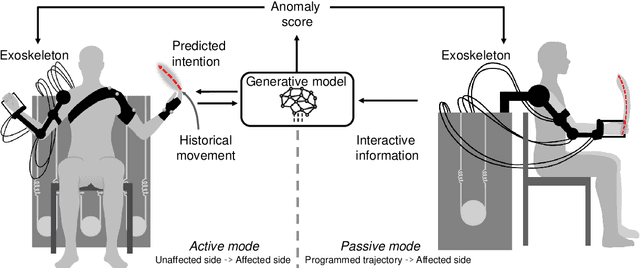
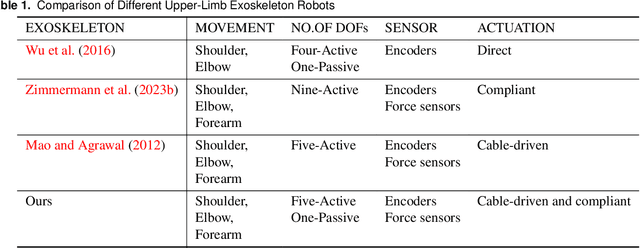
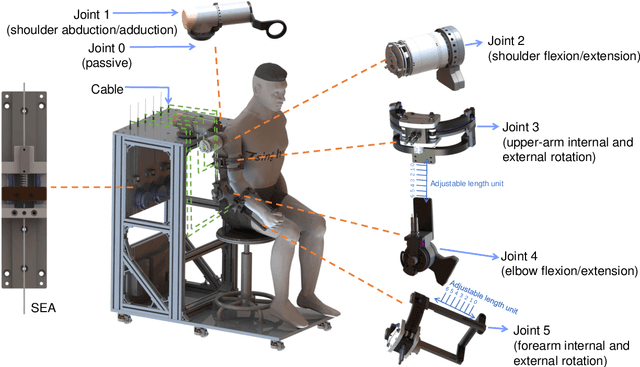
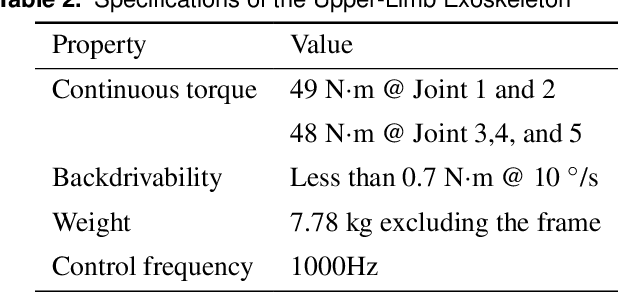
Several upper-limb exoskeleton robots have been developed for stroke rehabilitation, but their rather low level of individualized assistance typically limits their effectiveness and practicability. Individualized assistance involves an upper-limb exoskeleton robot continuously assessing feedback from a stroke patient and then meticulously adjusting interaction forces to suit specific conditions and online changes. This paper describes the development of a new upper-limb exoskeleton robot with a novel online generative capability that allows it to provide individualized assistance to support the rehabilitation training of stroke patients. Specifically, the upper-limb exoskeleton robot exploits generative models to customize the fine and fit trajectory for the patient, as medical conditions, responses, and comfort feedback during training generally differ between patients. This generative capability is integrated into the two working modes of the upper-limb exoskeleton robot: an active mirroring mode for patients who retain motor abilities on one side of the body and a passive following mode for patients who lack motor ability on both sides of the body. The performance of the upper-limb exoskeleton robot was illustrated in experiments involving healthy subjects and stroke patients.

Enabling Regional Explainability by Automatic and Model-agnostic Rule Extraction
Jun 25, 2024
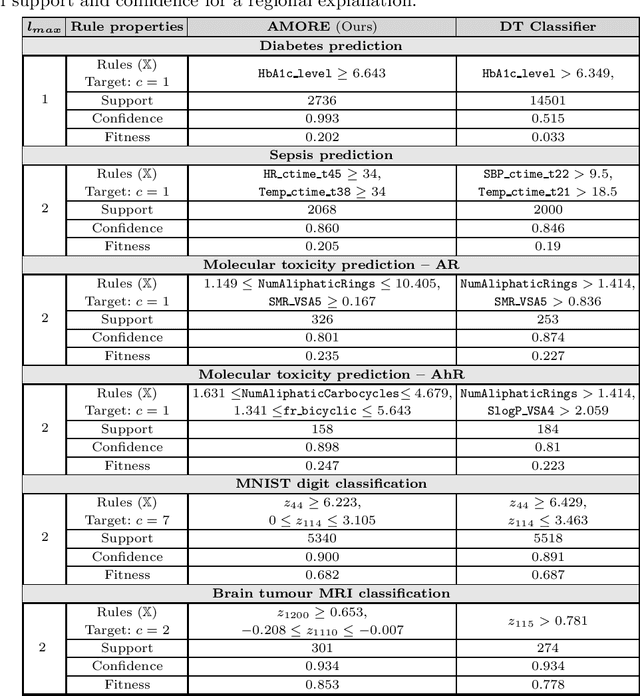

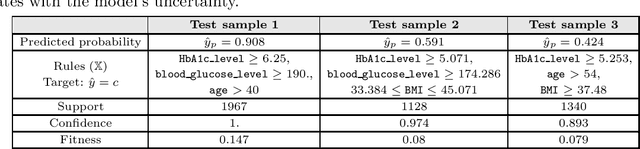
In Explainable AI, rule extraction translates model knowledge into logical rules, such as IF-THEN statements, crucial for understanding patterns learned by black-box models. This could significantly aid in fields like disease diagnosis, disease progression estimation, or drug discovery. However, such application domains often contain imbalanced data, with the class of interest underrepresented. Existing methods inevitably compromise the performance of rules for the minor class to maximise the overall performance. As the first attempt in this field, we propose a model-agnostic approach for extracting rules from specific subgroups of data, featuring automatic rule generation for numerical features. This method enhances the regional explainability of machine learning models and offers wider applicability compared to existing methods. We additionally introduce a new method for selecting features to compose rules, reducing computational costs in high-dimensional spaces. Experiments across various datasets and models demonstrate the effectiveness of our methods.
GeoLRM: Geometry-Aware Large Reconstruction Model for High-Quality 3D Gaussian Generation
Jun 21, 2024In this work, we introduce the Geometry-Aware Large Reconstruction Model (GeoLRM), an approach which can predict high-quality assets with 512k Gaussians and 21 input images in only 11 GB GPU memory. Previous works neglect the inherent sparsity of 3D structure and do not utilize explicit geometric relationships between 3D and 2D images. This limits these methods to a low-resolution representation and makes it difficult to scale up to the dense views for better quality. GeoLRM tackles these issues by incorporating a novel 3D-aware transformer structure that directly processes 3D points and uses deformable cross-attention mechanisms to effectively integrate image features into 3D representations. We implement this solution through a two-stage pipeline: initially, a lightweight proposal network generates a sparse set of 3D anchor points from the posed image inputs; subsequently, a specialized reconstruction transformer refines the geometry and retrieves textural details. Extensive experimental results demonstrate that GeoLRM significantly outperforms existing models, especially for dense view inputs. We also demonstrate the practical applicability of our model with 3D generation tasks, showcasing its versatility and potential for broader adoption in real-world applications.
Propagative Distance Optimization for Constrained Inverse Kinematics
Jun 17, 2024This paper investigates a constrained inverse kinematic (IK) problem that seeks a feasible configuration of an articulated robot under various constraints such as joint limits and obstacle collision avoidance. Due to the high-dimensionality and complex constraints, this problem is often solved numerically via iterative local optimization. Classic local optimization methods take joint angles as the decision variable, which suffers from non-linearity caused by the trigonometric constraints. Recently, distance-based IK methods have been developed as an alternative approach that formulates IK as an optimization over the distances among points attached to the robot and the obstacles. Although distance-based methods have demonstrated unique advantages, they still suffer from low computational efficiency, since these approaches usually ignore the chain structure in the kinematics of serial robots. This paper proposes a new method called propagative distance optimization for constrained inverse kinematics (PDO-IK), which captures and leverages the chain structure in the distance-based formulation and expedites the optimization by computing forward kinematics and the Jacobian propagatively along the kinematic chain. Test results show that PDO-IK runs up to two orders of magnitude faster than the existing distance-based methods under joint limits constraints and obstacle avoidance constraints. It also achieves up to three times higher success rates than the conventional joint-angle-based optimization methods for IK problems. The high runtime efficiency of PDO-IK allows the real-time computation (10$-$1500 Hz) and enables a simulated humanoid robot with 19 degrees of freedom (DoFs) to avoid moving obstacles, which is otherwise hard to achieve with the baselines.
Towards robust prediction of material properties for nuclear reactor design under scarce data -- a study in creep rupture property
May 28, 2024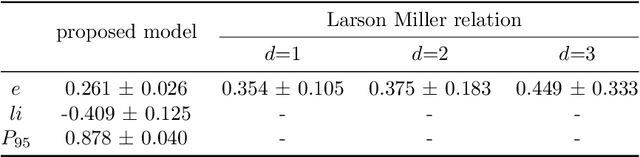
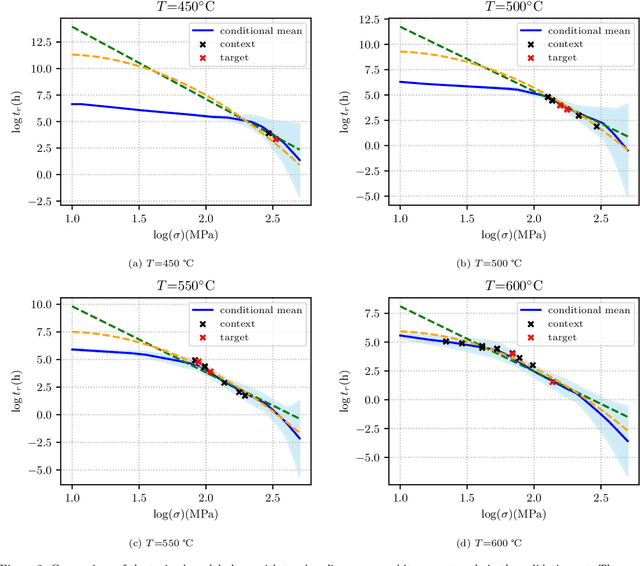
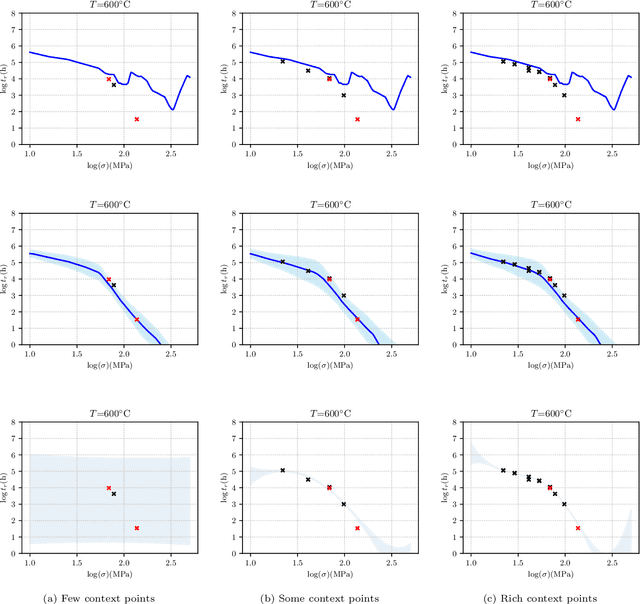
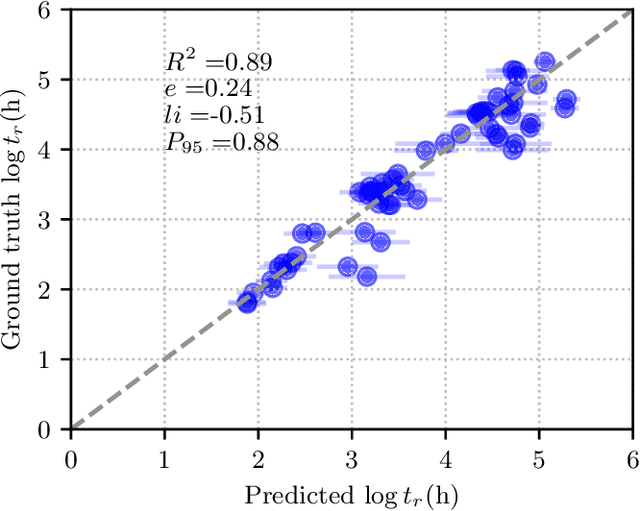
Advances in Deep Learning bring further investigation into credibility and robustness, especially for safety-critical engineering applications such as the nuclear industry. The key challenges include the availability of data set (often scarce and sparse) and insufficient consideration of the uncertainty in the data, model, and prediction. This paper therefore presents a meta-learning based approach that is both uncertainty- and prior knowledge-informed, aiming at trustful predictions of material properties for the nuclear reactor design. It is suited for robust learning under limited data. Uncertainty has been accounted for where a distribution of predictor functions are produced for extrapolation. Results suggest it achieves superior performance than existing empirical methods in rupture life prediction, a case which is typically under a small data regime. While demonstrated herein with rupture properties, this learning approach is transferable to solve similar problems of data scarcity across the nuclear industry. It is of great importance to boosting the AI analytics in the nuclear industry by proving the applicability and robustness while providing tools that can be trusted.
DoGaussian: Distributed-Oriented Gaussian Splatting for Large-Scale 3D Reconstruction Via Gaussian Consensus
May 22, 2024The recent advances in 3D Gaussian Splatting (3DGS) show promising results on the novel view synthesis (NVS) task. With its superior rendering performance and high-fidelity rendering quality, 3DGS is excelling at its previous NeRF counterparts. The most recent 3DGS method focuses either on improving the instability of rendering efficiency or reducing the model size. On the other hand, the training efficiency of 3DGS on large-scale scenes has not gained much attention. In this work, we propose DoGaussian, a method that trains 3DGS distributedly. Our method first decomposes a scene into K blocks and then introduces the Alternating Direction Method of Multipliers (ADMM) into the training procedure of 3DGS. During training, our DoGaussian maintains one global 3DGS model on the master node and K local 3DGS models on the slave nodes. The K local 3DGS models are dropped after training and we only query the global 3DGS model during inference. The training time is reduced by scene decomposition, and the training convergence and stability are guaranteed through the consensus on the shared 3D Gaussians. Our method accelerates the training of 3DGS by 6+ times when evaluated on large-scale scenes while concurrently achieving state-of-the-art rendering quality. Our project page is available at https://aibluefisher.github.io/DoGaussian.
ViViD: Video Virtual Try-on using Diffusion Models
May 20, 2024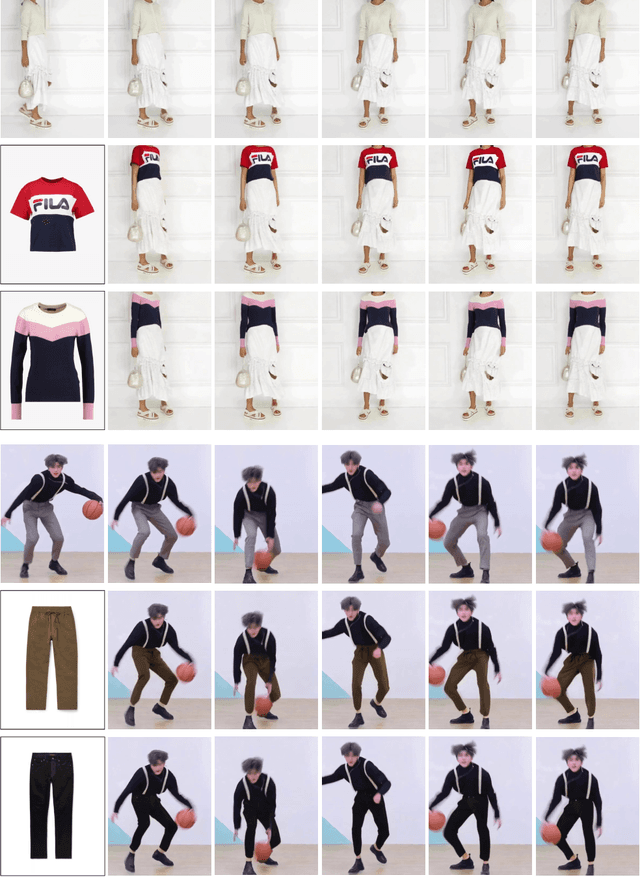
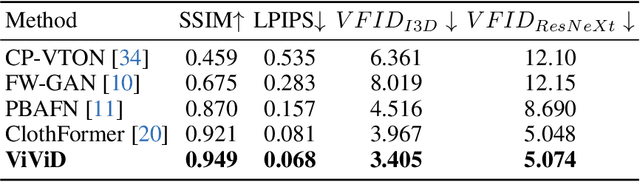
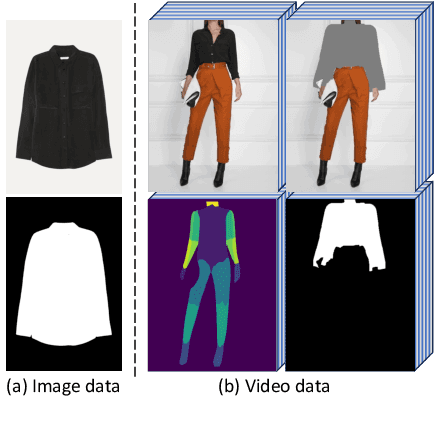

Video virtual try-on aims to transfer a clothing item onto the video of a target person. Directly applying the technique of image-based try-on to the video domain in a frame-wise manner will cause temporal-inconsistent outcomes while previous video-based try-on solutions can only generate low visual quality and blurring results. In this work, we present ViViD, a novel framework employing powerful diffusion models to tackle the task of video virtual try-on. Specifically, we design the Garment Encoder to extract fine-grained clothing semantic features, guiding the model to capture garment details and inject them into the target video through the proposed attention feature fusion mechanism. To ensure spatial-temporal consistency, we introduce a lightweight Pose Encoder to encode pose signals, enabling the model to learn the interactions between clothing and human posture and insert hierarchical Temporal Modules into the text-to-image stable diffusion model for more coherent and lifelike video synthesis. Furthermore, we collect a new dataset, which is the largest, with the most diverse types of garments and the highest resolution for the task of video virtual try-on to date. Extensive experiments demonstrate that our approach is able to yield satisfactory video try-on results. The dataset, codes, and weights will be publicly available. Project page: https://becauseimbatman0.github.io/ViViD.
HAGAN: Hybrid Augmented Generative Adversarial Network for Medical Image Synthesis
May 08, 2024
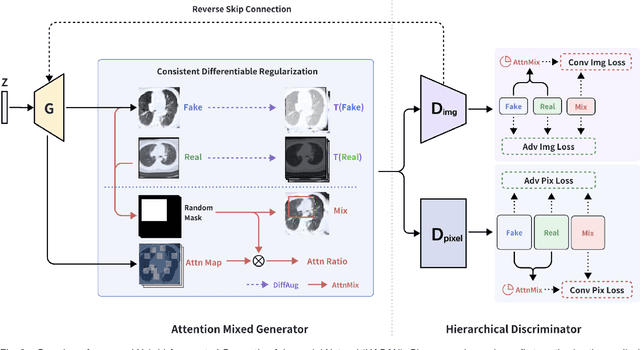

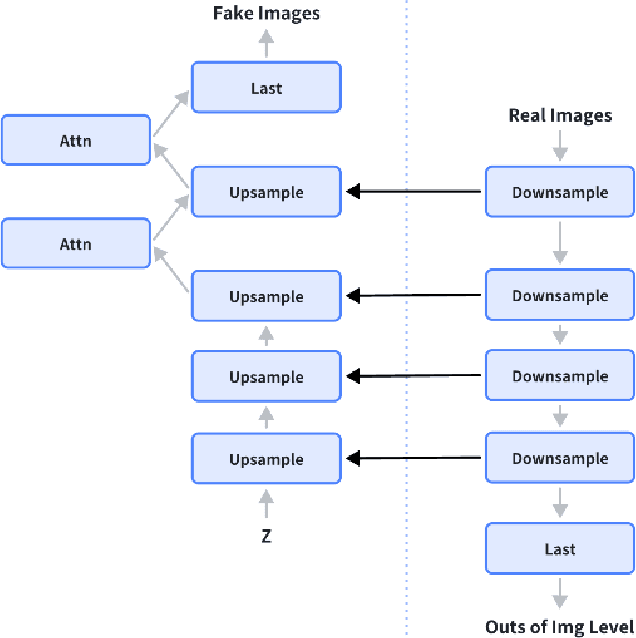
Medical Image Synthesis (MIS) plays an important role in the intelligent medical field, which greatly saves the economic and time costs of medical diagnosis. However, due to the complexity of medical images and similar characteristics of different tissue cells, existing methods face great challenges in meeting their biological consistency. To this end, we propose the Hybrid Augmented Generative Adversarial Network (HAGAN) to maintain the authenticity of structural texture and tissue cells. HAGAN contains Attention Mixed (AttnMix) Generator, Hierarchical Discriminator and Reverse Skip Connection between Discriminator and Generator. The AttnMix consistency differentiable regularization encourages the perception in structural and textural variations between real and fake images, which improves the pathological integrity of synthetic images and the accuracy of features in local areas. The Hierarchical Discriminator introduces pixel-by-pixel discriminant feedback to generator for enhancing the saliency and discriminance of global and local details simultaneously. The Reverse Skip Connection further improves the accuracy for fine details by fusing real and synthetic distribution features. Our experimental evaluations on three datasets of different scales, i.e., COVID-CT, ACDC and BraTS2018, demonstrate that HAGAN outperforms the existing methods and achieves state-of-the-art performance in both high-resolution and low-resolution.
Variational Schrödinger Diffusion Models
May 08, 2024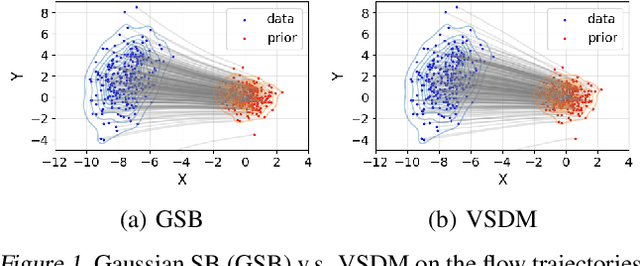


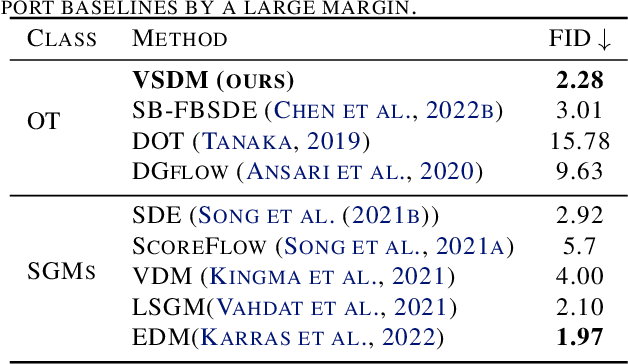
Schr\"odinger bridge (SB) has emerged as the go-to method for optimizing transportation plans in diffusion models. However, SB requires estimating the intractable forward score functions, inevitably resulting in the costly implicit training loss based on simulated trajectories. To improve the scalability while preserving efficient transportation plans, we leverage variational inference to linearize the forward score functions (variational scores) of SB and restore simulation-free properties in training backward scores. We propose the variational Schr\"odinger diffusion model (VSDM), where the forward process is a multivariate diffusion and the variational scores are adaptively optimized for efficient transport. Theoretically, we use stochastic approximation to prove the convergence of the variational scores and show the convergence of the adaptively generated samples based on the optimal variational scores. Empirically, we test the algorithm in simulated examples and observe that VSDM is efficient in generations of anisotropic shapes and yields straighter sample trajectories compared to the single-variate diffusion. We also verify the scalability of the algorithm in real-world data and achieve competitive unconditional generation performance in CIFAR10 and conditional generation in time series modeling. Notably, VSDM no longer depends on warm-up initializations and has become tuning-friendly in training large-scale experiments.
Representation Learning of Daily Movement Data Using Text Encoders
May 07, 2024

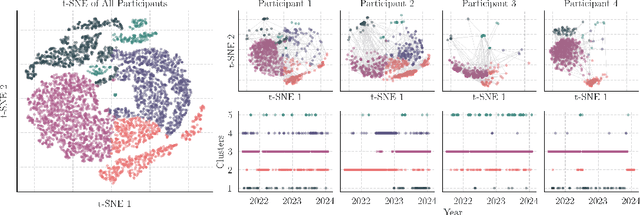

Time-series representation learning is a key area of research for remote healthcare monitoring applications. In this work, we focus on a dataset of recordings of in-home activity from people living with Dementia. We design a representation learning method based on converting activity to text strings that can be encoded using a language model fine-tuned to transform data from the same participants within a $30$-day window to similar embeddings in the vector space. This allows for clustering and vector searching over participants and days, and the identification of activity deviations to aid with personalised delivery of care.
* Accepted at ICLR 2024 Workshop on Learning from Time Series For Health: https://openreview.net/forum?id=mmxNNwxvWG