 Add to Chrome
 Add to Firefox
 Add to Edge
SkillMemo: Expert-guided Skill Memory Framework for Compositional Embodied Manipulation
Aug 06, 2026
Embodied visuomotor models, including Diffusion Policy (DP) and Vision-Language-Action (VLA) models, have demonstrated promising performance on robotic manipulation benchmarks. However, their potential remains fundamentally constrained by the scarcity of large-scale embodied trajectory datasets, leading to insufficient compositional generalization in out-of-distribution (OOD) scenarios with limited capability to capture reusable skill structures. To address this limitation, we propose Skill-Based Memory (SkillMemo) framework that implicitly decomposes long-horizon demonstrations into latent atomic skills and integrates skill-level features into a dynamic episodic memory bank for solving compositional tasks. Specifically, we first introduce an expert-guided trajectory segmentation module built upon a Mixture-of-Experts (MoE) architecture, which implicitly partitions trajectories into distinct skill primitives represented by learned gating coefficients. We further design a skill-level episodic memory architecture that stores compact skill representations as retrievable key-value pairs. During inference, the memory bank retrieves the most relevant skill primitives which are subsequently fused with the model's current gating distribution, providing a robust contextual prior to refine action predictions. Extensive experiments on the simulation benchmark and real-world manipulation tasks demonstrate that SkillMemo consistently enhances both DP and VLA backbones, achieving state-of-the-art performance and outperforming $π_{0.5}$, while exhibiting strong compositional generalization to unseen task configurations.

Calibration Is Not Control: Why LLM-Agent Oversight Needs Intervention
Jun 19, 2026Runtime oversight for LLM agents is commonly framed as scalar risk prediction: estimate failure likelihood, confidence, or uncertainty, then intervene once the score crosses a threshold. We argue that this framing targets the wrong object for control. The relevant question is not how likely the agent is to fail if it continues, but whether an available intervention would improve the outcome. Two trajectory prefixes can have the same risk estimate while requiring different actions, because one remains recoverable and the other does not. We formalize this mismatch as target error and identify intervention advantage, the expected utility gain from intervening rather than continuing, as the decision object for oversight. To measure this mismatch, we introduce prefix branching, a same-prefix counterfactual protocol that executes candidate actions from identical trajectory states. Across four benchmarks, action-conditioned control yields regime-dependent gains over scalar routing. In a calibration decomposition, recalibrating the same scalar score improves prediction metrics but leaves control regret unchanged, showing that calibration alone does not repair target error. A simple prefix-only action-conditioned controller substantially reduces regret in the strongest interactive regime, from 0.506 to 0.110 on ALFWorld. Gains shrink when interventions are weak or when scalar routing already preserves intervention-relevant information. These results suggest that LLM-agent oversight should move from calibrated risk scoring toward action-conditioned value estimation.
Don't Blindly Trust It: How Unreliable Feedback Breaks Tool-Using LLM Agents
Jun 19, 2026Tool-augmented agents are typically evaluated by their gains under reliable external feedback. Yet these gains leave open a key counterfactual: when feedback is unreliable, would the agent be better off receiving no task evidence? We study this question with a controlled matched-loop comparison that fixes the agent loop, prompt, action space, and decoding, while varying only the returned observation: faithful, misleading, or absent. Across question answering and fact verification, persistent misleading feedback produces a value inversion: agents that benefit from clean tools can perform worse than the matched no-feedback fallback. On HotpotQA, Qwen2.5-7B reaches 44.8 F1 with clean retrieval and 22.3 F1 with no feedback, but drops to 4.7 F1 under shuffled retrieval. The inversion persists under stronger clean retrieval and locally plausible distractors, but weakens when later clean evidence can repair the trajectory. Early trajectory signals predict many failures, yet simple repairs remain fallback-limited: rejecting bad evidence helps only when the exposed fallback is reliable. These results show that clean-tool gains can overstate tool value, and that matched no-feedback fallback controls are necessary for evaluating tool-augmented agents.
SAFE-Pruner: Semantic Attention-Guided Future-Aware Token Pruning for Efficient Vision-Language-Action Manipulation
May 28, 2026Real-time inference of vision-language-action (VLA) models is essential for robotic control. While visual token pruning has shown strong potential for accelerating inference, most existing methods mainly base pruning decisions on shallow-layer cues and risk discarding visual information required by deep layers. To address this issue, we propose SAFE-Pruner, a plug-and-play pruning framework that incorporates attention cues of future layers into pruning decisions. Specifically, we identify semantic attention consistency, the tendency that VLA models concentrate their attention probability mass on the same semantic entity across execution steps. Based on this observation, we design a forward-looking strategy to forecast the token saliency in deep layers, which prevents the premature removal of critical tokens and leads to more stable acceleration. We further introduce an adaptive subtask division strategy to detect abrupt attention shifts, thereby improving forecasting accuracy and pruning reliability. Extensive experiments in simulation and real-world settings demonstrate that our method achieves up to 1.89x speedup with a minimal degradation in success rate of less than 1.7%, while outperforming state-of-the-art methods by up to 1.9%.
Adversarial Dual On-Policy Distillation from Expressive Flow-based Teacher
May 26, 2026Learning from demonstrations in embodied control is often cast as behavioral cloning, and recent diffusion or flow-matching policies improve this paradigm by modeling multi-modal expert actions. Yet these methods remain offline supervised learners: the policy is trained only on expert states and receives no corrective signal on the states it actually visits. On-policy distillation (OPD) offers a natural remedy, but standard OPD assumes a strong fixed teacher, which is unavailable in demonstration-only control. We propose \textbf{FA-OPD}, an \emph{adversarial dual on-policy distillation} method in which a Flow Matching (FM) teacher is learned from demonstrations and co-trained with a lightweight MLP student. The teacher provides two complementary signals on student rollouts. The reward channel learns an expert-likeness objective over state-action pairs and drives online exploration through long-horizon policy optimization. The action channel supplies dense local targets at student-visited states, stabilizing exploitation. FA-OPD couples them so that reward distillation enables generalization beyond point-wise demonstrations, while action distillation keeps exploration anchored near expert-like behavior. Across six robot navigation, manipulation, and locomotion benchmarks, FA-OPD beats strong baselines and shows much stronger robustness under noisy or limited demonstrations.
StableVLA: Towards Robust Vision-Language-Action Models without Extra Data
May 18, 2026It is infeasible to encompass all possible disturbances within the training dataset. This raises a critical question regarding the robustness of Vision-Language-Action (VLA) models when encountering unseen real-world visual disturbances, particularly under imperfect visual conditions. In this work, we conduct a systematic study based on recent state-of-the-art VLA models and reveal a significant performance drop when visual disturbances absent from the training data are introduced. To mitigate this issue, we propose a lightweight adapter module grounded in information theory, termed the Information Bottleneck Adapter (IB-Adapter), which selectively filters potential noise from visual inputs. Without requiring any extra data or augmentation strategies, IB-Adapter consistently improves over the baseline by an average of 30%, while adding fewer than 10M parameters, demonstrating notable efficiency and effectiveness. Furthermore, even with a 14x smaller backbone (0.5B parameters) and no pre-training on the Open X-Embodiment dataset, our model StableVLA achieves robustness competitive with 7B-scale state-of-the-art VLAs. With negligible parameter overhead (<10M), our approach maintains accuracy on long-horizon tasks and surpasses OpenPi under both synthetic and physical visual corruptions.
CLAP: Contrastive Latent Action Pretraining for Learning Vision-Language-Action Models from Human Videos
Jan 07, 2026Generalist Vision-Language-Action models are currently hindered by the scarcity of robotic data compared to the abundance of human video demonstrations. Existing Latent Action Models attempt to leverage video data but often suffer from visual entanglement, capturing noise rather than manipulation skills. To address this, we propose Contrastive Latent Action Pretraining (CLAP), a framework that aligns the visual latent space from videos with a proprioceptive latent space from robot trajectories. By employing contrastive learning, CLAP maps video transitions onto a quantized, physically executable codebook. Building on this representation, we introduce a dual-formulation VLA framework offering both CLAP-NTP, an autoregressive model excelling at instruction following and object generalization, and CLAP-RF, a Rectified Flow-based policy designed for high-frequency, precise manipulation. Furthermore, we propose a Knowledge Matching (KM) regularization strategy to mitigate catastrophic forgetting during fine-tuning. Extensive experiments demonstrate that CLAP significantly outperforms strong baselines, enabling the effective transfer of skills from human videos to robotic execution. Project page: https://lin-shan.com/CLAP/.
DSPv2: Improved Dense Policy for Effective and Generalizable Whole-body Mobile Manipulation
Sep 19, 2025Learning whole-body mobile manipulation via imitation is essential for generalizing robotic skills to diverse environments and complex tasks. However, this goal is hindered by significant challenges, particularly in effectively processing complex observation, achieving robust generalization, and generating coherent actions. To address these issues, we propose DSPv2, a novel policy architecture. DSPv2 introduces an effective encoding scheme that aligns 3D spatial features with multi-view 2D semantic features. This fusion enables the policy to achieve broad generalization while retaining the fine-grained perception necessary for precise control. Furthermore, we extend the Dense Policy paradigm to the whole-body mobile manipulation domain, demonstrating its effectiveness in generating coherent and precise actions for the whole-body robotic platform. Extensive experiments show that our method significantly outperforms existing approaches in both task performance and generalization ability. Project page is available at: https://selen-suyue.github.io/DSPv2Net/.
VLA-RL: Towards Masterful and General Robotic Manipulation with Scalable Reinforcement Learning
May 24, 2025
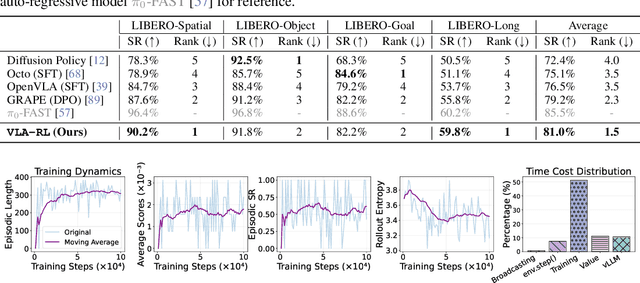
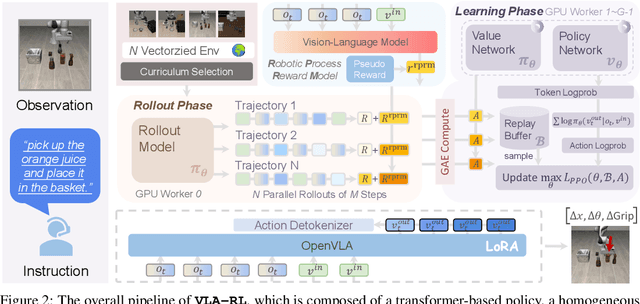
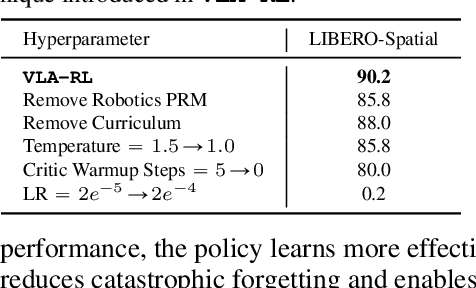
Recent high-capacity vision-language-action (VLA) models have demonstrated impressive performance on a range of robotic manipulation tasks by imitating human demonstrations. However, exploiting offline data with limited visited states will cause execution failure in out-of-distribution scenarios. Intuitively, an exploration-based method that improves on online collected data at test time could address this limitation. We present VLA-RL, an algorithmic and systematic framework that leverages online reinforcement learning (RL) to improve pretrained auto-regressive VLAs in downstream tasks. Within a unified perspective, we first introduce a trajectory-level RL formulation for auto-regressive VLA training, which models general robotic manipulation trajectory as multi-modal multi-turn conversation. To address the challenge of sparse rewards, we fine-tune a pretrained vision-language model as a robotic process reward model, which is trained on pseudo reward labels annotated on automatically extracted task segments. To scale up, we identify several implementation findings that improve the stability and efficiency including curriculum selection strategy, GPU-balanced vectorized environments, batch decoding, and critic warmup. VLA-RL enables OpenVLA-7B to surpass the strongest finetuned baseline by 4.5% on 40 challenging robotic manipulation tasks in LIBERO, and even matches the performance of advanced commercial models such as $\pi_0$-FAST. Notably, we observe that VLA-RL benefits from increased test-time optimization, indicating an early spark of inference scaling laws in robotics.
GeoLRM: Geometry-Aware Large Reconstruction Model for High-Quality 3D Gaussian Generation
Jun 21, 2024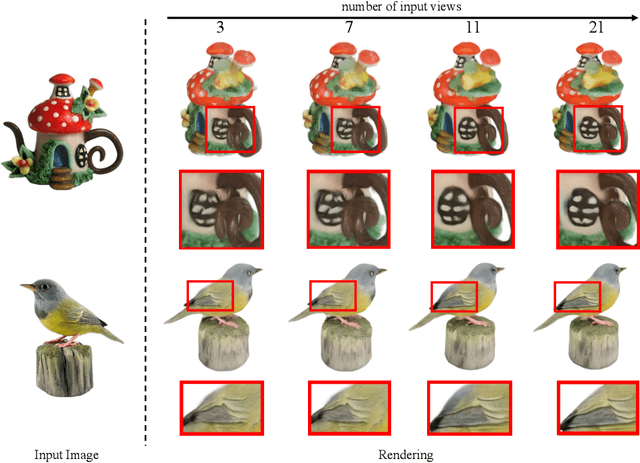
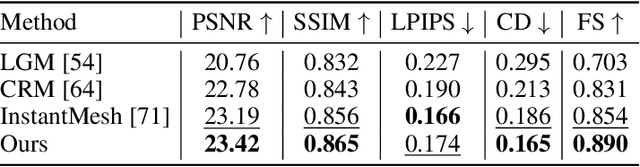
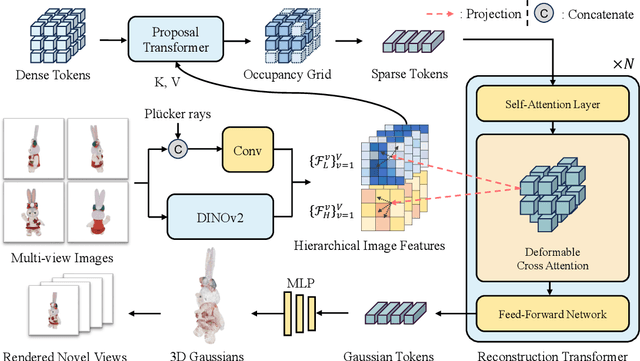

In this work, we introduce the Geometry-Aware Large Reconstruction Model (GeoLRM), an approach which can predict high-quality assets with 512k Gaussians and 21 input images in only 11 GB GPU memory. Previous works neglect the inherent sparsity of 3D structure and do not utilize explicit geometric relationships between 3D and 2D images. This limits these methods to a low-resolution representation and makes it difficult to scale up to the dense views for better quality. GeoLRM tackles these issues by incorporating a novel 3D-aware transformer structure that directly processes 3D points and uses deformable cross-attention mechanisms to effectively integrate image features into 3D representations. We implement this solution through a two-stage pipeline: initially, a lightweight proposal network generates a sparse set of 3D anchor points from the posed image inputs; subsequently, a specialized reconstruction transformer refines the geometry and retrieves textural details. Extensive experimental results demonstrate that GeoLRM significantly outperforms existing models, especially for dense view inputs. We also demonstrate the practical applicability of our model with 3D generation tasks, showcasing its versatility and potential for broader adoption in real-world applications.