 Add to Chrome
 Add to Firefox
 Add to Edge
Large Model Enabled Embodied Intelligence for 6G Integrated Perception, Communication, and Computation Network
Dec 22, 2025
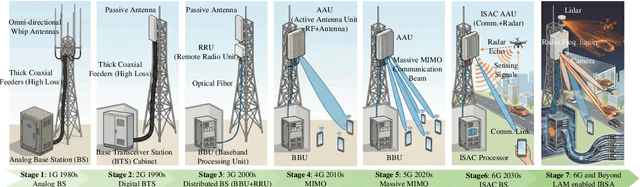
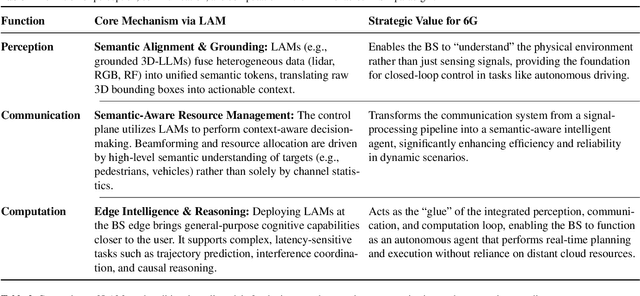
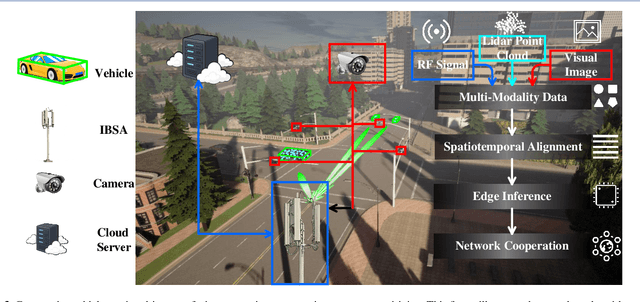
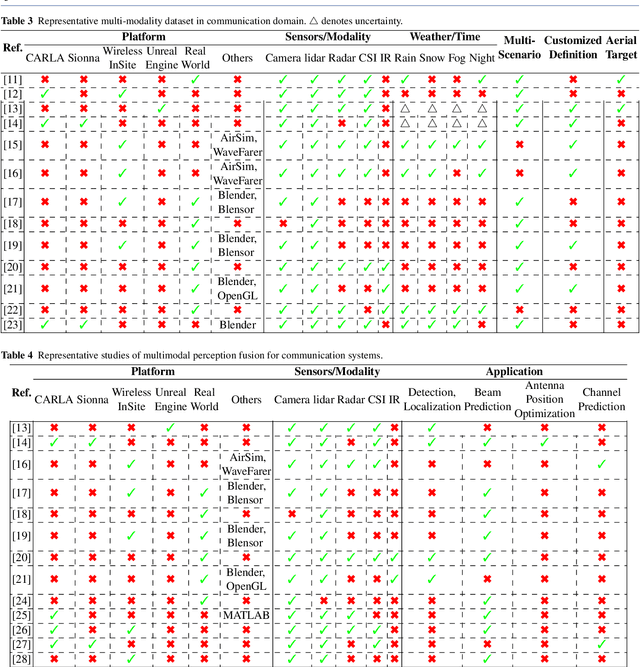
The advent of sixth-generation (6G) places intelligence at the core of wireless architecture, fusing perception, communication, and computation into a single closed-loop. This paper argues that large artificial intelligence models (LAMs) can endow base stations with perception, reasoning, and acting capabilities, thus transforming them into intelligent base station agents (IBSAs). We first review the historical evolution of BSs from single-functional analog infrastructure to distributed, software-defined, and finally LAM-empowered IBSA, highlighting the accompanying changes in architecture, hardware platforms, and deployment. We then present an IBSA architecture that couples a perception-cognition-execution pipeline with cloud-edge-end collaboration and parameter-efficient adaptation. Subsequently,we study two representative scenarios: (i) cooperative vehicle-road perception for autonomous driving, and (ii) ubiquitous base station support for low-altitude uncrewed aerial vehicle safety monitoring and response against unauthorized drones. On this basis, we analyze key enabling technologies spanning LAM design and training, efficient edge-cloud inference, multi-modal perception and actuation, as well as trustworthy security and governance. We further propose a holistic evaluation framework and benchmark considerations that jointly cover communication performance, perception accuracy, decision-making reliability, safety, and energy efficiency. Finally, we distill open challenges on benchmarks, continual adaptation, trustworthy decision-making, and standardization. Together, this work positions LAM-enabled IBSAs as a practical path toward integrated perception, communication, and computation native, safety-critical 6G systems.

Covariance-based Imaging and Multi-View Fusion for Networked Sensing
Nov 18, 2025This paper considers multi-view imaging in a sixth-generation (6G) integrated sensing and communication network, which consists of a transmit base-station (BS), multiple receive BSs connected to a central processing unit (CPU), and multiple extended targets. Our goal is to devise an effective multi-view imaging technique that can jointly leverage the targets' echo signals at all the receive BSs to precisely construct the image of these targets. To achieve this goal, we propose a two-phase approach. In Phase I, each receive BS recovers an individual image based on the sample covariance matrix of its received signals. Specifically, we propose a novel covariance-based imaging framework to jointly estimate effective scattering intensity and grid positions, which reduces the number of estimated parameters leveraging channel statistical properties and allows grid adjustment to conform to target geometry. In Phase II, the CPU fuses the individual images of all the receivers to construct a high-quality image of all the targets. Specifically, we design edge-preserving natural neighbor interpolation (EP-NNI) to map individual heterogeneous images onto common and finer grids, and then propose a joint optimization framework to estimate fused scattering intensity and BS fields of view. Extensive numerical results show that the proposed scheme significantly enhances imaging performance, facilitating high-quality environment reconstruction for future 6G networks.
Sensing-enabled Secure Rotatable Array System Enhanced by Multi-Layer Transmitting RIS
Nov 17, 2025Programmable metasurfaces and adjustable antennas are promising technologies. The security of a rotatable array system is investigated in this paper. A dual-base-station (BS) architecture is adopted, in which the BSs collaboratively perform integrated sensing of the eavesdropper (the target) and communication tasks. To address the security challenge when the sensing target is located on the main communication link, the problem of maximizing the secrecy rate (SR) under sensing signal-to-interference-plus-noise ratio requirements and discrete constraints is formulated. This problem involves the joint optimization of the array pose, the antenna distribution on the array surface, the multi-layer transmitting RIS phase matrices, and the beamforming matrices, which is non-convex. To solve this challenge, an two-stage online algorithm based on the generalized Rayleigh quotient and an offline algorithm based on the Multi-Agent Deep Deterministic Policy Gradient are proposed. Simulation results validate the effectiveness of the proposed algorithms. Compared to conventional schemes without array pose adjustment, the proposed approach achieves approximately 22\% improvement in SR. Furthermore, array rotation provides higher performance gains than position changes.
Integrated Massive Communication and Target Localization in 6G Cell-Free Networks
Oct 16, 2025This paper presents an initial investigation into the combination of integrated sensing and communication (ISAC) and massive communication, both of which are largely regarded as key scenarios in sixth-generation (6G) wireless networks. Specifically, we consider a cell-free network comprising a large number of users, multiple targets, and distributed base stations (BSs). In each time slot, a random subset of users becomes active, transmitting pilot signals that can be scattered by the targets before reaching the BSs. Unlike conventional massive random access schemes, where the primary objectives are device activity detection and channel estimation, our framework also enables target localization by leveraging the multipath propagation effects introduced by the targets. However, due to the intricate dependency between user channels and target locations, characterizing the posterior distribution required for minimum mean-square error (MMSE) estimation presents significant computational challenges. To handle this problem, we propose a hybrid message passing-based framework that incorporates multiple approximations to mitigate computational complexity. Numerical results demonstrate that the proposed approach achieves high-accuracy device activity detection, channel estimation, and target localization simultaneously, validating the feasibility of embedding localization functionality into massive communication systems for future 6G networks.
Secure Directional Modulation with Movable Antenna Array Aided by RIS
Apr 10, 2025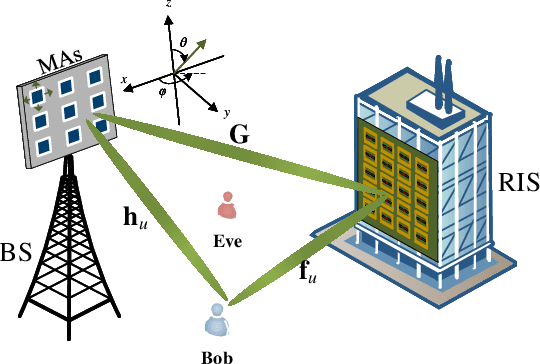
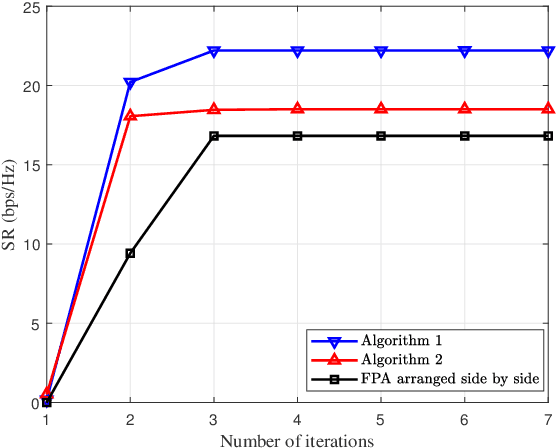
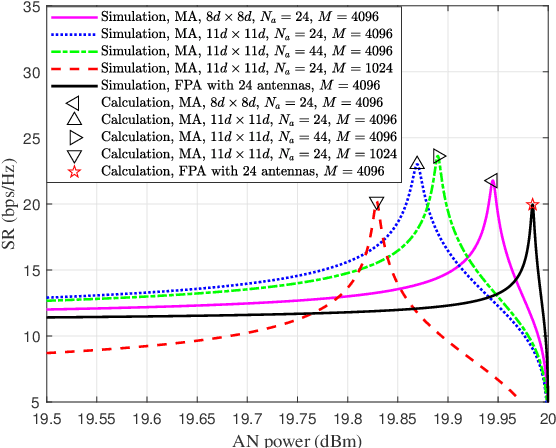
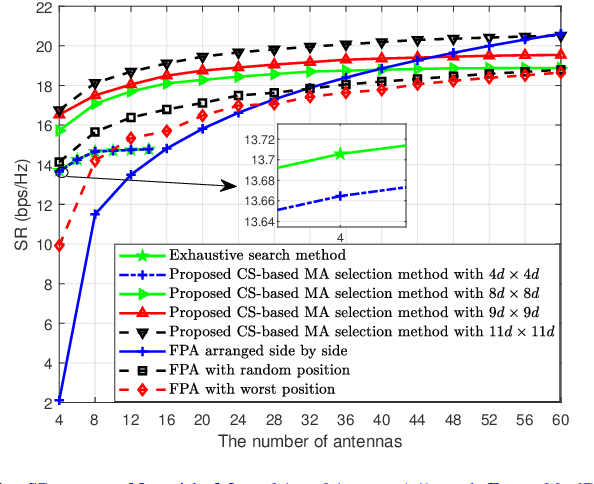
In this paper, to fully exploit the performance gains from moveable antennas (MAs) and reconfigurable intelligent surface (RIS), a RIS-aided directional modulation \textcolor{blue}{(DM)} network with movable antenna at base station (BS) is established Based on the principle of DM, a BS equipped with MAs transmits legitimate information to a single-antenna user (Bob) while exploiting artificial noise (AN) to degrade signal reception at the eavesdropper (Eve). The combination of AN and transmission beamforming vectors is modeled as joint beamforming vector (JBV) to achieve optimal power allocation. The objective is to maximize the achievable secrecy rate (SR) by optimizing MAs antenna position, phase shift matrix (PSM) of RIS, and JBV. The limited movable range (MR) and discrete candidate positions of the MAs at the BS are considered, which renders the optimization problem non-convex. To address these challenges, an optimization method under perfect channel state information (CSI) is firstly designed, in which the MAs antenna positions are obtained using compressive sensing (CS) technology, and JBV and PSM are iteratively optimized. Then, the design method and SR performance under imperfect CSI is investigated. The proposed algorithms have fewer iterations and lower complexity. Simulation results demonstrate that MAs outperform fixed-position antennas in SR performance when there is an adequately large MR available.
Grant-Free Random Access in Uplink LEO Satellite Communications with OFDM
Apr 08, 2025This paper investigates joint device activity detection and channel estimation for grant-free random access in Low-earth orbit (LEO) satellite communications. We consider uplink communications from multiple single-antenna terrestrial users to a LEO satellite equipped with a uniform planar array of multiple antennas, where orthogonal frequency division multiplexing (OFDM) modulation is adopted. To combat the severe Doppler shift, a transmission scheme is proposed, where the discrete prolate spheroidal basis expansion model (DPS-BEM) is introduced to reduce the number of unknown channel parameters. Then the vector approximate message passing (VAMP) algorithm is employed to approximate the minimum mean square error estimation of the channel, and the Markov random field is combined to capture the channel sparsity. Meanwhile, the expectation-maximization (EM) approach is integrated to learn the hyperparameters in priors. Finally, active devices are detected by calculating energy of the estimated channel. Simulation results demonstrate that the proposed method outperforms conventional algorithms in terms of activity error rate and channel estimation precision.
WVSC: Wireless Video Semantic Communication with Multi-frame Compensation
Mar 27, 2025Existing wireless video transmission schemes directly conduct video coding in pixel level, while neglecting the inner semantics contained in videos. In this paper, we propose a wireless video semantic communication framework, abbreviated as WVSC, which integrates the idea of semantic communication into wireless video transmission scenarios. WVSC first encodes original video frames as semantic frames and then conducts video coding based on such compact representations, enabling the video coding in semantic level rather than pixel level. Moreover, to further reduce the communication overhead, a reference semantic frame is introduced to substitute motion vectors of each frame in common video coding methods. At the receiver, multi-frame compensation (MFC) is proposed to produce compensated current semantic frame with a multi-frame fusion attention module. With both the reference frame transmission and MFC, the bandwidth efficiency improves with satisfying video transmission performance. Experimental results verify the performance gain of WVSC over other DL-based methods e.g. DVSC about 1 dB and traditional schemes about 2 dB in terms of PSNR.
Learnable Residual-based Latent Denoising in Semantic Communication
Feb 11, 2025A latent denoising semantic communication (SemCom) framework is proposed for robust image transmission over noisy channels. By incorporating a learnable latent denoiser into the receiver, the received signals are preprocessed to effectively remove the channel noise and recover the semantic information, thereby enhancing the quality of the decoded images. Specifically, a latent denoising mapping is established by an iterative residual learning approach to improve the denoising efficiency while ensuring stable performance. Moreover, channel signal-to-noise ratio (SNR) is utilized to estimate and predict the latent similarity score (SS) for conditional denoising, where the number of denoising steps is adapted based on the predicted SS sequence, further reducing the communication latency. Finally, simulations demonstrate that the proposed framework can effectively and efficiently remove the channel noise at various levels and reconstruct visual-appealing images.
Energy Efficiency Maximization for Movable Antenna-Enhanced System Based on Statistical CSI
Jan 18, 2025


This paper investigates an innovative movable antenna (MA)-enhanced multiple-input multiple-output (MIMO) system designed to enhance communication performance. We aim to maximize the energy efficiency (EE) under statistical channel state information (S-CSI) through a joint optimization of the transmit covariance matrix and the antenna position vectors (APVs). To solve the stochastic problem, we consider the large number of antennas scenario and resort to deterministic equivalent (DE) technology to reformulate the system EE w.r.t. the transmit variables, i.e., the transmit covariance matrix and APV, and the receive variables, i.e., the receive APV, respectively. Then, we propose an alternative optimization (AO) algorithm to update the transmit variables and the receive variables to maximize the system EE, respectively. Our numerical results reveal that, the proposed MA-enhanced system can significantly improve EE compared to several benchmark schemes and the optimal performance can be achieved with a finite size of movement regions for MAs.
LEO Satellite-Enabled Random Access with Large Differential Delay and Doppler Shift
Dec 30, 2024This paper investigates joint device identification, channel estimation, and symbol detection for LEO satellite-enabled grant-free random access systems, specifically targeting scenarios where remote Internet-of-Things (IoT) devices operate without global navigation satellite system (GNSS) assistance. Considering the constrained power consumption of these devices, the large differential delay and Doppler shift are handled at the satellite receiver. We firstly propose a spreading-based multi-frame transmission scheme with orthogonal time-frequency space (OTFS) modulation to mitigate the doubly dispersive effect in time and frequency, and then analyze the input-output relationship of the system. Next, we propose a receiver structure based on three modules: a linear module for identifying active devices that leverages the generalized approximate message passing algorithm to eliminate inter-user and inter-carrier interference; a non-linear module that employs the message passing algorithm to jointly estimate the channel and detect the transmitted symbols; and a third module that aims to exploit the three dimensional block channel sparsity in the delay-Doppler-angle domain. Soft information is exchanged among the three modules by careful message scheduling. Furthermore, the expectation-maximization algorithm is integrated to adjust phase rotation caused by the fractional Doppler and to learn the hyperparameters in the priors. Finally, the convolutional neural network is incorporated to enhance the symbol detection. Simulation results demonstrate that the proposed transmission scheme boosts the system performance, and the designed algorithms outperform the conventional methods significantly in terms of the device identification, channel estimation, and symbol detection.