 Add to Chrome
 Add to Firefox
 Add to Edge
Secure Relay Low-Altitude Networks via Hybrid Fixed-Position and Rotatable Antenna Arrays
Jul 29, 2026
In this paper, a relay network with hybrid fixed-position and rotatable antenna arrays is proposed. The deployment of rotatable arrays in conventional relay networks is considered to provide more secure communications for low-altitude economy applications. Specifically, both the base station and the relay station are equipped with fixed-position antenna arrays and rotatable arrays to serve ground users and aerial users, respectively. To address the challenge of multi-user interference, a low-cost reconfigurable intelligent surface is exploited as a candidate path. Accordingly, under constraints on transmit power, user quality of service, rotatable range, and path selection, the objective is to maximize the worst-case secrecy rate (SR) through joint beamforming, power allocation, and rotatable antenna orientation design. First, the SR performance in the single-user scenario is investigated, and a step-by-step leakage-based scheme is proposed. Then, the general multi-user scenario is studied, and a Distributional Soft Actor-Critic with Three refinements (DSAC-T)-based learning scheme, which supports hybrid discrete and continuous actions, is proposed to maximize the worst-case SR. Simulation results validate the effectiveness of the proposed schemes. The proposed schemes achieve approximately a twofold improvement in SR performance compared to isotropic antennas. The proposed system achieves approximately 71.4\% power saving, 55\% antenna saving, and can serve more users.

Covert Semantic Transmission in ISAC: Dual-Functional Waveform Design and Rectified Flow-Assisted Recovery
Jul 28, 2026Semantic integrated sensing and communication (ISAC) is envisioned as a promising paradigm for efficient and intelligent connectivity in future wireless networks. However, the open wireless channel exposes the dual-functional waveform to detection, which challenges the joint guarantee of covertness, sensing fidelity, and semantic accuracy. To address the challenge, we propose CoSMIC, a novel covertness-oriented semantic ISAC framework, where the sensing output is embedded into a dual-functional ISAC waveform through semantic modulation. Specifically, a semantic rotation coding scheme is established to map semantic latents onto the pairwise rotation and scaling of Gaussian reference sequences, which satisfies a derived closed-form covertness constraint by a differentiable budget projection. Moreover, the radar performance is analyzed to confirm an invariant matched-filter mainlobe response and a bounded output signal-to-interference-plus-noise ratio (SINR) under the semantic embedding. Subsequently, a reliability-guided rectified flow (RFlow) refiner is designed to effectively reconstruct high-fidelity semantic representations from coarse observations. Simulation results demonstrate that CoSMIC improves the semantic reconstruction quality by 18% over diffusion-based baseline schemes with substantially reduced inference latency under strict covertness constraints, which validates the applicability to practical ISAC scenarios. The source code and video demonstrations are available at https://github.com/LanceAnlan/CoSMIC-covertness-oriented-semantic-ISAC-framework.
A Covert Precision Satellite Communication Framework Assisted by Cooperative IRSs
Jul 22, 2026Satellite communication (SatCom), as an effective complement to terrestrial networks, has attracted considerable attention from both academia and industry owing to its wide coverage and high flexibility. However, the inherent openness of satellite links renders them highly vulnerable to eavesdropping, thereby posing significant security challenges. In this paper, we propose a satellite covert precision wireless communication (CPWC) system, where multiple intelligent reflecting surfaces (IRSs) cooperate to assist satellite transmissions, ensuring that confidential information is delivered to legitimate users while remaining undetectable to wardens. To further enhance covertness, an orthogonal frequency division multiplexing (OFDM)-based random subcarrier selection (RSCS) method is developed to concentrate the signal energy at the intended receiver. Under a practical satellite-terrestrial channel model, we derive closed-form covertness constraints for the CPWC system based on relative entropy and detection error probability. Under the relative-entropy constraint and the satellite power constraint, we maximize the covert rate by an alternating-optimization (AO) based semidefinite relaxation (SDR) iterative algorithm and obtain a high-quality feasible solution. Using this solution as a warm start, we further impose the detection-error-probability constraint and refine the beamformer through a sequential quadratic programming (SQP) based algorithm. Numerical results demonstrate the effectiveness of the proposed CPWC system, where the detection-error-probability-based scheme outperforms the second-order cone programming (SOCP) benchmark, the random-phase-shift design, the one-bit IRS quantized scheme, and the SDR baseline without precise communication (PC) in terms of covert rate.
Reinforcement Learning-Based Secure Near-field Directional Modulation Enhanced by Rotatable RIS
Mar 21, 2026This paper investigates secure Directional Modulation (DM) design enhanced by a rotatable active Reconfigurable Intelligent Surface (RIS). In conventional RIS-assisted DM networks, the security performance gain is limited due to the multiplicative path loss introduced by the RIS reflection path. To address this challenge, a Secrecy Rate (SR) maximization problem is formulated, subject to constraints including the eavesdropper's Direction Of Arrival (DOA) estimation performance, transmit power, rotatable range, and maximum reflection amplitude of the RIS elements. To solve this non-convex optimization problem, three algorithms are proposed: a multi-stream null-space projection and leakage-based method, an enhanced leakage-based method, and an optimization scheme based on the Distributed Soft Actor-Critic with Three refinements (DSAC-T). Simulation results validate the effectiveness of the proposed algorithms. A performance trade-off is observed between eavesdropper's DOA estimation accuracy and the achievable SR. The security enhancement provided by the RIS is more significant in systems equipped with a small number of antennas. By optimizing the orientation of the RIS, a 52.6\% improvement in SR performance can be achieved.
Enhanced Direction-Sensing Methods and Performance Analysis in Low-Altitude Wireless Network via a Rotation Antenna Array
Mar 21, 2026Due to the directive property of each antenna element, the received signal power can be severely attenuated when the emitter deviates from the array boresight, which will lead to a severe degradation in sensing performance along the corresponding direction. Although existing rotatable array sensing methods such as recursive rotation (RR-Root-MUSIC) can mitigate this issue by iteratively rotating and sensing, several mechanical rotations and repeated eigendecomposition operations are required to yield a high computational complexity and low time-efficiency. To address this problem, a pre-rotation initialization with recieve power as a rule is proposed to signifcantly reduce the computational complexity and improve the time-efficiency. Using this idea, a low-complexity enhanced direction-sensing framework with pre-rotation initialization and iterative greedy spatial-spectrum search (PRI-IGSS) is develped with three stages: (1) the normal vector of array is rotated to a set of candidates to find the opimal direction with the maximum sensing energy with the corresponding DOA value computed by the Root-MUSIC algorithm; (2) the array is mechanically rotated to the initial estimated direction and kept fixed; (3) an iterative greedy spatial-spectrum search or recieving beamforming method, moviated by reinforcement learning, is designed with a reduced search range and making a summation of all previous sampling variance matrices and the current one is adopted to provide an increasiong performance gain as the iteration process continues. To assess the performance of the proposed method, the corresponding CRLB is derived with a simplified rotation model. Simulation results demonstrate that the proposed PRI-IGSS method performs much better than RR-Root-MUSIC and achieves the CRLB in term of mean squared error due to the fact there is no sample accumulation for the latter.
A Two-Stage ISAC Framework for Low-Altitude Economy Based on 5G NR Signals
Nov 18, 2025The evolution of next-generation wireless networks has spurred the vigorous development of the low-altitude economy (LAE). To support this emerging field while remaining compatible with existing network architectures, integrated sensing and communication (ISAC) based on 5G New Radio (NR) signals is regarded as a promising solution. However, merely leveraging standard 5G NR signals, such as the Synchronization Signal Block (SSB), presents fundamental limitations in sensing resolution. To address the issue, this paper proposes a two-stage coarse-to-fine sensing framework that utilizes standard 5G NR initial access signals augmented by a custom-designed sparse pilot structure (SPS) for high-precision unmanned aerial vehicles (UAV) sensing. In Stage I, we first fuse information from the SSB, Type\#0-PDCCH, and system information block 1 (SIB1) to ensure the initial target detection. In Stage II, a refined estimation algorithm is introduced to overcome the resolution limitations of these signals. Inspired by the sparse array theory, this stage employs a novel SPS, which is inserted into resource blocks (RBs) within the CORSET\#0 bandwidth. To accurately extract the off-grid range and velocity parameters from these sparse pilots, we develop a corresponding high-resolution algorithm based on the weighted unwrapped phase (WUP) technique and the RELAX-based iterative method. Finally, the density-based spatial clustering of applications with noise (DBSCAN) algorithm is adopted to prune the redundant detections arising from beam overlap. Comprehensive simulation results demonstrate the superior estimation accuracy and computational efficiency of the proposed framework in comparison to other techniques.
Sensing-enabled Secure Rotatable Array System Enhanced by Multi-Layer Transmitting RIS
Nov 17, 2025Programmable metasurfaces and adjustable antennas are promising technologies. The security of a rotatable array system is investigated in this paper. A dual-base-station (BS) architecture is adopted, in which the BSs collaboratively perform integrated sensing of the eavesdropper (the target) and communication tasks. To address the security challenge when the sensing target is located on the main communication link, the problem of maximizing the secrecy rate (SR) under sensing signal-to-interference-plus-noise ratio requirements and discrete constraints is formulated. This problem involves the joint optimization of the array pose, the antenna distribution on the array surface, the multi-layer transmitting RIS phase matrices, and the beamforming matrices, which is non-convex. To solve this challenge, an two-stage online algorithm based on the generalized Rayleigh quotient and an offline algorithm based on the Multi-Agent Deep Deterministic Policy Gradient are proposed. Simulation results validate the effectiveness of the proposed algorithms. Compared to conventional schemes without array pose adjustment, the proposed approach achieves approximately 22\% improvement in SR. Furthermore, array rotation provides higher performance gains than position changes.
Millimeter-Wave Position Sensing Using Reconfigurable Intelligent Surfaces: Positioning Error Bound and Phase Shift Configuration
Aug 09, 2025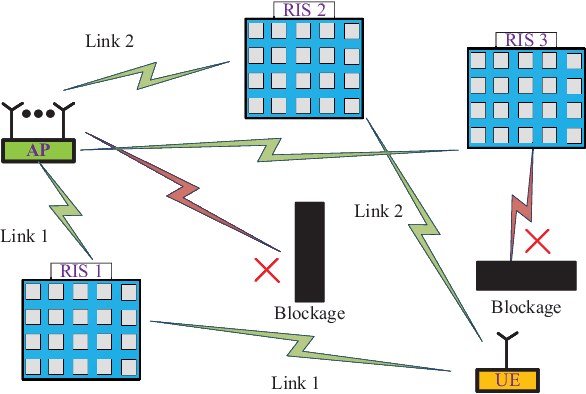
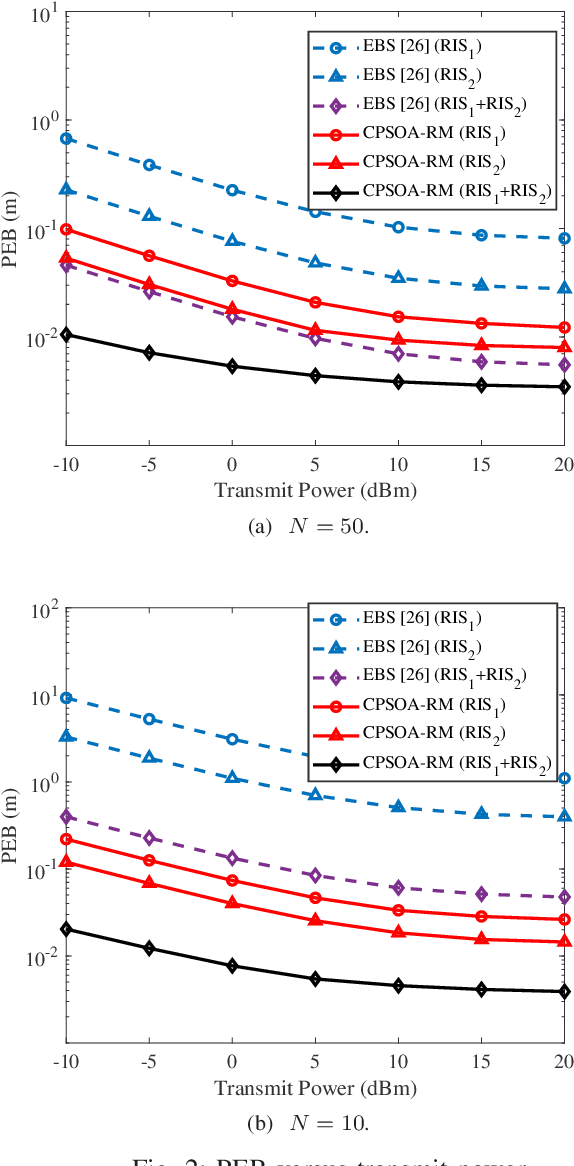
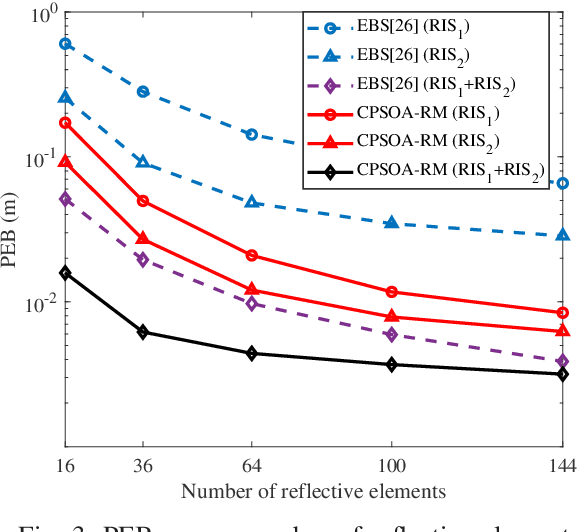
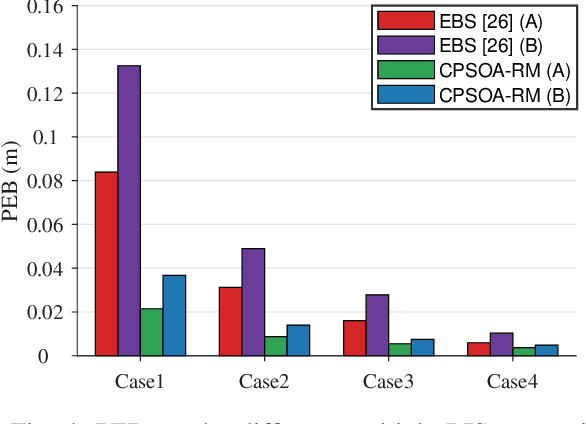
Millimeter-wave (mmWave) positioning has emerged as a promising technology for next-generation intelligent systems. The advent of reconfigurable intelligent surfaces (RISs) has revolutionized high-precision mmWave localization by enabling dynamic manipulation of wireless propagation environments. This paper investigates a three-dimensional (3D) multi-input single-output (MISO) mmWave positioning system assisted by multiple RISs. We introduce a measurement framework incorporating sequential RIS activation and directional beamforming to fully exploit virtual line-of-sight (VLoS) paths. The theoretical performance limits are rigorously analyzed through derivation of the Fisher information and subsequent positioning error bound (PEB). To minimize the PEB, two distinct optimization approaches are proposed for continuous and discrete phase shift configurations of RISs. For continuous phase shifts, a Riemannian manifold-based optimization algorithm is proposed. For discrete phase shifts, a heuristic algorithm incorporating the grey wolf optimizer is proposed. Extensive numerical simulations demonstrate the effectiveness of the proposed algorithms in reducing the PEB and validate the improvement in positioning accuracy achieved by multiple RISs.
AI-empowered Channel Estimation for Block-based Active IRS-enhanced Hybrid-field IoT Network
May 20, 2025In this paper, channel estimation (CE) for uplink hybrid-field communications involving multiple Internet of Things (IoT) devices assisted by an active intelligent reflecting surface (IRS) is investigated. Firstly, to reduce the complexity of near-field (NF) channel modeling and estimation between IoT devices and active IRS, a sub-blocking strategy for active IRS is proposed. Specifically, the entire active IRS is divided into multiple smaller sub-blocks, so that IoT devices are located in the far-field (FF) region of each sub block, while also being located in the NF region of the entire active IRS. This strategy significantly simplifies the channel model and reduces the parameter estimation dimension by decoupling the high-dimensional NF channel parameter space into low dimensional FF sub channels. Subsequently, the relationship between channel approximation error and CE error with respect to the number of sub blocks is derived, and the optimal number of sub blocks is solved based on the criterion of minimizing the total error. In addition, considering that the amplification capability of active IRS requires power consumption, a closed-form expression for the optimal power allocation factor is derived. To further reduce the pilot overhead, a lightweight CE algorithm based on convolutional autoencoder (CAE) and multi-head attention mechanism, called CAEformer, is designed. The Cramer-Rao lower bound is derived to evaluate the proposed algorithm's performance. Finally, simulation results demonstrate the proposed CAEformer network significantly outperforms the conventional least square and minimum mean square error scheme in terms of estimation accuracy.
Secure Directional Modulation with Movable Antenna Array Aided by RIS
Apr 10, 2025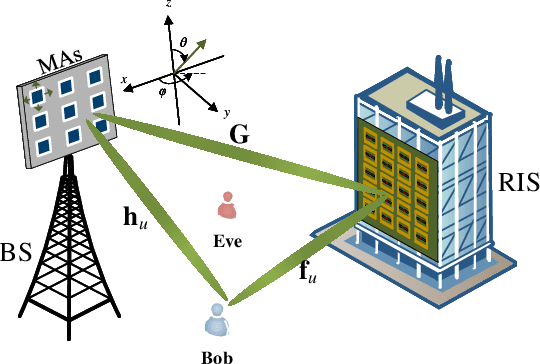
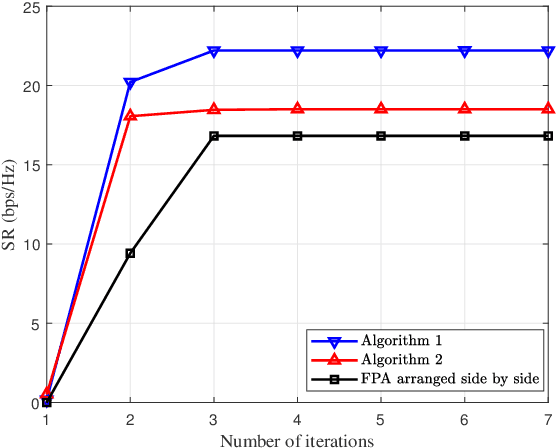
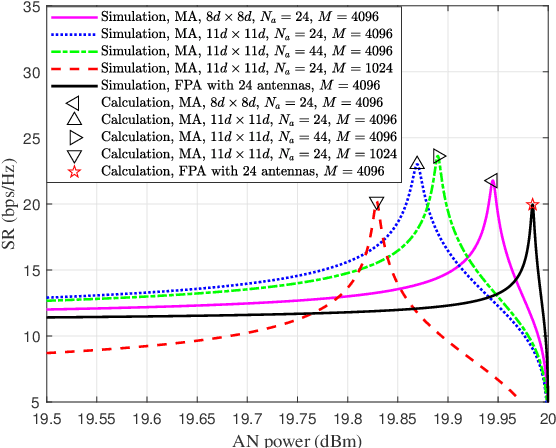
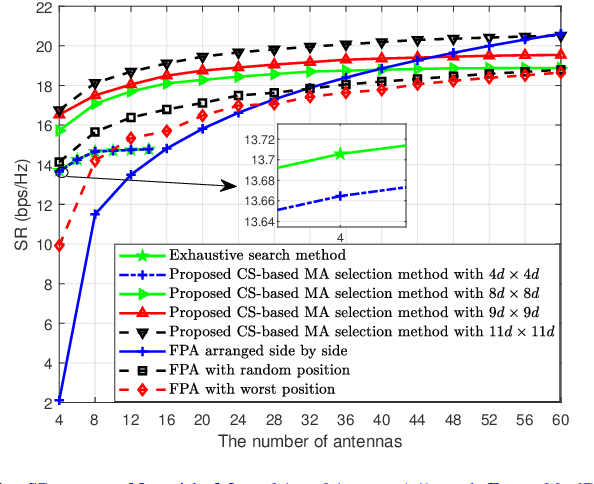
In this paper, to fully exploit the performance gains from moveable antennas (MAs) and reconfigurable intelligent surface (RIS), a RIS-aided directional modulation \textcolor{blue}{(DM)} network with movable antenna at base station (BS) is established Based on the principle of DM, a BS equipped with MAs transmits legitimate information to a single-antenna user (Bob) while exploiting artificial noise (AN) to degrade signal reception at the eavesdropper (Eve). The combination of AN and transmission beamforming vectors is modeled as joint beamforming vector (JBV) to achieve optimal power allocation. The objective is to maximize the achievable secrecy rate (SR) by optimizing MAs antenna position, phase shift matrix (PSM) of RIS, and JBV. The limited movable range (MR) and discrete candidate positions of the MAs at the BS are considered, which renders the optimization problem non-convex. To address these challenges, an optimization method under perfect channel state information (CSI) is firstly designed, in which the MAs antenna positions are obtained using compressive sensing (CS) technology, and JBV and PSM are iteratively optimized. Then, the design method and SR performance under imperfect CSI is investigated. The proposed algorithms have fewer iterations and lower complexity. Simulation results demonstrate that MAs outperform fixed-position antennas in SR performance when there is an adequately large MR available.