 Add to Chrome
 Add to Firefox
 Add to Edge
Towards Risk-free AI Agent Deployment
Aug 17, 2026
LLM-based agents are rapidly moving from research prototypes into the core business processes of organizations, but these agents pose deployment risks to security, compliance, and functionality. In this article, we argue that risk-free deployment must be grounded in the agent's trajectory: the recorded sequence of reasoning steps, tool invocations, and environmental observations. Trajectories are available for any agent, and many failures are visible only in the trajectory. To make agents deployable and sustainable, we advocate agent testing and debugging as a systematic research direction for detecting and mitigating these risks. This article begins with the challenges of testing agents, including the oracle problem, non-determinism, trajectory validation, and the absence of adequacy metrics. We then turn to debugging agents, from automated failure attribution to repair and self-evolution. We distill these directions into a practical deployment-readiness checklist covering the full deployment lifecycle. Finally, we identify open problems, i.e., formal adequacy metrics, root-cause attribution over long-horizon trajectories, and the reliability of self-evolving agents, that the community must address to enable trustworthy agent deployment.

LongRCA Bench: Diagnosing Responsible Roles and Root Causes in Long-Horizon Agent Failures
Aug 15, 2026When a long-horizon agent execution fails, outcome-level evaluation reveals the unsuccessful result but not where the decisive error entered the trajectory. Developers must then inspect the full execution to identify the responsible role and localize the earliest decisive root-cause step. Existing failure-attribution benchmarks largely focus on shorter traces, leaving diagnosis across hundreds of recorded steps underexplored. We introduce LongRCA Bench, comprising 1,140 failed trajectories across five domains without injected errors. It provides independently scored human labels for the responsible role and earliest decisive root-cause step. The median trajectory contains 145 steps, and the strongest baseline reaches only 13.2% exact root-step accuracy. We further present Root-Cause Trajectory Attribution (RCTA), a training-free method that retrieves candidate error steps from segment summaries and traces them to available earlier handoff instructions. Using the same backbone, benchmark instances, and scoring protocol, RCTA reaches 51.1% responsible-role accuracy and 24.1% exact root-step accuracy. These results highlight the need to evaluate responsible-role attribution and exact root-step localization as separate targets in long-trajectory failure diagnosis.
CodeShrink: Adaptive Visual Compression for Efficient Multimodal Code Understanding
Jul 31, 2026Rendering source code as images offers a promising way to reduce the input costs of Multimodal Large Language Models (MLLMs). Adjusting image resolution can trade visual token cost against content fidelity. However, resolution scaling alone overlooks two sources of inefficiency: blank regions created by line breaks and indentation, and code regions irrelevant to the current instruction. Moreover, the best compression setting varies across inputs, tasks, and models, limiting fixed-ratio strategies. We propose CodeShrink, an adaptive visual compression framework with three components. Blank-Free Rendering replaces whitespace-dependent layouts with compact layouts and explicit structural markers, removing layout-induced tokens. Adaptive Compression Configuration uses a lightweight agent trained with reinforcement learning to predict a per-input setting that balances token efficiency and readability. Dominant Token Selection jointly analyzes the instruction and code image to prune task-irrelevant visual tokens during inference. We evaluate CodeShrink on code question answering, clone detection, and code completion. CodeShrink reduces visual token use by up to 71.2\% while matching or exceeding uncompressed text-only inputs, and consistently outperforms text-based and visual compression baselines across all three tasks. These results show that combining layout compaction, adaptive configuration, and instruction-aware pruning can make multimodal code understanding more efficient. Our code is available at https://github.com/vinsontang1/CodeShrink.
Graph Is the Verifier: Agentic Reinforcement Learning for Interprocedural Vulnerability Detection
Jul 29, 2026Real-world vulnerabilities often span multiple functions, yet most learning-based detectors classify each function in isolation: on a sample of real CVEs, we find that 71.7% of vulnerable functions require evidence from outside the function to be classified correctly. Agentic reinforcement learning (RL) could close this gap by enabling a model to gather that evidence itself, but it lacks a reliable reward, since a reward defined on the final verdict alone can be obtained without performing any investigation. We propose VulAgentRL, an agentic RL framework for interprocedural vulnerability detection built on a Code Property Graph (CPG). The CPG serves two roles: at inference time the policy queries it for callers, callees, dataflow, and other queries, and at training time the same graph verifies the evidence the policy cites. Because every CPG node carries a persistent integer identifier, this verification is an exact comparison rather than a textual match, so the reward credits verdicts that are supported by evidence. We further initialize the policy by distilling teacher investigations, and show that this warm start is necessary, since RL cannot acquire tool-use behavior it never samples. Under a repository-level split that prevents leakage, VulAgentRL outperforms state-of-the-art baselines, including frontier models, on the strict pair-wise-correct metric while issuing fewer tool calls, and its advantage persists on an out-of-distribution corpus and under class imbalance.
Lost in the Flow with Code Talkers: Unveiling the Instruction-Tuning Tax of Large Language Models in Code Tasks
Jun 07, 2026AI coding assistants have significantly improved developer productivity by automatically suggesting code that aligns with user intent, and many of these tools are now integrated directly into Integrated Development Environments (IDEs). Developers interact with code in two distinct cognitive modes: Flow and Command. While developers require tools that directly complete or infill code in unfinished programs during Flow mode, they also need tools that can comprehend intentions expressed as natural-language instructions and convert them into executable code in Command mode. Although instruction-tuned Large Language Models (LLMs) dominate many application scenarios due to their abilities to infer and fulfill developers' intents, it remains unclear whether the same paradigm is equally suitable for different code-related tasks. Therefore, it is necessary to understand how instruction tuning affects the feasibility of CodeLLMs as coding assistants. To fill this gap, we conduct the first empirical study that uncovers a key trade-off caused by instruction tuning across programming modes, which we term the Instruction-Tuning Tax. Our results show that instruction tuning is not a free lunch: although instruction-tuned models are more capable of following instructions and leveraging structured guidance, these gains often come at the cost of weaker infilling performance. We further extend our study through both qualitative and quantitative analyses, including manual failure categorization, behavioral metrics that capture generation fidelity, and intermediate-checkpoint evaluation throughout the tuning process. Summarizing our results into seven findings and four implications, our study offers a new perspective on the development of AI-powered coding tools and highlights the need to carefully balance instruction-following ability with effective code generation assistance.
Making Embodied AI Reliable: A Community Agenda from Testing to Formal Verification
Jun 02, 2026Embodied AI systems are increasingly deployed in open-world environments, yet ensuring their reliability remains a fundamental challenge. Drawing on discussions from the AAAI'26 Bridge Program on "Making Embodied AI Reliable with Testing and Formal Verification", this article argues that reliability in embodied AI is inherently a lifecycle assurance problem arising from uncertainty, human interaction, and emergent behaviors across tightly coupled system components. We identify three complementary directions toward reliable embodied AI: (1) trustworthy scenario-based testing supported by validated specifications and meaningful coverage metrics, (2) compositional verification enabled by structured symbolic representations of system behavior and environmental context, and (3) runtime assurance mechanisms capable of adapting to uncertainty and distribution shifts during deployment. Rather than treating these approaches independently, we advocate integrated assurance workflows that connect testing, verification, and runtime adaptation through shared neuro-symbolic representations and continuous feedback across the system lifecycle. Such integration provides a foundation for building trustworthy embodied AI systems that can operate safely and reliably in complex real-world environments.
Inference-Time Scaling of Verification: Self-Evolving Deep Research Agents via Test-Time Rubric-Guided Verification
Jan 22, 2026Recent advances in Deep Research Agents (DRAs) are transforming automated knowledge discovery and problem-solving. While the majority of existing efforts focus on enhancing policy capabilities via post-training, we propose an alternative paradigm: self-evolving the agent's ability by iteratively verifying the policy model's outputs, guided by meticulously crafted rubrics. This approach gives rise to the inference-time scaling of verification, wherein an agent self-improves by evaluating its generated answers to produce iterative feedback and refinements. We derive the rubrics based on an automatically constructed DRA Failure Taxonomy, which systematically classifies agent failures into five major categories and thirteen sub-categories. We present DeepVerifier, a rubrics-based outcome reward verifier that leverages the asymmetry of verification and outperforms vanilla agent-as-judge and LLM judge baselines by 12%-48% in meta-evaluation F1 score. To enable practical self-evolution, DeepVerifier integrates as a plug-and-play module during test-time inference. The verifier produces detailed rubric-based feedback, which is fed back to the agent for iterative bootstrapping, refining responses without additional training. This test-time scaling delivers 8%-11% accuracy gains on challenging subsets of GAIA and XBench-DeepResearch when powered by capable closed-source LLMs. Finally, to support open-source advancement, we release DeepVerifier-4K, a curated supervised fine-tuning dataset of 4,646 high-quality agent steps focused on DRA verification. These examples emphasize reflection and self-critique, enabling open models to develop robust verification capabilities.
Exploring Autonomous Agents: A Closer Look at Why They Fail When Completing Tasks
Aug 18, 2025Autonomous agent systems powered by Large Language Models (LLMs) have demonstrated promising capabilities in automating complex tasks. However, current evaluations largely rely on success rates without systematically analyzing the interactions, communication mechanisms, and failure causes within these systems. To bridge this gap, we present a benchmark of 34 representative programmable tasks designed to rigorously assess autonomous agents. Using this benchmark, we evaluate three popular open-source agent frameworks combined with two LLM backbones, observing a task completion rate of approximately 50%. Through in-depth failure analysis, we develop a three-tier taxonomy of failure causes aligned with task phases, highlighting planning errors, task execution issues, and incorrect response generation. Based on these insights, we propose actionable improvements to enhance agent planning and self-diagnosis capabilities. Our failure taxonomy, together with mitigation advice, provides an empirical foundation for developing more robust and effective autonomous agent systems in the future.
Next Edit Prediction: Learning to Predict Code Edits from Context and Interaction History
Aug 13, 2025The rapid advancement of large language models (LLMs) has led to the widespread adoption of AI-powered coding assistants integrated into a development environment. On one hand, low-latency code completion offers completion suggestions but is fundamentally constrained to the cursor's current position. On the other hand, chat-based editing can perform complex modifications, yet forces developers to stop their work, describe the intent in natural language, which causes a context-switch away from the code. This creates a suboptimal user experience, as neither paradigm proactively predicts the developer's next edit in a sequence of related edits. To bridge this gap and provide the seamless code edit suggestion, we introduce the task of Next Edit Prediction, a novel task designed to infer developer intent from recent interaction history to predict both the location and content of the subsequent edit. Specifically, we curate a high-quality supervised fine-tuning dataset and an evaluation benchmark for the Next Edit Prediction task. Then, we conduct supervised fine-tuning on a series of models and performed a comprehensive evaluation of both the fine-tuned models and other baseline models, yielding several novel findings. This work lays the foundation for a new interaction paradigm that proactively collaborate with developers by anticipating their following action, rather than merely reacting to explicit instructions.
DesignBench: A Comprehensive Benchmark for MLLM-based Front-end Code Generation
Jun 06, 2025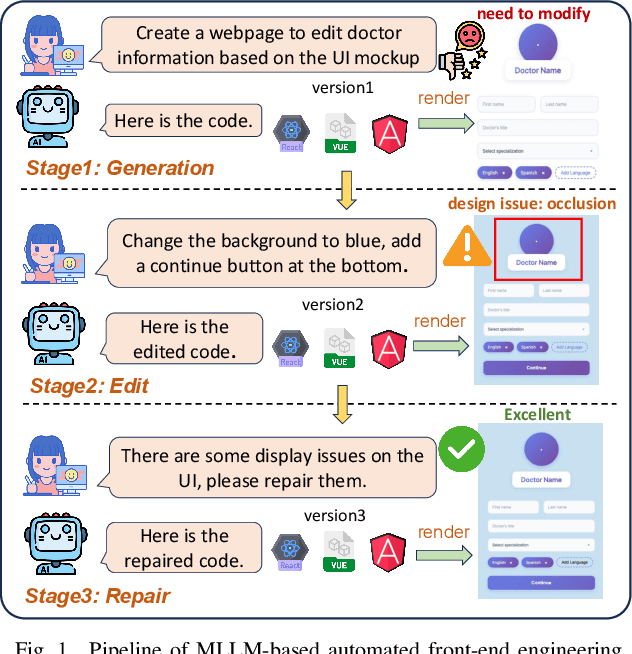
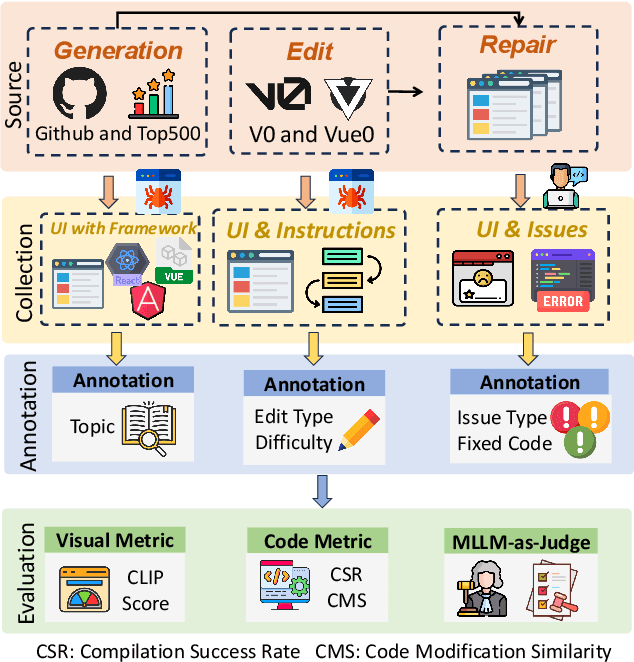

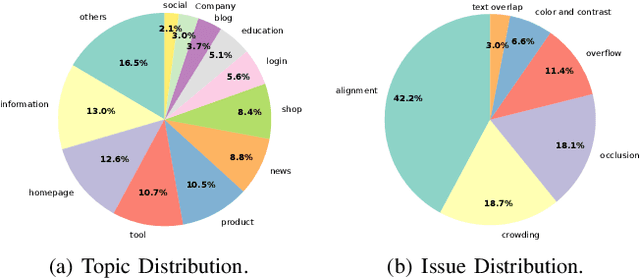
Multimodal Large Language Models (MLLMs) have demonstrated remarkable capabilities in automated front-end engineering, e.g., generating UI code from visual designs. However, existing front-end UI code generation benchmarks have the following limitations: (1) While framework-based development becomes predominant in modern front-end programming, current benchmarks fail to incorporate mainstream development frameworks. (2) Existing evaluations focus solely on the UI code generation task, whereas practical UI development involves several iterations, including refining editing, and repairing issues. (3) Current benchmarks employ unidimensional evaluation, lacking investigation into influencing factors like task difficulty, input context variations, and in-depth code-level analysis. To bridge these gaps, we introduce DesignBench, a multi-framework, multi-task evaluation benchmark for assessing MLLMs' capabilities in automated front-end engineering. DesignBench encompasses three widely-used UI frameworks (React, Vue, and Angular) alongside vanilla HTML/CSS, and evaluates on three essential front-end tasks (generation, edit, and repair) in real-world development workflows. DesignBench contains 900 webpage samples spanning over 11 topics, 9 edit types, and 6 issue categories, enabling detailed analysis of MLLM performance across multiple dimensions. Our systematic evaluation reveals critical insights into MLLMs' framework-specific limitations, task-related bottlenecks, and performance variations under different conditions, providing guidance for future research in automated front-end development. Our code and data are available at https://github.com/WebPAI/DesignBench.