 Add to Chrome
 Add to Firefox
 Add to Edge
Effective and Efficient Context Retrieval via Partial Dependency Graph for Repository-Level Code Generation
Aug 03, 2026
LLM-based repository-level code generation aims to generate code using the context available in a software repository, requiring LLMs to reason over complex code dependencies. Due to limited context windows and insufficient repository-specific understanding, LLMs typically rely on retrieval-augmented generation (RAG) to incorporate relevant code. Early RAG approaches primarily employ similarity-based retrieval, which often fails to retrieve code snippets that the target function depends on. Recent work introduces graph-based retrieval to model such dependencies, but typically relies on manually designed rules and static global graphs, leading to limited flexibility and high construction and maintenance costs. In contrast, human developers collect helpful context by implicitly constructing a partial dependency graph and iteratively inspecting along it. Inspired by this behavior, we propose DyRetriever, an efficient context retrieval method via partial dependency graphs. DyRetriever uses an LLM to first select a set of entry-point functions and then perform multi-hop reasoning along the code dependency graph. During multi-hop reasoning, it uses the LLM's semantic understanding to validate whether a function can help generate the target function, eliminating manually designed rules and enabling flexibility across scenarios. Instead of statically constructing a global dependency graph, DyRetriever builds a partial graph on demand and discards it after use, reducing construction and maintenance costs. We integrate DyRetriever with a similarity-based code retriever to build DyCoder and evaluate it on CoderEval and DevEval. Experimental results show that DyCoder achieves relative Pass@1 improvements of 25.63% and 59.73% on CoderEval and DevEval, respectively, compared with existing RAG-based methods, while being 7.4x faster than baselines based on static dependency graph construction.

Graph Is the Verifier: Agentic Reinforcement Learning for Interprocedural Vulnerability Detection
Jul 29, 2026Real-world vulnerabilities often span multiple functions, yet most learning-based detectors classify each function in isolation: on a sample of real CVEs, we find that 71.7% of vulnerable functions require evidence from outside the function to be classified correctly. Agentic reinforcement learning (RL) could close this gap by enabling a model to gather that evidence itself, but it lacks a reliable reward, since a reward defined on the final verdict alone can be obtained without performing any investigation. We propose VulAgentRL, an agentic RL framework for interprocedural vulnerability detection built on a Code Property Graph (CPG). The CPG serves two roles: at inference time the policy queries it for callers, callees, dataflow, and other queries, and at training time the same graph verifies the evidence the policy cites. Because every CPG node carries a persistent integer identifier, this verification is an exact comparison rather than a textual match, so the reward credits verdicts that are supported by evidence. We further initialize the policy by distilling teacher investigations, and show that this warm start is necessary, since RL cannot acquire tool-use behavior it never samples. Under a repository-level split that prevents leakage, VulAgentRL outperforms state-of-the-art baselines, including frontier models, on the strict pair-wise-correct metric while issuing fewer tool calls, and its advantage persists on an out-of-distribution corpus and under class imbalance.
An Indirect Rate-Distortion Characterization for Semantic Sources: General Model and the Case of Gaussian Observation
Jan 29, 2022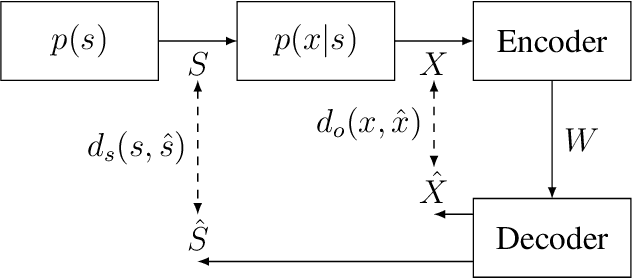
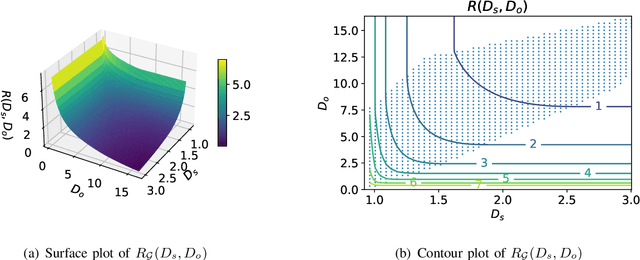
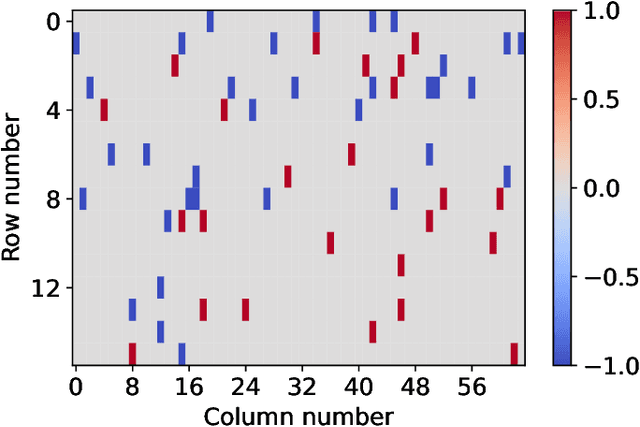
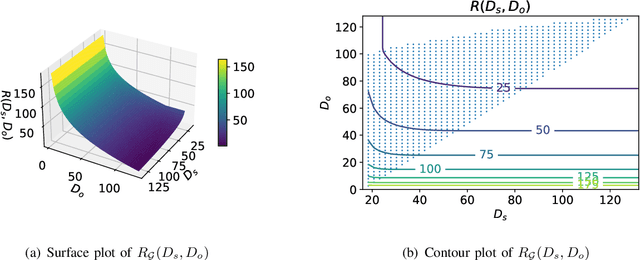
A new source model, which consists of an intrinsic state part and an extrinsic observation part, is proposed and its information-theoretic characterization, namely its rate-distortion function, is defined and analyzed. Such a source model is motivated by the recent surge of interest in the semantic aspect of information: the intrinsic state corresponds to the semantic feature of the source, which in general is not observable but can only be inferred from the extrinsic observation. There are two distortion measures, one between the intrinsic state and its reproduction, and the other between the extrinsic observation and its reproduction. Under a given code rate, the tradeoff between these two distortion measures is characterized by the rate-distortion function, which is solved via the indirect rate-distortion theory and is termed as the semantic rate-distortion function of the source. As an application of the general model and its analysis, the case of Gaussian extrinsic observation is studied, assuming a linear relationship between the intrinsic state and the extrinsic observation, under a quadratic distortion structure. The semantic rate-distortion function is shown to be the solution of a convex programming programming with respect to an error covariance matrix, and a reverse water-filling type of solution is provided when the model further satisfies a diagonalizability condition.