 Add to Chrome
 Add to Firefox
 Add to Edge
Graph Is the Verifier: Agentic Reinforcement Learning for Interprocedural Vulnerability Detection
Jul 29, 2026
Real-world vulnerabilities often span multiple functions, yet most learning-based detectors classify each function in isolation: on a sample of real CVEs, we find that 71.7% of vulnerable functions require evidence from outside the function to be classified correctly. Agentic reinforcement learning (RL) could close this gap by enabling a model to gather that evidence itself, but it lacks a reliable reward, since a reward defined on the final verdict alone can be obtained without performing any investigation. We propose VulAgentRL, an agentic RL framework for interprocedural vulnerability detection built on a Code Property Graph (CPG). The CPG serves two roles: at inference time the policy queries it for callers, callees, dataflow, and other queries, and at training time the same graph verifies the evidence the policy cites. Because every CPG node carries a persistent integer identifier, this verification is an exact comparison rather than a textual match, so the reward credits verdicts that are supported by evidence. We further initialize the policy by distilling teacher investigations, and show that this warm start is necessary, since RL cannot acquire tool-use behavior it never samples. Under a repository-level split that prevents leakage, VulAgentRL outperforms state-of-the-art baselines, including frontier models, on the strict pair-wise-correct metric while issuing fewer tool calls, and its advantage persists on an out-of-distribution corpus and under class imbalance.

Let the Trial Begin: A Mock-Court Approach to Vulnerability Detection using LLM-Based Agents
May 16, 2025
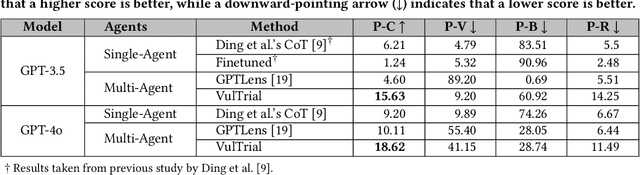
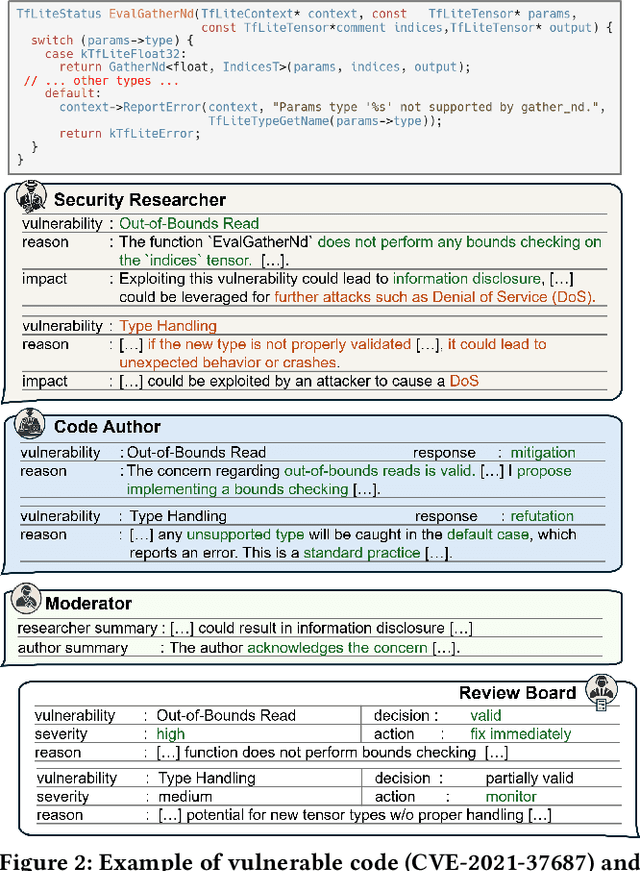
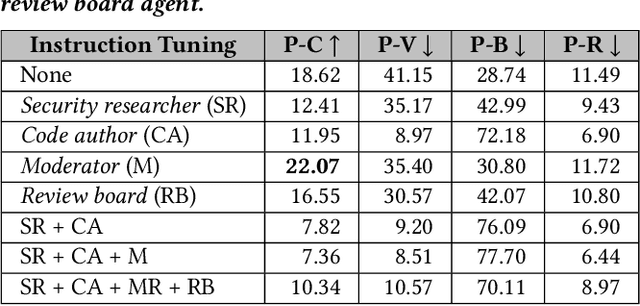
Detecting vulnerabilities in source code remains a critical yet challenging task, especially when benign and vulnerable functions share significant similarities. In this work, we introduce VulTrial, a courtroom-inspired multi-agent framework designed to enhance automated vulnerability detection. It employs four role-specific agents, which are security researcher, code author, moderator, and review board. Through extensive experiments using GPT-3.5 and GPT-4o we demonstrate that Vultrial outperforms single-agent and multi-agent baselines. Using GPT-4o, VulTrial improves the performance by 102.39% and 84.17% over its respective baseline. Additionally, we show that role-specific instruction tuning in multi-agent with small data (50 pair samples) improves the performance of VulTrial further by 139.89% and 118.30%. Furthermore, we analyze the impact of increasing the number of agent interactions on VulTrial's overall performance. While multi-agent setups inherently incur higher costs due to increased token usage, our findings reveal that applying VulTrial to a cost-effective model like GPT-3.5 can improve its performance by 69.89% compared to GPT-4o in a single-agent setting, at a lower overall cost.
R2Vul: Learning to Reason about Software Vulnerabilities with Reinforcement Learning and Structured Reasoning Distillation
Apr 07, 2025
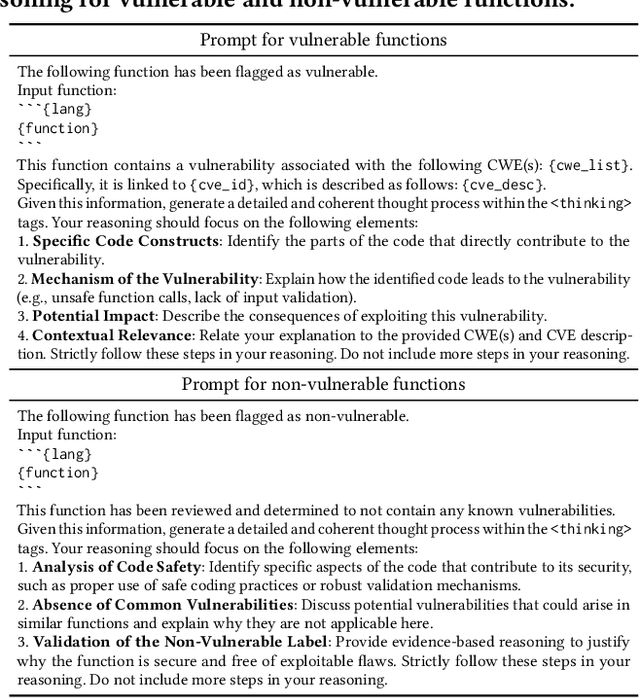
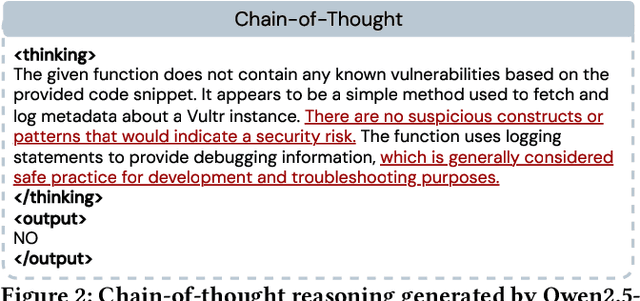
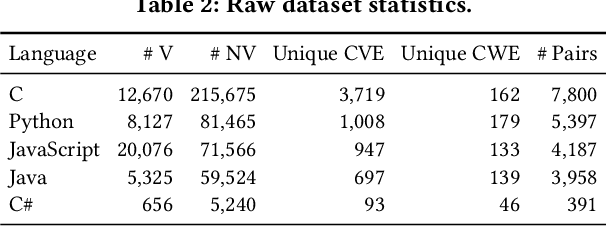
Large language models (LLMs) have shown promising performance in software vulnerability detection (SVD), yet their reasoning capabilities remain unreliable. Existing approaches relying on chain-of-thought (CoT) struggle to provide relevant and actionable security assessments. Additionally, effective SVD requires not only generating coherent reasoning but also differentiating between well-founded and misleading yet plausible security assessments, an aspect overlooked in prior work. To this end, we introduce R2Vul, a novel approach that distills structured reasoning into small LLMs using reinforcement learning from AI feedback (RLAIF). Through RLAIF, R2Vul enables LLMs to produce structured, security-aware reasoning that is actionable and reliable while explicitly learning to distinguish valid assessments from misleading ones. We evaluate R2Vul across five languages against SAST tools, CoT, instruction tuning, and classification-based baselines. Our results show that R2Vul with structured reasoning distillation enables a 1.5B student LLM to rival larger models while improving generalization to out-of-distribution vulnerabilities. Beyond model improvements, we contribute a large-scale, multilingual preference dataset featuring structured reasoning to support future research in SVD.