 Add to Chrome
 Add to Firefox
 Add to Edge
RHEA: Reliability-Harmonized Reconstruction and Assignment for Robust Multimodal-Attributed Graph Clustering
Aug 01, 2026
Multimodal-attributed graphs (MAGs), whose nodes carry heterogeneous attributes such as text and images over a relational structure, have become a fundamental substrate for label-free entity grouping tasks, including community discovery and product segmentation. Existing MAG clustering methods effectively integrate complementary modalities when attributes are clean and complete, but degrade substantially under noisy or missing attributes because they implicitly assume equal modality reliability across all nodes. In practice, modality reliability is inherently node-specific: images may be corrupted or absent, while textual descriptions are incomplete or noisy. We argue that, under attribute homophily, graph neighborhoods naturally provide supervision-free evidence for estimating node-specific modality reliability. Based on this insight, we propose RHEA, a reliability-aware framework for MAG clustering that estimates node-specific modality reliability from neighborhood consensus and propagates this signal throughout the clustering pipeline. RHEA reconstructs unreliable or missing modalities from graph neighborhoods, adaptively weights modalities during reliability-aware fusion, and performs topology-aware optimal transport clustering with reliability-aware transport assignment and neighbor-consensus assignment distillation. Furthermore, the confidence of reconstructed representations is incorporated into the clustering objective, allowing uncertain reconstructions to contribute proportionally during optimization. Experiments on four MAG benchmarks under five attribute conditions show that RHEA consistently outperforms the strongest baseline, with NMI gains increasing as attribute quality deteriorates.

Towards Effective Federated Multimodal Graph Learning via Navigating Multifaceted Heterogeneity
Aug 01, 2026Multimodal-attributed graphs (MAGs), where nodes carry heterogeneous semantic content across multiple modalities while edges encode relational dependencies, have been widely adopted across diverse domains. Federated multimodal graph learning (FMGL) extends federated graph learning (FGL) to MAGs, enabling collaborative optimization across decentralized MAGs without exposing raw data. However, naively applying existing FGL methods to FMGL is insufficient, as they fail to navigate the multifaceted heterogeneity inherent in decentralized MAGs, including task heterogeneity across diverse client objectives, modality heterogeneity from discrepant modality quality and semantic domains, and topology heterogeneity arising from divergent topological patterns with low cross-modality correlation. To address these challenges, we propose Federated multimodal graph learning with Topology-aware Cross-modal Routing (FedTCR), the first systematic algorithm designed for FMGL. To handle task heterogeneity, FedTCR employs a two-stage paradigm that comprises federated task-agnostic pre-training followed by isolated task-oriented fine-tuning. To jointly address modality and topology heterogeneity, FedTCR introduces a topology-aware cross-modal routing mechanism. Concretely, each client distills modality-specific knowledge into compact prototypes via topology-aware importance-weighted aggregation informed by graph structure; the server then evaluates cross-client cross-modal relationships among these structure-informed prototypes and routes informative ones as contrastive references, driving a tri-level cross-modal contrastive learning scheme that jointly aligns cross-client modalities while preserving discrimination. Experiments across 7 domains demonstrate that FedTCR outperforms state-of-the-art baselines on both graph-centric and modality-centric tasks.
CodeShrink: Adaptive Visual Compression for Efficient Multimodal Code Understanding
Jul 31, 2026Rendering source code as images offers a promising way to reduce the input costs of Multimodal Large Language Models (MLLMs). Adjusting image resolution can trade visual token cost against content fidelity. However, resolution scaling alone overlooks two sources of inefficiency: blank regions created by line breaks and indentation, and code regions irrelevant to the current instruction. Moreover, the best compression setting varies across inputs, tasks, and models, limiting fixed-ratio strategies. We propose CodeShrink, an adaptive visual compression framework with three components. Blank-Free Rendering replaces whitespace-dependent layouts with compact layouts and explicit structural markers, removing layout-induced tokens. Adaptive Compression Configuration uses a lightweight agent trained with reinforcement learning to predict a per-input setting that balances token efficiency and readability. Dominant Token Selection jointly analyzes the instruction and code image to prune task-irrelevant visual tokens during inference. We evaluate CodeShrink on code question answering, clone detection, and code completion. CodeShrink reduces visual token use by up to 71.2\% while matching or exceeding uncompressed text-only inputs, and consistently outperforms text-based and visual compression baselines across all three tasks. These results show that combining layout compaction, adaptive configuration, and instruction-aware pruning can make multimodal code understanding more efficient. Our code is available at https://github.com/vinsontang1/CodeShrink.
VulTriage: Triple-Path Context Augmentation for LLM-Based Vulnerability Detection
May 10, 2026Automated vulnerability detection is a fundamental task in software security, yet existing learning-based methods still struggle to capture the structural dependencies, domain-specific vulnerability knowledge, and complex program semantics required for accurate detection. Recent Large Language Models (LLMs) have shown strong code understanding ability, but directly prompting them with raw source code often leads to missed vulnerabilities or false alarms, especially when vulnerable and benign functions differ only in subtle semantic details. To address this, we propose VulTriage, a triple-path context augmentation framework for LLM-based vulnerability detection. VulTriage enhances the LLM input through three complementary paths: a Control Path that extracts and verbalizes AST, CFG, and DFG information to expose control and data dependencies; a Knowledge Path that retrieves relevant CWE-derived vulnerability patterns and examples through hybrid dense--sparse retrieval; and a Semantic Path that summarizes the functional behavior of the code before the final judgment. These contexts are integrated into a unified instruction to guide the LLM toward more reliable vulnerability reasoning. Experiments on the PrimeVul pair test set show that VulTriage achieves state-of-the-art performance, outperforming existing deep learning and LLM-based baselines on key pair-wise and classification metrics. Further ablation studies verify the effectiveness of each path, and additional experiments on the Kotlin dataset demonstrate the generalization ability of VulTriage under low-resource and class-imbalanced settings. Our code is available at https://github.com/vinsontang1/VulTriage
TMTE: Effective Multimodal Graph Learning with Task-aware Modality and Topology Co-evolution
Mar 29, 2026Multimodal-attributed graphs (MAGs) are a fundamental data structure for multimodal graph learning (MGL), enabling both graph-centric and modality-centric tasks. However, our empirical analysis reveals inherent topology quality limitations in real-world MAGs, including noisy interactions, missing connections, and task-agnostic relational structures. A single graph derived from generic relationships is therefore unlikely to be universally optimal for diverse downstream tasks. To address this challenge, we propose Task-aware Modality and Topology co-Evolution (TMTE), a novel MGL framework that jointly and iteratively optimizes graph topology and multimodal representations toward the target task. TMTE is motivated by the bidirectional coupling between modality and topology: multimodal attributes induce relational structures, while graph topology shapes modality representations. Concretely, TMTE casts topology evolution as multi-perspective metric learning over modality embeddings with an anchor-based approximation, and formulates modality evolution as smoothness-regularized fusion with cross-modal alignment, yielding a closed-loop task-aware co-evolution process. Extensive experiments on 9 MAG datasets and 1 non-graph multimodal dataset across 6 graph-centric and modality-centric tasks show that TMTE consistently achieves state-of-the-art performance. Our code is available at https://anonymous.4open.science/r/TMTE-1873.
Rethinking Multimodal Point Cloud Completion: A Completion-by-Correction Perspective
Nov 15, 2025Point cloud completion aims to reconstruct complete 3D shapes from partial observations, which is a challenging problem due to severe occlusions and missing geometry. Despite recent advances in multimodal techniques that leverage complementary RGB images to compensate for missing geometry, most methods still follow a Completion-by-Inpainting paradigm, synthesizing missing structures from fused latent features. We empirically show that this paradigm often results in structural inconsistencies and topological artifacts due to limited geometric and semantic constraints. To address this, we rethink the task and propose a more robust paradigm, termed Completion-by-Correction, which begins with a topologically complete shape prior generated by a pretrained image-to-3D model and performs feature-space correction to align it with the partial observation. This paradigm shifts completion from unconstrained synthesis to guided refinement, enabling structurally consistent and observation-aligned reconstruction. Building upon this paradigm, we introduce PGNet, a multi-stage framework that conducts dual-feature encoding to ground the generative prior, synthesizes a coarse yet structurally aligned scaffold, and progressively refines geometric details via hierarchical correction. Experiments on the ShapeNetViPC dataset demonstrate the superiority of PGNet over state-of-the-art baselines in terms of average Chamfer Distance (-23.5%) and F-score (+7.1%).
Towards Optimal Adversarial Robust Reinforcement Learning with Infinity Measurement Error
Feb 23, 2025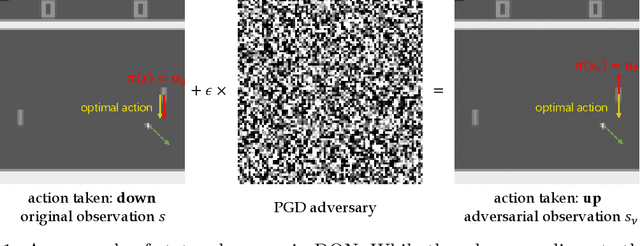
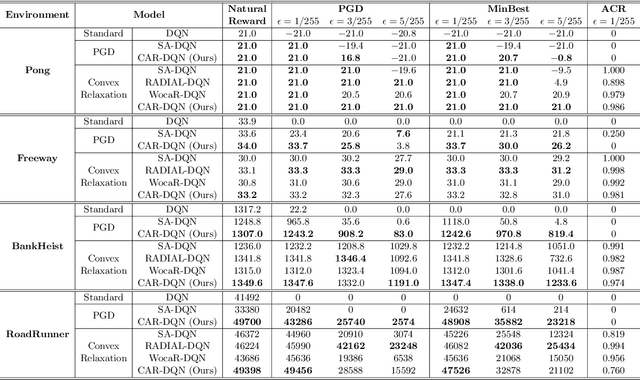
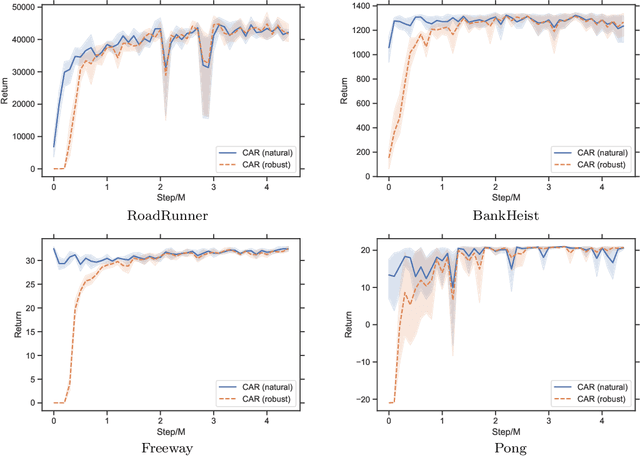
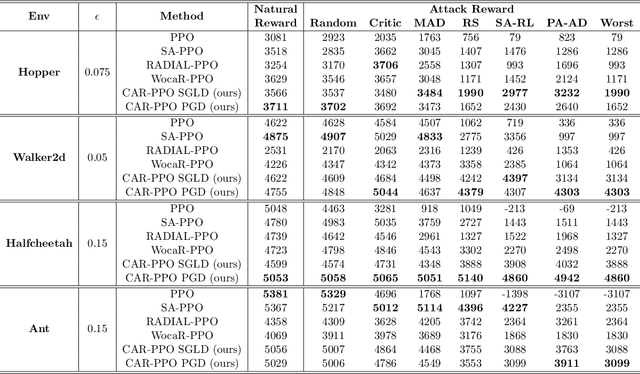
Ensuring the robustness of deep reinforcement learning (DRL) agents against adversarial attacks is critical for their trustworthy deployment. Recent research highlights the challenges of achieving state-adversarial robustness and suggests that an optimal robust policy (ORP) does not always exist, complicating the enforcement of strict robustness constraints. In this paper, we further explore the concept of ORP. We first introduce the Intrinsic State-adversarial Markov Decision Process (ISA-MDP), a novel formulation where adversaries cannot fundamentally alter the intrinsic nature of state observations. ISA-MDP, supported by empirical and theoretical evidence, universally characterizes decision-making under state-adversarial paradigms. We rigorously prove that within ISA-MDP, a deterministic and stationary ORP exists, aligning with the Bellman optimal policy. Our findings theoretically reveal that improving DRL robustness does not necessarily compromise performance in natural environments. Furthermore, we demonstrate the necessity of infinity measurement error (IME) in both $Q$-function and probability spaces to achieve ORP, unveiling vulnerabilities of previous DRL algorithms that rely on $1$-measurement errors. Motivated by these insights, we develop the Consistent Adversarial Robust Reinforcement Learning (CAR-RL) framework, which optimizes surrogates of IME. We apply CAR-RL to both value-based and policy-based DRL algorithms, achieving superior performance and validating our theoretical analysis.
Dual Alignment Maximin Optimization for Offline Model-based RL
Feb 02, 2025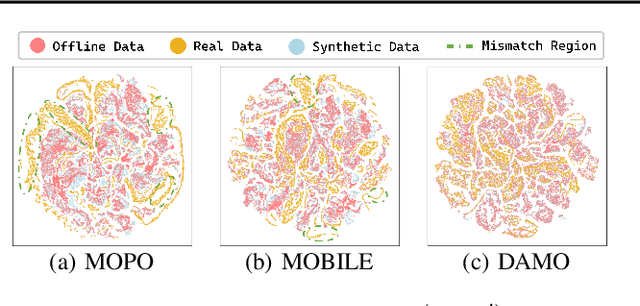
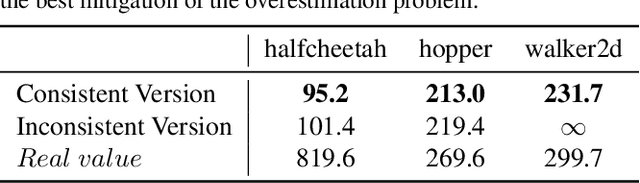
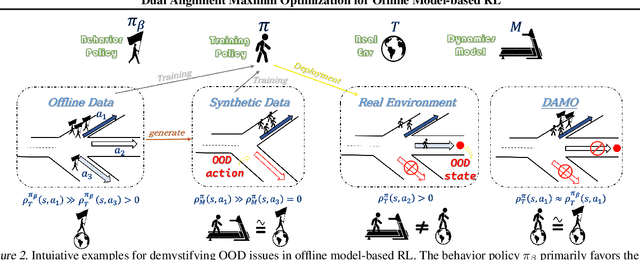
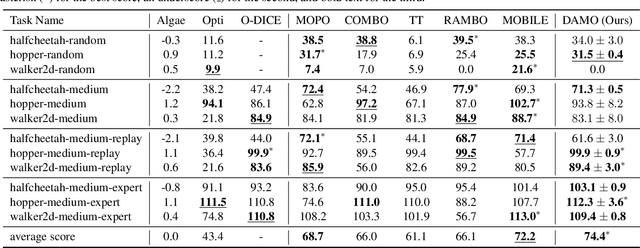
Offline reinforcement learning agents face significant deployment challenges due to the synthetic-to-real distribution mismatch. While most prior research has focused on improving the fidelity of synthetic sampling and incorporating off-policy mechanisms, the directly integrated paradigm often fails to ensure consistent policy behavior in biased models and underlying environmental dynamics, which inherently arise from discrepancies between behavior and learning policies. In this paper, we first shift the focus from model reliability to policy discrepancies while optimizing for expected returns, and then self-consistently incorporate synthetic data, deriving a novel actor-critic paradigm, Dual Alignment Maximin Optimization (DAMO). It is a unified framework to ensure both model-environment policy consistency and synthetic and offline data compatibility. The inner minimization performs dual conservative value estimation, aligning policies and trajectories to avoid out-of-distribution states and actions, while the outer maximization ensures that policy improvements remain consistent with inner value estimates. Empirical evaluations demonstrate that DAMO effectively ensures model and policy alignments, achieving competitive performance across diverse benchmark tasks.
SAMBO-RL: Shifts-aware Model-based Offline Reinforcement Learning
Aug 23, 2024Model-based Offline Reinforcement Learning trains policies based on offline datasets and model dynamics, without direct real-world environment interactions. However, this method is inherently challenged by distribution shift. Previous approaches have primarily focused on tackling this issue directly leveraging off-policy mechanisms and heuristic uncertainty in model dynamics, but they resulted in inconsistent objectives and lacked a unified theoretical foundation. This paper offers a comprehensive analysis that disentangles the problem into two key components: model bias and policy shift. We provide both theoretical insights and empirical evidence to demonstrate how these factors lead to inaccuracies in value function estimation and impose implicit restrictions on policy learning. To address these challenges, we derive adjustment terms for model bias and policy shift within a unified probabilistic inference framework. These adjustments are seamlessly integrated into the vanilla reward function to create a novel Shifts-aware Reward (SAR), aiming at refining value learning and facilitating policy training. Furthermore, we introduce Shifts-aware Model-based Offline Reinforcement Learning (SAMBO-RL), a practical framework that efficiently trains classifiers to approximate the SAR for policy optimization. Empirically, we show that SAR effectively mitigates distribution shift, and SAMBO-RL demonstrates superior performance across various benchmarks, underscoring its practical effectiveness and validating our theoretical analysis.
Towards Optimal Adversarial Robust Q-learning with Bellman Infinity-error
Feb 03, 2024Establishing robust policies is essential to counter attacks or disturbances affecting deep reinforcement learning (DRL) agents. Recent studies explore state-adversarial robustness and suggest the potential lack of an optimal robust policy (ORP), posing challenges in setting strict robustness constraints. This work further investigates ORP: At first, we introduce a consistency assumption of policy (CAP) stating that optimal actions in the Markov decision process remain consistent with minor perturbations, supported by empirical and theoretical evidence. Building upon CAP, we crucially prove the existence of a deterministic and stationary ORP that aligns with the Bellman optimal policy. Furthermore, we illustrate the necessity of $L^{\infty}$-norm when minimizing Bellman error to attain ORP. This finding clarifies the vulnerability of prior DRL algorithms that target the Bellman optimal policy with $L^{1}$-norm and motivates us to train a Consistent Adversarial Robust Deep Q-Network (CAR-DQN) by minimizing a surrogate of Bellman Infinity-error. The top-tier performance of CAR-DQN across various benchmarks validates its practical effectiveness and reinforces the soundness of our theoretical analysis.