 Add to Chrome
 Add to Firefox
 Add to Edge
WorldLines: Benchmarking and Modeling Long-Horizon Stateful Embodied Agents
Jun 17, 2026
To assist humans over extended periods in real homes, embodied agents must remember user routines, world states, and past interactions. Existing long-term memory benchmarks mainly evaluate language-centric retrieval and question answering, while embodied benchmarks often focus on short-horizon task execution without testing long-term memory use in dynamic environments. We introduce WorldLines, a project-driven benchmark for long-horizon embodied household assistance. It constructs temporally extended household traces with dialogues, actions, execution feedback, object and device state changes, and converts them into evidence-linked samples for Memory QA and Embodied Task Planning. We further propose ObsMem, an observer-grounded memory framework that maintains visibility-aware memories and action-native state trails for state-aware decisions. Experiments reveal persistent challenges in partial observability, overwritten world states, and translating long-term memory into embodied plans, while ObsMem offers a stronger reference architecture for this setting.

MC-Risk: Multi-Component Risk Fields for Risk Identification and Motion Planning
May 20, 2026We present MC-Risk, a planner-aligned, multi-component risk field on a bird's-eye-view grid that yields early, calibrated, and class-aware risk localization. MC-Risk linearly composes three interpretable modules: (i) a motorized-agent field that fuses a black-box multimodal trajectory predictor with an analytic Gaussian-torus construction whose lateral width grows with speed/curvature and whose height attenuates with look-ahead; (ii) a VRU risk field that replaces isotropic pedestrian blobs with a forward-biased anisotropic kernel aligned to heading and speed; and (iii) a road penalty field that exploits full HD-map topology, imposing an off-road penalty and lane-aware risk exposure for same/opposite directions. We conduct, to our knowledge, the first standardized quantitative evaluation of a risk-field formulation on RiskBench's collision subset. MC-Risk attains the best overall risk localization and the earliest hazard indication. Finally, we demonstrate a plug-and-play planning interface by using the field as an MPC cost density, enabling risk-aware trajectory generation without additional training.
RoboEvolve: Co-Evolving Planner-Simulator for Robotic Manipulation with Limited Data
May 13, 2026The scalability of robotic manipulation is fundamentally bottlenecked by the scarcity of task-aligned physical interaction data. While vision-language models (VLMs) and video generation models (VGMs) hold promise for autonomous data synthesis, they suffer from semantic-spatial misalignment and physical hallucinations, respectively. To bridge this gap, we introduce RoboEvolve, a novel framework that couples a VLM planner and a VGM simulator into a mutually reinforcing co-evolutionary loop. Operating purely on unlabeled seed images, RoboEvolve leverages a cognitive-inspired dual-phase mechanism: (i) daytime exploration fosters physically grounded behavioral discovery through a semantic-controlled multi-granular reward, and (ii) nighttime consolidation mines "near-miss" failures to stabilize policy optimization. Guided by an autonomous progressive curriculum, the system naturally scales from simple atomic actions to complex tasks. Extensive experiments demonstrate that RoboEvolve (I) achieves superior effectiveness, elevating base planners by 30 absolute points and amplifying simulator success by 48% on average; (II) exhibits extreme data efficiency, surpassing fully supervised baselines with merely 500 unlabeled seeds--a 50x reduction; and (III) demonstrates robust continual learning without catastrophic forgetting.
SegRGB-X: General RGB-X Semantic Segmentation Model
Mar 30, 2026Semantic segmentation across arbitrary sensor modalities faces significant challenges due to diverse sensor characteristics, and the traditional configurations for this task result in redundant development efforts. We address these challenges by introducing a universal arbitrary-modal semantic segmentation framework that unifies segmentation across multiple modalities. Our approach features three key innovations: (1) the Modality-aware CLIP (MA-CLIP), which provides modality-specific scene understanding guidance through LoRA fine-tuning; (2) Modality-aligned Embeddings for capturing fine-grained features; and (3) the Domain-specific Refinement Module (DSRM) for dynamic feature adjustment. Evaluated on five diverse datasets with different complementary modalities (event, thermal, depth, polarization, and light field), our model surpasses specialized multi-modal methods and achieves state-of-the-art performance with a mIoU of 65.03%. The codes will be released upon acceptance.
AgentRob: From Virtual Forum Agents to Hijacked Physical Robots
Feb 14, 2026Large Language Model (LLM)-powered autonomous agents have demonstrated significant capabilities in virtual environments, yet their integration with the physical world remains narrowly confined to direct control interfaces. We present AgentRob, a framework that bridges online community forums, LLM-powered agents, and physical robots through the Model Context Protocol (MCP). AgentRob enables a novel paradigm where autonomous agents participate in online forums--reading posts, extracting natural language commands, dispatching physical robot actions, and reporting results back to the community. The system comprises three layers: a Forum Layer providing asynchronous, persistent, multi-agent interaction; an Agent Layer with forum agents that poll for @mention-targeted commands; and a Robot Layer with VLM-driven controllers and Unitree Go2/G1 hardware that translate commands into robot primitives via iterative tool calling. The framework supports multiple concurrent agents with distinct identities and physical embodiments coexisting in the same forum, establishing the feasibility of forum-mediated multi-agent robot orchestration.
Distributed MIMO Positioning: Fundamental Limit Analysis and User Tracking Framework Design
Nov 17, 2025This paper presents a comprehensive study on the 3D positioning capabilities in distributed multiple-input multiple-output (MIMO) systems. Unlike previous studies that mainly rely on idealized isotropic antenna models, we adopt a polarimetric model that takes advantage of effective aperture distribution functions to characterize realistic antenna patterns, placements, and polarization effects. Based on this model, we analyze the fundamental limits of UE positioning using the Fisher information matrix (FIM) and the position error bound (PEB). The FIM is shown to be expressed as a weighted sum of the information contributions from individual access point (AP)-UE pairs, with each contribution interpreted geometrically across distance, azimuth, and elevation dimensions. The impact of the UE tilt and the spatial distribution of APs on the PEBs is further analyzed. As a further advancement, we propose a complete positioning framework from a UE tracking perspective. By integrating a global probability hypothesis density filter and a PEB-aware AP management strategy, the framework enables accurate tracking while optimizing AP scheduling. Finally, we present a distributed MIMO channel measurement campaign to validate the proposed framework. The results demonstrate a centimeter-level tracking accuracy. In addition, the PEB-aware AP management strategy is shown to maintain robust tracking performance while significantly reducing the number of concurrently active APs, thus lowering the overall system overhead.
3D Cooperative User Tracking for Distributed Integrated Sensing and Communication
Nov 05, 2025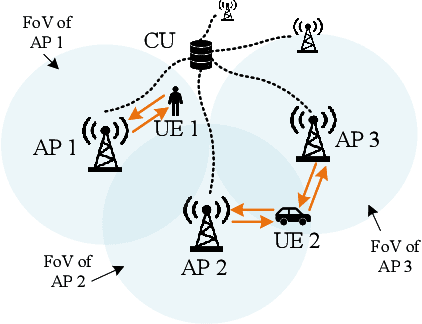
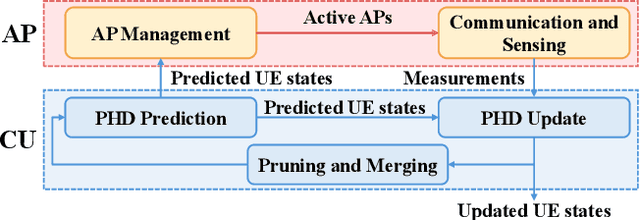
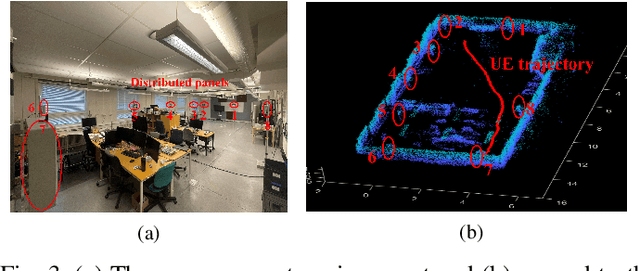
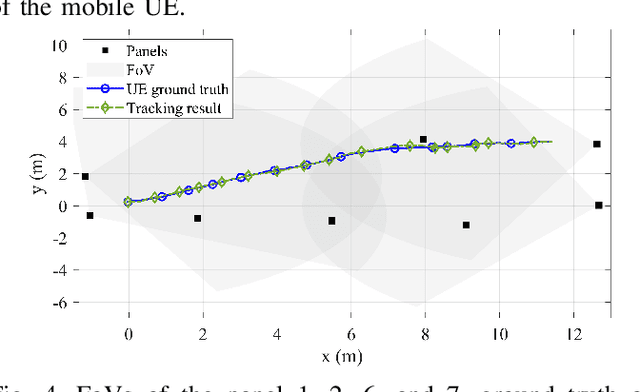
As integrated sensing and communication (ISAC) becomes an integral part of 6G networks, distributed ISAC (DISAC) is expected to enhance both sensing and communication performance through its decentralized architecture. This paper presents a complete framework to address the challenge of cooperative user tracking in DISAC systems. By incorporating a global probability hypothesis density (PHD) filter and a field-of-view-aware access point (AP) management strategy, the framework enables accurate user tracking using radio signals while optimizing AP scheduling. In addition, a real-world distributed MIMO channel measurement campaign is performed to evaluate the effectiveness of the framework. The results demonstrate that a centimeter-level root mean-square trajectory error can be achieved. Furthermore, the results show that it is not necessary to keep APs active at all times to maintain high tracking accuracy, indicating the need for robust and efficient AP management. These findings provide valuable insight into practical deployments and further development of cooperative user tracking techniques in DISAC systems.
BuildSTG: A Multi-building Energy Load Forecasting Method using Spatio-Temporal Graph Neural Network
Jul 28, 2025Due to the extensive availability of operation data, data-driven methods show strong capabilities in predicting building energy loads. Buildings with similar features often share energy patterns, reflected by spatial dependencies in their operational data, which conventional prediction methods struggle to capture. To overcome this, we propose a multi-building prediction approach using spatio-temporal graph neural networks, comprising graph representation, graph learning, and interpretation. First, a graph is built based on building characteristics and environmental factors. Next, a multi-level graph convolutional architecture with attention is developed for energy prediction. Lastly, a method interpreting the optimized graph structure is introduced. Experiments on the Building Data Genome Project 2 dataset confirm superior performance over baselines such as XGBoost, SVR, FCNN, GRU, and Naive, highlighting the method's robustness, generalization, and interpretability in capturing meaningful building similarities and spatial relationships.
Advancing high-fidelity 3D and Texture Generation with 2.5D latents
May 28, 2025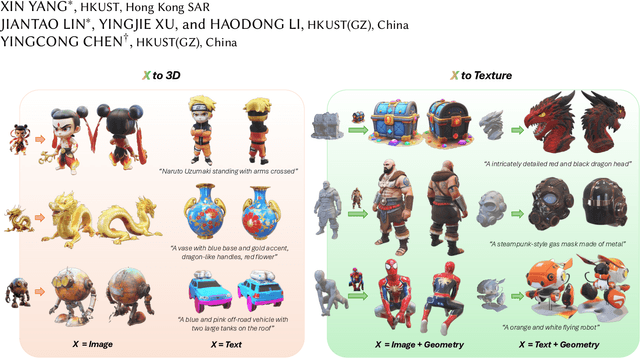

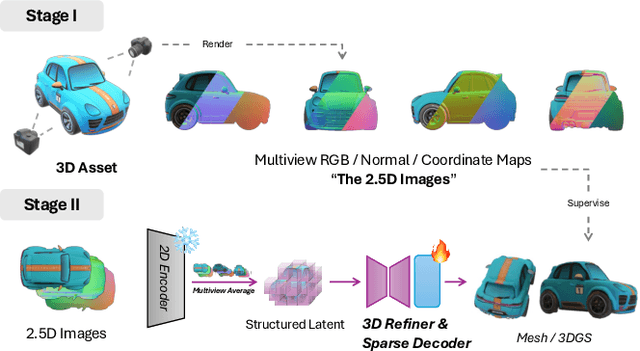
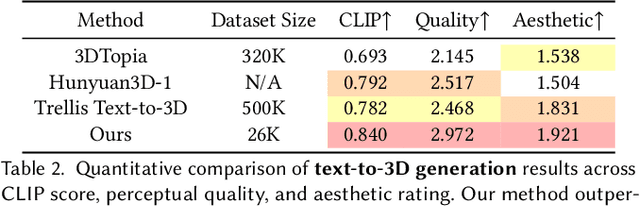
Despite the availability of large-scale 3D datasets and advancements in 3D generative models, the complexity and uneven quality of 3D geometry and texture data continue to hinder the performance of 3D generation techniques. In most existing approaches, 3D geometry and texture are generated in separate stages using different models and non-unified representations, frequently leading to unsatisfactory coherence between geometry and texture. To address these challenges, we propose a novel framework for joint generation of 3D geometry and texture. Specifically, we focus in generate a versatile 2.5D representations that can be seamlessly transformed between 2D and 3D. Our approach begins by integrating multiview RGB, normal, and coordinate images into a unified representation, termed as 2.5D latents. Next, we adapt pre-trained 2D foundation models for high-fidelity 2.5D generation, utilizing both text and image conditions. Finally, we introduce a lightweight 2.5D-to-3D refiner-decoder framework that efficiently generates detailed 3D representations from 2.5D images. Extensive experiments demonstrate that our model not only excels in generating high-quality 3D objects with coherent structure and color from text and image inputs but also significantly outperforms existing methods in geometry-conditioned texture generation.
Sparse Arrays Enable Near-Field Constant-Distance Focusing with Reduced Focal Shift
May 12, 2025In near-field beam focusing for finite-sized arrays, focal shift is a non-negligible issue. The actual focal point often appears closer to the array than the predefined focal distance, significantly degrading the focusing performance of finite aperture arrays. Moreover, when the focus point is scanned across different locations, the degradation becomes even more pronounced, leading not only to positional deviation but also to substantial energy loss. To address this issue, we revisit the problem from the perspective of communication degrees of freedom. We demonstrate that a properly designed sparse array with optimized element spacing can effectively mitigate focal shift while enabling stable control of the focusing height during beam scanning. Simulation results based on dipole antennas with different polarizations and patch antennas validate our findings. Notably, with optimized inter-element distances, the energy distribution across focal points becomes nearly uniform, and highly accurate focusing positions are achieved.