 Add to Chrome
 Add to Firefox
 Add to Edge
No Place to Hide: Benchmarking Video Hallucination with Background-Controlled Pairs
Jun 30, 2026
We introduce VidPair-Halluc, a new benchmark for evaluating video hallucination in large video models (LVMs) under rigorous and controlled conditions. Unlike previous benchmarks that primarily rely on text-based perturbations or adversarial questions while neglecting the consistency of visual backgrounds, VidPair-Halluc features video pairs with highly similar backgrounds but distinctly different foreground semantics, enabling precise attribution of model errors to genuine hallucination rather than background variation. The benchmark is constructed through PairFlow, a pipeline that leverages recent advances in text-to-image and video generation to systematically compose stories, generate coherent video clips, and assemble them into adversarial pairs. Covering both spatial and temporal reasoning across ten semantic aspects, VidPair-Halluc comprises 1K high-quality adversarial video pairs and 11K spatio-temporal QA pairs with control over background and foreground variations. Evaluations on mainstream LVMs show persistent difficulty with robust fine-grained video understanding in adversarial settings, and code and data are available at the https://jethrojames.github.io/VidPair-Halluc/.

OmniCoT: A Benchmark for Global and Multi-Step Panoramic Reasoning
Jun 29, 2026Multimodal Large Language Models (MLLMs) have demonstrated promising spatial reasoning capabilities, while these abilities remain underexplored in the emerging visual modality of panoramic imagery. The full 360°$\times$180° field of view of panoramas essentially supports complex global multi-step reasoning, which is also the fundamental advantage of panoramas in applications such as embodied intelligence. However, existing panoramic benchmarks largely focus on simplistic queries that rely on local cues or single-/few-step reasoning, thereby ignoring the fundamental advantage of panoramas and failing to fully exploit their potential. To address this gap, we introduce OmniCoT, a panoramic spatial reasoning suite designed to enable MLLMs to use global evidence and perform multi-step inference across viewpoints. It includes OmniCoT-B (6.7K data) for evaluation, which measures both answer accuracy and reasoning quality, OmniCoT-Real (1K data) as a manually annotated real-world subset to quantify the Sim-to-Real gap. For training, OmniCoT-T (14.3K data) is purpose-built with structured stepwise Chain-of-Thought annotations that explicitly link intermediate reasoning steps to panoramic evidence. Based on OmniCoT-T, we introduce OmniCoT-R1 and adopt a two-stage training strategy tailored to the geometrically complex panoramic space, where Supervised Fine-tuning (SFT) anchors reasoning to panoramic evidence (e.g., bearings, proximity) and GRPO penalizes geometrically incoherent paths to consolidate global 360° spatial consistency. Through OmniCoT, we aim to recalibrate the difficulty of panoramic spatial reasoning to better align with the intrinsic capabilities of panoramic imagery, thereby fostering meaningful progress in this research area.
RoboEvolve: Co-Evolving Planner-Simulator for Robotic Manipulation with Limited Data
May 13, 2026The scalability of robotic manipulation is fundamentally bottlenecked by the scarcity of task-aligned physical interaction data. While vision-language models (VLMs) and video generation models (VGMs) hold promise for autonomous data synthesis, they suffer from semantic-spatial misalignment and physical hallucinations, respectively. To bridge this gap, we introduce RoboEvolve, a novel framework that couples a VLM planner and a VGM simulator into a mutually reinforcing co-evolutionary loop. Operating purely on unlabeled seed images, RoboEvolve leverages a cognitive-inspired dual-phase mechanism: (i) daytime exploration fosters physically grounded behavioral discovery through a semantic-controlled multi-granular reward, and (ii) nighttime consolidation mines "near-miss" failures to stabilize policy optimization. Guided by an autonomous progressive curriculum, the system naturally scales from simple atomic actions to complex tasks. Extensive experiments demonstrate that RoboEvolve (I) achieves superior effectiveness, elevating base planners by 30 absolute points and amplifying simulator success by 48% on average; (II) exhibits extreme data efficiency, surpassing fully supervised baselines with merely 500 unlabeled seeds--a 50x reduction; and (III) demonstrates robust continual learning without catastrophic forgetting.
Panoramic Affordance Prediction
Mar 16, 2026Affordance prediction serves as a critical bridge between perception and action in embodied AI. However, existing research is confined to pinhole camera models, which suffer from narrow Fields of View (FoV) and fragmented observations, often missing critical holistic environmental context. In this paper, we present the first exploration into Panoramic Affordance Prediction, utilizing 360-degree imagery to capture global spatial relationships and holistic scene understanding. To facilitate this novel task, we first introduce PAP-12K, a large-scale benchmark dataset containing over 1,000 ultra-high-resolution (12k, 11904 x 5952) panoramic images with over 12k carefully annotated QA pairs and affordance masks. Furthermore, we propose PAP, a training-free, coarse-to-fine pipeline inspired by the human foveal visual system to tackle the ultra-high resolution and severe distortion inherent in panoramic images. PAP employs recursive visual routing via grid prompting to progressively locate targets, applies an adaptive gaze mechanism to rectify local geometric distortions, and utilizes a cascaded grounding pipeline to extract precise instance-level masks. Experimental results on PAP-12K reveal that existing affordance prediction methods designed for standard perspective images suffer severe performance degradation and fail due to the unique challenges of panoramic vision. In contrast, PAP framework effectively overcomes these obstacles, significantly outperforming state-of-the-art baselines and highlighting the immense potential of panoramic perception for robust embodied intelligence.
DVD: Deterministic Video Depth Estimation with Generative Priors
Mar 12, 2026Existing video depth estimation faces a fundamental trade-off: generative models suffer from stochastic geometric hallucinations and scale drift, while discriminative models demand massive labeled datasets to resolve semantic ambiguities. To break this impasse, we present DVD, the first framework to deterministically adapt pre-trained video diffusion models into single-pass depth regressors. Specifically, DVD features three core designs: (i) repurposing the diffusion timestep as a structural anchor to balance global stability with high-frequency details; (ii) latent manifold rectification (LMR) to mitigate regression-induced over-smoothing, enforcing differential constraints to restore sharp boundaries and coherent motion; and (iii) global affine coherence, an inherent property bounding inter-window divergence, which enables seamless long-video inference without requiring complex temporal alignment. Extensive experiments demonstrate that DVD achieves state-of-the-art zero-shot performance across benchmarks. Furthermore, DVD successfully unlocks the profound geometric priors implicit in video foundation models using 163x less task-specific data than leading baselines. Notably, we fully release our pipeline, providing the whole training suite for SOTA video depth estimation to benefit the open-source community.
LoopViT: Scaling Visual ARC with Looped Transformers
Feb 02, 2026Recent advances in visual reasoning have leveraged vision transformers to tackle the ARC-AGI benchmark. However, we argue that the feed-forward architecture, where computational depth is strictly bound to parameter size, falls short of capturing the iterative, algorithmic nature of human induction. In this work, we propose a recursive architecture called Loop-ViT, which decouples reasoning depth from model capacity through weight-tied recurrence. Loop-ViT iterates a weight-tied Hybrid Block, combining local convolutions and global attention, to form a latent chain of thought. Crucially, we introduce a parameter-free Dynamic Exit mechanism based on predictive entropy: the model halts inference when its internal state ``crystallizes" into a low-uncertainty attractor. Empirical results on the ARC-AGI-1 benchmark validate this perspective: our 18M model achieves 65.8% accuracy, outperforming massive 73M-parameter ensembles. These findings demonstrate that adaptive iterative computation offers a far more efficient scaling axis for visual reasoning than simply increasing network width. The code is available at https://github.com/WenjieShu/LoopViT.
Show, Don't Tell: Morphing Latent Reasoning into Image Generation
Feb 02, 2026Text-to-image (T2I) generation has achieved remarkable progress, yet existing methods often lack the ability to dynamically reason and refine during generation--a hallmark of human creativity. Current reasoning-augmented paradigms most rely on explicit thought processes, where intermediate reasoning is decoded into discrete text at fixed steps with frequent image decoding and re-encoding, leading to inefficiencies, information loss, and cognitive mismatches. To bridge this gap, we introduce LatentMorph, a novel framework that seamlessly integrates implicit latent reasoning into the T2I generation process. At its core, LatentMorph introduces four lightweight components: (i) a condenser for summarizing intermediate generation states into compact visual memory, (ii) a translator for converting latent thoughts into actionable guidance, (iii) a shaper for dynamically steering next image token predictions, and (iv) an RL-trained invoker for adaptively determining when to invoke reasoning. By performing reasoning entirely in continuous latent spaces, LatentMorph avoids the bottlenecks of explicit reasoning and enables more adaptive self-refinement. Extensive experiments demonstrate that LatentMorph (I) enhances the base model Janus-Pro by $16\%$ on GenEval and $25\%$ on T2I-CompBench; (II) outperforms explicit paradigms (e.g., TwiG) by $15\%$ and $11\%$ on abstract reasoning tasks like WISE and IPV-Txt, (III) while reducing inference time by $44\%$ and token consumption by $51\%$; and (IV) exhibits $71\%$ cognitive alignment with human intuition on reasoning invocation.
A4-Agent: An Agentic Framework for Zero-Shot Affordance Reasoning
Dec 16, 2025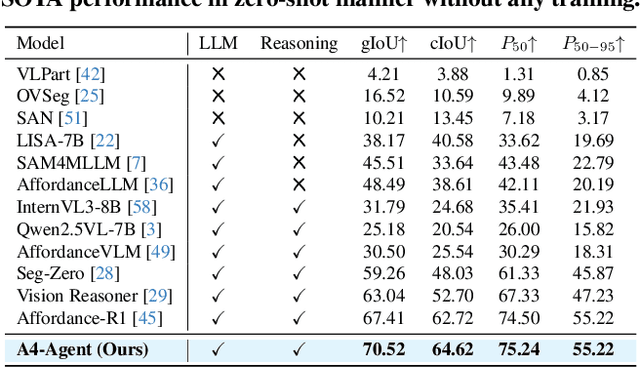
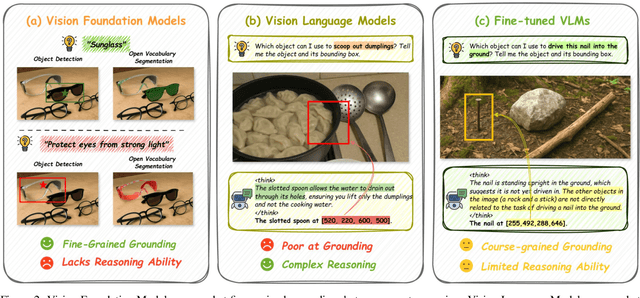
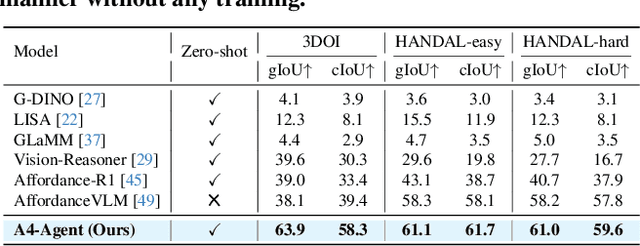
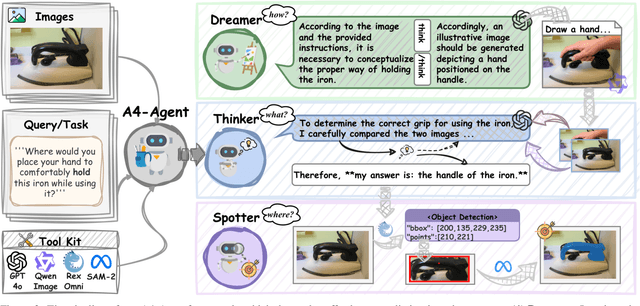
Affordance prediction, which identifies interaction regions on objects based on language instructions, is critical for embodied AI. Prevailing end-to-end models couple high-level reasoning and low-level grounding into a single monolithic pipeline and rely on training over annotated datasets, which leads to poor generalization on novel objects and unseen environments. In this paper, we move beyond this paradigm by proposing A4-Agent, a training-free agentic framework that decouples affordance prediction into a three-stage pipeline. Our framework coordinates specialized foundation models at test time: (1) a $\textbf{Dreamer}$ that employs generative models to visualize $\textit{how}$ an interaction would look; (2) a $\textbf{Thinker}$ that utilizes large vision-language models to decide $\textit{what}$ object part to interact with; and (3) a $\textbf{Spotter}$ that orchestrates vision foundation models to precisely locate $\textit{where}$ the interaction area is. By leveraging the complementary strengths of pre-trained models without any task-specific fine-tuning, our zero-shot framework significantly outperforms state-of-the-art supervised methods across multiple benchmarks and demonstrates robust generalization to real-world settings.
TiViBench: Benchmarking Think-in-Video Reasoning for Video Generative Models
Nov 17, 2025The rapid evolution of video generative models has shifted their focus from producing visually plausible outputs to tackling tasks requiring physical plausibility and logical consistency. However, despite recent breakthroughs such as Veo 3's chain-of-frames reasoning, it remains unclear whether these models can exhibit reasoning capabilities similar to large language models (LLMs). Existing benchmarks predominantly evaluate visual fidelity and temporal coherence, failing to capture higher-order reasoning abilities. To bridge this gap, we propose TiViBench, a hierarchical benchmark specifically designed to evaluate the reasoning capabilities of image-to-video (I2V) generation models. TiViBench systematically assesses reasoning across four dimensions: i) Structural Reasoning & Search, ii) Spatial & Visual Pattern Reasoning, iii) Symbolic & Logical Reasoning, and iv) Action Planning & Task Execution, spanning 24 diverse task scenarios across 3 difficulty levels. Through extensive evaluations, we show that commercial models (e.g., Sora 2, Veo 3.1) demonstrate stronger reasoning potential, while open-source models reveal untapped potential that remains hindered by limited training scale and data diversity. To further unlock this potential, we introduce VideoTPO, a simple yet effective test-time strategy inspired by preference optimization. By performing LLM self-analysis on generated candidates to identify strengths and weaknesses, VideoTPO significantly enhances reasoning performance without requiring additional training, data, or reward models. Together, TiViBench and VideoTPO pave the way for evaluating and advancing reasoning in video generation models, setting a foundation for future research in this emerging field.
Temporal Regularization Makes Your Video Generator Stronger
Mar 19, 2025Temporal quality is a critical aspect of video generation, as it ensures consistent motion and realistic dynamics across frames. However, achieving high temporal coherence and diversity remains challenging. In this work, we explore temporal augmentation in video generation for the first time, and introduce FluxFlow for initial investigation, a strategy designed to enhance temporal quality. Operating at the data level, FluxFlow applies controlled temporal perturbations without requiring architectural modifications. Extensive experiments on UCF-101 and VBench benchmarks demonstrate that FluxFlow significantly improves temporal coherence and diversity across various video generation models, including U-Net, DiT, and AR-based architectures, while preserving spatial fidelity. These findings highlight the potential of temporal augmentation as a simple yet effective approach to advancing video generation quality.