 Add to Chrome
 Add to Firefox
 Add to Edge
CoverPrune: Coverage-Driven Token Pruning for 3D VLMs via Optimal Transport
Aug 13, 2026
While 3D Vision-Language Models (3D VLMs) have demonstrated remarkable spatial reasoning capabilities, they suffer from massive visual token counts that create severe computational bottlenecks during inference. Existing token pruning methods primarily rely on diversity-based selection, discarding similar tokens to maximize dispersion. However, in 3D environments, this approach frequently drops representative prototype tokens in favor of outliers, breaking the multi-view consistencies and geometric structures essential for spatial reasoning. In this paper, we propose a paradigm shift for 3D VLM token pruning: from maximizing diversity to preserving visual evidence coverage. We introduce CoverPrune, a training-free framework that formulates inference-time token pruning as an Optimal Transport (OT) problem. To overcome the intractable combinatorial subset selection inherent in this formulation, we design the Feature-Spatial-Temporal (FST) transport cost and target capacity, along with an efficient Spatial-Guided Greedy Selection (SGS) algorithm to approximate the OT objective. Furthermore, we propose CoverPrune-Lite, an accelerated variant utilizing spatially structured local matching for minimal overhead. Extensive experiments across multiple 3D visual-spatial reasoning benchmarks demonstrate that our methods achieve state-of-the-art token efficiency, maintaining robust reasoning performance even under highly aggressive pruning budgets. Visit our project website at https://github.com/Brucess/CoverPrune.

Scenix: Sparse-View 3D Scene Reconstruction via Executable Scene Programs
Aug 07, 2026Synthesizing a structured and editable 3D indoor scene from a few uncalibrated RGB views requires more than generating high-quality individual assets: a system must infer the room structure, associate objects across incomplete observations, and recover a globally consistent spatial configuration. Previous methods mainly focus on 3D scene generation with text input or require continuous visual inputs with additional priors, \ e.g., human-annotated masks or accurate 3D layouts, which makes these methods labor demanding and hard to apply in general cases. We present \textsc{Scenix}, a sparse-view 3D scene reconstruction framework via executable scene programs, a structured representation that can be directly instantiated into editable 3D scenes. Given sparse views, \textsc{Scenix} predicts executable scene programs through perception-grounded asset instantiation and closed-loop spatial refinement. % We present \method, a framework that predicts an executable scene representation from sparse views and realizes it through perception-grounded asset instantiation and closed-loop spatial refinement. To support this task, we construct \dataset, a dataset of approximately 110,000 synthetic and real indoor scenes with multiview imagery, room structures, object-centric descriptions, and metric spatial annotations. We further introduce observation-consistent supervision that aligns each target scene with the visual evidence available in its input views. Experiments on held-out \textsc{XScene} scenes, real indoor images, and out-of-distribution SpatialGen cases evaluate structured scene prediction, object grounding, and spatial refinement.
MSVS-VAE: Multi-Scale Anchored VecSet for High-Fidelity 3D Reconstruction
Jul 27, 2026High-fidelity 3D generative modeling increasingly relies on the latent diffusion paradigm, where the reconstruction quality of the underlying 3D VAE becomes a primary bottleneck. Existing approaches largely follow two paradigms: sparse voxel-based representations achieve strong reconstruction quality but incur significant memory and computational overhead, while set-based representations are compact and continuous yet typically lag in fidelity due to latent sparsity and excessive global smoothness. We propose MSVS-VAE, a hierarchical set-based VAE that closes this fidelity gap without sacrificing compactness. Our key idea is to progressively densify anchored VecSet latents via hierarchical point-shuffle upsampling, increasing spatial capacity for fine-grained geometry modeling. To efficiently decode from the densified hierarchy, we replace global cross-attention with AVS-Conv, a geometry-aware local aggregation operator operating within local neighborhoods rather than the exhaustive latent set. We further introduce multi-scale query decoding to fuse coarse-to-fine latent features, where coarse scales provide stable global context, and fine scales refine localized geometry, reducing artifacts from overly local receptive fields. Extensive experiments on Objaverse, ABO, and in-the-wild benchmarks demonstrate that MSVS-VAE consistently outperforms prior set-based and voxel-based VAEs, delivering approximately 10x faster decoding than prior set-based methods and approximately 10x higher compactness than voxel-based baselines.
SAP: Segment Any 4K Panorama
Mar 13, 2026Promptable instance segmentation is widely adopted in embodied and AR systems, yet the performance of foundation models trained on perspective imagery often degrades on 360° panoramas. In this paper, we introduce Segment Any 4K Panorama (SAP), a foundation model for 4K high-resolution panoramic instance-level segmentation. We reformulate panoramic segmentation as fixed-trajectory perspective video segmentation, decomposing a panorama into overlapping perspective patches sampled along a continuous spherical traversal. This memory-aligned reformulation preserves native 4K resolution while restoring the smooth viewpoint transitions required for stable cross-view propagation. To enable large-scale supervision, we synthesize 183,440 4K-resolution panoramic images with instance segmentation labels using the InfiniGen engine. Trained under this trajectory-aligned paradigm, SAP generalizes effectively to real-world 360° images, achieving +17.2 zero-shot mIoU gain over vanilla SAM2 of different sizes on real-world 4K panorama benchmark.
CoSMo3D: Open-World Promptable 3D Semantic Part Segmentation through LLM-Guided Canonical Spatial Modeling
Mar 01, 2026Open-world promptable 3D semantic segmentation remains brittle as semantics are inferred in the input sensor coordinates. Yet, humans, in contrast, interpret parts via functional roles in a canonical space -- wings extend laterally, handles protrude to the side, and legs support from below. Psychophysical evidence shows that we mentally rotate objects into canonical frames to reveal these roles. To fill this gap, we propose \methodName{}, which attains canonical space perception by inducing a latent canonical reference frame learned directly from data. By construction, we create a unified canonical dataset through LLM-guided intra- and cross-category alignment, exposing canonical spatial regularities across 200 categories. By induction, we realize canonicality inside the model through a dual-branch architecture with canonical map anchoring and canonical box calibration, collapsing pose variation and symmetry into a stable canonical embedding. This shift from input pose space to canonical embedding yields far more stable and transferable part semantics. Experimental results show that \methodName{} establishes new state of the art in open-world promptable 3D segmentation.
Large Material Gaussian Model for Relightable 3D Generation
Sep 26, 2025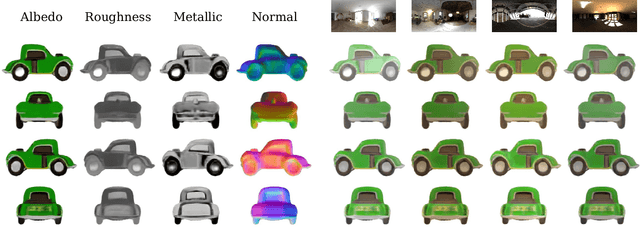
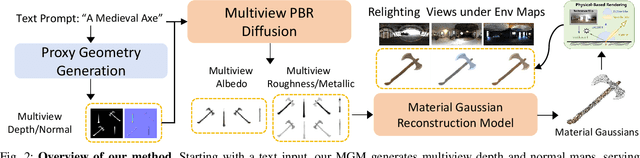
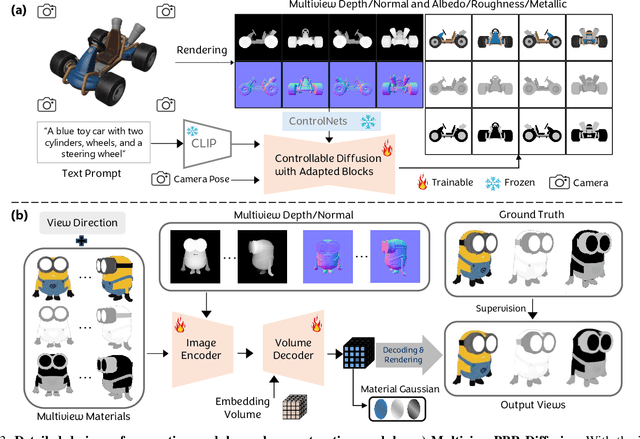
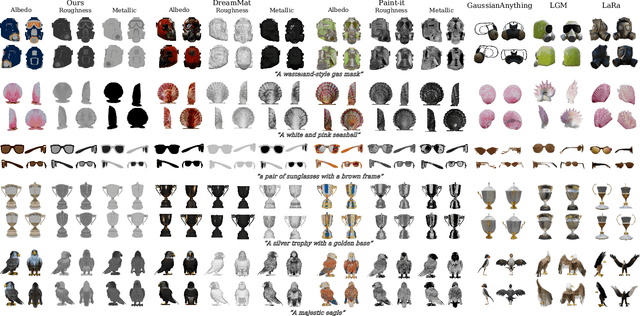
The increasing demand for 3D assets across various industries necessitates efficient and automated methods for 3D content creation. Leveraging 3D Gaussian Splatting, recent large reconstruction models (LRMs) have demonstrated the ability to efficiently achieve high-quality 3D rendering by integrating multiview diffusion for generation and scalable transformers for reconstruction. However, existing models fail to produce the material properties of assets, which is crucial for realistic rendering in diverse lighting environments. In this paper, we introduce the Large Material Gaussian Model (MGM), a novel framework designed to generate high-quality 3D content with Physically Based Rendering (PBR) materials, ie, albedo, roughness, and metallic properties, rather than merely producing RGB textures with uncontrolled light baking. Specifically, we first fine-tune a new multiview material diffusion model conditioned on input depth and normal maps. Utilizing the generated multiview PBR images, we explore a Gaussian material representation that not only aligns with 2D Gaussian Splatting but also models each channel of the PBR materials. The reconstructed point clouds can then be rendered to acquire PBR attributes, enabling dynamic relighting by applying various ambient light maps. Extensive experiments demonstrate that the materials produced by our method not only exhibit greater visual appeal compared to baseline methods but also enhance material modeling, thereby enabling practical downstream rendering applications.
SLAM3R: Real-Time Dense Scene Reconstruction from Monocular RGB Videos
Dec 12, 2024In this paper, we introduce \textbf{SLAM3R}, a novel and effective monocular RGB SLAM system for real-time and high-quality dense 3D reconstruction. SLAM3R provides an end-to-end solution by seamlessly integrating local 3D reconstruction and global coordinate registration through feed-forward neural networks. Given an input video, the system first converts it into overlapping clips using a sliding window mechanism. Unlike traditional pose optimization-based methods, SLAM3R directly regresses 3D pointmaps from RGB images in each window and progressively aligns and deforms these local pointmaps to create a globally consistent scene reconstruction - all without explicitly solving any camera parameters. Experiments across datasets consistently show that SLAM3R achieves state-of-the-art reconstruction accuracy and completeness while maintaining real-time performance at 20+ FPS. Code and weights at: \url{https://github.com/PKU-VCL-3DV/SLAM3R}.
SAI3D: Segment Any Instance in 3D Scenes
Dec 17, 2023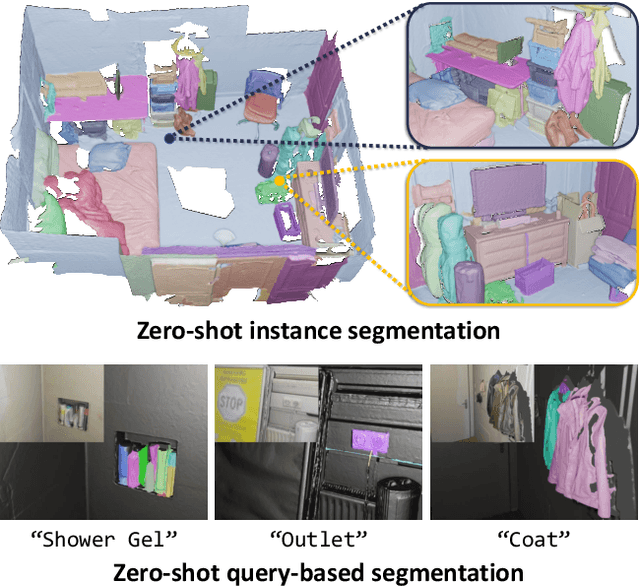
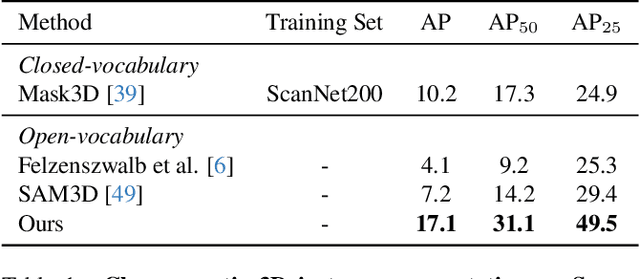
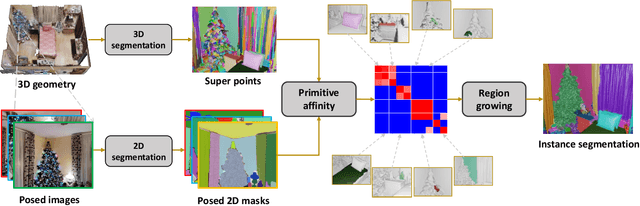

Advancements in 3D instance segmentation have traditionally been tethered to the availability of annotated datasets, limiting their application to a narrow spectrum of object categories. Recent efforts have sought to harness vision-language models like CLIP for open-set semantic reasoning, yet these methods struggle to distinguish between objects of the same categories and rely on specific prompts that are not universally applicable. In this paper, we introduce SAI3D, a novel zero-shot 3D instance segmentation approach that synergistically leverages geometric priors and semantic cues derived from Segment Anything Model (SAM). Our method partitions a 3D scene into geometric primitives, which are then progressively merged into 3D instance segmentations that are consistent with the multi-view SAM masks. Moreover, we design a hierarchical region-growing algorithm with a dynamic thresholding mechanism, which largely improves the robustness of finegrained 3D scene parsing. Empirical evaluations on Scan-Net and the more challenging ScanNet++ datasets demonstrate the superiority of our approach. Notably, SAI3D outperforms existing open-vocabulary baselines and even surpasses fully-supervised methods in class-agnostic segmentation on ScanNet++.
Towards Robust Probabilistic Modeling on SO(3) via Rotation Laplace Distribution
May 17, 2023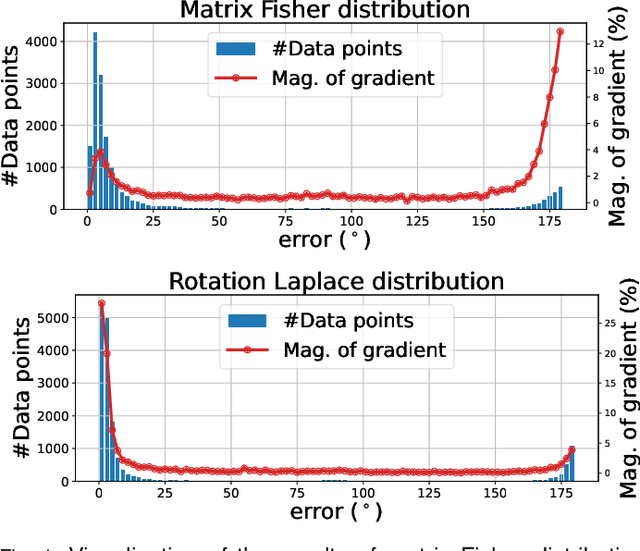
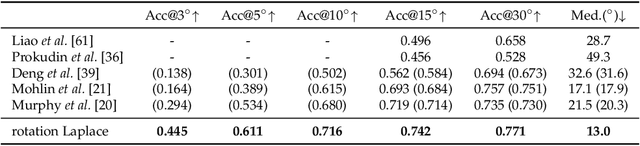
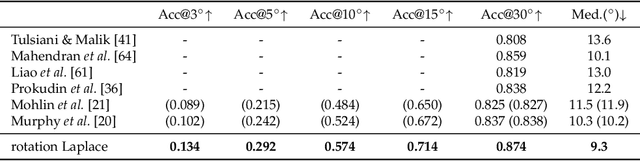

Estimating the 3DoF rotation from a single RGB image is an important yet challenging problem. As a popular approach, probabilistic rotation modeling additionally carries prediction uncertainty information, compared to single-prediction rotation regression. For modeling probabilistic distribution over SO(3), it is natural to use Gaussian-like Bingham distribution and matrix Fisher, however they are shown to be sensitive to outlier predictions, e.g. $180^\circ$ error and thus are unlikely to converge with optimal performance. In this paper, we draw inspiration from multivariate Laplace distribution and propose a novel rotation Laplace distribution on SO(3). Our rotation Laplace distribution is robust to the disturbance of outliers and enforces much gradient to the low-error region that it can improve. In addition, we show that our method also exhibits robustness to small noises and thus tolerates imperfect annotations. With this benefit, we demonstrate its advantages in semi-supervised rotation regression, where the pseudo labels are noisy. To further capture the multi-modal rotation solution space for symmetric objects, we extend our distribution to rotation Laplace mixture model and demonstrate its effectiveness. Our extensive experiments show that our proposed distribution and the mixture model achieve state-of-the-art performance in all the rotation regression experiments over both probabilistic and non-probabilistic baselines.
Delving into Discrete Normalizing Flows on SO Manifold for Probabilistic Rotation Modeling
Apr 08, 2023Normalizing flows (NFs) provide a powerful tool to construct an expressive distribution by a sequence of trackable transformations of a base distribution and form a probabilistic model of underlying data. Rotation, as an important quantity in computer vision, graphics, and robotics, can exhibit many ambiguities when occlusion and symmetry occur and thus demands such probabilistic models. Though much progress has been made for NFs in Euclidean space, there are no effective normalizing flows without discontinuity or many-to-one mapping tailored for SO(3) manifold. Given the unique non-Euclidean properties of the rotation manifold, adapting the existing NFs to SO(3) manifold is non-trivial. In this paper, we propose a novel normalizing flow on SO(3) by combining a Mobius transformation-based coupling layer and a quaternion affine transformation. With our proposed rotation normalizing flows, one can not only effectively express arbitrary distributions on SO(3), but also conditionally build the target distribution given input observations. Extensive experiments show that our rotation normalizing flows significantly outperform the baselines on both unconditional and conditional tasks.