 Add to Chrome
 Add to Firefox
 Add to Edge
Channel-Adaptive Edge AI: Maximizing Inference Throughput by Adapting Computational Complexity to Channel States
Mar 03, 2026
\emph{Integrated communication and computation} (IC$^2$) has emerged as a new paradigm for enabling efficient edge inference in sixth-generation (6G) networks. However, the design of IC$^2$ technologies is hindered by the lack of a tractable theoretical framework for characterizing \emph{end-to-end} (E2E) inference performance. The metric is highly complicated as it needs to account for both channel distortion and artificial intelligence (AI) model architecture and computational complexity. In this work, we address this challenge by developing a tractable analytical model for E2E inference accuracy and leveraging it to design a \emph{channel-adaptive AI} algorithm that maximizes inference throughput, referred to as the edge processing rate (EPR), under latency and accuracy constraints. Specifically, we consider an edge inference system in which a server deploys a backbone model with early exit, which enables flexible computational complexity, to perform inference on data features transmitted by a mobile device. The proposed accuracy model characterizes high-dimensional feature distributions in the angular domain using a Mixture of von Mises (MvM) distribution. This leads to a desired closed-form expression for inference accuracy as a function of quantization bit-width and model traversal depth, which represents channel distortion and computational complexity, respectively. Building upon this accuracy model, we formulate and solve the EPR maximization problem under joint latency and accuracy constraints, leading to a channel-adaptive AI algorithm that achieves full IC$^2$ integration. The proposed algorithm jointly adapts transmit-side feature compression and receive-side model complexity according to channel conditions to maximize overall efficiency and inference throughput. Experimental results demonstrate its superior performance as compared with fixed-complexity counterparts.

LoLaFL: Low-Latency Federated Learning via Forward-only Propagation
Dec 19, 2024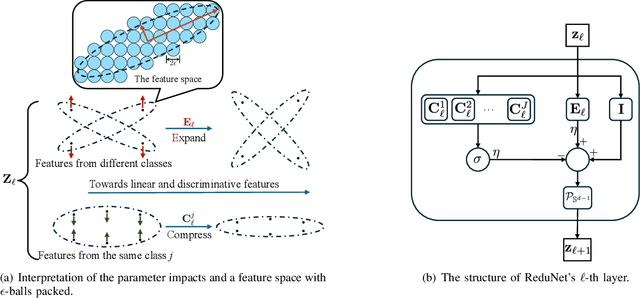

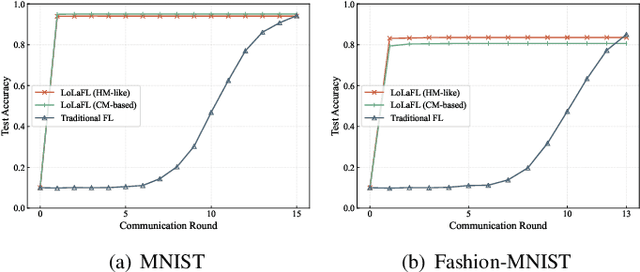
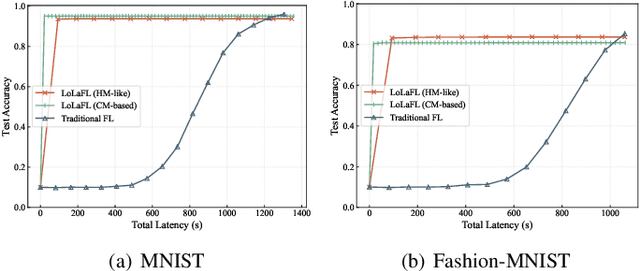
Federated learning (FL) has emerged as a widely adopted paradigm for enabling edge learning with distributed data while ensuring data privacy. However, the traditional FL with deep neural networks trained via backpropagation can hardly meet the low-latency learning requirements in the sixth generation (6G) mobile networks. This challenge mainly arises from the high-dimensional model parameters to be transmitted and the numerous rounds of communication required for convergence due to the inherent randomness of the training process. To address this issue, we adopt the state-of-the-art principle of maximal coding rate reduction to learn linear discriminative features and extend the resultant white-box neural network into FL, yielding the novel framework of Low-Latency Federated Learning (LoLaFL) via forward-only propagation. LoLaFL enables layer-wise transmissions and aggregation with significantly fewer communication rounds, thereby considerably reducing latency. Additionally, we propose two \emph{nonlinear} aggregation schemes for LoLaFL. The first scheme is based on the proof that the optimal NN parameter aggregation in LoLaFL should be harmonic-mean-like. The second scheme further exploits the low-rank structures of the features and transmits the low-rank-approximated covariance matrices of features to achieve additional latency reduction. Theoretic analysis and experiments are conducted to evaluate the performance of LoLaFL. In comparison with traditional FL, the two nonlinear aggregation schemes for LoLaFL can achieve reductions in latency of over 91\% and 98\%, respectively, while maintaining comparable accuracies.