 Add to Chrome
 Add to Firefox
 Add to Edge
Hindsight Distillation Reasoning with Knowledge Encouragement Preference for Knowledge-based Visual Question Answering
Nov 14, 2025
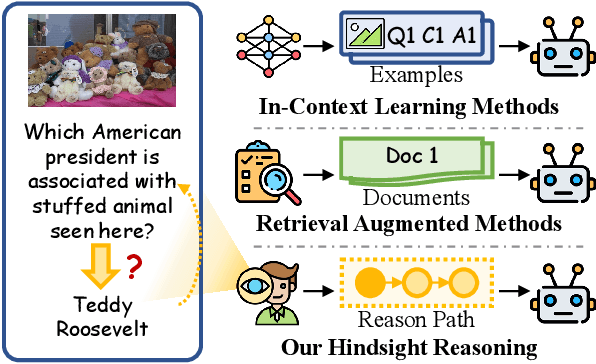
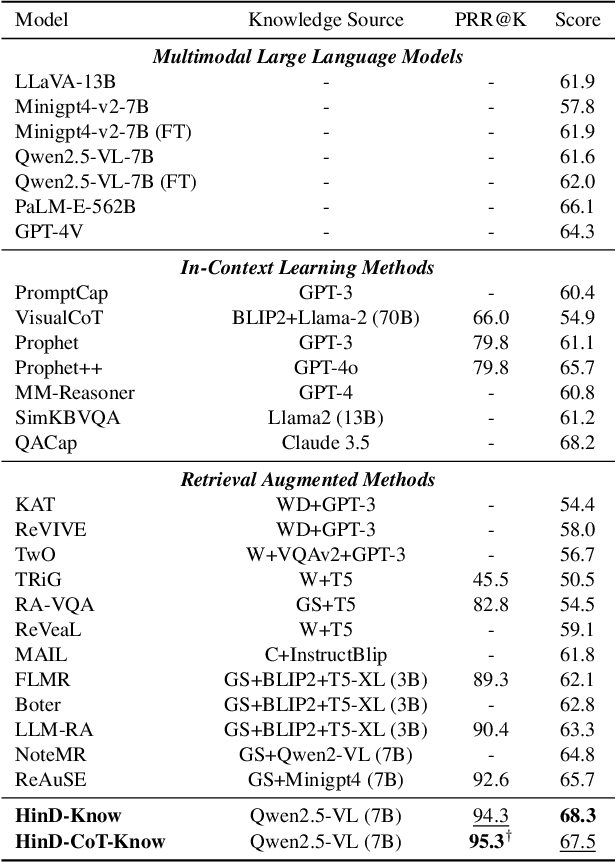
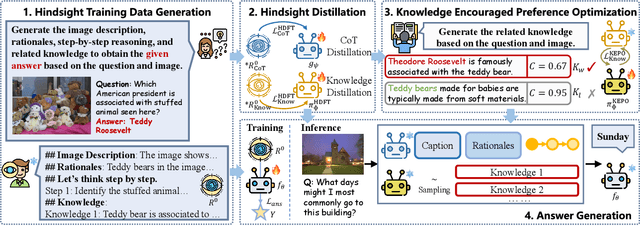
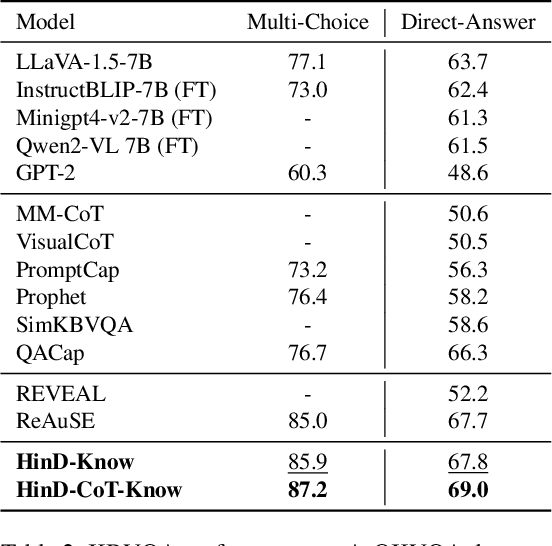
Knowledge-based Visual Question Answering (KBVQA) necessitates external knowledge incorporation beyond cross-modal understanding. Existing KBVQA methods either utilize implicit knowledge in multimodal large language models (MLLMs) via in-context learning or explicit knowledge via retrieval augmented generation. However, their reasoning processes remain implicit, without explicit multi-step trajectories from MLLMs. To address this gap, we provide a Hindsight Distilled Reasoning (HinD) framework with Knowledge Encouragement Preference Optimization (KEPO), designed to elicit and harness internal knowledge reasoning ability in MLLMs. First, to tackle the reasoning supervision problem, we propose to emphasize the hindsight wisdom of MLLM by prompting a frozen 7B-size MLLM to complete the reasoning process between the question and its ground truth answer, constructing Hindsight-Zero training data. Then we self-distill Hindsight-Zero into Chain-of-Thought (CoT) Generator and Knowledge Generator, enabling the generation of sequential steps and discrete facts. Secondly, to tackle the misalignment between knowledge correctness and confidence, we optimize the Knowledge Generator with KEPO, preferring under-confident but helpful knowledge over the over-confident but unhelpful one. The generated CoT and sampled knowledge are then exploited for answer prediction. Experiments on OK-VQA and A-OKVQA validate the effectiveness of HinD, showing that HinD with elicited reasoning from 7B-size MLLM achieves superior performance without commercial model APIs or outside knowledge.

Learning to Restore Multi-Degraded Images via Ingredient Decoupling and Task-Aware Path Adaptation
Nov 07, 2025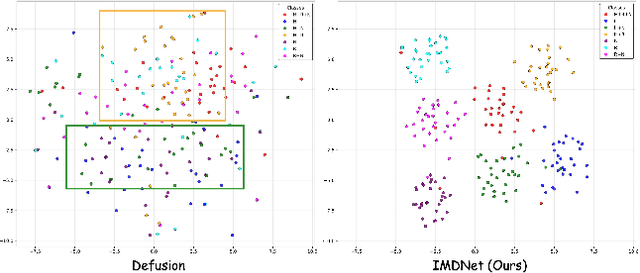
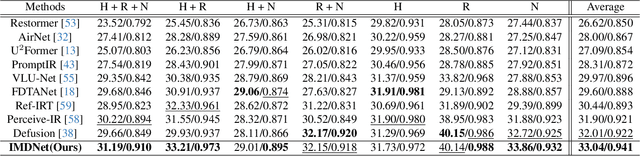
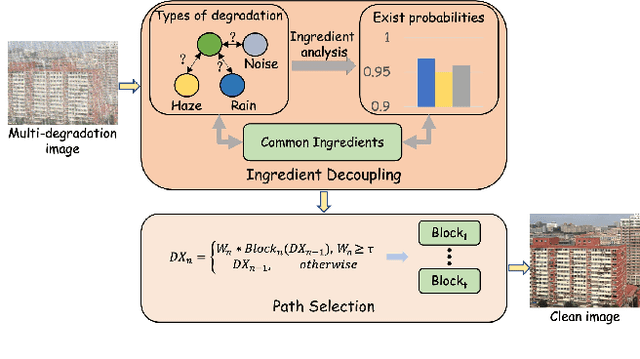
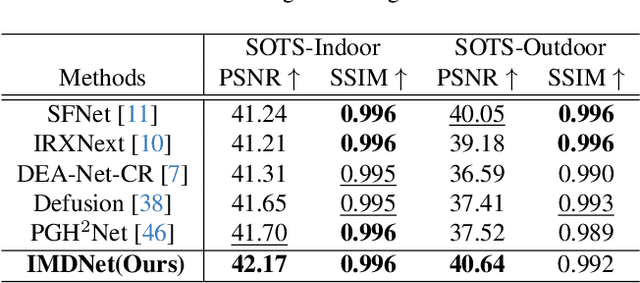
Image restoration (IR) aims to recover clean images from degraded observations. Despite remarkable progress, most existing methods focus on a single degradation type, whereas real-world images often suffer from multiple coexisting degradations, such as rain, noise, and haze coexisting in a single image, which limits their practical effectiveness. In this paper, we propose an adaptive multi-degradation image restoration network that reconstructs images by leveraging decoupled representations of degradation ingredients to guide path selection. Specifically, we design a degradation ingredient decoupling block (DIDBlock) in the encoder to separate degradation ingredients statistically by integrating spatial and frequency domain information, enhancing the recognition of multiple degradation types and making their feature representations independent. In addition, we present fusion block (FBlock) to integrate degradation information across all levels using learnable matrices. In the decoder, we further introduce a task adaptation block (TABlock) that dynamically activates or fuses functional branches based on the multi-degradation representation, flexibly selecting optimal restoration paths under diverse degradation conditions. The resulting tightly integrated architecture, termed IMDNet, is extensively validated through experiments, showing superior performance on multi-degradation restoration while maintaining strong competitiveness on single-degradation tasks.
Plan of Knowledge: Retrieval-Augmented Large Language Models for Temporal Knowledge Graph Question Answering
Nov 06, 2025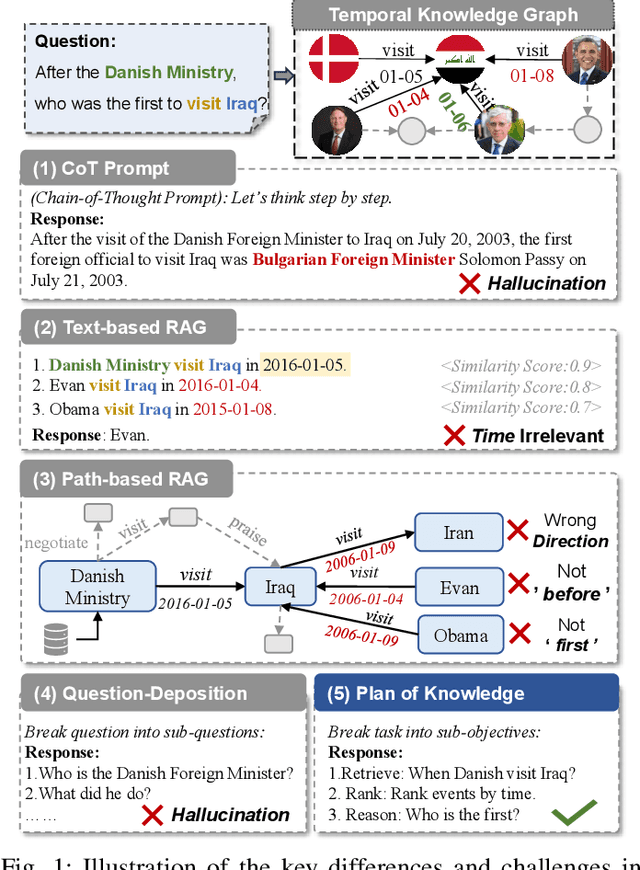
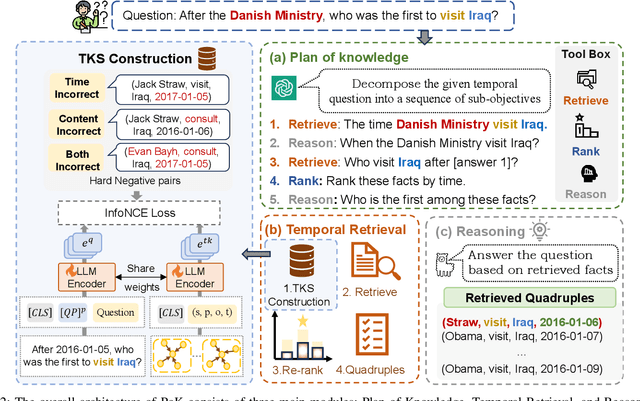
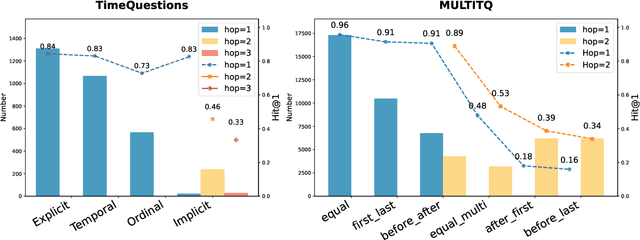
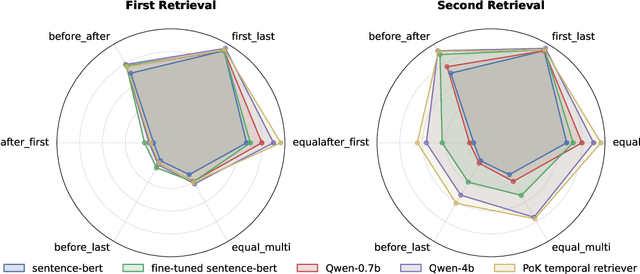
Temporal Knowledge Graph Question Answering (TKGQA) aims to answer time-sensitive questions by leveraging factual information from Temporal Knowledge Graphs (TKGs). While previous studies have employed pre-trained TKG embeddings or graph neural networks to inject temporal knowledge, they fail to fully understand the complex semantic information of time constraints. Recently, Large Language Models (LLMs) have shown remarkable progress, benefiting from their strong semantic understanding and reasoning generalization capabilities. However, their temporal reasoning ability remains limited. LLMs frequently suffer from hallucination and a lack of knowledge. To address these limitations, we propose the Plan of Knowledge framework with a contrastive temporal retriever, which is named PoK. Specifically, the proposed Plan of Knowledge module decomposes a complex temporal question into a sequence of sub-objectives from the pre-defined tools, serving as intermediate guidance for reasoning exploration. In parallel, we construct a Temporal Knowledge Store (TKS) with a contrastive retrieval framework, enabling the model to selectively retrieve semantically and temporally aligned facts from TKGs. By combining structured planning with temporal knowledge retrieval, PoK effectively enhances the interpretability and factual consistency of temporal reasoning. Extensive experiments on four benchmark TKGQA datasets demonstrate that PoK significantly improves the retrieval precision and reasoning accuracy of LLMs, surpassing the performance of the state-of-the-art TKGQA methods by 56.0% at most.
KnowThyself: An Agentic Assistant for LLM Interpretability
Nov 05, 2025We develop KnowThyself, an agentic assistant that advances large language model (LLM) interpretability. Existing tools provide useful insights but remain fragmented and code-intensive. KnowThyself consolidates these capabilities into a chat-based interface, where users can upload models, pose natural language questions, and obtain interactive visualizations with guided explanations. At its core, an orchestrator LLM first reformulates user queries, an agent router further directs them to specialized modules, and the outputs are finally contextualized into coherent explanations. This design lowers technical barriers and provides an extensible platform for LLM inspection. By embedding the whole process into a conversational workflow, KnowThyself offers a robust foundation for accessible LLM interpretability.
Closing the Loop: Coordinating Inventory and Recommendation via Deep Reinforcement Learning on Multiple Timescales
Oct 05, 2025Effective cross-functional coordination is essential for enhancing firm-wide profitability, particularly in the face of growing organizational complexity and scale. Recent advances in artificial intelligence, especially in reinforcement learning (RL), offer promising avenues to address this fundamental challenge. This paper proposes a unified multi-agent RL framework tailored for joint optimization across distinct functional modules, exemplified via coordinating inventory replenishment and personalized product recommendation. We first develop an integrated theoretical model to capture the intricate interplay between these functions and derive analytical benchmarks that characterize optimal coordination. The analysis reveals synchronized adjustment patterns across products and over time, highlighting the importance of coordinated decision-making. Leveraging these insights, we design a novel multi-timescale multi-agent RL architecture that decomposes policy components according to departmental functions and assigns distinct learning speeds based on task complexity and responsiveness. Our model-free multi-agent design improves scalability and deployment flexibility, while multi-timescale updates enhance convergence stability and adaptability across heterogeneous decisions. We further establish the asymptotic convergence of the proposed algorithm. Extensive simulation experiments demonstrate that the proposed approach significantly improves profitability relative to siloed decision-making frameworks, while the behaviors of the trained RL agents align closely with the managerial insights from our theoretical model. Taken together, this work provides a scalable, interpretable RL-based solution to enable effective cross-functional coordination in complex business settings.
DHG-Bench: A Comprehensive Benchmark on Deep Hypergraph Learning
Aug 17, 2025Although conventional deep graph models have achieved great success in relational learning, their focus on pairwise relationships limits their capacity to learn pervasive higher-order interactions in real-world complex systems, which can be naturally modeled as hypergraphs. To tackle this, hypergraph neural networks (HNNs), the dominant approach in deep hypergraph learning (DHGL), has garnered substantial attention in recent years. Despite the proposal of numerous HNN methods, there is no comprehensive benchmark for HNNs, which creates a great obstacle to understanding the progress of DHGL in several aspects: (i) insufficient coverage of datasets, algorithms, and tasks; (ii) a narrow evaluation of algorithm performance; and (iii) inconsistent dataset usage, preprocessing, and experimental setups that hinder comparability. To fill the gap, we introduce DHG-Bench, the first comprehensive benchmark for DHGL. Specifically, DHG-Bench integrates 20 diverse datasets spanning node-, edge-, and graph-level tasks, along with 16 state-of-the-art HNN algorithms, under consistent data processing and experimental protocols. Our benchmark systematically investigates the characteristics of HNNs in terms of four dimensions: effectiveness, efficiency, robustness, and fairness. Further, to facilitate reproducible research, we have developed an easy-to-use library for training and evaluating different HNN methods. Extensive experiments conducted with DHG-Bench reveal both the strengths and inherent limitations of existing algorithms, offering valuable insights and directions for future research. The code is publicly available at: https://github.com/Coco-Hut/DHG-Bench.
GLM-4.5: Agentic, Reasoning, and Coding (ARC) Foundation Models
Aug 08, 2025We present GLM-4.5, an open-source Mixture-of-Experts (MoE) large language model with 355B total parameters and 32B activated parameters, featuring a hybrid reasoning method that supports both thinking and direct response modes. Through multi-stage training on 23T tokens and comprehensive post-training with expert model iteration and reinforcement learning, GLM-4.5 achieves strong performance across agentic, reasoning, and coding (ARC) tasks, scoring 70.1% on TAU-Bench, 91.0% on AIME 24, and 64.2% on SWE-bench Verified. With much fewer parameters than several competitors, GLM-4.5 ranks 3rd overall among all evaluated models and 2nd on agentic benchmarks. We release both GLM-4.5 (355B parameters) and a compact version, GLM-4.5-Air (106B parameters), to advance research in reasoning and agentic AI systems. Code, models, and more information are available at https://github.com/zai-org/GLM-4.5.
WeTok: Powerful Discrete Tokenization for High-Fidelity Visual Reconstruction
Aug 07, 2025Visual tokenizer is a critical component for vision generation. However, the existing tokenizers often face unsatisfactory trade-off between compression ratios and reconstruction fidelity. To fill this gap, we introduce a powerful and concise WeTok tokenizer, which surpasses the previous leading tokenizers via two core innovations. (1) Group-wise lookup-free Quantization (GQ). We partition the latent features into groups, and perform lookup-free quantization for each group. As a result, GQ can efficiently overcome memory and computation limitations of prior tokenizers, while achieving a reconstruction breakthrough with more scalable codebooks. (2) Generative Decoding (GD). Different from prior tokenizers, we introduce a generative decoder with a prior of extra noise variable. In this case, GD can probabilistically model the distribution of visual data conditioned on discrete tokens, allowing WeTok to reconstruct visual details, especially at high compression ratios. Extensive experiments on mainstream benchmarks show superior performance of our WeTok. On the ImageNet 50k validation set, WeTok achieves a record-low zero-shot rFID (WeTok: 0.12 vs. FLUX-VAE: 0.18 vs. SD-VAE 3.5: 0.19). Furthermore, our highest compression model achieves a zero-shot rFID of 3.49 with a compression ratio of 768, outperforming Cosmos (384) 4.57 which has only 50% compression rate of ours. Code and models are available: https://github.com/zhuangshaobin/WeTok.
Mesh based segmentation for automated margin line generation on incisors receiving crown treatment
Jul 30, 2025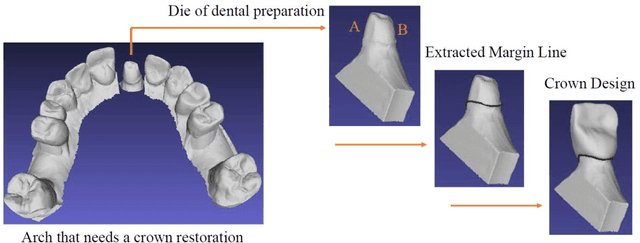

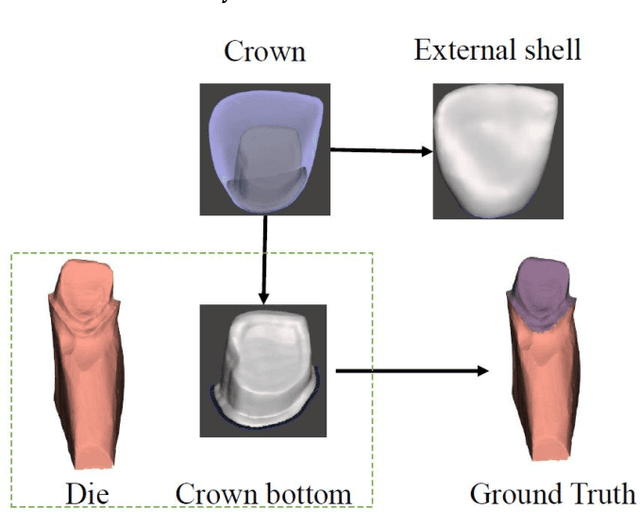
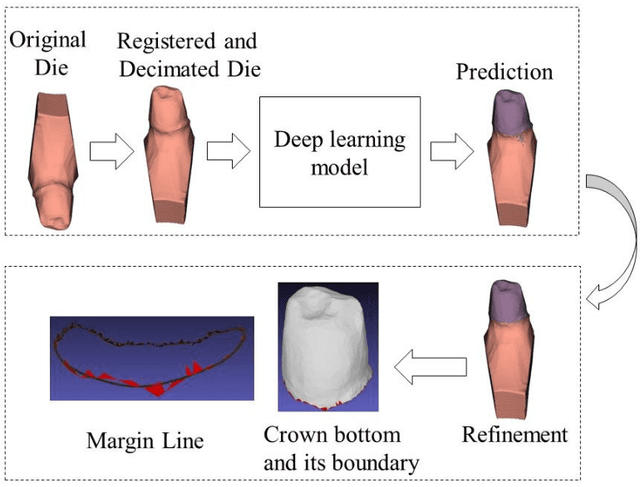
Dental crowns are essential dental treatments for restoring damaged or missing teeth of patients. Recent design approaches of dental crowns are carried out using commercial dental design software. Once a scan of a preparation is uploaded to the software, a dental technician needs to manually define a precise margin line on the preparation surface, which constitutes a non-repeatable and inconsistent procedure. This work proposes a new framework to determine margin lines automatically and accurately using deep learning. A dataset of incisor teeth was provided by a collaborating dental laboratory to train a deep learning segmentation model. A mesh-based neural network was modified by changing its input channels and used to segment the prepared tooth into two regions such that the margin line is contained within the boundary faces separating the two regions. Next, k-fold cross-validation was used to train 5 models, and a voting classifier technique was used to combine their results to enhance the segmentation. After that, boundary smoothing and optimization using the graph cut method were applied to refine the segmentation results. Then, boundary faces separating the two regions were selected to represent the margin line faces. A spline was approximated to best fit the centers of the boundary faces to predict the margin line. Our results show that an ensemble model combined with maximum probability predicted the highest number of successful test cases (7 out of 13) based on a maximum distance threshold of 200 m (representing human error) between the predicted and ground truth point clouds. It was also demonstrated that the better the quality of the preparation, the smaller the divergence between the predicted and ground truth margin lines (Spearman's rank correlation coefficient of -0.683). We provide the train and test datasets for the community.
Regularizing Subspace Redundancy of Low-Rank Adaptation
Jul 28, 2025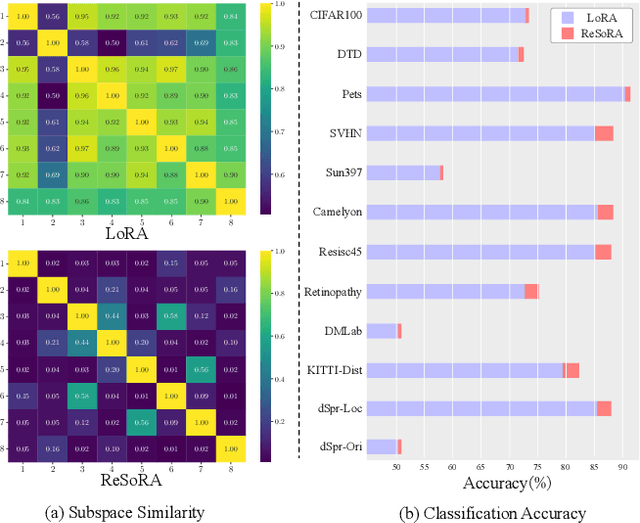
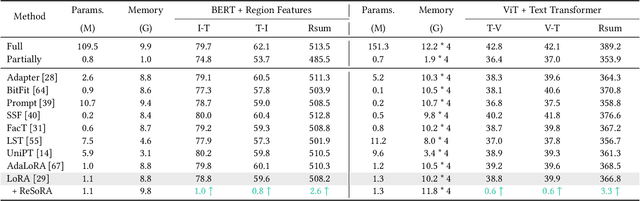
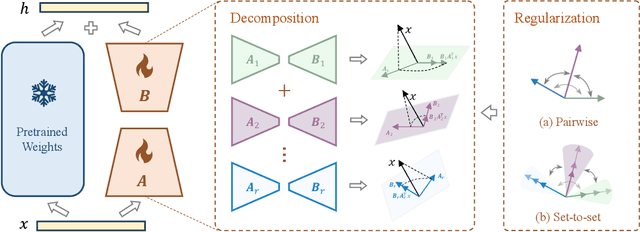

Low-Rank Adaptation (LoRA) and its variants have delivered strong capability in Parameter-Efficient Transfer Learning (PETL) by minimizing trainable parameters and benefiting from reparameterization. However, their projection matrices remain unrestricted during training, causing high representation redundancy and diminishing the effectiveness of feature adaptation in the resulting subspaces. While existing methods mitigate this by manually adjusting the rank or implicitly applying channel-wise masks, they lack flexibility and generalize poorly across various datasets and architectures. Hence, we propose ReSoRA, a method that explicitly models redundancy between mapping subspaces and adaptively Regularizes Subspace redundancy of Low-Rank Adaptation. Specifically, it theoretically decomposes the low-rank submatrices into multiple equivalent subspaces and systematically applies de-redundancy constraints to the feature distributions across different projections. Extensive experiments validate that our proposed method consistently facilitates existing state-of-the-art PETL methods across various backbones and datasets in vision-language retrieval and standard visual classification benchmarks. Besides, as a training supervision, ReSoRA can be seamlessly integrated into existing approaches in a plug-and-play manner, with no additional inference costs. Code is publicly available at: https://github.com/Lucenova/ReSoRA.