 Add to Chrome
 Add to Firefox
 Add to Edge
CAKE: Compiler-Agent Co-Design for Frontier Kernel Evolution
Aug 12, 2026
GPU kernel agents and GPU programming languages have advanced separately, leaving expert kernels difficult to reproduce. Agents usually treat the compiler as a fixed black box and receive only errors, correctness outcomes, and timing, while existing DSLs either hide critical scheduling decisions or expose them through difficult layout abstractions. We present CAKE, a compiler-agent co-design in which agents author CAKE IR, a typed, hardware-explicit schedule representation. CAKE exposes warp roles, memory movement, synchronization, and pipelines while supporting verification, cost modeling, and localized diagnostics. The harness itself evolves: recurring failures become verifier rules, IR primitives, model calibrations, and reusable optimization tactics. In matched implementation-hidden Flash-KMeans clean starts on B200, the best CAKE IR candidate at an 80-million-token budget runs at 1.144x the tuned FlashML baseline, compared with 0.928x for direct CUDA/PTX. Beyond this benchmark, agent-generated Kimi Delta Attention achieves a 2.05x geometric-mean speedup over official FlashKDA and passes end-to-end serving validation. Dispatcher-backed KNN and KMeans improve performance by 1.42x to 2.12x across more than 400 shapes, and four kernel changes are available as upstream PRs. CAKE targets NVIDIA GPUs from Ampere through Blackwell and separates single-shape evolution from library generalization and dispatch.

Tabular Numeric Stretch Transformation
Aug 10, 2026Tabular data presents unique challenges for deep learning due to its heterogeneous nature, where numeric features exhibit diverse distributions, scales, and statistical properties. Although recent advances have improved how models learn from tabular data, how numeric data are transformed into model-friendly representations remains comparatively underexplored. We introduce the stretch transformation framework, which formulates numeric feature preprocessing as an optimization problem to make the target function smoother and thus more learnable. Our framework has two variants: (1) unsupervised stretch, which uniformly redistributes feature density via minimax optimization, and (2) supervised stretch, which optimizes target-aware numeric feature transformations from the perspective of target-function smoothness by minimizing the target function's Dirichlet energy in the transformed space. Our theoretical analysis further connects this framework to several popular transformations: unsupervised stretch is closely related to Piecewise Linear Encoding through a shared piecewise-linear geometry and approaches the empirical CDF transformation as the number of bins grows, while supervised stretch becomes closely related to target encoding in the fine-binning limit. Comprehensive experiments on 38 datasets from the TALENT benchmark demonstrate that supervised stretch consistently outperforms all baselines. These results show that explicitly optimizing for target function smoothness is a powerful and underexplored strategy for tabular deep learning.
Evaluation of Winning Solutions of 2025 Low Power Computer Vision Challenge
Apr 22, 2026The IEEE Low-Power Computer Vision Challenge (LPCVC) aims to promote the development of efficient vision models for edge devices, balancing accuracy with constraints such as latency, memory capacity, and energy use. The 2025 challenge featured three tracks: (1) Image classification under various lighting conditions and styles, (2) Open-Vocabulary Segmentation with Text Prompt, and (3) Monocular Depth Estimation. This paper presents the design of LPCVC 2025, including its competition structure and evaluation framework, which integrates the Qualcomm AI Hub for consistent and reproducible benchmarking. The paper also introduces the top-performing solutions from each track and outlines key trends and observations. The paper concludes with suggestions for future computer vision competitions.
Event Tensor: A Unified Abstraction for Compiling Dynamic Megakernel
Apr 14, 2026Modern GPU workloads, especially large language model (LLM) inference, suffer from kernel launch overheads and coarse synchronization that limit inter-kernel parallelism. Recent megakernel techniques fuse multiple operators into a single persistent kernel to eliminate launch gaps and expose inter-kernel parallelism, but struggle to handle dynamic shapes and data-dependent computation in real workloads. We present Event Tensor, a unified compiler abstraction for dynamic megakernels. Event Tensor encodes dependencies between tiled tasks, and enables first-class support for both shape and data-dependent dynamism. Built atop this abstraction, our Event Tensor Compiler (ETC) applies static and dynamic scheduling transformations to generate high-performance persistent kernels. Evaluations show that ETC achieves state-of-the-art LLM serving latency while significantly reducing system warmup overhead.
AVO: Agentic Variation Operators for Autonomous Evolutionary Search
Mar 25, 2026Agentic Variation Operators (AVO) are a new family of evolutionary variation operators that replace the fixed mutation, crossover, and hand-designed heuristics of classical evolutionary search with autonomous coding agents. Rather than confining a language model to candidate generation within a prescribed pipeline, AVO instantiates variation as a self-directed agent loop that can consult the current lineage, a domain-specific knowledge base, and execution feedback to propose, repair, critique, and verify implementation edits. We evaluate AVO on attention, among the most aggressively optimized kernel targets in AI, on NVIDIA Blackwell (B200) GPUs. Over 7 days of continuous autonomous evolution on multi-head attention, AVO discovers kernels that outperform cuDNN by up to 3.5% and FlashAttention-4 by up to 10.5% across the evaluated configurations. The discovered optimizations transfer readily to grouped-query attention, requiring only 30 minutes of additional autonomous adaptation and yielding gains of up to 7.0% over cuDNN and 9.3% over FlashAttention-4. Together, these results show that agentic variation operators move beyond prior LLM-in-the-loop evolutionary pipelines by elevating the agent from candidate generator to variation operator, and can discover performance-critical micro-architectural optimizations that produce kernels surpassing state-of-the-art expert-engineered attention implementations on today's most advanced GPU hardware.
SOL-ExecBench: Speed-of-Light Benchmarking for Real-World GPU Kernels Against Hardware Limits
Mar 19, 2026As agentic AI systems become increasingly capable of generating and optimizing GPU kernels, progress is constrained by benchmarks that reward speedup over software baselines rather than proximity to hardware-efficient execution. We present SOL-ExecBench, a benchmark of 235 CUDA kernel optimization problems extracted from 124 production and emerging AI models spanning language, diffusion, vision, audio, video, and hybrid architectures, targeting NVIDIA Blackwell GPUs. The benchmark covers forward and backward workloads across BF16, FP8, and NVFP4, including kernels whose best performance is expected to rely on Blackwell-specific capabilities. Unlike prior benchmarks that evaluate kernels primarily relative to software implementations, SOL-ExecBench measures performance against analytically derived Speed-of-Light (SOL) bounds computed by SOLAR, our pipeline for deriving hardware-grounded SOL bounds, yielding a fixed target for hardware-efficient optimization. We report a SOL Score that quantifies how much of the gap between a release-defined scoring baseline and the hardware SOL bound a candidate kernel closes. To support robust evaluation of agentic optimizers, we additionally provide a sandboxed harness with GPU clock locking, L2 cache clearing, isolated subprocess execution, and static analysis based checks against common reward-hacking strategies. SOL-ExecBench reframes GPU kernel benchmarking from beating a mutable software baseline to closing the remaining gap to hardware Speed-of-Light.
Axe: A Simple Unified Layout Abstraction for Machine Learning Compilers
Jan 27, 2026Scaling modern deep learning workloads demands coordinated placement of data and compute across device meshes, memory hierarchies, and heterogeneous accelerators. We present Axe Layout, a hardware-aware abstraction that maps logical tensor coordinates to a multi-axis physical space via named axes. Axe unifies tiling, sharding, replication, and offsets across inter-device distribution and on-device layouts, enabling collective primitives to be expressed consistently from device meshes to threads. Building on Axe, we design a multi-granularity, distribution-aware DSL and compiler that composes thread-local control with collective operators in a single kernel. Experiments show that our unified approach can bring performance close to hand-tuned kernels on across latest GPU devices and multi-device environments and accelerator backends.
FlashInfer-Bench: Building the Virtuous Cycle for AI-driven LLM Systems
Jan 01, 2026Recent advances show that large language models (LLMs) can act as autonomous agents capable of generating GPU kernels, but integrating these AI-generated kernels into real-world inference systems remains challenging. FlashInfer-Bench addresses this gap by establishing a standardized, closed-loop framework that connects kernel generation, benchmarking, and deployment. At its core, FlashInfer Trace provides a unified schema describing kernel definitions, workloads, implementations, and evaluations, enabling consistent communication between agents and systems. Built on real serving traces, FlashInfer-Bench includes a curated dataset, a robust correctness- and performance-aware benchmarking framework, a public leaderboard to track LLM agents' GPU programming capabilities, and a dynamic substitution mechanism (apply()) that seamlessly injects the best-performing kernels into production LLM engines such as SGLang and vLLM. Using FlashInfer-Bench, we further evaluate the performance and limitations of LLM agents, compare the trade-offs among different GPU programming languages, and provide insights for future agent design. FlashInfer-Bench thus establishes a practical, reproducible pathway for continuously improving AI-generated kernels and deploying them into large-scale LLM inference.
Mirage Persistent Kernel: A Compiler and Runtime for Mega-Kernelizing Tensor Programs
Dec 22, 2025We introduce Mirage Persistent Kernel (MPK), the first compiler and runtime system that automatically transforms multi-GPU model inference into a single high-performance megakernel. MPK introduces an SM-level graph representation that captures data dependencies at the granularity of individual streaming multiprocessors (SMs), enabling cross-operator software pipelining, fine-grained kernel overlap, and other previously infeasible GPU optimizations. The MPK compiler lowers tensor programs into highly optimized SM-level task graphs and generates optimized CUDA implementations for all tasks, while the MPK in-kernel parallel runtime executes these tasks within a single mega-kernel using decentralized scheduling across SMs. Together, these components provide end-to-end kernel fusion with minimal developer effort, while preserving the flexibility of existing programming models. Our evaluation shows that MPK significantly outperforms existing kernel-per-operator LLM serving systems by reducing end-to-end inference latency by up to 1.7x, pushing LLM inference performance close to hardware limits. MPK is publicly available at https://github.com/mirage-project/mirage.
TeleRAG: Efficient Retrieval-Augmented Generation Inference with Lookahead Retrieval
Feb 28, 2025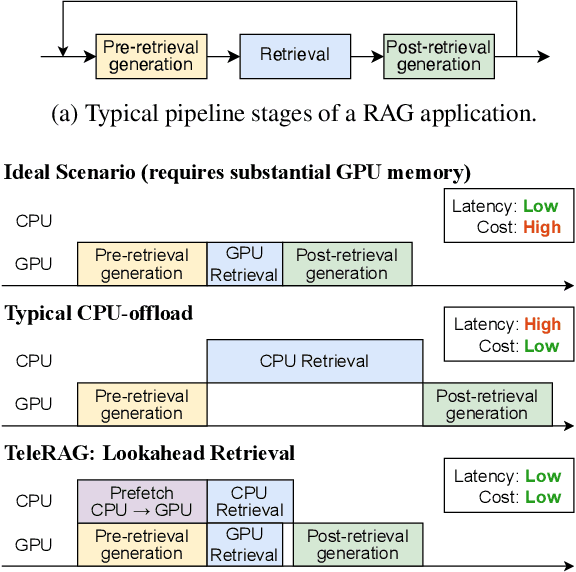
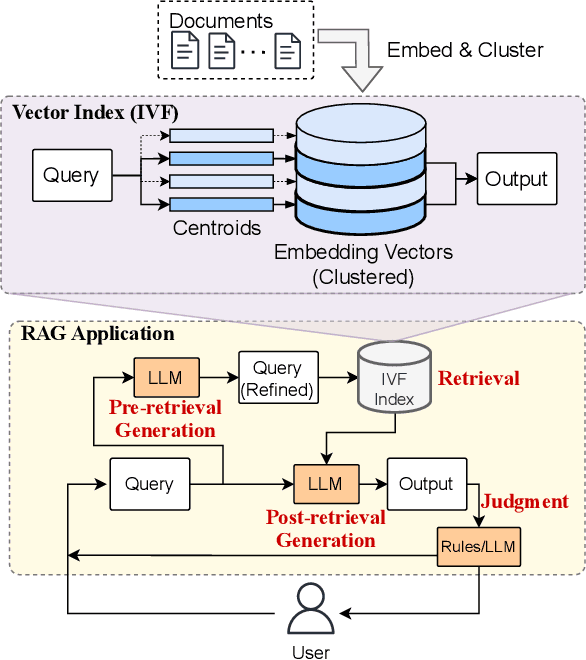
Retrieval-augmented generation (RAG) extends large language models (LLMs) with external data sources to enhance factual correctness and domain coverage. Modern RAG pipelines rely on large datastores, leading to system challenges in latency-sensitive deployments, especially when limited GPU memory is available. To address these challenges, we propose TeleRAG, an efficient inference system that reduces RAG latency with minimal GPU memory requirements. The core innovation of TeleRAG is lookahead retrieval, a prefetching mechanism that anticipates required data and transfers it from CPU to GPU in parallel with LLM generation. By leveraging the modularity of RAG pipelines, the inverted file index (IVF) search algorithm and similarities between queries, TeleRAG optimally overlaps data movement and computation. Experimental results show that TeleRAG reduces end-to-end RAG inference latency by up to 1.72x on average compared to state-of-the-art systems, enabling faster, more memory-efficient deployments of advanced RAG applications.