 Add to Chrome
 Add to Firefox
 Add to Edge
Evading Visual Aphasia: Contrastive Adaptive Semantic Token Pruning for Vision-Language Models
May 10, 2026
Are low-attention visual tokens truly redundant in vision-language reasoning? Existing pruning methods often assume so, ranking visual tokens by shallow text-to-image attention and discarding low-scoring patches to accelerate LVLM inference. We show that this scalar criterion is unreliable for compositional reasoning: tokens ignored in early layers can later become essential for resolving secondary objects, spatial relations, and contextual cues. Premature pruning can therefore induce Visual Aphasia, a failure mode in which the model loses visual grounding and falls back on language priors. We introduce COAST (COntrastive Adaptive Semantic Token Pruning), a training-free pruning framework that casts compression as adaptive semantic routing. COAST uses native cross-modal attention to identify query-specific anchors and estimate contextual dispersion via attention entropy, then adapts the retention trade-off between semantic evidence and spatial context. It further uses a contrastive routing score to preserve both anchor-aligned evidence and complementary spatial context. Across seven benchmarks, COAST reduces visual tokens by 77.8% and achieves a 2.15x latency speedup while retaining 98.64% of the original average performance. Beyond a single backbone or compression setting, COAST consistently outperforms strong pruning baselines across token budgets and generalizes across multiple LVLM families, showing that adaptive semantic routing is a robust alternative to one-shot scalar pruning

PRISM: Iterative Cross-Modal Posterior Refinement for Dynamic Text-Attributed Graphs
May 07, 2026Dynamic text-attributed graphs (DyTAGs) provide a powerful framework for modeling evolving systems in which node semantics and time-dependent interactions are tightly coupled. Recently, multimodal learning has emerged as a promising yet underexplored direction for enhancing DyTAG representation learning. However, existing methods typically rely on rigid modality partitions and one-shot fusion strategies, which limit their ability to capture the intrinsic and evolving dependencies between node semantics and interaction behaviors. To address these limitations, we propose \textbf{PRISM}, an iterative cross-modal posterior refinement framework for DyTAG representation learning. PRISM organizes DyTAG information into semantic and behavioral modalities, providing a more intrinsic alternative to carrier-level modality partitions. Instead of fusing the two modalities in a single step, PRISM learns a refinement trajectory that progressively transforms semantic priors into behavior-conditioned posterior states through cross-modal interaction with behavioral evidence. Extensive experiments on DTGB benchmark datasets show that PRISM achieves strong performance on temporal link prediction and destination node retrieval tasks. Further ablation studies validate the effectiveness of semantic--behavioral modeling and iterative posterior refinement.
M-IDoL: Information Decomposition for Modality-Specific and Diverse Representation Learning in Medical Foundation Model
Apr 10, 2026Medical foundation models (MFMs) aim to learn universal representations from multimodal medical images that can generalize effectively to diverse downstream clinical tasks. However, most existing MFMs suffer from information ambiguity that blend multimodal representations in a single embedding space, leading to the degradation of modality specificity and diversity. In this paper, we propose M-IDoL, a self-supervised \underline{\textit{M}}FM that introduces Information Decomposition for multimodal representation Learning via two objectives: i) maximize inter-modality entropy by dispersing multimodal representation into separable Mixture-of-Experts (MoE) subspaces to achieve representation specificity across modalities; and ii) minimize intra-modality uncertainty by performing fine-grained semantic discrimination within each MoE subspace to enrich representation diversity per modality. By pre-training on 1.15 million medical images, M-IDoL i) delivers superior generalization across 21 downstream clinical tasks, outperforming 20 foundation models on five imaging modalities (e.g., X-ray, fundus, OCT, dermoscopy and pathology), and ii) learns modality-specific and diverse representations, showing clearer separation of feature cluster across modalities and finer-grained feature discrimination within each modality.
TexEditor: Structure-Preserving Text-Driven Texture Editing
Mar 19, 2026Text-guided texture editing aims to modify object appearance while preserving the underlying geometric structure. However, our empirical analysis reveals that even SOTA editing models frequently struggle to maintain structural consistency during texture editing, despite the intended changes being purely appearance-related. Motivated by this observation, we jointly enhance structure preservation from both data and training perspectives, and build TexEditor, a dedicated texture editing model based on Qwen-Image-Edit-2509. Firstly, we construct TexBlender, a high-quality SFT dataset generated with Blender, which provides strong structural priors for a cold start. Sec- ondly, we introduce StructureNFT, a RL-based approach that integrates structure-preserving losses to transfer the structural priors learned during SFT to real-world scenes. Moreover, due to the limited realism and evaluation coverage of existing benchmarks, we introduce TexBench, a general-purpose real-world benchmark for text-guided texture editing. Extensive experiments on existing Blender-based texture benchmarks and our TexBench show that TexEditor consistently outperforms strong baselines such as Nano Banana Pro. In addition, we assess TexEditor on the general purpose benchmark ImgEdit to validate its generalization. Our code and data are available at https://github.com/KlingAIResearch/TexEditor.
EntropyPrune: Matrix Entropy Guided Visual Token Pruning for Multimodal Large Language Models
Feb 19, 2026Multimodal large language models (MLLMs) incur substantial inference cost due to the processing of hundreds of visual tokens per image. Although token pruning has proven effective for accelerating inference, determining when and where to prune remains largely heuristic. Existing approaches typically rely on static, empirically selected layers, which limit interpretability and transferability across models. In this work, we introduce a matrix-entropy perspective and identify an "Entropy Collapse Layer" (ECL), where the information content of visual representations exhibits a sharp and consistent drop, which provides a principled criterion for selecting the pruning stage. Building on this observation, we propose EntropyPrune, a novel matrix-entropy-guided token pruning framework that quantifies the information value of individual visual tokens and prunes redundant ones without relying on attention maps. Moreover, to enable efficient computation, we exploit the spectral equivalence of dual Gram matrices, reducing the complexity of entropy computation and yielding up to a 64x theoretical speedup. Extensive experiments on diverse multimodal benchmarks demonstrate that EntropyPrune consistently outperforms state-of-the-art pruning methods in both accuracy and efficiency. On LLaVA-1.5-7B, our method achieves a 68.2% reduction in FLOPs while preserving 96.0% of the original performance. Furthermore, EntropyPrune generalizes effectively to high-resolution and video-based models, highlighting the strong robustness and scalability in practical MLLM acceleration. The code will be publicly available at https://github.com/YahongWang1/EntropyPrune.
All You Need Are Random Visual Tokens? Demystifying Token Pruning in VLLMs
Dec 08, 2025Vision Large Language Models (VLLMs) incur high computational costs due to their reliance on hundreds of visual tokens to represent images. While token pruning offers a promising solution for accelerating inference, this paper, however, identifies a key observation: in deeper layers (e.g., beyond the 20th), existing training-free pruning methods perform no better than random pruning. We hypothesize that this degradation is caused by "vanishing token information", where visual tokens progressively lose their salience with increasing network depth. To validate this hypothesis, we quantify a token's information content by measuring the change in the model output probabilities upon its removal. Using this proposed metric, our analysis of the information of visual tokens across layers reveals three key findings: (1) As layers deepen, the information of visual tokens gradually becomes uniform and eventually vanishes at an intermediate layer, which we term as "information horizon", beyond which the visual tokens become redundant; (2) The position of this horizon is not static; it extends deeper for visually intensive tasks, such as Optical Character Recognition (OCR), compared to more general tasks like Visual Question Answering (VQA); (3) This horizon is also strongly correlated with model capacity, as stronger VLLMs (e.g., Qwen2.5-VL) employ deeper visual tokens than weaker models (e.g., LLaVA-1.5). Based on our findings, we show that simple random pruning in deep layers efficiently balances performance and efficiency. Moreover, integrating random pruning consistently enhances existing methods. Using DivPrune with random pruning achieves state-of-the-art results, maintaining 96.9% of Qwen-2.5-VL-7B performance while pruning 50% of visual tokens. The code will be publicly available at https://github.com/YahongWang1/Information-Horizon.
Pathology-CoT: Learning Visual Chain-of-Thought Agent from Expert Whole Slide Image Diagnosis Behavior
Oct 06, 2025Diagnosing a whole-slide image is an interactive, multi-stage process involving changes in magnification and movement between fields. Although recent pathology foundation models are strong, practical agentic systems that decide what field to examine next, adjust magnification, and deliver explainable diagnoses are still lacking. The blocker is data: scalable, clinically aligned supervision of expert viewing behavior that is tacit and experience-based, not written in textbooks or online, and therefore absent from large language model training. We introduce the AI Session Recorder, which works with standard WSI viewers to unobtrusively record routine navigation and convert the viewer logs into standardized behavioral commands (inspect or peek at discrete magnifications) and bounding boxes. A lightweight human-in-the-loop review turns AI-drafted rationales into the Pathology-CoT dataset, a form of paired "where to look" and "why it matters" supervision produced at roughly six times lower labeling time. Using this behavioral data, we build Pathologist-o3, a two-stage agent that first proposes regions of interest and then performs behavior-guided reasoning. On gastrointestinal lymph-node metastasis detection, it achieved 84.5% precision, 100.0% recall, and 75.4% accuracy, exceeding the state-of-the-art OpenAI o3 model and generalizing across backbones. To our knowledge, this constitutes one of the first behavior-grounded agentic systems in pathology. Turning everyday viewer logs into scalable, expert-validated supervision, our framework makes agentic pathology practical and establishes a path to human-aligned, upgradeable clinical AI.
multivariateGPT: a decoder-only transformer for multivariate categorical and numeric data
May 27, 2025Real-world processes often generate data that are a mix of categorical and numeric values that are recorded at irregular and informative intervals. Discrete token-based approaches are limited in numeric representation capacity while methods like neural ordinary differential equations are not well suited for categorical data or informative sampling and require augmentation to handle certain classes of trajectories. Here, we present multivariateGPT, a single architecture for modeling sequences of mixed categorical (including tokenized text) and numeric data. This is accomplished with an autoregressive sequence decomposition, embedding scheme, and loss function that extend the next token prediction task to likelihood estimation of the joint distribution of next token class and value. We demonstrate how this approach can efficiently learn to generalize patterns in simple physical systems and model complex time series including electrocardiograms and multivariate electronic health record data. This work extends the utility of transformer based models to additional classes of data.
AFiRe: Anatomy-Driven Self-Supervised Learning for Fine-Grained Representation in Radiographic Images
Apr 15, 2025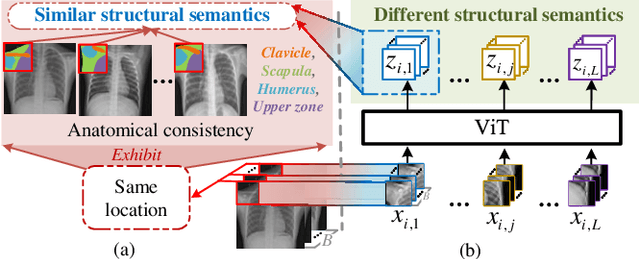
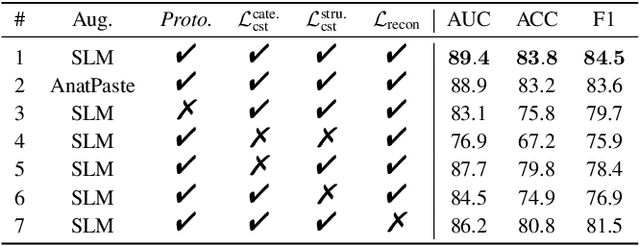
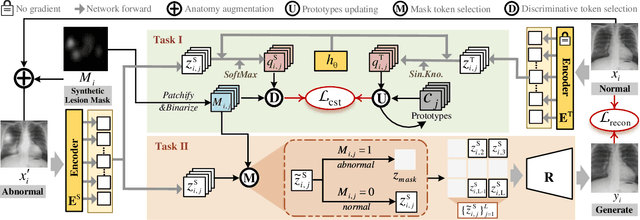
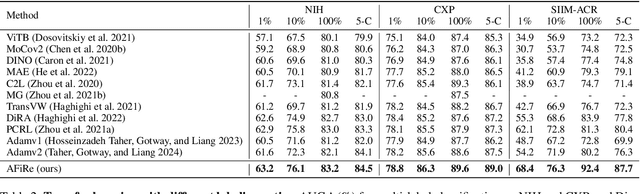
Current self-supervised methods, such as contrastive learning, predominantly focus on global discrimination, neglecting the critical fine-grained anatomical details required for accurate radiographic analysis. To address this challenge, we propose an Anatomy-driven self-supervised framework for enhancing Fine-grained Representation in radiographic image analysis (AFiRe). The core idea of AFiRe is to align the anatomical consistency with the unique token-processing characteristics of Vision Transformer. Specifically, AFiRe synergistically performs two self-supervised schemes: (i) Token-wise anatomy-guided contrastive learning, which aligns image tokens based on structural and categorical consistency, thereby enhancing fine-grained spatial-anatomical discrimination; (ii) Pixel-level anomaly-removal restoration, which particularly focuses on local anomalies, thereby refining the learned discrimination with detailed geometrical information. Additionally, we propose Synthetic Lesion Mask to enhance anatomical diversity while preserving intra-consistency, which is typically corrupted by traditional data augmentations, such as Cropping and Affine transformations. Experimental results show that AFiRe: (i) provides robust anatomical discrimination, achieving more cohesive feature clusters compared to state-of-the-art contrastive learning methods; (ii) demonstrates superior generalization, surpassing 7 radiography-specific self-supervised methods in multi-label classification tasks with limited labeling; and (iii) integrates fine-grained information, enabling precise anomaly detection using only image-level annotations.
ClinKD: Cross-Modal Clinic Knowledge Distiller For Multi-Task Medical Images
Feb 09, 2025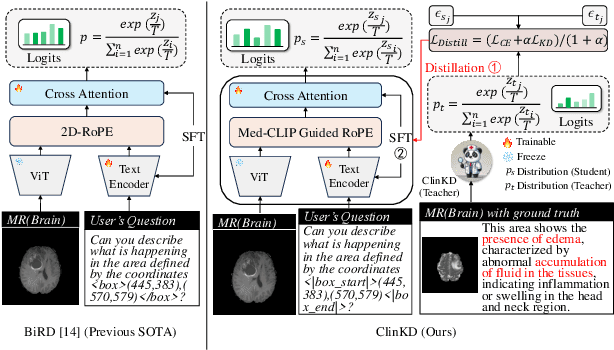
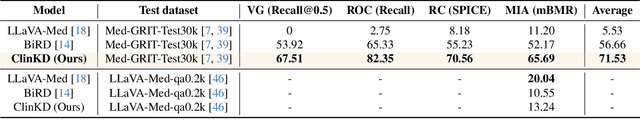
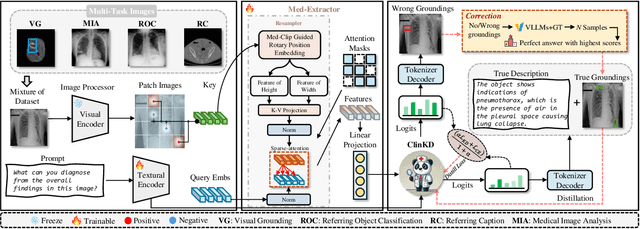
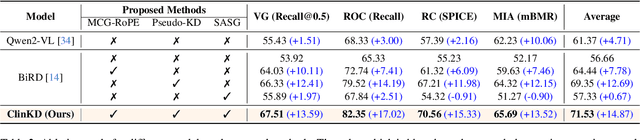
Med-VQA (Medical Visual Question Answering) is a crucial subtask within the broader VQA (Visual Question Answering) domain. This task requires a visual question answering system to analyze the provided image and corresponding question,offering reasonable analysis and suggestions to assist medical professionals in making pathological diagnoses, or ideally, enabling the system to independently provide correct diagnoses. Furthermore, more advanced Med-VQA tasks involve Referring and Grounding, which not only require the system to accurately comprehend medical images but also to pinpoint specific biological locations within those images. While many large pre-trained models have demonstrated substantial VQA capabilities,challenges persist in the medical imaging domain. The intricacy of biological features in medical images and the scarcity of high-quality medical image datasets, combined with the fact that current models are not tailored for the medical field in terms of architecture and training paradigms, hinder the full exploitation of model generalization. This results in issues such as hallucination in Visual Grounding. In this paper, we introduce the ClinKD model, which incorporates modifications to model position encoding and a diversified training process. Initially, we enhance the model's ability to perceive image and modality variations by using Med-CLIP Guided Rotary Position Embedding. Subsequently, we leverage distillation to provide prior knowledge to the model before using complete training data. Additionally, the feedback-based training process during the formal training phase further enhances data utilization. Notably, under unchanged evaluation protocols, we achieve a new state-of-the-art performance on the Med-GRIT-270k dataset, and the Med-CLIP Guided Rotary Position Embedding approach presents potential for generalizing to universal model position encoding.