 Add to Chrome
 Add to Firefox
 Add to Edge
LACE-SVD: Loss-Aware SVD with Cumulative Error Correction for LLM Compression
Jul 03, 2026
The rapid growth in the parameter scale of large language models (LLMs) has created a strong demand for efficient compression techniques. As a hardware-agnostic and highly compatible approach, low-rank compression has been widely adopted to reduce both memory footprint and computational cost. However, existing SVD-based methods are still largely driven by local reconstruction objectives, overlooking two critical limitations: rank budgets are often allocated without explicitly considering layer-wise loss sensitivity, and local approximation errors can propagate and accumulate through the residual stream, leading to amplified global deviations from the original model. To address these issues, we propose LACE-SVD, a Loss-Aware SVD framework with Cumulative Error correction for LLM compression. LACE-SVD first estimates the calibration negative-log-likelihood increase induced by candidate layer-wise compression ratios and solves a budget-constrained allocation problem to assign rank budgets. It then refines the compressed model with closed-form local updates and introduces a propagation-aware correction for residual-stream output modules, reducing layer-output discrepancy as a proxy for cumulative error propagation. Experimental results demonstrate that at a high compression ratio (0.6), the WikiText-2 PPL of our method on LLaMA-7B (32.57) is significantly better than that of Dobi-SVD (46.18).

Speculative Rollback Correction for Quality-Diverse Web Agent Imitation
Jun 10, 2026Training interactive web agents through imitation learning from expert trajectories has emerged as a highly effective approach. However, determining the optimal timing for expert intervention presents a critical challenge in this context. Delayed intervention often leads to the accumulation of early-stage errors, pushing the page state into an irrecoverable regime. Conversely, premature or excessive intervention causes the agent to become overly reliant on expert policies, trapping the model in local optima characterized by a single, rigid trajectory. We propose Speculative Rollback Correction (SRC), a branch-level imitation framework for resettable agent environments. Instead of requesting teacher labels at every visited state or correcting only after a completed trajectory, SRC uses fixed-horizon branch review: the student executes a short speculative segment before teacher review, and the teacher localizes the first harmful deviation only when local progress breaks. Rollback preserves useful prefixes, while successful rollouts are filtered by a hard verifier and retained in a lightweight quality-diversity archive. The resulting data supports next-action supervised fine-tuning on both localized corrections and verifier-passing trajectories. On WebArena-Infinity, SRC collects 977 verifier-passing trajectories and 9,183 next-action examples; fixed-horizon review improves the recovery-versus-query tradeoff over step-level review while retaining verifier-passing solution variants. Code is available at https://github.com/LongkunHao/SRC_gui_agent.
StainFlow: Entity-Stain Tracking and Evidence Linking for Process Rewards in GUI Agents
Jun 05, 2026Reinforcement Learning (RL) has become a promising approach for improving GUI Agents in long-horizon, stochastic digital environments, but trajectory-level success feedback is too sparse to provide reliable credit assignment for intermediate exploration steps. To mitigate this issue, recent studies introduce Process Reward Models (PRMs), which provide finer-grained training feedback through global milestone verification or local step-level evaluation. However, these methods still suffer from two level-specific limitations: global milestone decomposition is subjective and singular, making it difficult to accommodate the multiple valid execution paths in real GUI tasks, while fixed local judging windows may miss long-range key evidence or dilute the decision signal with irrelevant frames. Inspired by stain-tracing mechanisms in network flow analysis, we propose StainFlow, an entity-stain-flow process reward model for GUI Agents. To reduce the subjectivity of global partitioning, we introduce the Global Entity Stain Tracking module, which extracts visually verifiable task entities and tracks how their stain concentrations and states evolve along the trajectory, allowing task phases to be objectively separated by changes in the entity evidence flow. To improve the accuracy of local verification, we introduce the Local Stain Evidence Linking module. Centered on the triggering entities of each candidate key node, it retrieves relevant steps based on their stain concentrations and state changes, and dynamically constructs high-density evidence windows for verifying true key nodes. Extensive experiments on AndroidWorld and OGRBench show that StainFlow relatively improves online RL success by 3.2% and trajectory completion judgment accuracy by 1.8%.
MIRAGE: Mobile Agents with Implicit Reasoning and Generative World Models
Jun 03, 2026Mobile agents are increasingly expected to operate everyday applications from screenshots and language goals, where reliable control requires reasoning over screen affordances, multi-step navigation, and future state changes. However, many agents externalize this computation as long textual chains of thought, which slows interaction, increases supervision cost, and complicates deployment. We introduce MIRAGE, a framework that learns continuous latent reasoning representations from visible textual reasoning traces. MIRAGE transfers explicit reasoning into compact hidden states, enabling the agent to reason internally without decoding long rationales. It also incorporates a generative world-model objective: latent reasoning vectors are aligned with future screenshots, encouraging the agent to anticipate upcoming interface states before acting. This turns hidden computation into both a compressed thought representation and a forward-looking model of environment dynamics. At inference time, MIRAGE reasons in continuous latent space, reducing token generation while improving execution efficiency. On AndroidWorld, MIRAGE matches explicit chain-of-thought supervised fine-tuning in the 4B ablation with a 3-5x lower decoded-token budget and improves a comparable instruction-tuned baseline by 10.2 points; on AndroidControl, it improves action grounding while generating over 75% fewer tokens.
SWE-Hub: A Unified Production System for Scalable, Executable Software Engineering Tasks
Feb 28, 2026Progress in software-engineering agents is increasingly constrained by the scarcity of executable, scalable, and realistic data for training and evaluation. This scarcity stems from three fundamental challenges in existing pipelines: environments are brittle and difficult to reproduce across languages; synthesizing realistic, system-level bugs at scale is computationally expensive; and existing data predominantly consists of short-horizon repairs, failing to capture long-horizon competencies like architectural consistency. We introduce \textbf{SWE-Hub}, an end-to-end system that operationalizes the data factory abstraction by unifying environment automation, scalable synthesis, and diverse task generation into a coherent production stack. At its foundation, the \textbf{Env Agent} establishes a shared execution substrate by automatically converting raw repository snapshots into reproducible, multi-language container environments with standardized interfaces. Built upon this substrate, \textbf{SWE-Scale} engine addresses the need for high-throughput generation, combining cross-language code analysis with cluster-scale validation to synthesize massive volumes of localized bug-fix instances. \textbf{Bug Agent} generates high-fidelity repair tasks by synthesizing system-level regressions involving cross-module dependencies, paired with user-like issue reports that describe observable symptoms rather than root causes. Finally, \textbf{SWE-Architect} expands the task scope from repair to creation by translating natural-language requirements into repository-scale build-a-repo tasks. By integrating these components, SWE-Hub establishes a unified production pipeline capable of continuously delivering executable tasks across the entire software engineering lifecycle.
ClinKD: Cross-Modal Clinic Knowledge Distiller For Multi-Task Medical Images
Feb 09, 2025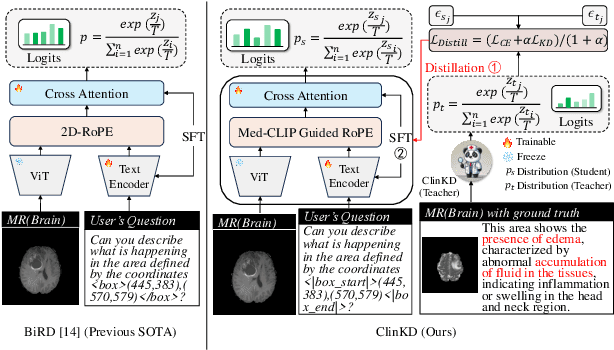
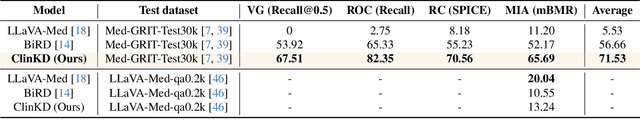
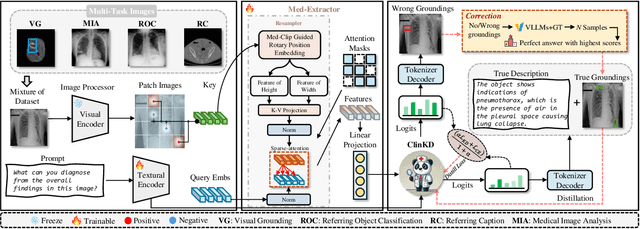
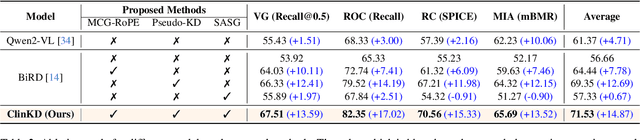
Med-VQA (Medical Visual Question Answering) is a crucial subtask within the broader VQA (Visual Question Answering) domain. This task requires a visual question answering system to analyze the provided image and corresponding question,offering reasonable analysis and suggestions to assist medical professionals in making pathological diagnoses, or ideally, enabling the system to independently provide correct diagnoses. Furthermore, more advanced Med-VQA tasks involve Referring and Grounding, which not only require the system to accurately comprehend medical images but also to pinpoint specific biological locations within those images. While many large pre-trained models have demonstrated substantial VQA capabilities,challenges persist in the medical imaging domain. The intricacy of biological features in medical images and the scarcity of high-quality medical image datasets, combined with the fact that current models are not tailored for the medical field in terms of architecture and training paradigms, hinder the full exploitation of model generalization. This results in issues such as hallucination in Visual Grounding. In this paper, we introduce the ClinKD model, which incorporates modifications to model position encoding and a diversified training process. Initially, we enhance the model's ability to perceive image and modality variations by using Med-CLIP Guided Rotary Position Embedding. Subsequently, we leverage distillation to provide prior knowledge to the model before using complete training data. Additionally, the feedback-based training process during the formal training phase further enhances data utilization. Notably, under unchanged evaluation protocols, we achieve a new state-of-the-art performance on the Med-GRIT-270k dataset, and the Med-CLIP Guided Rotary Position Embedding approach presents potential for generalizing to universal model position encoding.