 Add to Chrome
 Add to Firefox
 Add to Edge
LoMeVQA: A Comprehensive Benchmark for Longitudinal Medical VQA
Jul 30, 2026
In clinical practice, patients often undergo multiple imaging examinations over successive visits, yielding longitudinal data. Modeling such temporal information is crucial for reliable assessment of disease progression and treatment response. However, despite the rapid advancement of multimodal large language models (MLLMs), longitudinal medical visual reasoning remains largely underexplored. To fill this gap, we propose LoMeVQA, a comprehensive benchmark consisting of 206K longitudinal visual question answering (VQA) pairs for temporal medical image analysis. LoMeVQA covers five tasks: progress classification, progress description, progress report generation, differential region grounding, and differential region description. To construct the dataset, we develop an automated pipeline that (1) organizes patient records chronologically, (2) extracts clinically meaningful entities via a medical knowledge graph, and (3) models their temporal evolution to guide large language models in generating high-quality longitudinal VQA pairs. Extensive evaluations demonstrate that both general-purpose and medical-domain MLLMs perform poorly on LoMeVQA, revealing substantial limitations in temporal reasoning. To address these limitations, we introduce MedLong-8B, which achieves state-of-the-art performance across all tasks. Beyond benchmarking, we conduct detailed analyses that uncover key failure modes and shed light on how to improve longitudinal medical visual reasoning. Our data is available at: https://github.com/pepperbubble/LoMeVQA

EntropyPrune: Matrix Entropy Guided Visual Token Pruning for Multimodal Large Language Models
Feb 19, 2026Multimodal large language models (MLLMs) incur substantial inference cost due to the processing of hundreds of visual tokens per image. Although token pruning has proven effective for accelerating inference, determining when and where to prune remains largely heuristic. Existing approaches typically rely on static, empirically selected layers, which limit interpretability and transferability across models. In this work, we introduce a matrix-entropy perspective and identify an "Entropy Collapse Layer" (ECL), where the information content of visual representations exhibits a sharp and consistent drop, which provides a principled criterion for selecting the pruning stage. Building on this observation, we propose EntropyPrune, a novel matrix-entropy-guided token pruning framework that quantifies the information value of individual visual tokens and prunes redundant ones without relying on attention maps. Moreover, to enable efficient computation, we exploit the spectral equivalence of dual Gram matrices, reducing the complexity of entropy computation and yielding up to a 64x theoretical speedup. Extensive experiments on diverse multimodal benchmarks demonstrate that EntropyPrune consistently outperforms state-of-the-art pruning methods in both accuracy and efficiency. On LLaVA-1.5-7B, our method achieves a 68.2% reduction in FLOPs while preserving 96.0% of the original performance. Furthermore, EntropyPrune generalizes effectively to high-resolution and video-based models, highlighting the strong robustness and scalability in practical MLLM acceleration. The code will be publicly available at https://github.com/YahongWang1/EntropyPrune.
All You Need Are Random Visual Tokens? Demystifying Token Pruning in VLLMs
Dec 08, 2025Vision Large Language Models (VLLMs) incur high computational costs due to their reliance on hundreds of visual tokens to represent images. While token pruning offers a promising solution for accelerating inference, this paper, however, identifies a key observation: in deeper layers (e.g., beyond the 20th), existing training-free pruning methods perform no better than random pruning. We hypothesize that this degradation is caused by "vanishing token information", where visual tokens progressively lose their salience with increasing network depth. To validate this hypothesis, we quantify a token's information content by measuring the change in the model output probabilities upon its removal. Using this proposed metric, our analysis of the information of visual tokens across layers reveals three key findings: (1) As layers deepen, the information of visual tokens gradually becomes uniform and eventually vanishes at an intermediate layer, which we term as "information horizon", beyond which the visual tokens become redundant; (2) The position of this horizon is not static; it extends deeper for visually intensive tasks, such as Optical Character Recognition (OCR), compared to more general tasks like Visual Question Answering (VQA); (3) This horizon is also strongly correlated with model capacity, as stronger VLLMs (e.g., Qwen2.5-VL) employ deeper visual tokens than weaker models (e.g., LLaVA-1.5). Based on our findings, we show that simple random pruning in deep layers efficiently balances performance and efficiency. Moreover, integrating random pruning consistently enhances existing methods. Using DivPrune with random pruning achieves state-of-the-art results, maintaining 96.9% of Qwen-2.5-VL-7B performance while pruning 50% of visual tokens. The code will be publicly available at https://github.com/YahongWang1/Information-Horizon.
Mutually Guided Few-shot Learning for Relational Triple Extraction
Jun 23, 2023
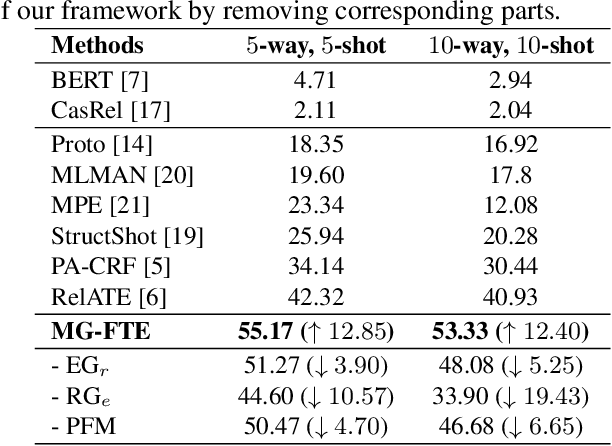
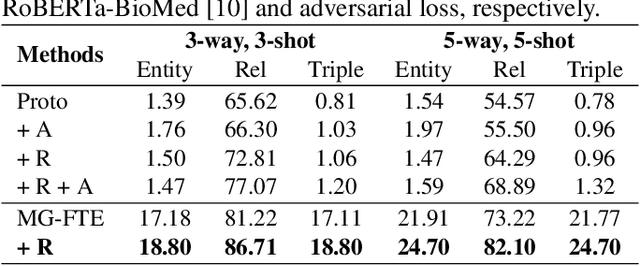
Knowledge graphs (KGs), containing many entity-relation-entity triples, provide rich information for downstream applications. Although extracting triples from unstructured texts has been widely explored, most of them require a large number of labeled instances. The performance will drop dramatically when only few labeled data are available. To tackle this problem, we propose the Mutually Guided Few-shot learning framework for Relational Triple Extraction (MG-FTE). Specifically, our method consists of an entity-guided relation proto-decoder to classify the relations firstly and a relation-guided entity proto-decoder to extract entities based on the classified relations. To draw the connection between entity and relation, we design a proto-level fusion module to boost the performance of both entity extraction and relation classification. Moreover, a new cross-domain few-shot triple extraction task is introduced. Extensive experiments show that our method outperforms many state-of-the-art methods by 12.6 F1 score on FewRel 1.0 (single-domain) and 20.5 F1 score on FewRel 2.0 (cross-domain).
Class Distribution Alignment for Adversarial Domain Adaptation
Apr 20, 2020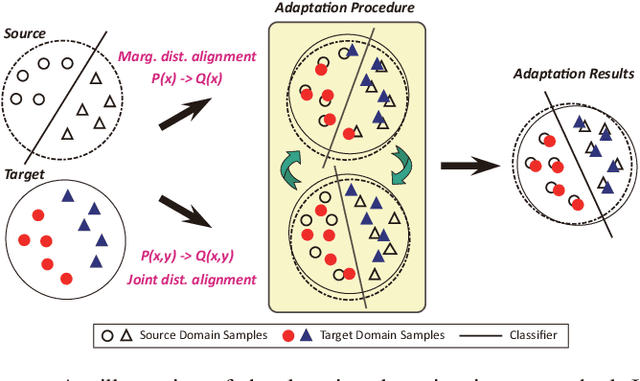
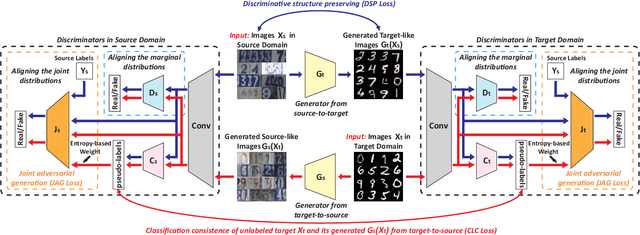
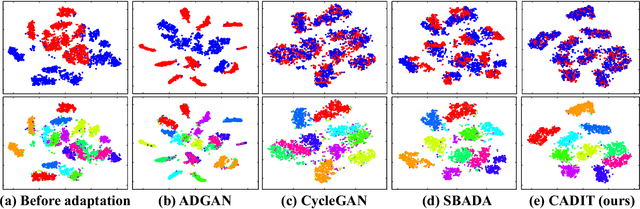
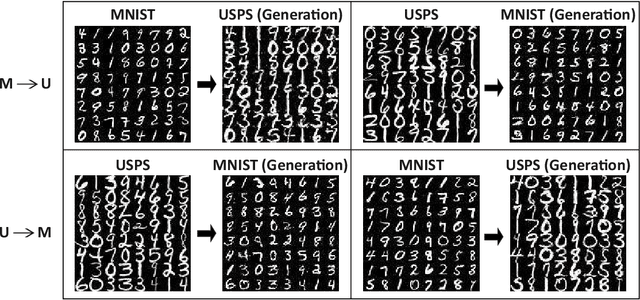
Most existing unsupervised domain adaptation methods mainly focused on aligning the marginal distributions of samples between the source and target domains. This setting does not sufficiently consider the class distribution information between the two domains, which could adversely affect the reduction of domain gap. To address this issue, we propose a novel approach called Conditional ADversarial Image Translation (CADIT) to explicitly align the class distributions given samples between the two domains. It integrates a discriminative structure-preserving loss and a joint adversarial generation loss. The former effectively prevents undesired label-flipping during the whole process of image translation, while the latter maintains the joint distribution alignment of images and labels. Furthermore, our approach enforces the classification consistence of target domain images before and after adaptation to aid the classifier training in both domains. Extensive experiments were conducted on multiple benchmark datasets including Digits, Faces, Scenes and Office31, showing that our approach achieved superior classification in the target domain when compared to the state-of-the-art methods. Also, both qualitative and quantitative results well supported our motivation that aligning the class distributions can indeed improve domain adaptation.