 Add to Chrome
 Add to Firefox
 Add to Edge
Existence Precedes Value: Joint Modeling of Observational Existence and Evolving States in Time Series Forecasting
Jun 11, 2026
Real-world time series are often highly incomplete and irregular due to sensor dormancy, transmission delays, and event-driven sampling, making reliable forecasting fundamentally challenging. Existing methods have evolved from impute-then-forecast pipelines to continuous-time models such as Neural ODEs and continuous-time graph networks. While these approaches improve the modeling of historical irregularity, they still rely on an implicit oracle assumption at inference time: the timestamps of future valid observations are presumed to be known in advance. This assumption limits practical relevance, since in many real systems the more fundamental question is not only what the future value will be, but also whether a valid observation will occur at all. In this paper, we propose Timeflies, a unified framework that reformulates forecasting as a joint problem of future observability inference and value estimation. To explicitly model the interaction between observation dynamics and state evolution, Timeflies adopts an observation stream and a value stream, coupled through three dedicated modules for reliability-aware embedding, observation-guided dependency modeling, and joint prediction. We further construct Shadow, a benchmark that combines natural missingness from public datasets with real-world industrial data, and introduce the Observation-Value Joint Entropy (OVJE) metric to comprehensively evaluate this coupled predictability. Extensive experiments show that Timeflies consistently outperforms existing methods, highlighting the importance of explicitly modeling future observability in time series forecasting with missing values. Code and dataset are available in https://github.com/ant-intl/Timeflies.

Falcon-X: A Time Series Foundation Model for Heterogeneous Multivariate Modeling
May 26, 2026Time series foundation models (TSFMs) are transforming the forecasting paradigm through large-scale cross-domain pretraining. However, most existing TSFMs remain univariate, and recent efforts to enable cross-variate modeling still operate directly within the raw variate space. This design introduces fundamental limitations in semantic alignment and relational expressivity. Specifically, raw-space group mixing lacks a dedicated mechanism to align heterogeneous physical quantities, while standard non-negative attention fails to capture the complex synergistic and antagonistic interactions ubiquitous in real-world systems. To address these challenges, we propose Falcon-X, decouples variates from the raw space and maps them into a unified latent prototype space. Falcon-X employs a Unified Prototype Diff-Attention mechanism that explicitly evaluates both positive and negative semantic affinities to explicitly align heterogeneous variates. Cross-variate interactions are then efficiently performed within this shared space via Latent Entity Attention, naturally facilitating zero-shot structural transfer. Finally, a Variate Reassembly Router robustly reconstructs variate-specific trajectories via a request-and-dispatch mechanism. Extensive evaluations on the GIFT-Eval and fev-bench benchmarks demonstrate that Falcon-X achieves state-of-the-art forecasting performance, offering a principled and scalable paradigm for complex multivariate environments. Falcon-X is publicly released to support future research.
AFiRe: Anatomy-Driven Self-Supervised Learning for Fine-Grained Representation in Radiographic Images
Apr 15, 2025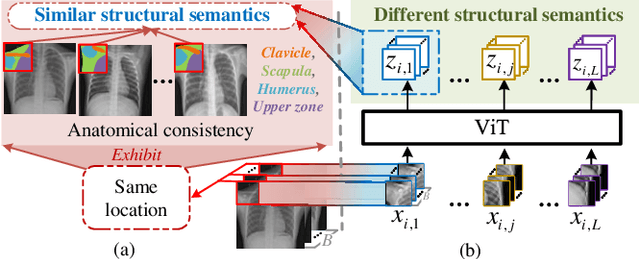
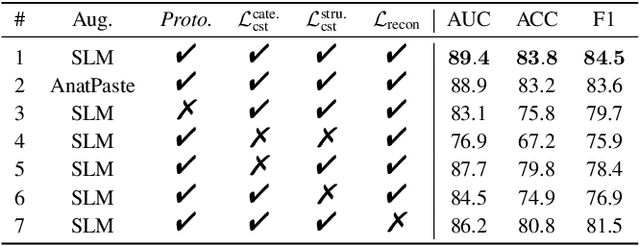
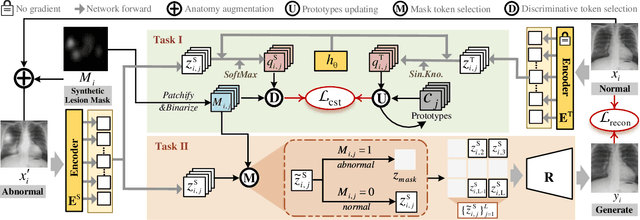
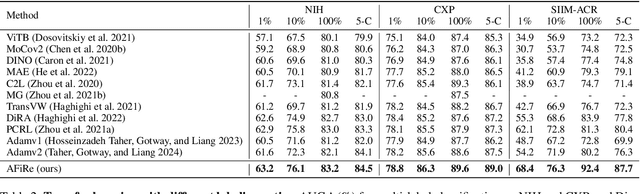
Current self-supervised methods, such as contrastive learning, predominantly focus on global discrimination, neglecting the critical fine-grained anatomical details required for accurate radiographic analysis. To address this challenge, we propose an Anatomy-driven self-supervised framework for enhancing Fine-grained Representation in radiographic image analysis (AFiRe). The core idea of AFiRe is to align the anatomical consistency with the unique token-processing characteristics of Vision Transformer. Specifically, AFiRe synergistically performs two self-supervised schemes: (i) Token-wise anatomy-guided contrastive learning, which aligns image tokens based on structural and categorical consistency, thereby enhancing fine-grained spatial-anatomical discrimination; (ii) Pixel-level anomaly-removal restoration, which particularly focuses on local anomalies, thereby refining the learned discrimination with detailed geometrical information. Additionally, we propose Synthetic Lesion Mask to enhance anatomical diversity while preserving intra-consistency, which is typically corrupted by traditional data augmentations, such as Cropping and Affine transformations. Experimental results show that AFiRe: (i) provides robust anatomical discrimination, achieving more cohesive feature clusters compared to state-of-the-art contrastive learning methods; (ii) demonstrates superior generalization, surpassing 7 radiography-specific self-supervised methods in multi-label classification tasks with limited labeling; and (iii) integrates fine-grained information, enabling precise anomaly detection using only image-level annotations.
Visual Neural Decoding via Improved Visual-EEG Semantic Consistency
Aug 13, 2024Visual neural decoding refers to the process of extracting and interpreting original visual experiences from human brain activity. Recent advances in metric learning-based EEG visual decoding methods have delivered promising results and demonstrated the feasibility of decoding novel visual categories from brain activity. However, methods that directly map EEG features to the CLIP embedding space may introduce mapping bias and cause semantic inconsistency among features, thereby degrading alignment and impairing decoding performance. To further explore the semantic consistency between visual and neural signals. In this work, we construct a joint semantic space and propose a Visual-EEG Semantic Decouple Framework that explicitly extracts the semantic-related features of these two modalities to facilitate optimal alignment. Specifically, a cross-modal information decoupling module is introduced to guide the extraction of semantic-related information from modalities. Then, by quantifying the mutual information between visual image and EEG features, we observe a strong positive correlation between the decoding performance and the magnitude of mutual information. Furthermore, inspired by the mechanisms of visual object understanding from neuroscience, we propose an intra-class geometric consistency approach during the alignment process. This strategy maps visual samples within the same class to consistent neural patterns, which further enhances the robustness and the performance of EEG visual decoding. Experiments on a large Image-EEG dataset show that our method achieves state-of-the-art results in zero-shot neural decoding tasks.