 Add to Chrome
 Add to Firefox
 Add to Edge
AusSmoke meets MultiNatSmoke: a fully-labelled diverse smoke segmentation dataset
Apr 26, 2026
Wildfires are an escalating global concern due to the devastating impacts on the environment, economy, and human health, with notable incidents such as the 2019-2020 Australian bushfires and the 2025 California wildfires underscoring the severity of these events. AI-enabled camera-based smoke detection has emerged as a promising approach for the rapid detection of wildfires. However, existing wildfire smoke segmentation datasets that are used for training detection and segmentation models are limited in scale, geographically constrained, and often rely on synthetic imagery, which hinders effective training and generalization. To overcome these limitations, we present AusSmoke, a new smoke segmentation dataset collected from Australia to address the data scarcity in this region. Furthermore, we introduce a MultiNational geographically diverse and substantially larger fully-labelled benchmark, called MultiNatSmoke, that consolidates publicly available international datasets with the newly collected Australian imagery, expanding the scale by an order of magnitude over previous collections. Finally, we benchmark smoke segmentation models, demonstrating improved performance and enhanced generalization across diverse geographical contexts. The project is available at \href{https://github.com/henryzhao0615/MultiNatSmoke}{Github}.

Mind the Rarities: Can Rare Skin Diseases Be Reliably Diagnosed via Diagnostic Reasoning?
Mar 19, 2026Large vision-language models (LVLMs) demonstrate strong performance in dermatology; however, evaluating diagnostic reasoning for rare conditions remains largely unexplored. Existing benchmarks focus on common diseases and assess only final accuracy, overlooking the clinical reasoning process, which is critical for complex cases. We address this gap by constructing DermCase, a long-context benchmark derived from peer-reviewed case reports. Our dataset contains 26,030 multi-modal image-text pairs and 6,354 clinically challenging cases, each annotated with comprehensive clinical information and step-by-step reasoning chains. To enable reliable evaluation, we establish DermLIP-based similarity metrics that achieve stronger alignment with dermatologists for assessing differential diagnosis quality. Benchmarking 22 leading LVLMs exposes significant deficiencies across diagnosis accuracy, differential diagnosis, and clinical reasoning. Fine-tuning experiments demonstrate that instruction tuning substantially improves performance while Direct Preference Optimization (DPO) yields minimal gains. Systematic error analysis further reveals critical limitations in current models' reasoning capabilities.
ClinKD: Cross-Modal Clinic Knowledge Distiller For Multi-Task Medical Images
Feb 09, 2025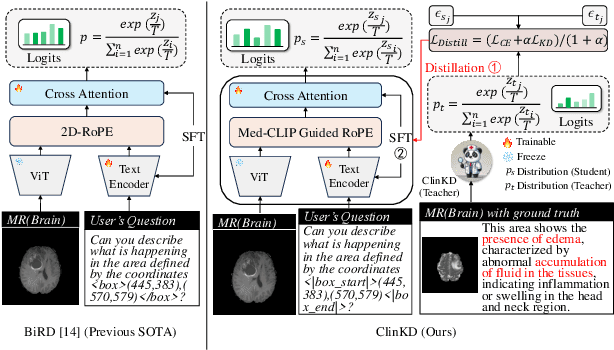
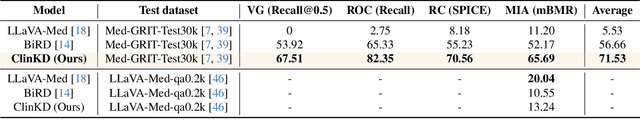
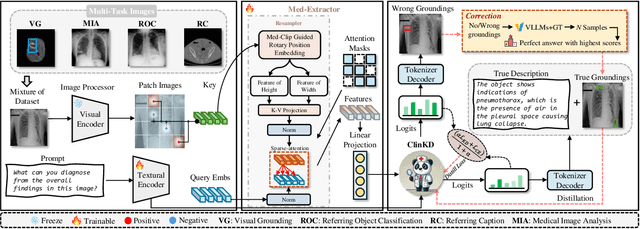
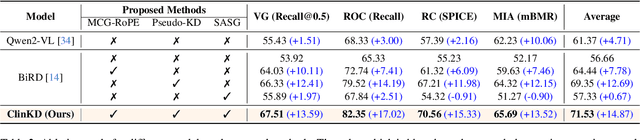
Med-VQA (Medical Visual Question Answering) is a crucial subtask within the broader VQA (Visual Question Answering) domain. This task requires a visual question answering system to analyze the provided image and corresponding question,offering reasonable analysis and suggestions to assist medical professionals in making pathological diagnoses, or ideally, enabling the system to independently provide correct diagnoses. Furthermore, more advanced Med-VQA tasks involve Referring and Grounding, which not only require the system to accurately comprehend medical images but also to pinpoint specific biological locations within those images. While many large pre-trained models have demonstrated substantial VQA capabilities,challenges persist in the medical imaging domain. The intricacy of biological features in medical images and the scarcity of high-quality medical image datasets, combined with the fact that current models are not tailored for the medical field in terms of architecture and training paradigms, hinder the full exploitation of model generalization. This results in issues such as hallucination in Visual Grounding. In this paper, we introduce the ClinKD model, which incorporates modifications to model position encoding and a diversified training process. Initially, we enhance the model's ability to perceive image and modality variations by using Med-CLIP Guided Rotary Position Embedding. Subsequently, we leverage distillation to provide prior knowledge to the model before using complete training data. Additionally, the feedback-based training process during the formal training phase further enhances data utilization. Notably, under unchanged evaluation protocols, we achieve a new state-of-the-art performance on the Med-GRIT-270k dataset, and the Med-CLIP Guided Rotary Position Embedding approach presents potential for generalizing to universal model position encoding.