 Add to Chrome
 Add to Firefox
 Add to Edge
Joint Consistency: A Unified Test-Time Aggregation Framework via Energy Minimization
May 07, 2026
This paper studies test-time aggregation, an approach that generates multiple reasoning traces and aggregates them into a final answer. Most existing methods rely on evaluation signals collected from candidate traces in isolation or answer frequencies, while ignoring comparative interactions among candidates. We propose Joint Consistency (JC), formulated as a constrained Ising-type energy minimization problem, where independent evaluation signals act as external fields and pairwise comparisons act as interactions. JC provides a unified framework for test-time aggregation that subsumes existing voting and weighted aggregation methods as special cases. Our construction of the interaction matrix leverages LLM-as-a-judge comparisons, and admits a theoretical interpretation under answer-level homogeneity assumptions. Moreover, we develop an efficient approximation strategy that makes interaction modeling practical for large-scale test-time aggregation. Experiments on math and code reasoning benchmarks show that JC consistently outperforms existing baselines across tasks, judge models, trace budgets, and trace-generation settings.

EntropyPrune: Matrix Entropy Guided Visual Token Pruning for Multimodal Large Language Models
Feb 19, 2026Multimodal large language models (MLLMs) incur substantial inference cost due to the processing of hundreds of visual tokens per image. Although token pruning has proven effective for accelerating inference, determining when and where to prune remains largely heuristic. Existing approaches typically rely on static, empirically selected layers, which limit interpretability and transferability across models. In this work, we introduce a matrix-entropy perspective and identify an "Entropy Collapse Layer" (ECL), where the information content of visual representations exhibits a sharp and consistent drop, which provides a principled criterion for selecting the pruning stage. Building on this observation, we propose EntropyPrune, a novel matrix-entropy-guided token pruning framework that quantifies the information value of individual visual tokens and prunes redundant ones without relying on attention maps. Moreover, to enable efficient computation, we exploit the spectral equivalence of dual Gram matrices, reducing the complexity of entropy computation and yielding up to a 64x theoretical speedup. Extensive experiments on diverse multimodal benchmarks demonstrate that EntropyPrune consistently outperforms state-of-the-art pruning methods in both accuracy and efficiency. On LLaVA-1.5-7B, our method achieves a 68.2% reduction in FLOPs while preserving 96.0% of the original performance. Furthermore, EntropyPrune generalizes effectively to high-resolution and video-based models, highlighting the strong robustness and scalability in practical MLLM acceleration. The code will be publicly available at https://github.com/YahongWang1/EntropyPrune.
All You Need Are Random Visual Tokens? Demystifying Token Pruning in VLLMs
Dec 08, 2025Vision Large Language Models (VLLMs) incur high computational costs due to their reliance on hundreds of visual tokens to represent images. While token pruning offers a promising solution for accelerating inference, this paper, however, identifies a key observation: in deeper layers (e.g., beyond the 20th), existing training-free pruning methods perform no better than random pruning. We hypothesize that this degradation is caused by "vanishing token information", where visual tokens progressively lose their salience with increasing network depth. To validate this hypothesis, we quantify a token's information content by measuring the change in the model output probabilities upon its removal. Using this proposed metric, our analysis of the information of visual tokens across layers reveals three key findings: (1) As layers deepen, the information of visual tokens gradually becomes uniform and eventually vanishes at an intermediate layer, which we term as "information horizon", beyond which the visual tokens become redundant; (2) The position of this horizon is not static; it extends deeper for visually intensive tasks, such as Optical Character Recognition (OCR), compared to more general tasks like Visual Question Answering (VQA); (3) This horizon is also strongly correlated with model capacity, as stronger VLLMs (e.g., Qwen2.5-VL) employ deeper visual tokens than weaker models (e.g., LLaVA-1.5). Based on our findings, we show that simple random pruning in deep layers efficiently balances performance and efficiency. Moreover, integrating random pruning consistently enhances existing methods. Using DivPrune with random pruning achieves state-of-the-art results, maintaining 96.9% of Qwen-2.5-VL-7B performance while pruning 50% of visual tokens. The code will be publicly available at https://github.com/YahongWang1/Information-Horizon.
PhyBench: A Physical Commonsense Benchmark for Evaluating Text-to-Image Models
Jun 17, 2024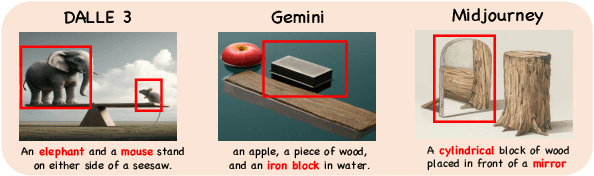
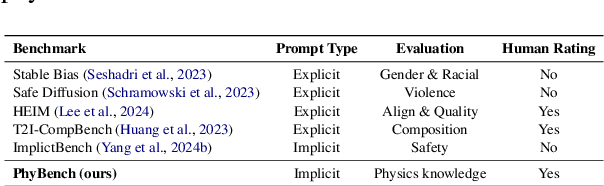
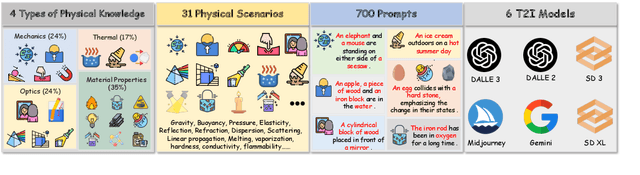
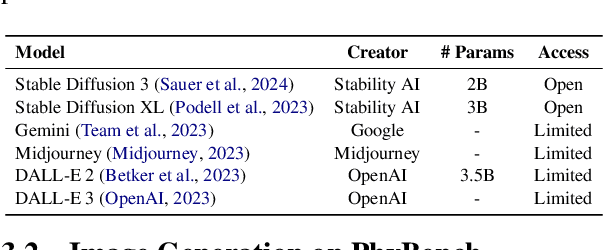
Text-to-image (T2I) models have made substantial progress in generating images from textual prompts. However, they frequently fail to produce images consistent with physical commonsense, a vital capability for applications in world simulation and everyday tasks. Current T2I evaluation benchmarks focus on metrics such as accuracy, bias, and safety, neglecting the evaluation of models' internal knowledge, particularly physical commonsense. To address this issue, we introduce PhyBench, a comprehensive T2I evaluation dataset comprising 700 prompts across 4 primary categories: mechanics, optics, thermodynamics, and material properties, encompassing 31 distinct physical scenarios. We assess 6 prominent T2I models, including proprietary models DALLE3 and Gemini, and demonstrate that incorporating physical principles into prompts enhances the models' ability to generate physically accurate images. Our findings reveal that: (1) even advanced models frequently err in various physical scenarios, except for optics; (2) GPT-4o, with item-specific scoring instructions, effectively evaluates the models' understanding of physical commonsense, closely aligning with human assessments; and (3) current T2I models are primarily focused on text-to-image translation, lacking profound reasoning regarding physical commonsense. We advocate for increased attention to the inherent knowledge within T2I models, beyond their utility as mere image generation tools. The code and data are available at https://github.com/OpenGVLab/PhyBench.