 Add to Chrome
 Add to Firefox
 Add to Edge
DGL: Dynamic Global-Local Prompt Tuning for Text-Video Retrieval
Jan 19, 2024
Text-video retrieval is a critical multi-modal task to find the most relevant video for a text query. Although pretrained models like CLIP have demonstrated impressive potential in this area, the rising cost of fully finetuning these models due to increasing model size continues to pose a problem. To address this challenge, prompt tuning has emerged as an alternative. However, existing works still face two problems when adapting pretrained image-text models to downstream video-text tasks: (1) The visual encoder could only encode frame-level features and failed to extract global-level general video information. (2) Equipping the visual and text encoder with separated prompts failed to mitigate the visual-text modality gap. To this end, we propose DGL, a cross-modal Dynamic prompt tuning method with Global-Local video attention. In contrast to previous prompt tuning methods, we employ the shared latent space to generate local-level text and frame prompts that encourage inter-modal interaction. Furthermore, we propose modeling video in a global-local attention mechanism to capture global video information from the perspective of prompt tuning. Extensive experiments reveal that when only 0.67% parameters are tuned, our cross-modal prompt tuning strategy DGL outperforms or is comparable to fully finetuning methods on MSR-VTT, VATEX, LSMDC, and ActivityNet datasets. Code will be available at https://github.com/knightyxp/DGL

DoraemonGPT: Toward Understanding Dynamic Scenes with Large Language Models
Jan 16, 2024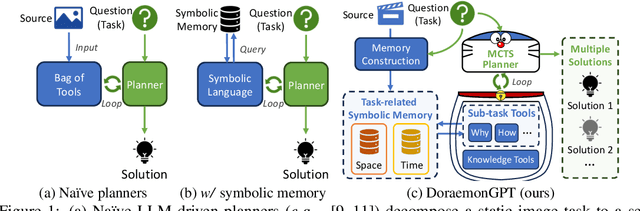

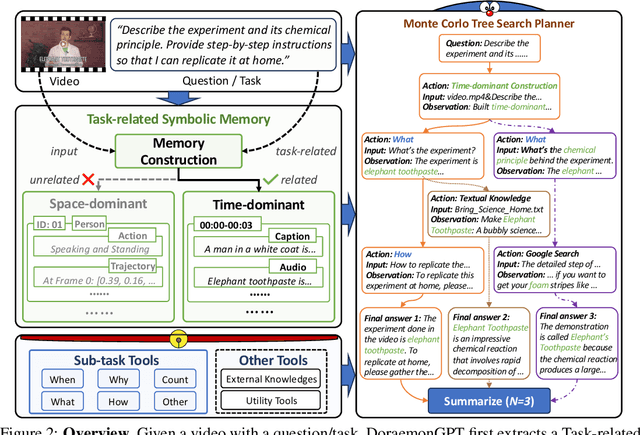
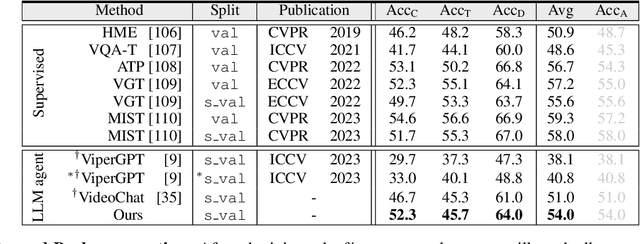
The field of AI agents is advancing at an unprecedented rate due to the capabilities of large language models (LLMs). However, LLM-driven visual agents mainly focus on solving tasks for the image modality, which limits their ability to understand the dynamic nature of the real world, making it still far from real-life applications, e.g., guiding students in laboratory experiments and identifying their mistakes. Considering the video modality better reflects the ever-changing and perceptually intensive nature of real-world scenarios, we devise DoraemonGPT, a comprehensive and conceptually elegant system driven by LLMs to handle dynamic video tasks. Given a video with a question/task, DoraemonGPT begins by converting the input video with massive content into a symbolic memory that stores \textit{task-related} attributes. This structured representation allows for spatial-temporal querying and reasoning by sub-task tools, resulting in concise and relevant intermediate results. Recognizing that LLMs have limited internal knowledge when it comes to specialized domains (e.g., analyzing the scientific principles underlying experiments), we incorporate plug-and-play tools to assess external knowledge and address tasks across different domains. Moreover, we introduce a novel LLM-driven planner based on Monte Carlo Tree Search to efficiently explore the large planning space for scheduling various tools. The planner iteratively finds feasible solutions by backpropagating the result's reward, and multiple solutions can be summarized into an improved final answer. We extensively evaluate DoraemonGPT in dynamic scenes and provide in-the-wild showcases demonstrating its ability to handle more complex questions than previous studies.
AntEval: Quantitatively Evaluating Informativeness and Expressiveness of Agent Social Interactions
Jan 12, 2024While Large Language Models (LLMs) based agents have successfully mimicked human behaviors in various scenarios, the realm of complex, multi-character social interactions within extended contexts remains underexplored. The challenge is compounded by privacy concerns, making it difficult to capture and utilize intricate real-life interactions. More importantly, the absence of quantitative evaluation methods hampers the pursuit of high-quality agent interactions, often leading to interactions that are limited in informativeness and expressiveness, characterized by superficial small talk without clear intentions. In this work, we leverage the rules of Tabletop Role-Playing Games (TRPG) to create an environment conducive to complex, context-rich interactions, emphasizing informativeness and expressiveness. This virtual setting alleviates privacy concerns and motivates agents to engage in meaningful, high-quality interactions as part of their in-game objectives. To assess these interactions, we introduce the Agent interaction Evaluation framework (AntEval), targeting the qualitative evaluation of interaction informativeness and expressiveness. Specifically, we propose two novel evaluation metrics: Information Exchanging Precision (IEP) and Interaction Expressiveness Gap (IEG). These metrics are designed to assess interactions in scenarios focused on information exchange and intention expression, respectively. Our experimental results demonstrate the effectiveness of these metrics in evaluating interaction quality. Notably, we identify significant areas for improvement in LLMs regarding social interactions, as highlighted by our metrics. We believe AntEval will guide further exploration in complex agent interactions, bringing them closer to emulating real human behavior and enhancing their integration and utility in real-world applications.
MS-DETR: Efficient DETR Training with Mixed Supervision
Jan 08, 2024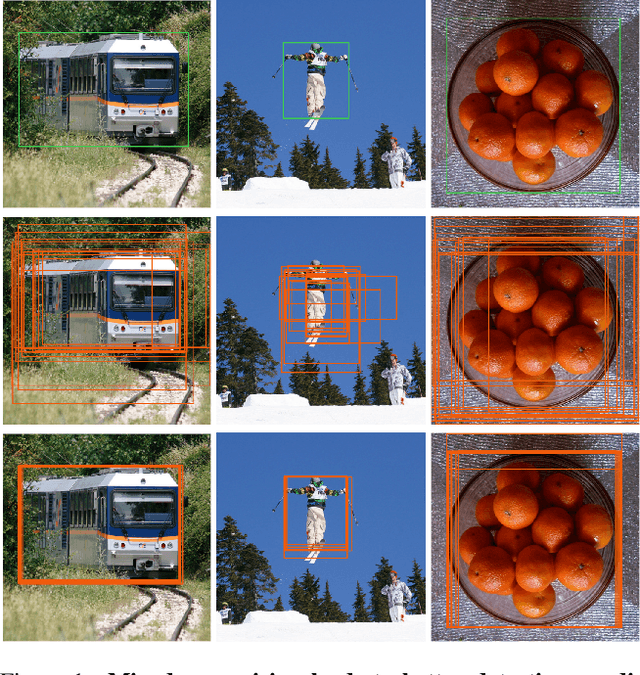

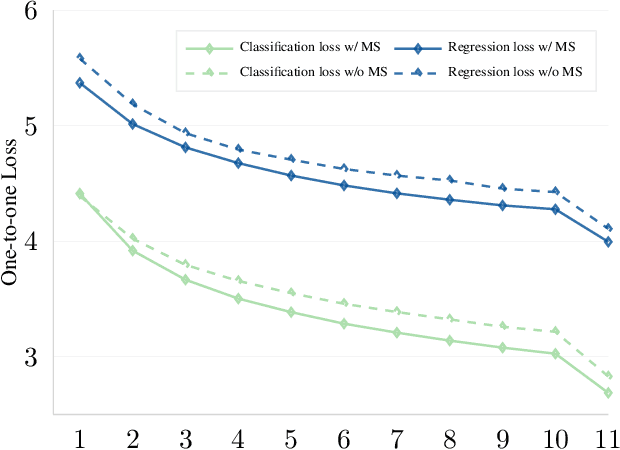
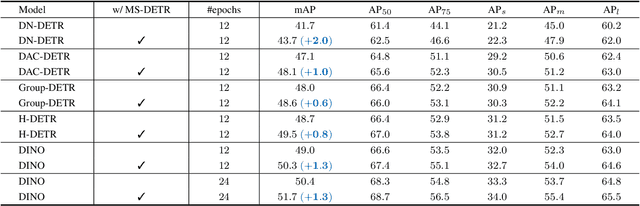
DETR accomplishes end-to-end object detection through iteratively generating multiple object candidates based on image features and promoting one candidate for each ground-truth object. The traditional training procedure using one-to-one supervision in the original DETR lacks direct supervision for the object detection candidates. We aim at improving the DETR training efficiency by explicitly supervising the candidate generation procedure through mixing one-to-one supervision and one-to-many supervision. Our approach, namely MS-DETR, is simple, and places one-to-many supervision to the object queries of the primary decoder that is used for inference. In comparison to existing DETR variants with one-to-many supervision, such as Group DETR and Hybrid DETR, our approach does not need additional decoder branches or object queries. The object queries of the primary decoder in our approach directly benefit from one-to-many supervision and thus are superior in object candidate prediction. Experimental results show that our approach outperforms related DETR variants, such as DN-DETR, Hybrid DETR, and Group DETR, and the combination with related DETR variants further improves the performance.
GD^2-NeRF: Generative Detail Compensation via GAN and Diffusion for One-shot Generalizable Neural Radiance Fields
Jan 02, 2024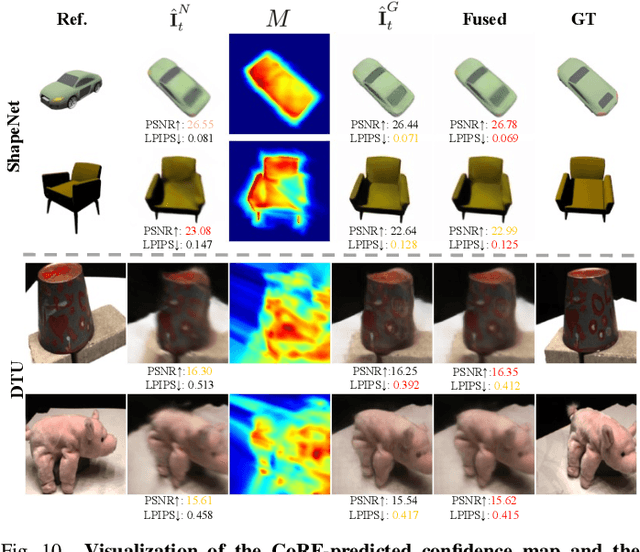
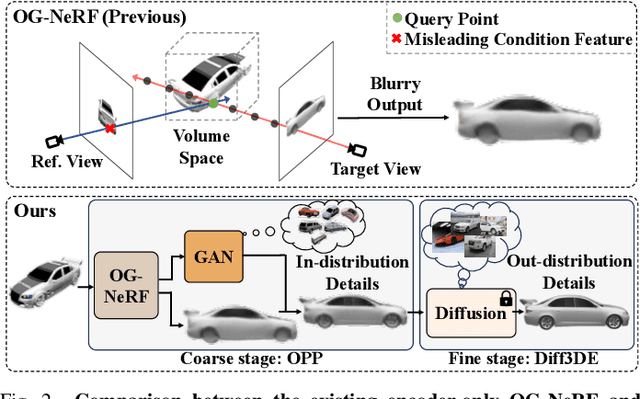
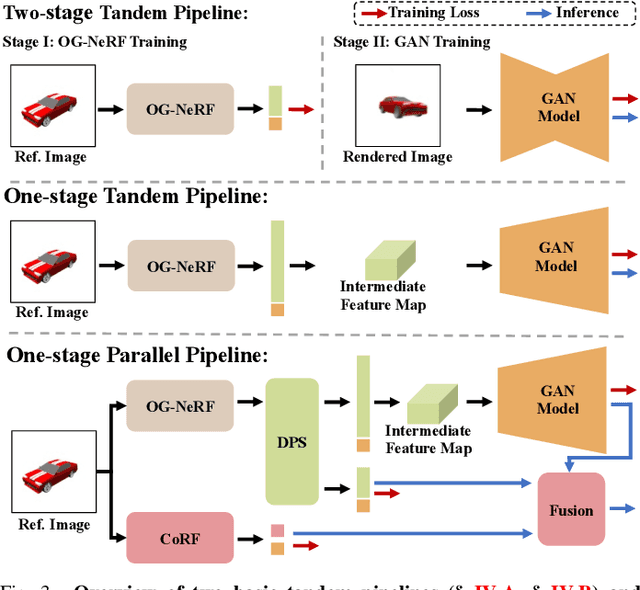
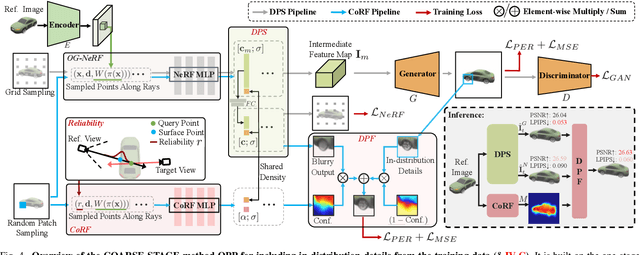
In this paper, we focus on the One-shot Novel View Synthesis (O-NVS) task which targets synthesizing photo-realistic novel views given only one reference image per scene. Previous One-shot Generalizable Neural Radiance Fields (OG-NeRF) methods solve this task in an inference-time finetuning-free manner, yet suffer the blurry issue due to the encoder-only architecture that highly relies on the limited reference image. On the other hand, recent diffusion-based image-to-3d methods show vivid plausible results via distilling pre-trained 2D diffusion models into a 3D representation, yet require tedious per-scene optimization. Targeting these issues, we propose the GD$^2$-NeRF, a Generative Detail compensation framework via GAN and Diffusion that is both inference-time finetuning-free and with vivid plausible details. In detail, following a coarse-to-fine strategy, GD$^2$-NeRF is mainly composed of a One-stage Parallel Pipeline (OPP) and a 3D-consistent Detail Enhancer (Diff3DE). At the coarse stage, OPP first efficiently inserts the GAN model into the existing OG-NeRF pipeline for primarily relieving the blurry issue with in-distribution priors captured from the training dataset, achieving a good balance between sharpness (LPIPS, FID) and fidelity (PSNR, SSIM). Then, at the fine stage, Diff3DE further leverages the pre-trained image diffusion models to complement rich out-distribution details while maintaining decent 3D consistency. Extensive experiments on both the synthetic and real-world datasets show that GD$^2$-NeRF noticeably improves the details while without per-scene finetuning.
Model Stealing Attack against Recommender System
Dec 26, 2023Recent studies have demonstrated the vulnerability of recommender systems to data privacy attacks. However, research on the threat to model privacy in recommender systems, such as model stealing attacks, is still in its infancy. Some adversarial attacks have achieved model stealing attacks against recommender systems, to some extent, by collecting abundant training data of the target model (target data) or making a mass of queries. In this paper, we constrain the volume of available target data and queries and utilize auxiliary data, which shares the item set with the target data, to promote model stealing attacks. Although the target model treats target and auxiliary data differently, their similar behavior patterns allow them to be fused using an attention mechanism to assist attacks. Besides, we design stealing functions to effectively extract the recommendation list obtained by querying the target model. Experimental results show that the proposed methods are applicable to most recommender systems and various scenarios and exhibit excellent attack performance on multiple datasets.
Model Stealing Attack against Graph Classification with Authenticity, Uncertainty and Diversity
Dec 26, 2023Recent research demonstrates that GNNs are vulnerable to the model stealing attack, a nefarious endeavor geared towards duplicating the target model via query permissions. However, they mainly focus on node classification tasks, neglecting the potential threats entailed within the domain of graph classification tasks. Furthermore, their practicality is questionable due to unreasonable assumptions, specifically concerning the large data requirements and extensive model knowledge. To this end, we advocate following strict settings with limited real data and hard-label awareness to generate synthetic data, thereby facilitating the stealing of the target model. Specifically, following important data generation principles, we introduce three model stealing attacks to adapt to different actual scenarios: MSA-AU is inspired by active learning and emphasizes the uncertainty to enhance query value of generated samples; MSA-AD introduces diversity based on Mixup augmentation strategy to alleviate the query inefficiency issue caused by over-similar samples generated by MSA-AU; MSA-AUD combines the above two strategies to seamlessly integrate the authenticity, uncertainty, and diversity of the generated samples. Finally, extensive experiments consistently demonstrate the superiority of the proposed methods in terms of concealment, query efficiency, and stealing performance.
SEEAvatar: Photorealistic Text-to-3D Avatar Generation with Constrained Geometry and Appearance
Dec 26, 2023Powered by large-scale text-to-image generation models, text-to-3D avatar generation has made promising progress. However, most methods fail to produce photorealistic results, limited by imprecise geometry and low-quality appearance. Towards more practical avatar generation, we present SEEAvatar, a method for generating photorealistic 3D avatars from text with SElf-Evolving constraints for decoupled geometry and appearance. For geometry, we propose to constrain the optimized avatar in a decent global shape with a template avatar. The template avatar is initialized with human prior and can be updated by the optimized avatar periodically as an evolving template, which enables more flexible shape generation. Besides, the geometry is also constrained by the static human prior in local parts like face and hands to maintain the delicate structures. For appearance generation, we use diffusion model enhanced by prompt engineering to guide a physically based rendering pipeline to generate realistic textures. The lightness constraint is applied on the albedo texture to suppress incorrect lighting effect. Experiments show that our method outperforms previous methods on both global and local geometry and appearance quality by a large margin. Since our method can produce high-quality meshes and textures, such assets can be directly applied in classic graphics pipeline for realistic rendering under any lighting condition. Project page at: https://yoxu515.github.io/SEEAvatar/.
Human101: Training 100+FPS Human Gaussians in 100s from 1 View
Dec 23, 2023Reconstructing the human body from single-view videos plays a pivotal role in the virtual reality domain. One prevalent application scenario necessitates the rapid reconstruction of high-fidelity 3D digital humans while simultaneously ensuring real-time rendering and interaction. Existing methods often struggle to fulfill both requirements. In this paper, we introduce Human101, a novel framework adept at producing high-fidelity dynamic 3D human reconstructions from 1-view videos by training 3D Gaussians in 100 seconds and rendering in 100+ FPS. Our method leverages the strengths of 3D Gaussian Splatting, which provides an explicit and efficient representation of 3D humans. Standing apart from prior NeRF-based pipelines, Human101 ingeniously applies a Human-centric Forward Gaussian Animation method to deform the parameters of 3D Gaussians, thereby enhancing rendering speed (i.e., rendering 1024-resolution images at an impressive 60+ FPS and rendering 512-resolution images at 100+ FPS). Experimental results indicate that our approach substantially eclipses current methods, clocking up to a 10 times surge in frames per second and delivering comparable or superior rendering quality. Code and demos will be released at https://github.com/longxiang-ai/Human101.
Vista-LLaMA: Reliable Video Narrator via Equal Distance to Visual Tokens
Dec 12, 2023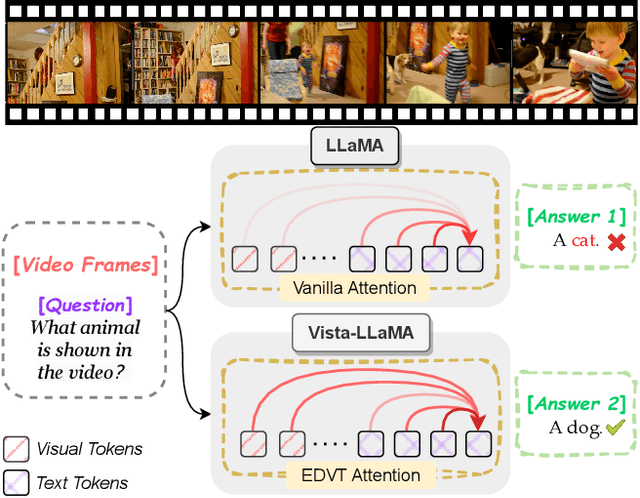
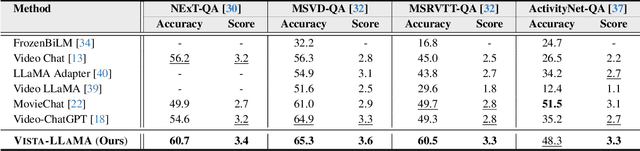
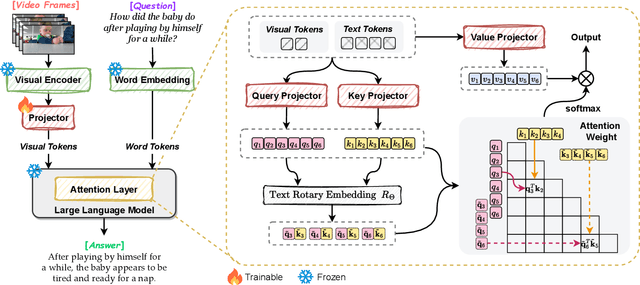
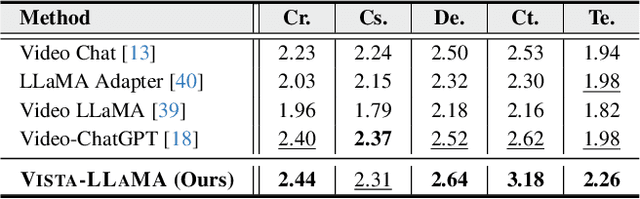
Recent advances in large video-language models have displayed promising outcomes in video comprehension. Current approaches straightforwardly convert video into language tokens and employ large language models for multi-modal tasks. However, this method often leads to the generation of irrelevant content, commonly known as "hallucination", as the length of the text increases and the impact of the video diminishes. To address this problem, we propose Vista-LLaMA, a novel framework that maintains the consistent distance between all visual tokens and any language tokens, irrespective of the generated text length. Vista-LLaMA omits relative position encoding when determining attention weights between visual and text tokens, retaining the position encoding for text and text tokens. This amplifies the effect of visual tokens on text generation, especially when the relative distance is longer between visual and text tokens. The proposed attention mechanism significantly reduces the chance of producing irrelevant text related to the video content. Furthermore, we present a sequential visual projector that projects the current video frame into tokens of language space with the assistance of the previous frame. This approach not only captures the temporal relationship within the video, but also allows less visual tokens to encompass the entire video. Our approach significantly outperforms various previous methods (e.g., Video-ChatGPT, MovieChat) on four challenging open-ended video question answering benchmarks. We reach an accuracy of 60.7 on the zero-shot NExT-QA and 60.5 on the zero-shot MSRVTT-QA, setting a new state-of-the-art performance. This project is available at https://jinxxian.github.io/Vista-LLaMA.