 Add to Chrome
 Add to Firefox
 Add to Edge
OmniPlan: An Adaptive Framework for Timely and Near-Optimal Network Planning Optimization
Jun 17, 2026
Network planning optimization is a fundamental problem across diverse domains, including transportation systems, communication networks, and power grids. It requires simultaneous optimization of multiple competing objectives under complex constraints. Existing network planning optimization frameworks rely on mixed integer programming (MIP) solvers, heuristics, and deep reinforcement learning (DRL) models to compute planning decisions. However, they lack effective adaptability to diverse and dynamic user intents, thus leading to the trade-off between execution time and optimality. In this paper, we propose OmniPlan, an adaptive framework that achieves both timeliness and near-optimality in network planning optimization. To achieve the adaptability lacking in existing solutions, OmniPlan employs a large language model (LLM)-based interpreter to convert heterogeneous natural-language intents into a unified and quantifiable user-preference vector. Then it employs a mixture-of-experts architecture that integrates MIP solvers, heuristics, and DRL models as specialized experts, where OmniPlan adapts to diverse intents by dynamically selecting timely and near-optimal experts. Finally, it incorporates a DRL-based expert configuration module that fine-tunes optimization objective weights to align planning decisions with user-specific preferences. We evaluate OmniPlan with a representative real-world workload, i.e., distributed machine learning (ML), where we leverage OmniPlan to offload a wide spectrum of ML inference tasks, e.g., decision trees, SVM, naive Bayes, XGBoost, and random forests, onto a network of hardware devices. Our experiments on a real-world testbed indicate that OmniPlan achieves near-optimal and low-execution-time offloading for real-world ML inference tasks, reducing latency by up to 97.8\% and network device resource consumption by up to 11.5\%.

VIA-SD: Verification via Intra-Model Routing for Speculative Decoding
Jun 10, 2026Speculative decoding (SD) addresses the high inference costs of LLMs by having lightweight drafters generate candidates for large verifiers to validate in parallel. Existing draft-verify methods use binary decisions: accept or fully recompute. Yet we find that many rejected tokens can be verified correctly by a slim submodel derived from the full verifier via intra-model routing, instead of the full verifier. This motivates our slim-verifier to handle tokens requiring moderate verification resources, reducing expensive large-model calls. We propose Verification via Intra-Model Routing for Speculative Decoding (VIA-SD), a multi-tier framework using a routed slim-verifier. Draft tokens are processed hierarchically: direct acceptance for high-confidence cases, slim-verifier regeneration for medium-confidence cases, and full-model verification for uncertain cases. Across four representative tasks and multiple model families, VIA-SD reduces rejection rates by 0.10-0.22 and delivers 10-20% speedups over strong SD baselines, while achieving 2.5-3x acceleration over non-drafting decoding. Moreover, VIA-SD is compatible with existing SD frameworks without modifying their training procedures. Our results suggest multi-tier SD as a general paradigm for scalable and efficient LLM inference. Project page: https://zju-xyc.github.io/VIA-SD-Project-Page/
From 2D Grids to 1D Tokens: Reforming Shared Representations for Multimodal Image Fusion
Jun 10, 2026Multimodal image fusion aims to integrate complementary information from different modalities into a fused image that preserves rich local details while maintaining globally consistent appearance. Existing approaches build shared representations on 2D feature grids, which excel at modeling local structures but offer limited leverage over image-level global appearance factors. To balance these objectives, we introduce a compact 1D token interface based on a frozen pretrained image tokenizer for modeling non-local appearance/base factors. Rather than using the tokenizer as a reconstruction backbone, our design uses the 1D token space as a global carrier while retaining the 2D spatial pathway for local structure restoration. Specifically, we introduce Selective Token Editing (STE), which sparsely updates/replaces a small set of critical tokens, providing a lightweight mechanism to steer global appearance coherence while keeping the fusion backbone unchanged and avoiding extra losses. Experiments on four commonly used benchmarks show that our method achieves the best overall performance, with consistent, multi-metric improvements in both global coherence and local fidelity. Project page: https://zju-xyc.github.io/1D-Fusion-Project-Page/
Vista-LLaMA: Reliable Video Narrator via Equal Distance to Visual Tokens
Dec 12, 2023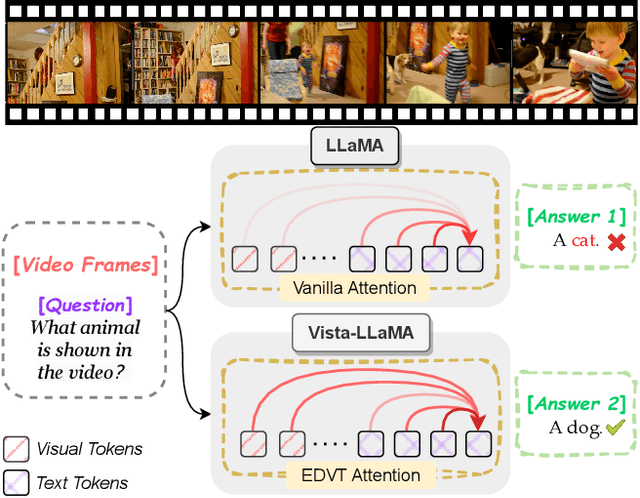
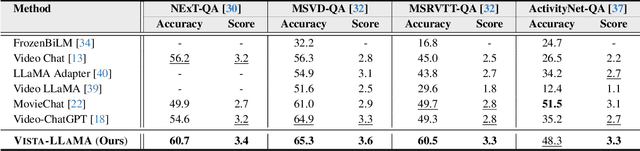
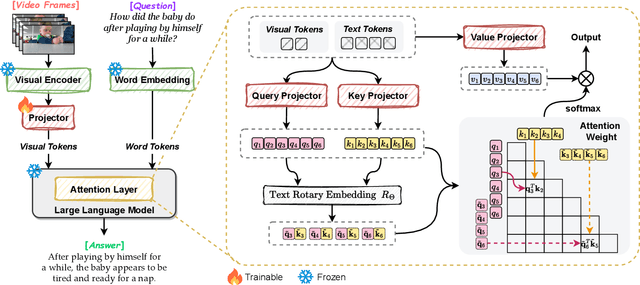
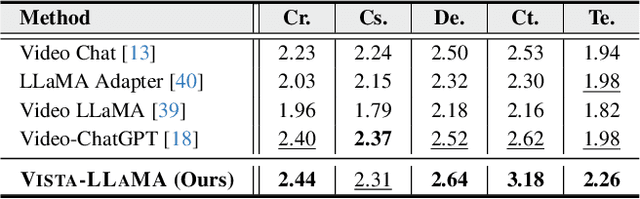
Recent advances in large video-language models have displayed promising outcomes in video comprehension. Current approaches straightforwardly convert video into language tokens and employ large language models for multi-modal tasks. However, this method often leads to the generation of irrelevant content, commonly known as "hallucination", as the length of the text increases and the impact of the video diminishes. To address this problem, we propose Vista-LLaMA, a novel framework that maintains the consistent distance between all visual tokens and any language tokens, irrespective of the generated text length. Vista-LLaMA omits relative position encoding when determining attention weights between visual and text tokens, retaining the position encoding for text and text tokens. This amplifies the effect of visual tokens on text generation, especially when the relative distance is longer between visual and text tokens. The proposed attention mechanism significantly reduces the chance of producing irrelevant text related to the video content. Furthermore, we present a sequential visual projector that projects the current video frame into tokens of language space with the assistance of the previous frame. This approach not only captures the temporal relationship within the video, but also allows less visual tokens to encompass the entire video. Our approach significantly outperforms various previous methods (e.g., Video-ChatGPT, MovieChat) on four challenging open-ended video question answering benchmarks. We reach an accuracy of 60.7 on the zero-shot NExT-QA and 60.5 on the zero-shot MSRVTT-QA, setting a new state-of-the-art performance. This project is available at https://jinxxian.github.io/Vista-LLaMA.