 Add to Chrome
 Add to Firefox
 Add to Edge
WAM-Diff2: Hierarchical AR-to-Diffusion Distillation for Highly Efficient Autonomous Driving VLA
Aug 02, 2026
Vision-Language-Action (VLA) models have emerged as a prominent paradigm for end-to-end autonomous driving; however, their efficient deployment is severely constrained by high computational latency and exposure bias arising from sequential autoregressive decoding. Conversely, while specialized diffusion policies enable low-latency, parallel execution, training them from scratch typically yields narrow, single-task architectures that lack holistic visual-linguistic reasoning. Successfully transforming pre-trained autoregressive generalists into parallel diffusion models could combine multi-task cognitive intelligence with execution efficiency, yet this transition presents a formidable architectural challenge due to mismatched attention patterns (causal versus bidirectional) and divergent optimization objectives. To bridge this divide, we introduce WAM-Diff2, a multi-task discrete diffusion VLA framework powered by a three-stage hierarchical distillation strategy. By structuring the architectural shift through progressive block-wise adaptation, block-wise distillation, and model-wise cross-scale distillation, WAM-Diff2 preserves the underlying semantic foundations of the base model while accelerating inference. Extensive evaluations across driving understanding, perception, and planning benchmarks demonstrate that WAM-Diff2 effectively mitigates exposure bias and achieves performance parity with autoregressive baselines. Crucially, the autoregressive-to-diffusion transition yields a 2.8x decoding speedup, which scales to an ultimate 15.1x acceleration when combined with system-level optimizations including FlashInfer and CUDA Graphs.

When Search Agents Should Ask: DiscoBench for Clarification-Aware Deep Search
Jul 01, 2026Search agents powered by large language models (LLMs) are increasingly used to solve complex information-seeking tasks, requiring multi-step retrieval and reasoning to fulfill user goals. However, existing benchmarks often assume that user queries are complete and explicit, overlooking the fact that real-world search requests are frequently vague, underspecified, or even factually incorrect. In deep search scenarios, such ambiguity can propagate along multi-step reasoning chains and lead agents toward incorrect search trajectories. To address this gap, we introduce DiscoBench, a benchmark for clarification-aware deep search, designed to evaluate whether search agents can proactively identify ambiguity, ask effective clarification questions, and recover correct reasoning paths through user interaction. DiscoBench contains 211 samples and 463 ambiguity instances across 11 real-world domains, covering four ambiguity types. We further design a user simulator for multi-turn interaction and evaluate model performance from four perspectives: task utility, ambiguity detection, interaction strategy, and cost efficiency. Experiments on representative LLMs show that ambiguity detection and effective clarification are distinct capabilities, and that repeatedly searching instead of asking for clarification often performs worse than direct guessing, highlighting a critical gap between retrieval ability and interactive problem-solving in current search agents.
Revealing Training Data Exposure in Vision Language Large Models via Parameter Gradients
Jun 23, 2026Vision-Language Large Models (VLLMs) trained on massive crawled corpora raise pressing copyright and data-provenance concerns. These concerns are particularly acute in healthcare, where patient medical images paired with clinical reports demand rigorous privacy safeguards. However, existing training data detection methods either fail in cross-modal scenarios or rely on superficial output signals with insufficient discriminative power. We introduce GradAudit, a gradient-based auditing framework that examines internal optimization dynamics rather than treating VLLMs as black boxes. Our approach builds on a key observation: model parameters converge to regions where gradients on training samples become stable and well-aligned, whereas gradients on non-training samples remain noisy and inconsistent. By analyzing these gradient signatures, GradAudit achieves strong separability and detects genuine image-text associations learned during training, not merely individual modality membership. Empirically, across both medical and general-domain datasets, GradAudit substantially outperforms state-of-the-art baselines in both pretraining and fine-tuning VLLMs. In a case study employing copyrighted content, we show that existing training data detection methods not only underestimate the extent of unauthorized data usage, but that this underestimation becomes more pronounced as models become more recent and more advanced.
DistractMIA: Black-Box Membership Inference on Vision-Language Models via Semantic Distraction
May 12, 2026Vision-language models (VLMs) are trained on large-scale image-text corpora that may contain private, copyrighted, or otherwise sensitive data, motivating membership inference as a tool for training-data auditing. This is especially challenging for deployed VLMs, where auditors typically observe only generated textual responses. Existing VLM membership inference attacks either rely on probability-level signals unavailable in such settings, or use mask-based semantic prediction tasks whose effectiveness depends on object-centric visual assumptions. To address these limitations, we propose DistractMIA, an output-only black-box framework based on semantic distraction. Rather than removing visual evidence, DistractMIA preserves the original image, inserts a known semantic distractor, and measures how generated responses change. This design is motivated by the intuition that member samples remain more anchored to the original image semantics, while non-member samples are more easily redirected toward the distractor. To make this signal reliable, DistractMIA calibrates distractor configurations on a reference set and derives membership scores from repeated textual generations, capturing response stability and distractor uptake without accessing logits, probabilities, or hidden states. Experiments across multiple VLMs and benchmarks show that DistractMIA consistently outperforms both output-only and stronger-access baselines. Its performance on a medical benchmark further demonstrates applicability beyond object-centric natural images.
Perception Without Engagement: Dissecting the Causal Discovery Deficit in LMMs
May 10, 2026Although Large Multimodal Models (LMMs) have achieved strong performance on general video understanding, their susceptibility to textual prior shortcuts during causal discovery has been recognized as a critical deficit. The underlying mechanisms of this phenomenon remain incompletely understood, as existing benchmarks only measure response accuracy without revealing the sources and extent of the deficit. We introduce ProCauEval, a perturbation-based evaluation protocol that shifts from outcome assessment to mechanism diagnosis, probing causal discovery through five controlled configurations that systematically manipulate visual and textual modalities to decompose their respective contributions to model behavior and dissect the failure modes. Evaluating 17 mainstream LMMs, we find that models faithfully perceive video content yet systematically underexploit it during causal reasoning. We further observe that stronger post-training amplifies rather than mitigates textual prior reliance, and that higher baseline performance correlates with greater fragility under perturbation. To address these, we propose Anti-Distillation Policy Optimization (ADPO), a reinforcement learning framework built on negative teacher alignment, which augments GRPO by explicitly pushing the policy away from a prior-only counterfactual teacher induced by visual corruption. Specifically, ADPO maximizes the divergence between the policy distributions conditioned on the original and visually corrupted inputs, thereby forcing the model to ground its reasoning in visual evidence rather than textual shortcuts. Extensive experiments show that ADPO improves visual engagement without sacrificing fundamental comprehension, thus offering a preliminary step toward reliable causal discovery.
Analyzing Reasoning Consistency in Large Multimodal Models under Cross-Modal Conflicts
Jan 07, 2026Large Multimodal Models (LMMs) have demonstrated impressive capabilities in video reasoning via Chain-of-Thought (CoT). However, the robustness of their reasoning chains remains questionable. In this paper, we identify a critical failure mode termed textual inertia, where once a textual hallucination occurs in the thinking process, models tend to blindly adhere to the erroneous text while neglecting conflicting visual evidence. To systematically investigate this, we propose the LogicGraph Perturbation Protocol that structurally injects perturbations into the reasoning chains of diverse LMMs spanning both native reasoning architectures and prompt-driven paradigms to evaluate their self-reflection capabilities. The results reveal that models successfully self-correct in less than 10% of cases and predominantly succumb to blind textual error propagation. To mitigate this, we introduce Active Visual-Context Refinement, a training-free inference paradigm which orchestrates an active visual re-grounding mechanism to enforce fine-grained verification coupled with an adaptive context refinement strategy to summarize and denoise the reasoning history. Experiments demonstrate that our approach significantly stifles hallucination propagation and enhances reasoning robustness.
AI Meets Brain: Memory Systems from Cognitive Neuroscience to Autonomous Agents
Dec 29, 2025Memory serves as the pivotal nexus bridging past and future, providing both humans and AI systems with invaluable concepts and experience to navigate complex tasks. Recent research on autonomous agents has increasingly focused on designing efficient memory workflows by drawing on cognitive neuroscience. However, constrained by interdisciplinary barriers, existing works struggle to assimilate the essence of human memory mechanisms. To bridge this gap, we systematically synthesizes interdisciplinary knowledge of memory, connecting insights from cognitive neuroscience with LLM-driven agents. Specifically, we first elucidate the definition and function of memory along a progressive trajectory from cognitive neuroscience through LLMs to agents. We then provide a comparative analysis of memory taxonomy, storage mechanisms, and the complete management lifecycle from both biological and artificial perspectives. Subsequently, we review the mainstream benchmarks for evaluating agent memory. Additionally, we explore memory security from dual perspectives of attack and defense. Finally, we envision future research directions, with a focus on multimodal memory systems and skill acquisition.
Identifying Pre-training Data in LLMs: A Neuron Activation-Based Detection Framework
Jul 22, 2025The performance of large language models (LLMs) is closely tied to their training data, which can include copyrighted material or private information, raising legal and ethical concerns. Additionally, LLMs face criticism for dataset contamination and internalizing biases. To address these issues, the Pre-Training Data Detection (PDD) task was proposed to identify if specific data was included in an LLM's pre-training corpus. However, existing PDD methods often rely on superficial features like prediction confidence and loss, resulting in mediocre performance. To improve this, we introduce NA-PDD, a novel algorithm analyzing differential neuron activation patterns between training and non-training data in LLMs. This is based on the observation that these data types activate different neurons during LLM inference. We also introduce CCNewsPDD, a temporally unbiased benchmark employing rigorous data transformations to ensure consistent time distributions between training and non-training data. Our experiments demonstrate that NA-PDD significantly outperforms existing methods across three benchmarks and multiple LLMs.
Salient Temporal Encoding for Dynamic Scene Graph Generation
Mar 15, 2025Representing a dynamic scene using a structured spatial-temporal scene graph is a novel and particularly challenging task. To tackle this task, it is crucial to learn the temporal interactions between objects in addition to their spatial relations. Due to the lack of explicitly annotated temporal relations in current benchmark datasets, most of the existing spatial-temporal scene graph generation methods build dense and abstract temporal connections among all objects across frames. However, not all temporal connections are encoding meaningful temporal dynamics. We propose a novel spatial-temporal scene graph generation method that selectively builds temporal connections only between temporal-relevant objects pairs and represents the temporal relations as explicit edges in the scene graph. The resulting sparse and explicit temporal representation allows us to improve upon strong scene graph generation baselines by up to $4.4\%$ in Scene Graph Detection. In addition, we show that our approach can be leveraged to improve downstream vision tasks. Particularly, applying our approach to action recognition, shows 0.6\% gain in mAP in comparison to the state-of-the-art
TDDBench: A Benchmark for Training data detection
Nov 05, 2024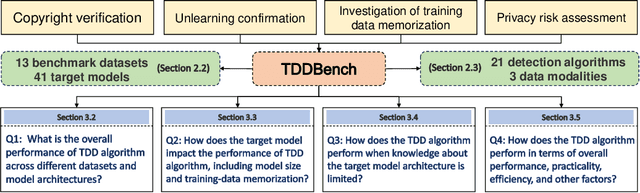
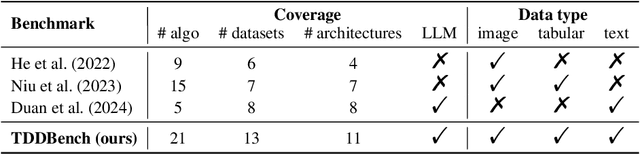
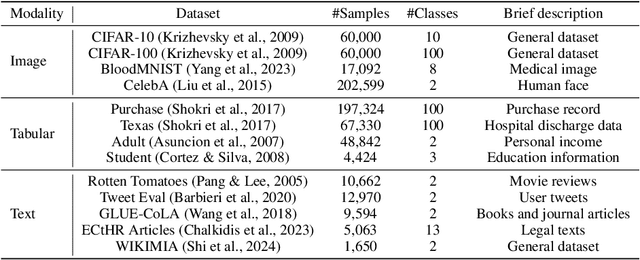
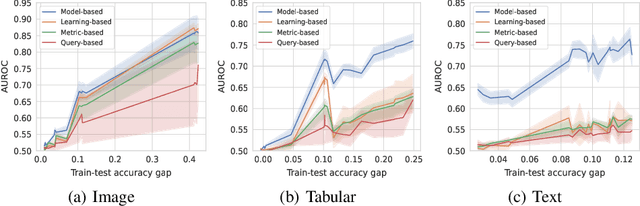
Training Data Detection (TDD) is a task aimed at determining whether a specific data instance is used to train a machine learning model. In the computer security literature, TDD is also referred to as Membership Inference Attack (MIA). Given its potential to assess the risks of training data breaches, ensure copyright authentication, and verify model unlearning, TDD has garnered significant attention in recent years, leading to the development of numerous methods. Despite these advancements, there is no comprehensive benchmark to thoroughly evaluate the effectiveness of TDD methods. In this work, we introduce TDDBench, which consists of 13 datasets spanning three data modalities: image, tabular, and text. We benchmark 21 different TDD methods across four detection paradigms and evaluate their performance from five perspectives: average detection performance, best detection performance, memory consumption, and computational efficiency in both time and memory. With TDDBench, researchers can identify bottlenecks and areas for improvement in TDD algorithms, while practitioners can make informed trade-offs between effectiveness and efficiency when selecting TDD algorithms for specific use cases. Our large-scale benchmarking also reveals the generally unsatisfactory performance of TDD algorithms across different datasets. To enhance accessibility and reproducibility, we open-source TDDBench for the research community.