 Add to Chrome
 Add to Firefox
 Add to Edge
The Price Reversal Phenomenon: When Cheaper Reasoning Models End Up Costing More
Mar 25, 2026
Developers and consumers increasingly choose reasoning language models (RLMs) based on their listed API prices. However, how accurately do these prices reflect actual inference costs? We conduct the first systematic study of this question, evaluating 8 frontier RLMs across 9 diverse tasks covering competition math, science QA, code generation, and multi-domain reasoning. We uncover the pricing reversal phenomenon: in 21.8% of model-pair comparisons, the model with a lower listed price actually incurs a higher total cost, with reversal magnitude reaching up to 28x. For example, Gemini 3 Flash's listed price is 78% cheaper than GPT-5.2's, yet its actual cost across all tasks is 22% higher. We trace the root cause to vast heterogeneity in thinking token consumption: on the same query, one model may use 900% more thinking tokens than another. In fact, removing thinking token costs reduces ranking reversals by 70% and raises the rank correlation (Kendall's $τ$ ) between price and cost rankings from 0.563 to 0.873. We further show that per-query cost prediction is fundamentally difficult: repeated runs of the same query yield thinking token variation up to 9.7x, establishing an irreducible noise floor for any predictor. Our findings demonstrate that listed API pricing is an unreliable proxy for actual cost, calling for cost-aware model selection and transparent per-request cost monitoring.

MoDora: Tree-Based Semi-Structured Document Analysis System
Feb 26, 2026Semi-structured documents integrate diverse interleaved data elements (e.g., tables, charts, hierarchical paragraphs) arranged in various and often irregular layouts. These documents are widely observed across domains and account for a large portion of real-world data. However, existing methods struggle to support natural language question answering over these documents due to three main technical challenges: (1) The elements extracted by techniques like OCR are often fragmented and stripped of their original semantic context, making them inadequate for analysis. (2) Existing approaches lack effective representations to capture hierarchical structures within documents (e.g., associating tables with nested chapter titles) and to preserve layout-specific distinctions (e.g., differentiating sidebars from main content). (3) Answering questions often requires retrieving and aligning relevant information scattered across multiple regions or pages, such as linking a descriptive paragraph to table cells located elsewhere in the document. To address these issues, we propose MoDora, an LLM-powered system for semi-structured document analysis. First, we adopt a local-alignment aggregation strategy to convert OCR-parsed elements into layout-aware components, and conduct type-specific information extraction for components with hierarchical titles or non-text elements. Second, we design the Component-Correlation Tree (CCTree) to hierarchically organize components, explicitly modeling inter-component relations and layout distinctions through a bottom-up cascade summarization process. Finally, we propose a question-type-aware retrieval strategy that supports (1) layout-based grid partitioning for location-based retrieval and (2) LLM-guided pruning for semantic-based retrieval. Experiments show MoDora outperforms baselines by 5.97%-61.07% in accuracy. The code is at https://github.com/weAIDB/MoDora.
Qute: Towards Quantum-Native Database
Feb 16, 2026This paper envisions a quantum database (Qute) that treats quantum computation as a first-class execution option. Unlike prior simulation-based methods that either run quantum algorithms on classical machines or adapt existing databases for quantum simulation, Qute instead (i) compiles an extended form of SQL into gate-efficient quantum circuits, (ii) employs a hybrid optimizer to dynamically select between quantum and classical execution plans, (iii) introduces selective quantum indexing, and (iv) designs fidelity-preserving storage to mitigate current qubit constraints. We also present a three-stage evolution roadmap toward quantum-native database. Finally, by deploying Qute on a real quantum processor (origin_wukong), we show that it outperforms a classical baseline at scale, and we release an open-source prototype at https://github.com/weAIDB/Qute.
Nexus: Inferring Join Graphs from Metadata Alone via Iterative Low-Rank Matrix Completion
Feb 09, 2026Automatically inferring join relationships is a critical task for effective data discovery, integration, querying and reuse. However, accurately and efficiently identifying these relationships in large and complex schemas can be challenging, especially in enterprise settings where access to data values is constrained. In this paper, we introduce the problem of join graph inference when only metadata is available. We conduct an empirical study on a large number of real-world schemas and observe that join graphs when represented as adjacency matrices exhibit two key properties: high sparsity and low-rank structure. Based on these novel observations, we formulate join graph inference as a low-rank matrix completion problem and propose Nexus, an end-to-end solution using only metadata. To further enhance accuracy, we propose a novel Expectation-Maximization algorithm that alternates between low-rank matrix completion and refining join candidate probabilities by leveraging Large Language Models. Our extensive experiments demonstrate that Nexus outperforms existing methods by a significant margin on four datasets including a real-world production dataset. Additionally, Nexus can operate in a fast mode, providing comparable results with up to 6x speedup, offering a practical and efficient solution for real-world deployments.
Can LLMs Clean Up Your Mess? A Survey of Application-Ready Data Preparation with LLMs
Jan 22, 2026Data preparation aims to denoise raw datasets, uncover cross-dataset relationships, and extract valuable insights from them, which is essential for a wide range of data-centric applications. Driven by (i) rising demands for application-ready data (e.g., for analytics, visualization, decision-making), (ii) increasingly powerful LLM techniques, and (iii) the emergence of infrastructures that facilitate flexible agent construction (e.g., using Databricks Unity Catalog), LLM-enhanced methods are rapidly becoming a transformative and potentially dominant paradigm for data preparation. By investigating hundreds of recent literature works, this paper presents a systematic review of this evolving landscape, focusing on the use of LLM techniques to prepare data for diverse downstream tasks. First, we characterize the fundamental paradigm shift, from rule-based, model-specific pipelines to prompt-driven, context-aware, and agentic preparation workflows. Next, we introduce a task-centric taxonomy that organizes the field into three major tasks: data cleaning (e.g., standardization, error processing, imputation), data integration (e.g., entity matching, schema matching), and data enrichment (e.g., data annotation, profiling). For each task, we survey representative techniques, and highlight their respective strengths (e.g., improved generalization, semantic understanding) and limitations (e.g., the prohibitive cost of scaling LLMs, persistent hallucinations even in advanced agents, the mismatch between advanced methods and weak evaluation). Moreover, we analyze commonly used datasets and evaluation metrics (the empirical part). Finally, we discuss open research challenges and outline a forward-looking roadmap that emphasizes scalable LLM-data systems, principled designs for reliable agentic workflows, and robust evaluation protocols.
Jupiter: Enhancing LLM Data Analysis Capabilities via Notebook and Inference-Time Value-Guided Search
Sep 11, 2025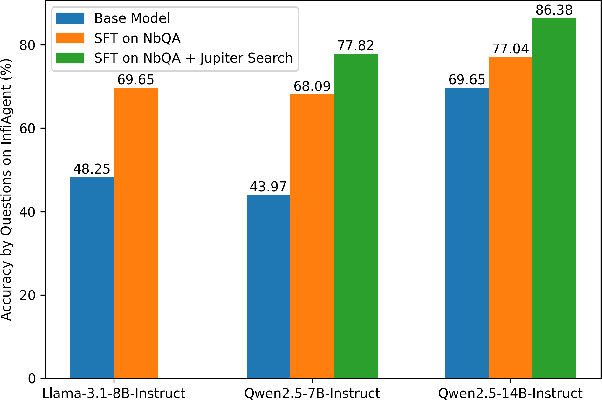
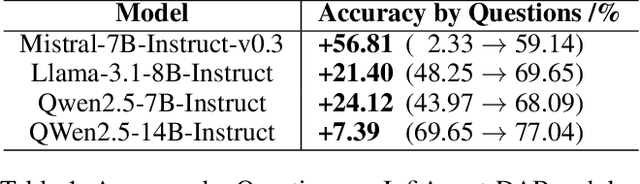
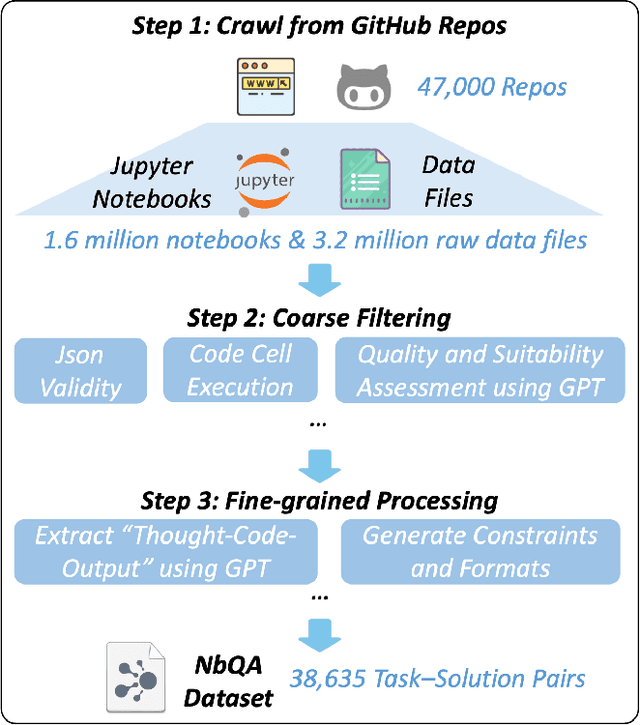
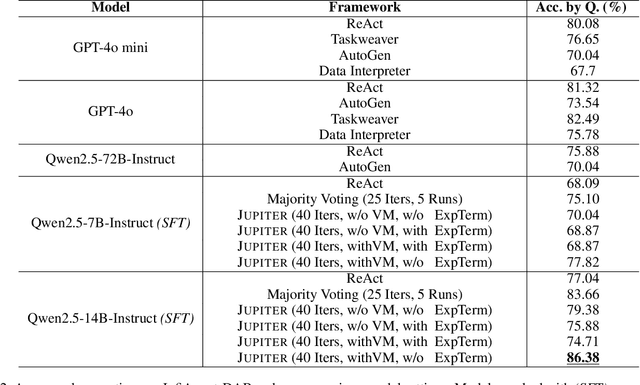
Large language models (LLMs) have shown great promise in automating data science workflows, but existing models still struggle with multi-step reasoning and tool use, which limits their effectiveness on complex data analysis tasks. To address this, we propose a scalable pipeline that extracts high-quality, tool-based data analysis tasks and their executable multi-step solutions from real-world Jupyter notebooks and associated data files. Using this pipeline, we introduce NbQA, a large-scale dataset of standardized task-solution pairs that reflect authentic tool-use patterns in practical data science scenarios. To further enhance multi-step reasoning, we present Jupiter, a framework that formulates data analysis as a search problem and applies Monte Carlo Tree Search (MCTS) to generate diverse solution trajectories for value model learning. During inference, Jupiter combines the value model and node visit counts to efficiently collect executable multi-step plans with minimal search steps. Experimental results show that Qwen2.5-7B and 14B-Instruct models on NbQA solve 77.82% and 86.38% of tasks on InfiAgent-DABench, respectively-matching or surpassing GPT-4o and advanced agent frameworks. Further evaluations demonstrate improved generalization and stronger tool-use reasoning across diverse multi-step reasoning tasks.
MMTU: A Massive Multi-Task Table Understanding and Reasoning Benchmark
Jun 05, 2025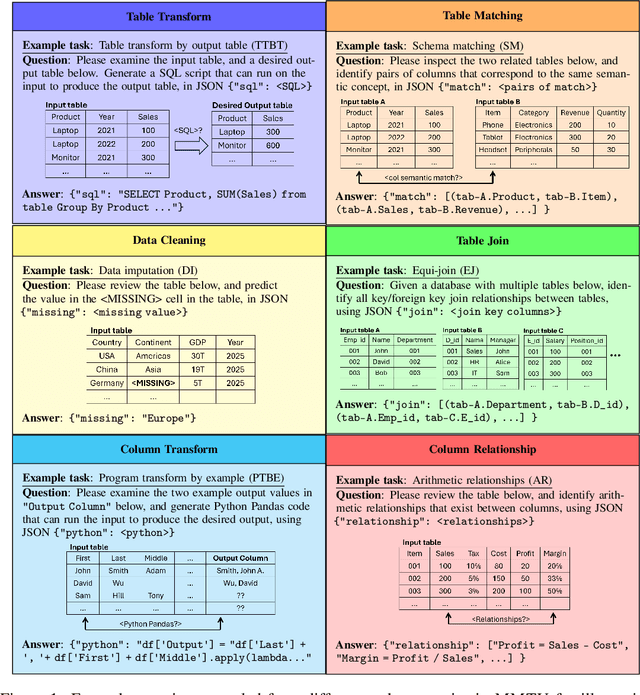
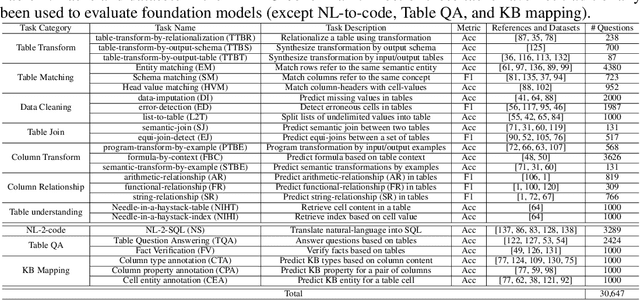

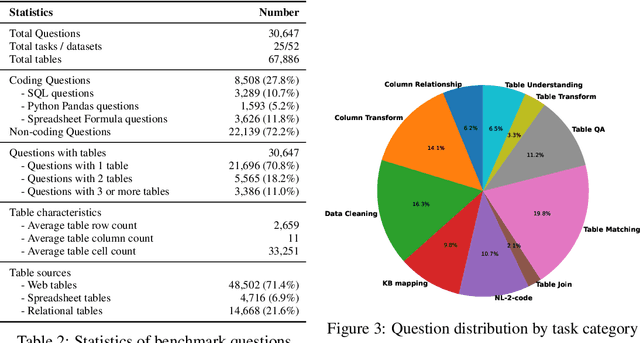
Tables and table-based use cases play a crucial role in many important real-world applications, such as spreadsheets, databases, and computational notebooks, which traditionally require expert-level users like data engineers, data analysts, and database administrators to operate. Although LLMs have shown remarkable progress in working with tables (e.g., in spreadsheet and database copilot scenarios), comprehensive benchmarking of such capabilities remains limited. In contrast to an extensive and growing list of NLP benchmarks, evaluations of table-related tasks are scarce, and narrowly focus on tasks like NL-to-SQL and Table-QA, overlooking the broader spectrum of real-world tasks that professional users face. This gap limits our understanding and model progress in this important area. In this work, we introduce MMTU, a large-scale benchmark with over 30K questions across 25 real-world table tasks, designed to comprehensively evaluate models ability to understand, reason, and manipulate real tables at the expert-level. These tasks are drawn from decades' worth of computer science research on tabular data, with a focus on complex table tasks faced by professional users. We show that MMTU require a combination of skills -- including table understanding, reasoning, and coding -- that remain challenging for today's frontier models, where even frontier reasoning models like OpenAI o4-mini and DeepSeek R1 score only around 60%, suggesting significant room for improvement. We highlight key findings in our evaluation using MMTU and hope that this benchmark drives further advances in understanding and developing foundation models for structured data processing and analysis. Our code and data are available at https://github.com/MMTU-Benchmark/MMTU and https://huggingface.co/datasets/MMTU-benchmark/MMTU.
Auto-Test: Learning Semantic-Domain Constraints for Unsupervised Error Detection in Tables
Apr 14, 2025
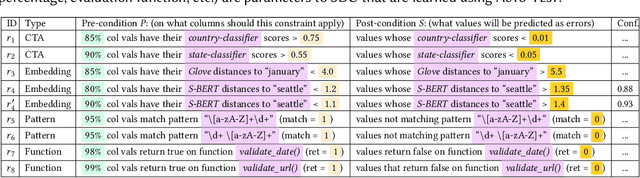

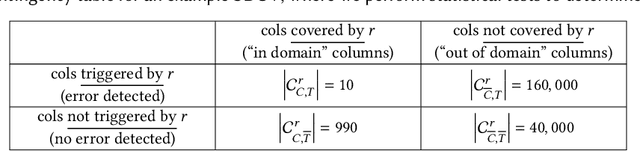
Data cleaning is a long-standing challenge in data management. While powerful logic and statistical algorithms have been developed to detect and repair data errors in tables, existing algorithms predominantly rely on domain-experts to first manually specify data-quality constraints specific to a given table, before data cleaning algorithms can be applied. In this work, we propose a new class of data-quality constraints that we call Semantic-Domain Constraints, which can be reliably inferred and automatically applied to any tables, without requiring domain-experts to manually specify on a per-table basis. We develop a principled framework to systematically learn such constraints from table corpora using large-scale statistical tests, which can further be distilled into a core set of constraints using our optimization framework, with provable quality guarantees. Extensive evaluations show that this new class of constraints can be used to both (1) directly detect errors on real tables in the wild, and (2) augment existing expert-driven data-cleaning techniques as a new class of complementary constraints. Our extensively labeled benchmark dataset with 2400 real data columns, as well as our code are available at https://github.com/qixuchen/AutoTest to facilitate future research.
TableLoRA: Low-rank Adaptation on Table Structure Understanding for Large Language Models
Mar 06, 2025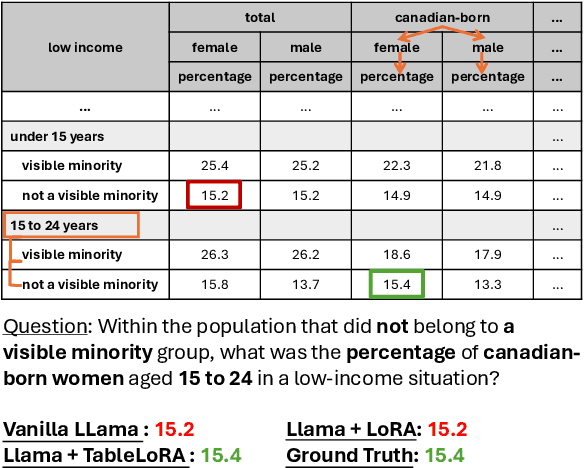
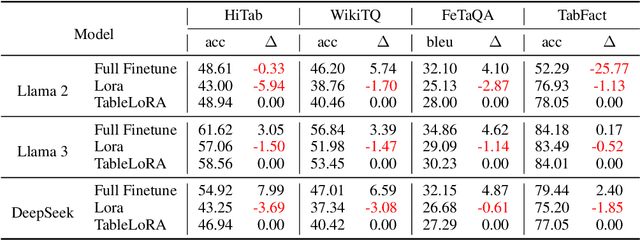
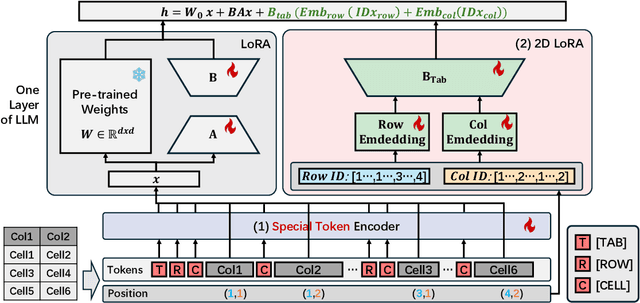
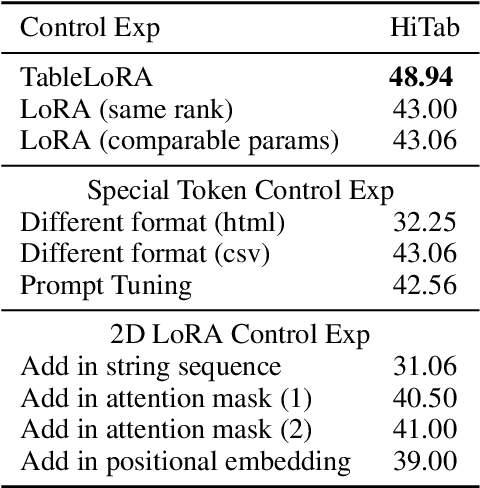
Tabular data are crucial in many fields and their understanding by large language models (LLMs) under high parameter efficiency paradigm is important. However, directly applying parameter-efficient fine-tuning (PEFT) techniques to tabular tasks presents significant challenges, particularly in terms of better table serialization and the representation of two-dimensional structured information within a one-dimensional sequence. To address this, we propose TableLoRA, a module designed to improve LLMs' understanding of table structure during PEFT. It incorporates special tokens for serializing tables with special token encoder and uses 2D LoRA to encode low-rank information on cell positions. Experiments on four tabular-related datasets demonstrate that TableLoRA consistently outperforms vanilla LoRA and surpasses various table encoding methods tested in control experiments. These findings reveal that TableLoRA, as a table-specific LoRA, enhances the ability of LLMs to process tabular data effectively, especially in low-parameter settings, demonstrating its potential as a robust solution for handling table-related tasks.
Table-LLM-Specialist: Language Model Specialists for Tables using Iterative Generator-Validator Fine-tuning
Oct 16, 2024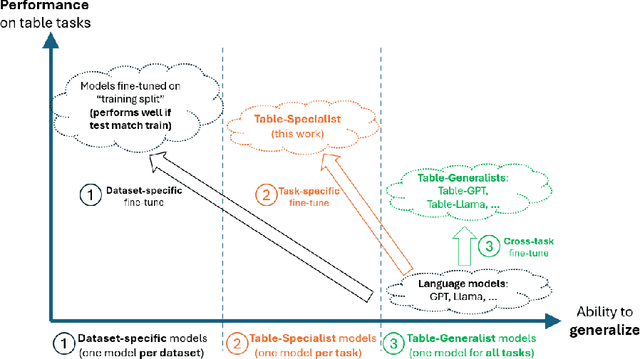
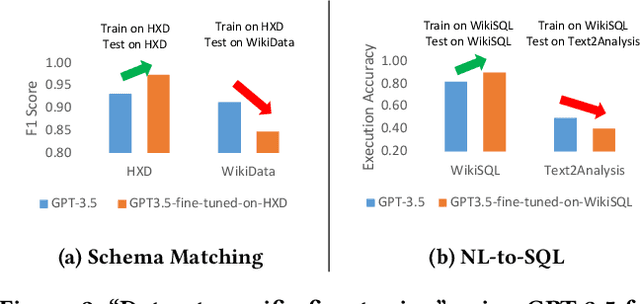
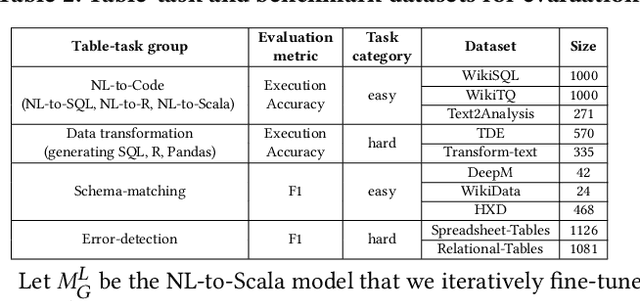
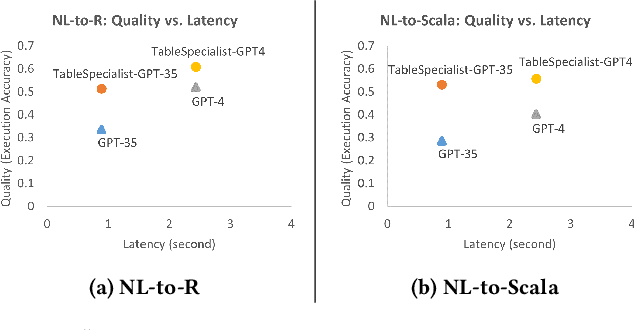
In this work, we propose Table-LLM-Specialist, or Table-Specialist for short, as a new self-trained fine-tuning paradigm specifically designed for table tasks. Our insight is that for each table task, there often exist two dual versions of the same task, one generative and one classification in nature. Leveraging their duality, we propose a Generator-Validator paradigm, to iteratively generate-then-validate training data from language-models, to fine-tune stronger \sys models that can specialize in a given task, without requiring manually-labeled data. Our extensive evaluations suggest that our Table-Specialist has (1) \textit{strong performance} on diverse table tasks over vanilla language-models -- for example, Table-Specialist fine-tuned on GPT-3.5 not only outperforms vanilla GPT-3.5, but can often match or surpass GPT-4 level quality, (2) \textit{lower cost} to deploy, because when Table-Specialist fine-tuned on GPT-3.5 achieve GPT-4 level quality, it becomes possible to deploy smaller models with lower latency and inference cost, with comparable quality, and (3) \textit{better generalizability} when evaluated across multiple benchmarks, since \sys is fine-tuned on a broad range of training data systematically generated from diverse real tables. Our code and data will be available at https://github.com/microsoft/Table-LLM-Specialist.