 Add to Chrome
 Add to Firefox
 Add to Edge
Tracing Agentic Failure from the Flow of Success
Jul 14, 2026
Failure attribution for LLM-based agentic systems, i.e., identifying which steps in a failure trajectory caused the task to fail, is critical for debugging and improving these systems. Existing approaches either rely on prompting-based pipelines, which are computationally expensive, or require post-training on failure trajectories with step-level error annotations, which are costly to collect and difficult to scale. We argue that a practical failure attribution model should be lightweight and trainable without step-level supervision on failure data. To this end, we address unsupervised failure attribution, i.e., training exclusively on successful trajectories and identifying error steps at inference time given a failure trajectory. We propose OAT, which casts this problem as one-class learning with neural controlled differential equations, modeling the dynamical pattern of successful trajectories in latent space. At inference time, each step in a failure trajectory is assigned an anomaly score based on its deviation from the dynamics learned on successful trajectories, which is then used to form a set of error steps. With training on only 100 successful trajectories, experiments show that OAT is 200--5000 $\times$ faster than prompting-based baselines, and, at the same time, consistently outperforms them in both in-domain and out-of-distribution datasets with +20% and +7% F1 scores, respectively, demonstrating that OAT is a promising and efficient direction for diagnosing agentic system failures.

Nexus: Inferring Join Graphs from Metadata Alone via Iterative Low-Rank Matrix Completion
Feb 09, 2026Automatically inferring join relationships is a critical task for effective data discovery, integration, querying and reuse. However, accurately and efficiently identifying these relationships in large and complex schemas can be challenging, especially in enterprise settings where access to data values is constrained. In this paper, we introduce the problem of join graph inference when only metadata is available. We conduct an empirical study on a large number of real-world schemas and observe that join graphs when represented as adjacency matrices exhibit two key properties: high sparsity and low-rank structure. Based on these novel observations, we formulate join graph inference as a low-rank matrix completion problem and propose Nexus, an end-to-end solution using only metadata. To further enhance accuracy, we propose a novel Expectation-Maximization algorithm that alternates between low-rank matrix completion and refining join candidate probabilities by leveraging Large Language Models. Our extensive experiments demonstrate that Nexus outperforms existing methods by a significant margin on four datasets including a real-world production dataset. Additionally, Nexus can operate in a fast mode, providing comparable results with up to 6x speedup, offering a practical and efficient solution for real-world deployments.
From Words to Code: Harnessing Data for Program Synthesis from Natural Language
May 03, 2023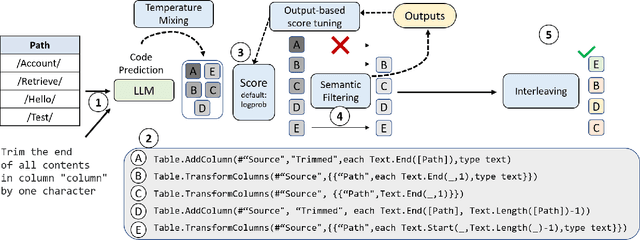
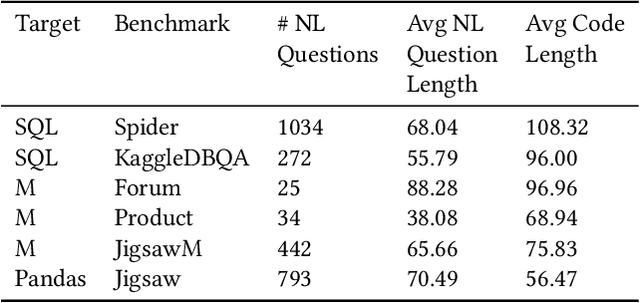
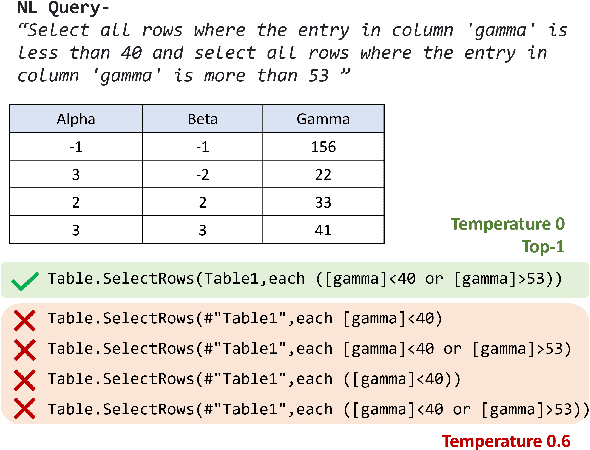
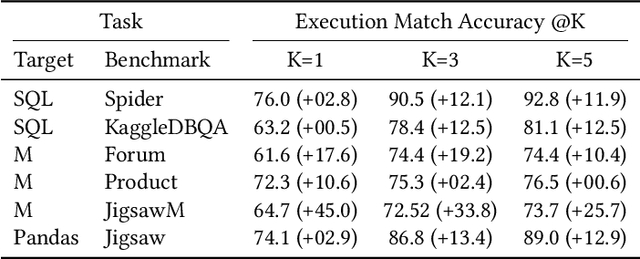
Creating programs to correctly manipulate data is a difficult task, as the underlying programming languages and APIs can be challenging to learn for many users who are not skilled programmers. Large language models (LLMs) demonstrate remarkable potential for generating code from natural language, but in the data manipulation domain, apart from the natural language (NL) description of the intended task, we also have the dataset on which the task is to be performed, or the "data context". Existing approaches have utilized data context in a limited way by simply adding relevant information from the input data into the prompts sent to the LLM. In this work, we utilize the available input data to execute the candidate programs generated by the LLMs and gather their outputs. We introduce semantic reranking, a technique to rerank the programs generated by LLMs based on three signals coming the program outputs: (a) semantic filtering and well-formedness based score tuning: do programs even generate well-formed outputs, (b) semantic interleaving: how do the outputs from different candidates compare to each other, and (c) output-based score tuning: how do the outputs compare to outputs predicted for the same task. We provide theoretical justification for semantic interleaving. We also introduce temperature mixing, where we combine samples generated by LLMs using both high and low temperatures. We extensively evaluate our approach in three domains, namely databases (SQL), data science (Pandas) and business intelligence (Excel's Power Query M) on a variety of new and existing benchmarks. We observe substantial gains across domains, with improvements of up to 45% in top-1 accuracy and 34% in top-3 accuracy.