 Add to Chrome
 Add to Firefox
 Add to Edge
Leveraging Audio-LLMs to Filter Speech-to-Speech Training Data
Jun 11, 2026
Large-scale mined corpora provide abundant training data for end-to-end speech-to-speech translation (S2ST) but may contain noise, misalignment, and semantic errors. Filtering noisy data is crucial to maintain robust speech translation performance. We study how to train an audio-language model to make keep/drop decisions on paired speech directly from audio. To obtain reliable supervision without manual labels, we adopt a scalable two-stage Rank-to-Distill strategy. A lightweight ranker generates keep/drop pseudo-labels from noisy speech pairs, then trains an audio large language model to predict keep/drop directly from raw paired speech. The resulting model jointly captures acoustic fidelity and cross-lingual semantic consistency for the selection of speech-conditioned data. Experiments on CVSS-C and SpeechMatrix show consistent improvements over unfiltered training, yielding up to +1.4 ASR-BLEU for end-to-end S2ST.

Auto-Test: Learning Semantic-Domain Constraints for Unsupervised Error Detection in Tables
Apr 14, 2025
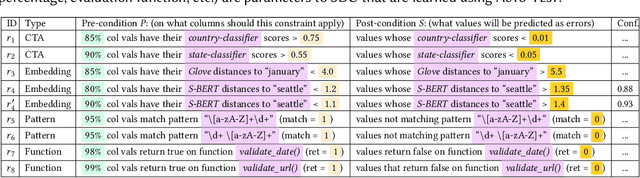

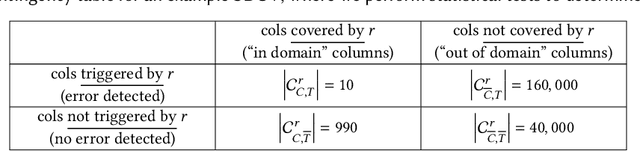
Data cleaning is a long-standing challenge in data management. While powerful logic and statistical algorithms have been developed to detect and repair data errors in tables, existing algorithms predominantly rely on domain-experts to first manually specify data-quality constraints specific to a given table, before data cleaning algorithms can be applied. In this work, we propose a new class of data-quality constraints that we call Semantic-Domain Constraints, which can be reliably inferred and automatically applied to any tables, without requiring domain-experts to manually specify on a per-table basis. We develop a principled framework to systematically learn such constraints from table corpora using large-scale statistical tests, which can further be distilled into a core set of constraints using our optimization framework, with provable quality guarantees. Extensive evaluations show that this new class of constraints can be used to both (1) directly detect errors on real tables in the wild, and (2) augment existing expert-driven data-cleaning techniques as a new class of complementary constraints. Our extensively labeled benchmark dataset with 2400 real data columns, as well as our code are available at https://github.com/qixuchen/AutoTest to facilitate future research.