 Add to Chrome
 Add to Firefox
 Add to Edge
Gemini 1.5: Unlocking multimodal understanding across millions of tokens of context
Mar 08, 2024
In this report, we present the latest model of the Gemini family, Gemini 1.5 Pro, a highly compute-efficient multimodal mixture-of-experts model capable of recalling and reasoning over fine-grained information from millions of tokens of context, including multiple long documents and hours of video and audio. Gemini 1.5 Pro achieves near-perfect recall on long-context retrieval tasks across modalities, improves the state-of-the-art in long-document QA, long-video QA and long-context ASR, and matches or surpasses Gemini 1.0 Ultra's state-of-the-art performance across a broad set of benchmarks. Studying the limits of Gemini 1.5 Pro's long-context ability, we find continued improvement in next-token prediction and near-perfect retrieval (>99%) up to at least 10M tokens, a generational leap over existing models such as Claude 2.1 (200k) and GPT-4 Turbo (128k). Finally, we highlight surprising new capabilities of large language models at the frontier; when given a grammar manual for Kalamang, a language with fewer than 200 speakers worldwide, the model learns to translate English to Kalamang at a similar level to a person who learned from the same content.

ZSL-RPPO: Zero-Shot Learning for Quadrupedal Locomotion in Challenging Terrains using Recurrent Proximal Policy Optimization
Mar 04, 2024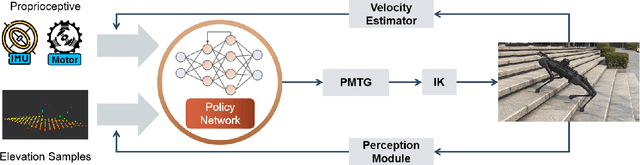
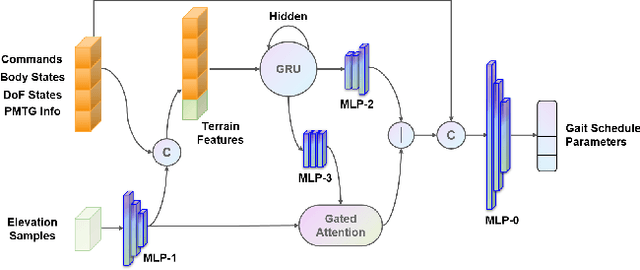
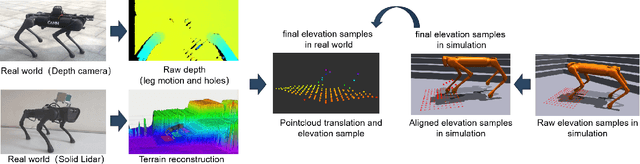
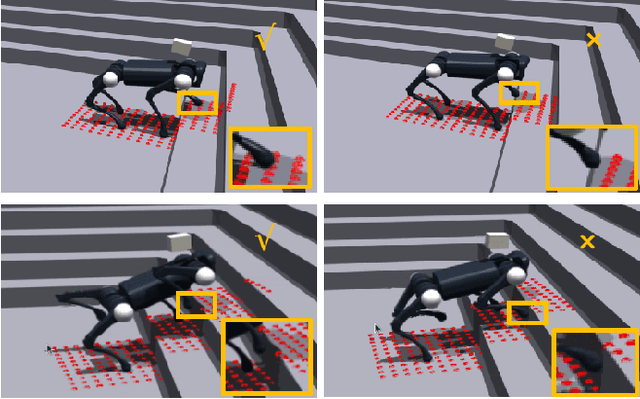
We present ZSL-RPPO, an improved zero-shot learning architecture that overcomes the limitations of teacher-student neural networks and enables generating robust, reliable, and versatile locomotion for quadrupedal robots in challenging terrains. We propose a new algorithm RPPO (Recurrent Proximal Policy Optimization) that directly trains recurrent neural network in partially observable environments and results in more robust training using domain randomization. Our locomotion controller supports extensive perturbation across simulation-to-reality transfer for both intrinsic and extrinsic physical parameters without further fine-tuning. This can avoid the significant decline of student's performance during simulation-to-reality transfer and therefore enhance the robustness and generalization of the locomotion controller. We deployed our controller on the Unitree A1 and Aliengo robots in real environment and exteroceptive perception is provided by either a solid-state Lidar or a depth camera. Our locomotion controller was tested in various challenging terrains like slippery surfaces, Grassy Terrain, and stairs. Our experiment results and comparison show that our approach significantly outperforms the state-of-the-art.
Region-Adaptive Transform with Segmentation Prior for Image Compression
Mar 01, 2024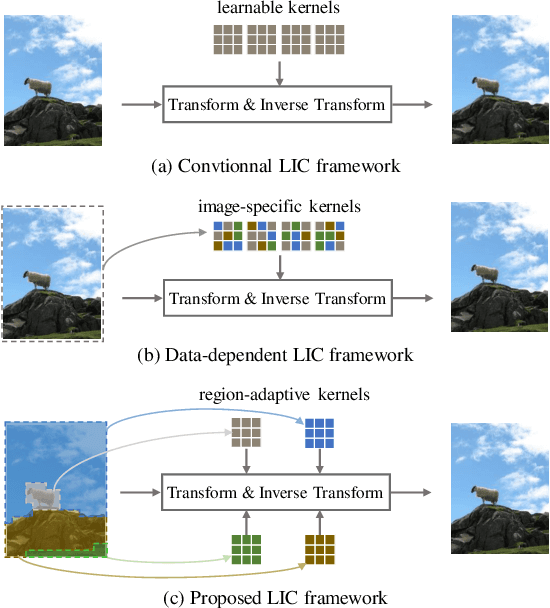
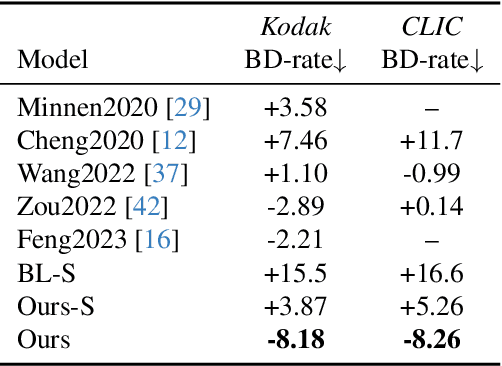
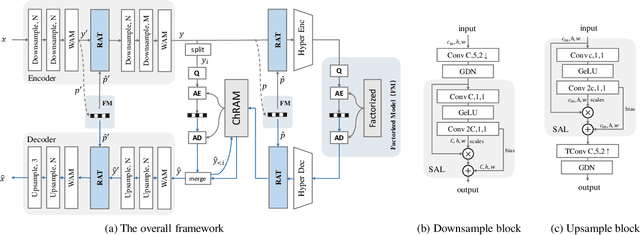
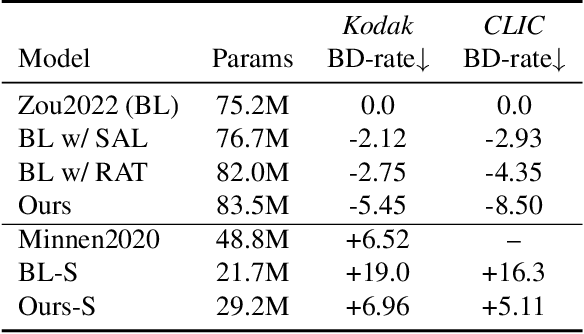
Learned Image Compression (LIC) has shown remarkable progress in recent years. Existing works commonly employ CNN-based or self-attention-based modules as transform methods for compression. However, there is no prior research on neural transform that focuses on specific regions. In response, we introduce the class-agnostic segmentation masks (i.e. semantic masks without category labels) for extracting region-adaptive contextual information. Our proposed module, Region-Adaptive Transform, applies adaptive convolutions on different regions guided by the masks. Additionally, we introduce a plug-and-play module named Scale Affine Layer to incorporate rich contexts from various regions. While there have been prior image compression efforts that involve segmentation masks as additional intermediate inputs, our approach differs significantly from them. Our advantages lie in that, to avoid extra bitrate overhead, we treat these masks as privilege information, which is accessible during the model training stage but not required during the inference phase. To the best of our knowledge, we are the first to employ class-agnostic masks as privilege information and achieve superior performance in pixel-fidelity metrics, such as Peak Signal to Noise Ratio (PSNR). The experimental results demonstrate our improvement compared to previously well-performing methods, with about 8.2% bitrate saving compared to VTM-17.0. The code will be released at https://github.com/GityuxiLiu/Region-Adaptive-Transform-with-Segmentation-Prior-for-Image-Compression.
Direct Language Model Alignment from Online AI Feedback
Feb 07, 2024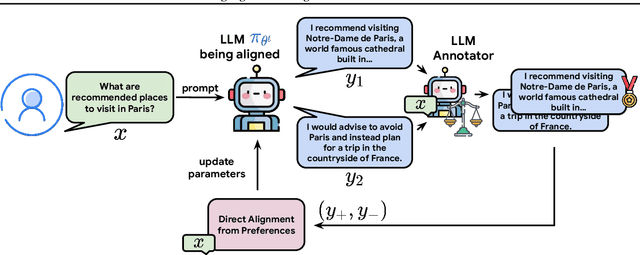
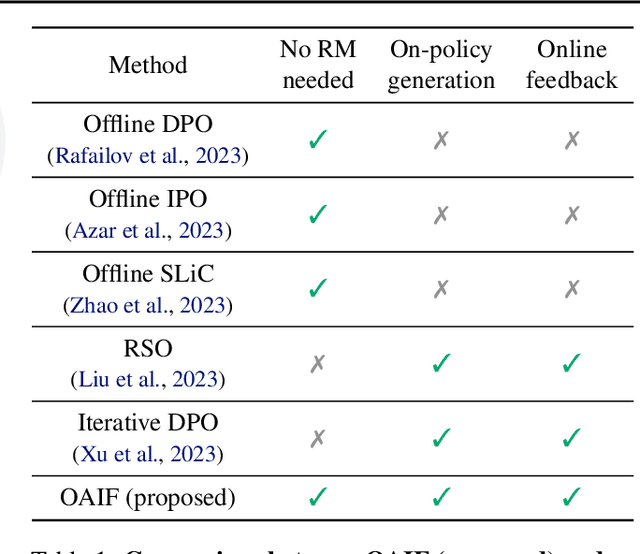
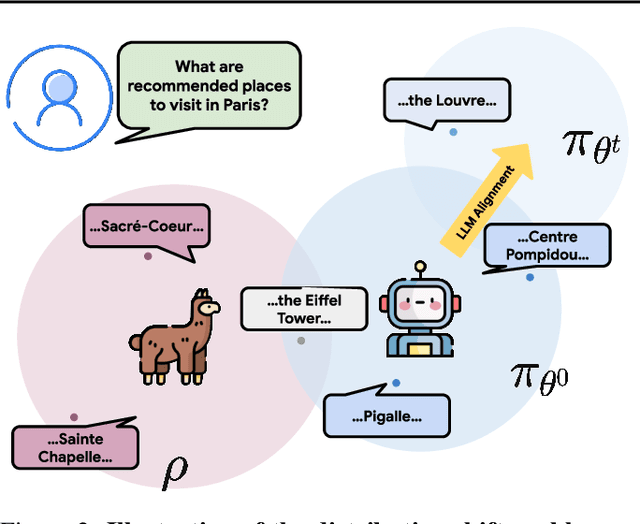
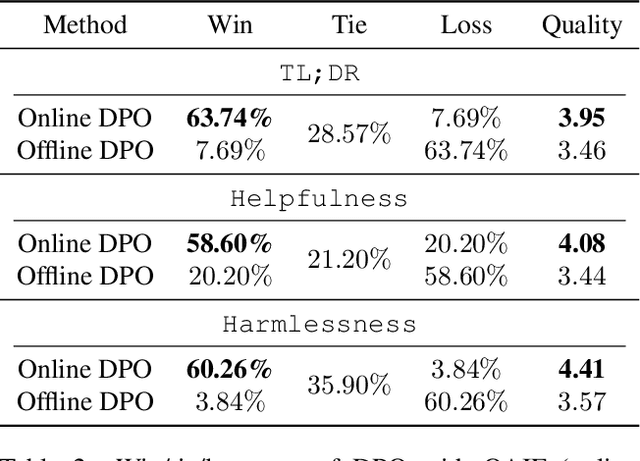
Direct alignment from preferences (DAP) methods, such as DPO, have recently emerged as efficient alternatives to reinforcement learning from human feedback (RLHF), that do not require a separate reward model. However, the preference datasets used in DAP methods are usually collected ahead of training and never updated, thus the feedback is purely offline. Moreover, responses in these datasets are often sampled from a language model distinct from the one being aligned, and since the model evolves over training, the alignment phase is inevitably off-policy. In this study, we posit that online feedback is key and improves DAP methods. Our method, online AI feedback (OAIF), uses an LLM as annotator: on each training iteration, we sample two responses from the current model and prompt the LLM annotator to choose which one is preferred, thus providing online feedback. Despite its simplicity, we demonstrate via human evaluation in several tasks that OAIF outperforms both offline DAP and RLHF methods. We further show that the feedback leveraged in OAIF is easily controllable, via instruction prompts to the LLM annotator.
LiPO: Listwise Preference Optimization through Learning-to-Rank
Feb 02, 2024


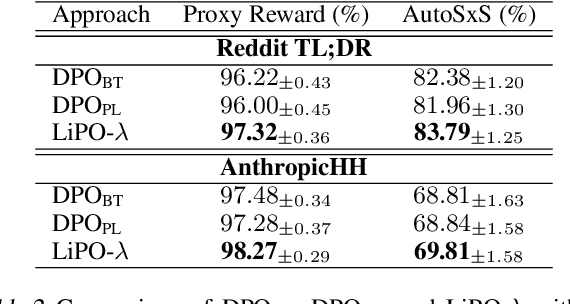
Aligning language models (LMs) with curated human feedback is critical to control their behaviors in real-world applications. Several recent policy optimization methods, such as DPO and SLiC, serve as promising alternatives to the traditional Reinforcement Learning from Human Feedback (RLHF) approach. In practice, human feedback often comes in a format of a ranked list over multiple responses to amortize the cost of reading prompt. Multiple responses can also be ranked by reward models or AI feedback. There lacks such a study on directly fitting upon a list of responses. In this work, we formulate the LM alignment as a listwise ranking problem and describe the Listwise Preference Optimization (LiPO) framework, where the policy can potentially learn more effectively from a ranked list of plausible responses given the prompt. This view draws an explicit connection to Learning-to-Rank (LTR), where most existing preference optimization work can be mapped to existing ranking objectives, especially pairwise ones. Following this connection, we provide an examination of ranking objectives that are not well studied for LM alignment withDPO and SLiC as special cases when list size is two. In particular, we highlight a specific method, LiPO-{\lambda}, which leverages a state-of-the-art listwise ranking objective and weights each preference pair in a more advanced manner. We show that LiPO-{\lambda} can outperform DPO and SLiC by a clear margin on two preference alignment tasks.
EASRec: Elastic Architecture Search for Efficient Long-term Sequential Recommender Systems
Feb 01, 2024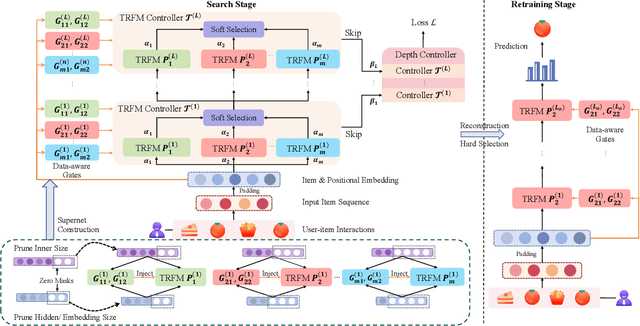

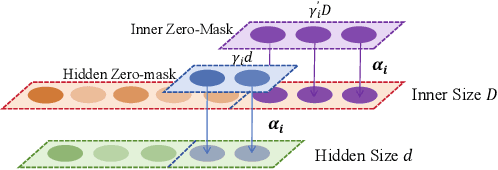
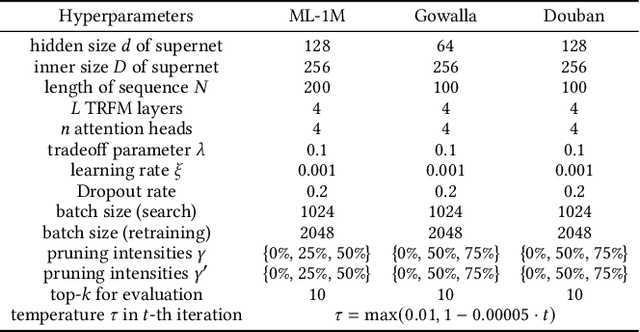
In this age where data is abundant, the ability to distill meaningful insights from the sea of information is essential. Our research addresses the computational and resource inefficiencies that current Sequential Recommender Systems (SRSs) suffer from. especially those employing attention-based models like SASRec, These systems are designed for next-item recommendations in various applications, from e-commerce to social networks. However, such systems suffer from substantial computational costs and resource consumption during the inference stage. To tackle these issues, our research proposes a novel method that combines automatic pruning techniques with advanced model architectures. We also explore the potential of resource-constrained Neural Architecture Search (NAS), a technique prevalent in the realm of recommendation systems, to fine-tune models for reduced FLOPs, latency, and energy usage while retaining or even enhancing accuracy. The main contribution of our work is developing the Elastic Architecture Search for Efficient Long-term Sequential Recommender Systems (EASRec). This approach aims to find optimal compact architectures for attention-based SRSs, ensuring accuracy retention. EASRec introduces data-aware gates that leverage historical information from input data batch to improve the performance of the recommendation network. Additionally, it utilizes a dynamic resource constraint approach, which standardizes the search process and results in more appropriate architectures. The effectiveness of our methodology is validated through exhaustive experiments on three benchmark datasets, which demonstrates EASRec's superiority in SRSs. Our research set a new standard for future exploration into efficient and accurate recommender systems, signifying a substantial advancement within this swiftly advancing field.
One for all: A novel Dual-space Co-training baseline for Large-scale Multi-View Clustering
Jan 28, 2024In this paper, we propose a novel multi-view clustering model, named Dual-space Co-training Large-scale Multi-view Clustering (DSCMC). The main objective of our approach is to enhance the clustering performance by leveraging co-training in two distinct spaces. In the original space, we learn a projection matrix to obtain latent consistent anchor graphs from different views. This process involves capturing the inherent relationships and structures between data points within each view. Concurrently, we employ a feature transformation matrix to map samples from various views to a shared latent space. This transformation facilitates the alignment of information from multiple views, enabling a comprehensive understanding of the underlying data distribution. We jointly optimize the construction of the latent consistent anchor graph and the feature transformation to generate a discriminative anchor graph. This anchor graph effectively captures the essential characteristics of the multi-view data and serves as a reliable basis for subsequent clustering analysis. Moreover, the element-wise method is proposed to avoid the impact of diverse information between different views. Our algorithm has an approximate linear computational complexity, which guarantees its successful application on large-scale datasets. Through experimental validation, we demonstrate that our method significantly reduces computational complexity while yielding superior clustering performance compared to existing approaches.
Semi-Supervised Coupled Thin-Plate Spline Model for Rotation Correction and Beyond
Jan 24, 2024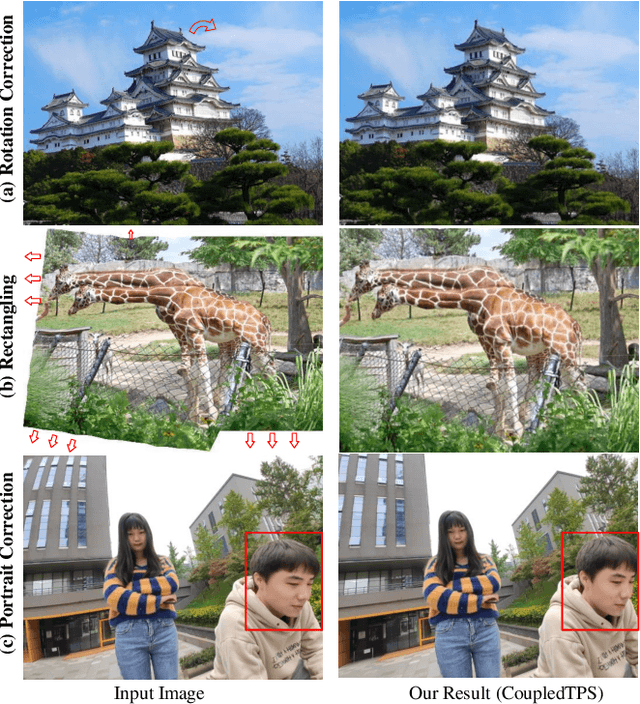
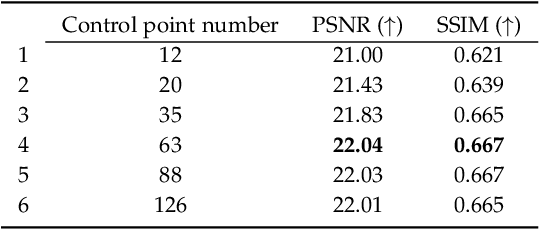
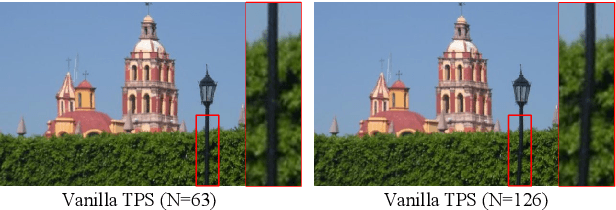
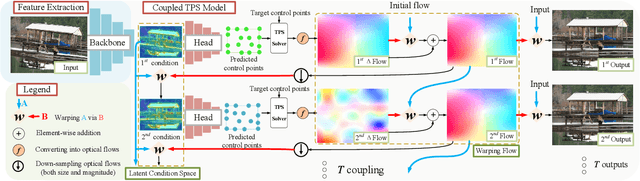
Thin-plate spline (TPS) is a principal warp that allows for representing elastic, nonlinear transformation with control point motions. With the increase of control points, the warp becomes increasingly flexible but usually encounters a bottleneck caused by undesired issues, e.g., content distortion. In this paper, we explore generic applications of TPS in single-image-based warping tasks, such as rotation correction, rectangling, and portrait correction. To break this bottleneck, we propose the coupled thin-plate spline model (CoupledTPS), which iteratively couples multiple TPS with limited control points into a more flexible and powerful transformation. Concretely, we first design an iterative search to predict new control points according to the current latent condition. Then, we present the warping flow as a bridge for the coupling of different TPS transformations, effectively eliminating interpolation errors caused by multiple warps. Besides, in light of the laborious annotation cost, we develop a semi-supervised learning scheme to improve warping quality by exploiting unlabeled data. It is formulated through dual transformation between the searched control points of unlabeled data and its graphic augmentation, yielding an implicit correction consistency constraint. Finally, we collect massive unlabeled data to exhibit the benefit of our semi-supervised scheme in rotation correction. Extensive experiments demonstrate the superiority and universality of CoupledTPS over the existing state-of-the-art (SoTA) solutions for rotation correction and beyond. The code and data will be available at https://github.com/nie-lang/CoupledTPS.
DeepSeek LLM: Scaling Open-Source Language Models with Longtermism
Jan 05, 2024
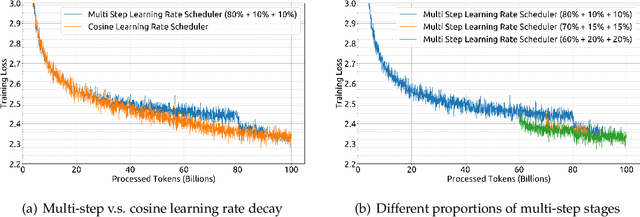


The rapid development of open-source large language models (LLMs) has been truly remarkable. However, the scaling law described in previous literature presents varying conclusions, which casts a dark cloud over scaling LLMs. We delve into the study of scaling laws and present our distinctive findings that facilitate scaling of large scale models in two commonly used open-source configurations, 7B and 67B. Guided by the scaling laws, we introduce DeepSeek LLM, a project dedicated to advancing open-source language models with a long-term perspective. To support the pre-training phase, we have developed a dataset that currently consists of 2 trillion tokens and is continuously expanding. We further conduct supervised fine-tuning (SFT) and Direct Preference Optimization (DPO) on DeepSeek LLM Base models, resulting in the creation of DeepSeek Chat models. Our evaluation results demonstrate that DeepSeek LLM 67B surpasses LLaMA-2 70B on various benchmarks, particularly in the domains of code, mathematics, and reasoning. Furthermore, open-ended evaluations reveal that DeepSeek LLM 67B Chat exhibits superior performance compared to GPT-3.5.
Lookahead: An Inference Acceleration Framework for Large Language Model with Lossless Generation Accuracy
Jan 04, 2024As Large Language Models (LLMs) have made significant advancements across various tasks, such as question answering, translation, text summarization, and dialogue systems, the need for accuracy in information becomes crucial, especially for serious financial products serving billions of users like Alipay. To address this, Alipay has developed a Retrieval-Augmented Generation (RAG) system that grounds LLMs on the most accurate and up-to-date information. However, for a real-world product serving millions of users, the inference speed of LLMs becomes a critical factor compared to a mere experimental model. Hence, this paper presents a generic framework for accelerating the inference process, resulting in a substantial increase in speed and cost reduction for our RAG system, with lossless generation accuracy. In the traditional inference process, each token is generated sequentially by the LLM, leading to a time consumption proportional to the number of generated tokens. To enhance this process, our framework, named \textit{lookahead}, introduces a \textit{multi-branch} strategy. Instead of generating a single token at a time, we propose a \textit{Trie-based Retrieval} (TR) process that enables the generation of multiple branches simultaneously, each of which is a sequence of tokens. Subsequently, for each branch, a \textit{Verification and Accept} (VA) process is performed to identify the longest correct sub-sequence as the final output. Our strategy offers two distinct advantages: (1) it guarantees absolute correctness of the output, avoiding any approximation algorithms, and (2) the worst-case performance of our approach is equivalent to the conventional process. We conduct extensive experiments to demonstrate the significant improvements achieved by applying our inference acceleration framework. Code is avaliable: https://github.com/alipay/PainlessInferenceAcceleration.