 Add to Chrome
 Add to Firefox
 Add to Edge
Explainable Fall Detection for Elderly Care via Temporally Stable SHAP in Skeleton-Based Human Activity Recognition
Apr 14, 2026
Fall detection in elderly care requires not only accurate classification but also reliable explanations that clinicians can trust. However, existing post-hoc explainability methods, when applied frame-by-frame to sequential data, produce temporally unstable attribution maps that clinicians cannot reliably act upon. To address this issue, we propose a lightweight and explainable framework for skeleton-based fall detection that combines an efficient LSTM model with T-SHAP, a temporally aware post-hoc aggregation strategy that stabilizes SHAP-based feature attributions over contiguous time windows. Unlike standard SHAP, which treats each frame independently, T-SHAP applies a linear smoothing operator to the attribution sequence, reducing high-frequency variance while preserving the theoretical guarantees of Shapley values, including local accuracy and consistency. Experiments on the NTU RGB+D Dataset demonstrate that the proposed framework achieves 94.3% classification accuracy with an end-to-end inference latency below 25 milliseconds, satisfying real-time constraints on mid-range hardware and indicating strong potential for deployment in clinical monitoring scenarios. Quantitative evaluation using perturbation-based faithfulness metrics shows that T-SHAP improves explanation reliability compared to standard SHAP (AUP: 0.89 vs. 0.91) and Grad-CAM (0.82), with consistent improvements observed across five-fold cross-validation, indicating enhanced explanation reliability. The resulting attributions consistently highlight biomechanically relevant motion patterns, including lower-limb instability and changes in spinal alignment, aligning with established clinical observations of fall dynamics and supporting their use as transparent decision aids in long-term care environments

Building Math Agents with Multi-Turn Iterative Preference Learning
Sep 04, 2024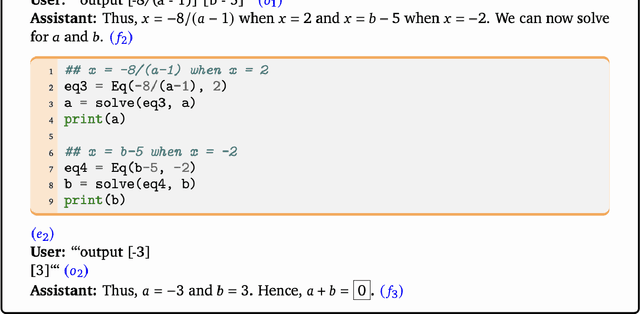

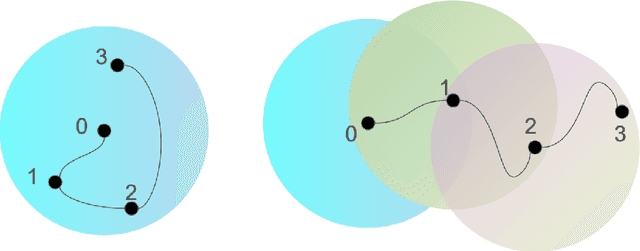

Recent studies have shown that large language models' (LLMs) mathematical problem-solving capabilities can be enhanced by integrating external tools, such as code interpreters, and employing multi-turn Chain-of-Thought (CoT) reasoning. While current methods focus on synthetic data generation and Supervised Fine-Tuning (SFT), this paper studies the complementary direct preference learning approach to further improve model performance. However, existing direct preference learning algorithms are originally designed for the single-turn chat task, and do not fully address the complexities of multi-turn reasoning and external tool integration required for tool-integrated mathematical reasoning tasks. To fill in this gap, we introduce a multi-turn direct preference learning framework, tailored for this context, that leverages feedback from code interpreters and optimizes trajectory-level preferences. This framework includes multi-turn DPO and multi-turn KTO as specific implementations. The effectiveness of our framework is validated through training of various language models using an augmented prompt set from the GSM8K and MATH datasets. Our results demonstrate substantial improvements: a supervised fine-tuned Gemma-1.1-it-7B model's performance increased from 77.5% to 83.9% on GSM8K and from 46.1% to 51.2% on MATH. Similarly, a Gemma-2-it-9B model improved from 84.1% to 86.3% on GSM8K and from 51.0% to 54.5% on MATH.
Gemini 1.5: Unlocking multimodal understanding across millions of tokens of context
Mar 08, 2024In this report, we present the latest model of the Gemini family, Gemini 1.5 Pro, a highly compute-efficient multimodal mixture-of-experts model capable of recalling and reasoning over fine-grained information from millions of tokens of context, including multiple long documents and hours of video and audio. Gemini 1.5 Pro achieves near-perfect recall on long-context retrieval tasks across modalities, improves the state-of-the-art in long-document QA, long-video QA and long-context ASR, and matches or surpasses Gemini 1.0 Ultra's state-of-the-art performance across a broad set of benchmarks. Studying the limits of Gemini 1.5 Pro's long-context ability, we find continued improvement in next-token prediction and near-perfect retrieval (>99%) up to at least 10M tokens, a generational leap over existing models such as Claude 2.1 (200k) and GPT-4 Turbo (128k). Finally, we highlight surprising new capabilities of large language models at the frontier; when given a grammar manual for Kalamang, a language with fewer than 200 speakers worldwide, the model learns to translate English to Kalamang at a similar level to a person who learned from the same content.
LiPO: Listwise Preference Optimization through Learning-to-Rank
Feb 02, 2024


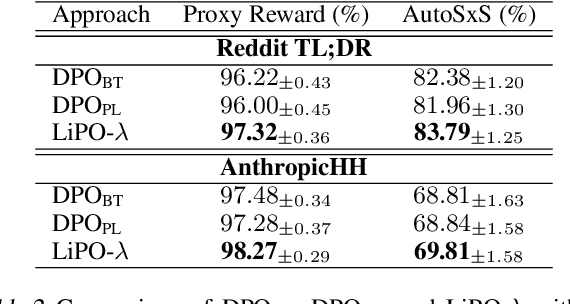
Aligning language models (LMs) with curated human feedback is critical to control their behaviors in real-world applications. Several recent policy optimization methods, such as DPO and SLiC, serve as promising alternatives to the traditional Reinforcement Learning from Human Feedback (RLHF) approach. In practice, human feedback often comes in a format of a ranked list over multiple responses to amortize the cost of reading prompt. Multiple responses can also be ranked by reward models or AI feedback. There lacks such a study on directly fitting upon a list of responses. In this work, we formulate the LM alignment as a listwise ranking problem and describe the Listwise Preference Optimization (LiPO) framework, where the policy can potentially learn more effectively from a ranked list of plausible responses given the prompt. This view draws an explicit connection to Learning-to-Rank (LTR), where most existing preference optimization work can be mapped to existing ranking objectives, especially pairwise ones. Following this connection, we provide an examination of ranking objectives that are not well studied for LM alignment withDPO and SLiC as special cases when list size is two. In particular, we highlight a specific method, LiPO-{\lambda}, which leverages a state-of-the-art listwise ranking objective and weights each preference pair in a more advanced manner. We show that LiPO-{\lambda} can outperform DPO and SLiC by a clear margin on two preference alignment tasks.
Gemini: A Family of Highly Capable Multimodal Models
Dec 19, 2023This report introduces a new family of multimodal models, Gemini, that exhibit remarkable capabilities across image, audio, video, and text understanding. The Gemini family consists of Ultra, Pro, and Nano sizes, suitable for applications ranging from complex reasoning tasks to on-device memory-constrained use-cases. Evaluation on a broad range of benchmarks shows that our most-capable Gemini Ultra model advances the state of the art in 30 of 32 of these benchmarks - notably being the first model to achieve human-expert performance on the well-studied exam benchmark MMLU, and improving the state of the art in every one of the 20 multimodal benchmarks we examined. We believe that the new capabilities of Gemini models in cross-modal reasoning and language understanding will enable a wide variety of use cases and we discuss our approach toward deploying them responsibly to users.
Statistical Rejection Sampling Improves Preference Optimization
Sep 13, 2023

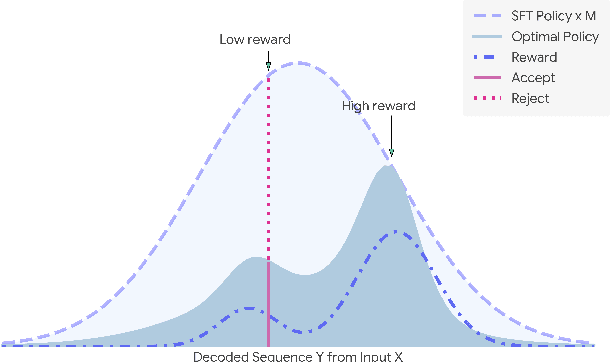

Improving the alignment of language models with human preferences remains an active research challenge. Previous approaches have primarily utilized Reinforcement Learning from Human Feedback (RLHF) via online RL methods such as Proximal Policy Optimization (PPO). Recently, offline methods such as Sequence Likelihood Calibration (SLiC) and Direct Preference Optimization (DPO) have emerged as attractive alternatives, offering improvements in stability and scalability while maintaining competitive performance. SLiC refines its loss function using sequence pairs sampled from a supervised fine-tuned (SFT) policy, while DPO directly optimizes language models based on preference data, foregoing the need for a separate reward model. However, the maximum likelihood estimator (MLE) of the target optimal policy requires labeled preference pairs sampled from that policy. DPO's lack of a reward model constrains its ability to sample preference pairs from the optimal policy, and SLiC is restricted to sampling preference pairs only from the SFT policy. To address these limitations, we introduce a novel approach called Statistical Rejection Sampling Optimization (RSO) that aims to source preference data from the target optimal policy using rejection sampling, enabling a more accurate estimation of the optimal policy. We also propose a unified framework that enhances the loss functions used in both SLiC and DPO from a preference modeling standpoint. Through extensive experiments across three diverse tasks, we demonstrate that RSO consistently outperforms both SLiC and DPO on evaluations from both Large Language Model (LLM) and human raters.
SLiC-HF: Sequence Likelihood Calibration with Human Feedback
May 17, 2023Learning from human feedback has been shown to be effective at aligning language models with human preferences. Past work has often relied on Reinforcement Learning from Human Feedback (RLHF), which optimizes the language model using reward scores assigned from a reward model trained on human preference data. In this work we show how the recently introduced Sequence Likelihood Calibration (SLiC), can also be used to effectively learn from human preferences (SLiC-HF). Furthermore, we demonstrate this can be done with human feedback data collected for a different model, similar to off-policy, offline RL data. Automatic and human evaluation experiments on the TL;DR summarization task show that SLiC-HF significantly improves supervised fine-tuning baselines. Furthermore, SLiC-HF presents a competitive alternative to the PPO RLHF implementation used in past work while being much simpler to implement, easier to tune and more computationally efficient in practice.
Improving the Robustness of Summarization Models by Detecting and Removing Input Noise
Dec 20, 2022


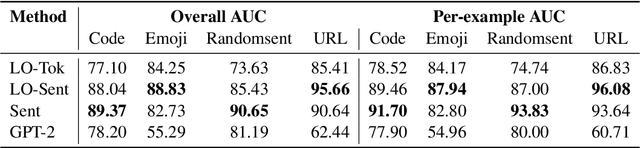
The evaluation of abstractive summarization models typically uses test data that is identically distributed as training data. In real-world practice, documents to be summarized may contain input noise caused by text extraction artifacts or data pipeline bugs. The robustness of model performance under distribution shift caused by such noise is relatively under-studied. We present a large empirical study quantifying the sometimes severe loss in performance (up to 12 ROUGE-1 points) from different types of input noise for a range of datasets and model sizes. We then propose a light-weight method for detecting and removing such noise in the input during model inference without requiring any extra training, auxiliary models, or even prior knowledge of the type of noise. Our proposed approach effectively mitigates the loss in performance, recovering a large fraction of the performance drop, sometimes as large as 11 ROUGE-1 points.
Calibrating Sequence likelihood Improves Conditional Language Generation
Sep 30, 2022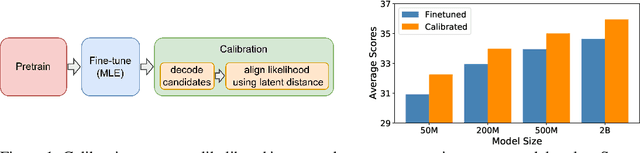
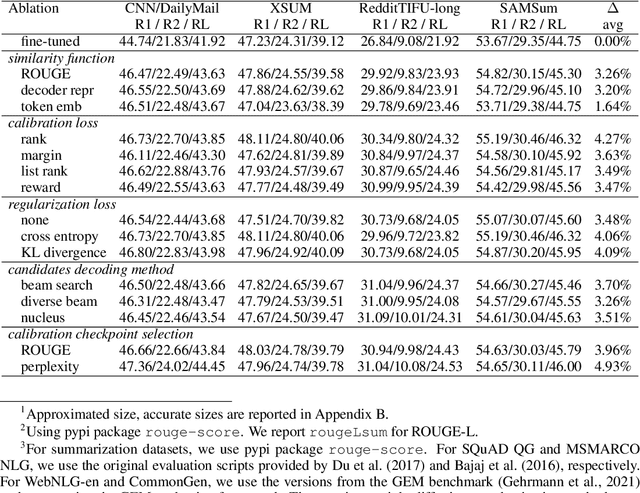


Conditional language models are predominantly trained with maximum likelihood estimation (MLE), giving probability mass to sparsely observed target sequences. While MLE trained models assign high probability to plausible sequences given the context, the model probabilities often do not accurately rank-order generated sequences by quality. This has been empirically observed in beam search decoding as output quality degrading with large beam sizes, and decoding strategies benefiting from heuristics such as length normalization and repetition-blocking. In this work, we introduce sequence likelihood calibration (SLiC) where the likelihood of model generated sequences are calibrated to better align with reference sequences in the model's latent space. With SLiC, decoding heuristics become unnecessary and decoding candidates' quality significantly improves regardless of the decoding method. Furthermore, SLiC shows no sign of diminishing returns with model scale, and presents alternative ways to improve quality with limited training and inference budgets. With SLiC, we exceed or match SOTA results on a wide range of generation tasks spanning abstractive summarization, question generation, abstractive question answering and data-to-text generation, even with modest-sized models.
Out-of-Distribution Detection and Selective Generation for Conditional Language Models
Sep 30, 2022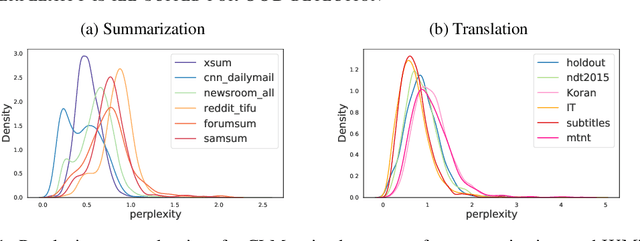
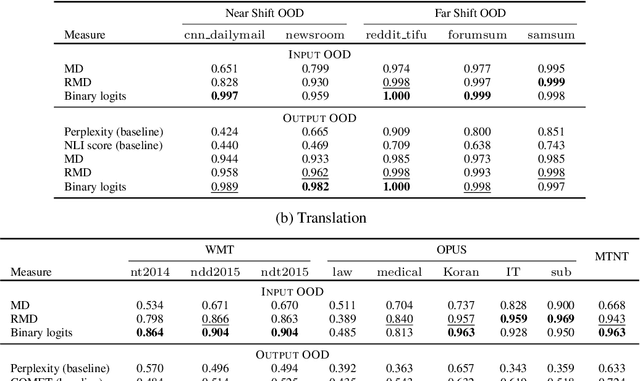
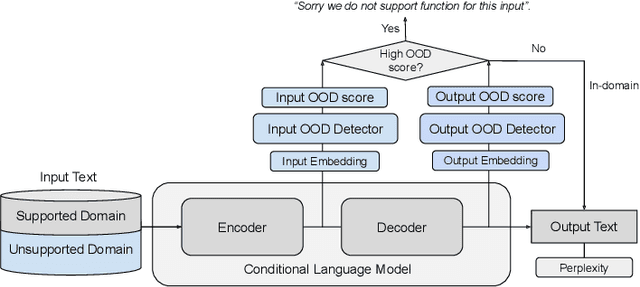
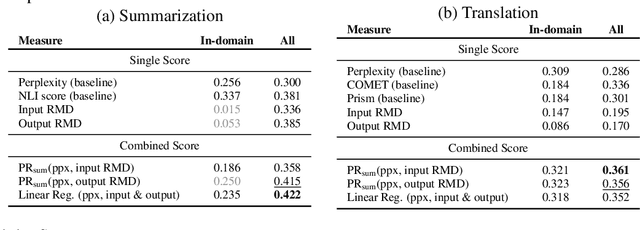
Machine learning algorithms typically assume independent and identically distributed samples in training and at test time. Much work has shown that high-performing ML classifiers can degrade significantly and provide overly-confident, wrong classification predictions, particularly for out-of-distribution (OOD) inputs. Conditional language models (CLMs) are predominantly trained to classify the next token in an output sequence, and may suffer even worse degradation on OOD inputs as the prediction is done auto-regressively over many steps. Furthermore, the space of potential low-quality outputs is larger as arbitrary text can be generated and it is important to know when to trust the generated output. We present a highly accurate and lightweight OOD detection method for CLMs, and demonstrate its effectiveness on abstractive summarization and translation. We also show how our method can be used under the common and realistic setting of distribution shift for selective generation (analogous to selective prediction for classification) of high-quality outputs, while automatically abstaining from low-quality ones, enabling safer deployment of generative language models.