 Add to Chrome
 Add to Firefox
 Add to Edge
TokAN: Accent Normalization Using Self-Supervised Speech Tokens
Jul 04, 2026
Accent normalization (AN) seeks to convert non-native (L2) accented speech into standard (L1) speech while preserving speaker identity. The current techniques either require naturally recorded parallel L1-L2 speech for training, or suffer from quality degradation when supervised by synthesized targets. In this paper, we present TokAN, a token-based accent normalization framework that operates on self-supervised discrete speech tokens extracted from a L1-L2 jointly trained vector-quantization (VQ) tokenizer, without the need of synthetic supervisory speech. An autoregressive encoder-decoder model performs token-to-token conversion, translating L2-accented token sequences into the tokens of standard voice. We also introduce reinforcement learning (RL) post-training based on Group Relative Policy Optimization (GRPO), using word error rate and accent classifier confidence as complementary rewards. A non-autoregressive flow-matching synthesizer recovers the Mel-spectrogram from the converted tokens, conditioned on the source speaker embedding. We also develop a flow-matching duration predictor that supports total-duration-aware synthesis, making TokAN applicable to duration-critical tasks such as voice dubbing and live casting. Experiments on seven English accents demonstrate that TokAN reduced the word error rate from 12.40% to 9.89% after supervised fine-tuning, and further to 9.23% after RL post-training, consistently outperforming frame-to-frame, direct flow-matching, and prompt-based token-conversion baselines in terms of accent reduction and intelligibility.

CoMIC: Collaborative Memory and Insights Circulation for Long-Horizon LLM Agents in Cloud-Edge Systems
May 30, 2026Deploying lightweight Large Language Model (LLM) agents on edge servers can reduce latency and move agentic services closer to users, but resource-constrained edge models often struggle with long-horizon tasks that require persistent memory, subgoal tracking, and reflection. Fine-tuning edge models after deployment is costly and difficult to scale across heterogeneous nodes, while purely local memory leaves agents with isolated experience and growing prompt context. We propose \textsc{CoMIC}, a parameter-update-free cloud-edge framework for Collaborative Memory and Insights Circulation. \textsc{CoMIC} follows a \textit{Centralized Reflection, Decentralized Execution} design: edge agents execute locally using subgoal-oriented hierarchical memory and selective re-expansion of relevant histories, while a cloud-side LLM critic asynchronously evaluates completed trajectories, filters reusable experience, and aggregates cross-agent guidance keyed by semantic subgoal identifiers. Across five long-horizon agent tasks spanning symbolic planning and text interaction, \textsc{CoMIC} improves progress rate and action grounding for weak edge agents and yields task-dependent success-rate gains without updating model parameters.
DM-ASR: Diarization-aware Multi-speaker ASR with Large Language Models
Apr 24, 2026Multi-speaker automatic speech recognition (ASR) aims to transcribe conversational speech involving multiple speakers, requiring the model to capture not only what was said, but also who said it and sometimes when it was spoken. Recent Speech-LLM approaches have shown the potential of unified modeling for this task, but jointly learning speaker attribution, temporal structure, and lexical recognition remains difficult and data-intensive. At the current stage, leveraging reliable speaker diarization as an explicit structural prior provides a practical and efficient way to simplify this task. To effectively exploit such priors, we propose DM-ASR, a diarization-aware multi-speaker ASR framework that reformulates the task as a multi-turn dialogue generation process. Given an audio chunk and diarization results, DM-ASR decomposes transcription into a sequence of speaker- and time-conditioned queries, each corresponding to one speaker in one time segment. This formulation converts multi-speaker recognition into a series of structured sub-tasks, explicitly decoupling speaker-temporal structure from linguistic content and enabling effective integration of diarization cues with the reasoning capability of large language models. We further introduce an optional word-level timestamp prediction mechanism that interleaves word and timestamp tokens, yielding richer structured outputs and better transcription quality. Our analysis shows that diarization systems provide more reliable speaker identities and segment-level boundaries, while LLMs excel at modeling linguistic content and long-range dependencies, demonstrating their complementary strengths. Experiments on Mandarin and English benchmarks show that the proposed approach achieves strong performance with relatively small models and training data, while remaining competitive with or outperforming existing unified approaches.
Bridging What the Model Thinks and How It Speaks: Self-Aware Speech Language Models for Expressive Speech Generation
Apr 13, 2026Speech Language Models (SLMs) exhibit strong semantic understanding, yet their generated speech often sounds flat and fails to convey expressive intent, undermining user engagement. We term this mismatch the semantic understanding-acoustic realization gap. We attribute this gap to two key deficiencies: (1) intent transmission failure, where SLMs fail to provide the stable utterance-level intent needed for expressive delivery; and (2) realization-unaware training, where no feedback signal verifies whether acoustic outputs faithfully reflect intended expression. To address these issues, we propose SA-SLM (Self-Aware Speech Language Model), built on the principle that the model should be aware of what it thinks during generation and how it speaks during training. SA-SLM addresses this gap through two core contributions: (1) Intent-Aware Bridging, which uses a Variational Information Bottleneck (VIB) objective to translate the model's internal semantics into temporally smooth expressive intent, making speech generation aware of what the model intends to express; and (2) Realization-Aware Alignment, which repurposes the model as its own critic to verify and align acoustic realization with intended expressive intent via rubric-based feedback. Trained on only 800 hours of expressive speech data, our 3B parameter SA-SLM surpasses all open-source baselines and comes within 0.08 points of GPT-4o-Audio in overall expressiveness on the EchoMind benchmark.
Controllable Accent Normalization via Discrete Diffusion
Mar 15, 2026Existing accent normalization methods do not typically offer control over accent strength, yet many applications-such as language learning and dubbing-require tunable accent retention. We propose DLM-AN, a controllable accent normalization system built on masked discrete diffusion over self-supervised speech tokens. A Common Token Predictor identifies source tokens that likely encode native pronunciation; these tokens are selectively reused to initialize the reverse diffusion process. This provides a simple yet effective mechanism for controlling accent strength: reusing more tokens preserves more of the original accent. DLM-AN further incorporates a flow-matching Duration Ratio Predictor that automatically adjusts the total duration to better match the native rhythm. Experiments on multi-accent English data show that DLM-AN achieves the lowest word error rate among all compared systems while delivering competitive accent reduction and smooth, interpretable accent strength control.
CosyAccent: Duration-Controllable Accent Normalization Using Source-Synthesis Training Data
Feb 22, 2026Accent normalization (AN) systems often struggle with unnatural outputs and undesired content distortion, stemming from both suboptimal training data and rigid duration modeling. In this paper, we propose a "source-synthesis" methodology for training data construction. By generating source L2 speech and using authentic native speech as the training target, our approach avoids learning from TTS artifacts and, crucially, requires no real L2 data in training. Alongside this data strategy, we introduce CosyAccent, a non-autoregressive model that resolves the trade-off between prosodic naturalness and duration control. CosyAccent implicitly models rhythm for flexibility yet offers explicit control over total output duration. Experiments show that, despite being trained without any real L2 speech, CosyAccent achieves significantly improved content preservation and superior naturalness compared to strong baselines trained on real-world data.
Accent Normalization Using Self-Supervised Discrete Tokens with Non-Parallel Data
Jul 23, 2025Accent normalization converts foreign-accented speech into native-like speech while preserving speaker identity. We propose a novel pipeline using self-supervised discrete tokens and non-parallel training data. The system extracts tokens from source speech, converts them through a dedicated model, and synthesizes the output using flow matching. Our method demonstrates superior performance over a frame-to-frame baseline in naturalness, accentedness reduction, and timbre preservation across multiple English accents. Through token-level phonetic analysis, we validate the effectiveness of our token-based approach. We also develop two duration preservation methods, suitable for applications such as dubbing.
SpeechRefiner: Towards Perceptual Quality Refinement for Front-End Algorithms
Jun 16, 2025Speech pre-processing techniques such as denoising, de-reverberation, and separation, are commonly employed as front-ends for various downstream speech processing tasks. However, these methods can sometimes be inadequate, resulting in residual noise or the introduction of new artifacts. Such deficiencies are typically not captured by metrics like SI-SNR but are noticeable to human listeners. To address this, we introduce SpeechRefiner, a post-processing tool that utilizes Conditional Flow Matching (CFM) to improve the perceptual quality of speech. In this study, we benchmark SpeechRefiner against recent task-specific refinement methods and evaluate its performance within our internal processing pipeline, which integrates multiple front-end algorithms. Experiments show that SpeechRefiner exhibits strong generalization across diverse impairment sources, significantly enhancing speech perceptual quality. Audio demos can be found at https://speechrefiner.github.io/SpeechRefiner/.
Multi-Level Speaker Representation for Target Speaker Extraction
Oct 21, 2024Target speaker extraction (TSE) relies on a reference cue of the target to extract the target speech from a speech mixture. While a speaker embedding is commonly used as the reference cue, such embedding pre-trained with a large number of speakers may suffer from confusion of speaker identity. In this work, we propose a multi-level speaker representation approach, from raw features to neural embeddings, to serve as the speaker reference cue. We generate a spectral-level representation from the enrollment magnitude spectrogram as a raw, low-level feature, which significantly improves the model's generalization capability. Additionally, we propose a contextual embedding feature based on cross-attention mechanisms that integrate frame-level embeddings from a pre-trained speaker encoder. By incorporating speaker features across multiple levels, we significantly enhance the performance of the TSE model. Our approach achieves a 2.74 dB improvement and a 4.94% increase in extraction accuracy on Libri2mix test set over the baseline.
Joint Training or Not: An Exploration of Pre-trained Speech Models in Audio-Visual Speaker Diarization
Dec 07, 2023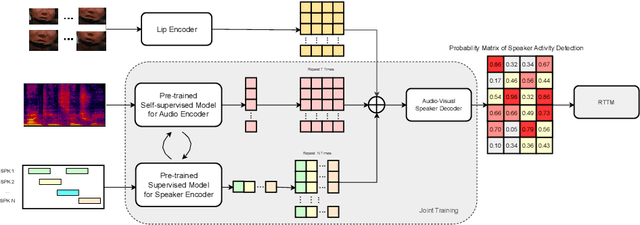


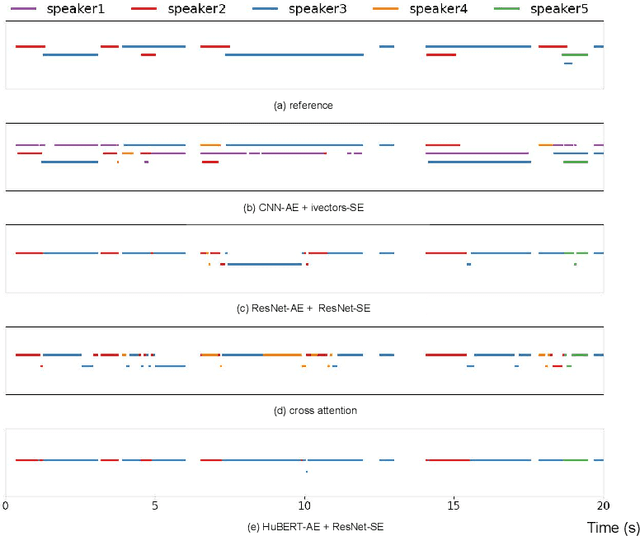
The scarcity of labeled audio-visual datasets is a constraint for training superior audio-visual speaker diarization systems. To improve the performance of audio-visual speaker diarization, we leverage pre-trained supervised and self-supervised speech models for audio-visual speaker diarization. Specifically, we adopt supervised~(ResNet and ECAPA-TDNN) and self-supervised pre-trained models~(WavLM and HuBERT) as the speaker and audio embedding extractors in an end-to-end audio-visual speaker diarization~(AVSD) system. Then we explore the effectiveness of different frameworks, including Transformer, Conformer, and cross-attention mechanism, in the audio-visual decoder. To mitigate the degradation of performance caused by separate training, we jointly train the audio encoder, speaker encoder, and audio-visual decoder in the AVSD system. Experiments on the MISP dataset demonstrate that the proposed method achieves superior performance and obtained third place in MISP Challenge 2022.