 Add to Chrome
 Add to Firefox
 Add to Edge
SE-AGCNet: An End-to-End Framework for Joint Speech Enhancement and Loudness Control in Meeting Scenarios
Jun 24, 2026
Conventional audio pipelines typically treat speech enhancement (SE) and automatic gain control (AGC) as discrete modules, which often limits overall performance. For instance, applying AGC before SE may inadvertently amplify background noise, while prioritizing SE tends to over-suppress low-volume speech. To address these limitations, we propose SE-AGCNet, an end-to-end framework that jointly optimizes SE and AGC. Tailored for meeting scenarios with significant volume variations, SE-AGCNet leverages the synergy between the two tasks: SE preserves quiet speech, thereby facilitating effective volume adjustment by the AGC component. Furthermore, we propose a specialized data simulation pipeline, SE-AGC-DataGen, and incorporate standardized loudness evaluation metrics: integrated loudness (LUFS), short-term loudness (St LUFS), and LRA. Experiments show that SE-AGCNet consistently achieves target loudness while improving speech quality and ASR accuracy over competitive baselines.

VoxWatermark: A Large-Scale Benchmark for Audio Watermark Detection under Perturbations
Jun 13, 2026With the rapid deployment of speech generation systems in open environments, providing verifiable source attribution and copyright accountability for audio content has become critical. A gap in current research is the lack of a unified benchmark that systematically compares different watermark injection methods under realistic distribution shifts. To address this, we build VoxWatermark by applying 10 watermarking methods (4 neural and 6 traditional) with unified injection and annotation on multilingual, multi-source corpora, and introducing no-box, black-box, and white-box perturbations to simulate real recording and transmission conditions. Based on this benchmark, we propose AudioWMD as a robust baseline detector for large-scale, multi-method, cross-distribution settings. Results show that injection-method diversity and distribution shifts affect detection stability, while validating the effectiveness and scalability of AudioWMD. Dataset and code are publicly available.
Chain-of-Glimpse: Search-Guided Progressive Object-Grounded Reasoning for Video Understanding
Apr 16, 2026Video understanding requires identifying and reasoning over semantically discriminative visual objects across frames, yet existing object-agnostic solutions struggle to effectively handle substantial object variations over time. To address this, we introduce Chain-of-Glimpse, a search-guided progressive object-grounded reasoning framework that explicitly anchors each reasoning step to specific visual evidence regions, enabling compositional and multi-step decision-making. Formally, Chain-of-Glimpse formulates video reasoning as a step-by-step process that incrementally builds spatially grounded traces around task-relevant visual objects, thereby mitigating over-reliance on saliency-driven cues. Specifically, Chain-of-Glimpse features a search-guided controller, optimized via reinforcement learning with a format reward that significantly incentivizes grounding capability, to iteratively ground visual evidence regions and form reliable reasoning trajectories, yielding accurate and interpretable multi-step decisions. Extensive evaluations on both in domain NExTQA and out-of-domain Video-Holmes, CG-Bench Reasoning, and VRBench benchmarks demonstrate consistent performance gains, robustness and generalization of Chain-of-Glimpse across diverse video reasoning tasks.
Training-Free Intelligibility-Guided Observation Addition for Noisy ASR
Feb 24, 2026Automatic speech recognition (ASR) degrades severely in noisy environments. Although speech enhancement (SE) front-ends effectively suppress background noise, they often introduce artifacts that harm recognition. Observation addition (OA) addressed this issue by fusing noisy and SE enhanced speech, improving recognition without modifying the parameters of the SE or ASR models. This paper proposes an intelligibility-guided OA method, where fusion weights are derived from intelligibility estimates obtained directly from the backend ASR. Unlike prior OA methods based on trained neural predictors, the proposed method is training-free, reducing complexity and enhances generalization. Extensive experiments across diverse SE-ASR combinations and datasets demonstrate strong robustness and improvements over existing OA baselines. Additional analyses of intelligibility-guided switching-based alternatives and frame versus utterance-level OA further validate the proposed design.
GenTSE: Enhancing Target Speaker Extraction via a Coarse-to-Fine Generative Language Model
Dec 24, 2025Language Model (LM)-based generative modeling has emerged as a promising direction for TSE, offering potential for improved generalization and high-fidelity speech. We present GenTSE, a two-stage decoder-only generative LM approach for TSE: Stage-1 predicts coarse semantic tokens, and Stage-2 generates fine acoustic tokens. Separating semantics and acoustics stabilizes decoding and yields more faithful, content-aligned target speech. Both stages use continuous SSL or codec embeddings, offering richer context than discretized-prompt methods. To reduce exposure bias, we employ a Frozen-LM Conditioning training strategy that conditions the LMs on predicted tokens from earlier checkpoints to reduce the gap between teacher-forcing training and autoregressive inference. We further employ DPO to better align outputs with human perceptual preferences. Experiments on Libri2Mix show that GenTSE surpasses previous LM-based systems in speech quality, intelligibility, and speaker consistency.
Joint Training or Not: An Exploration of Pre-trained Speech Models in Audio-Visual Speaker Diarization
Dec 07, 2023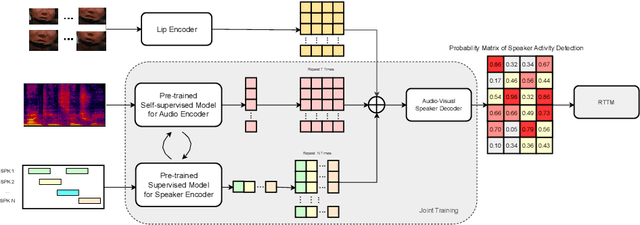


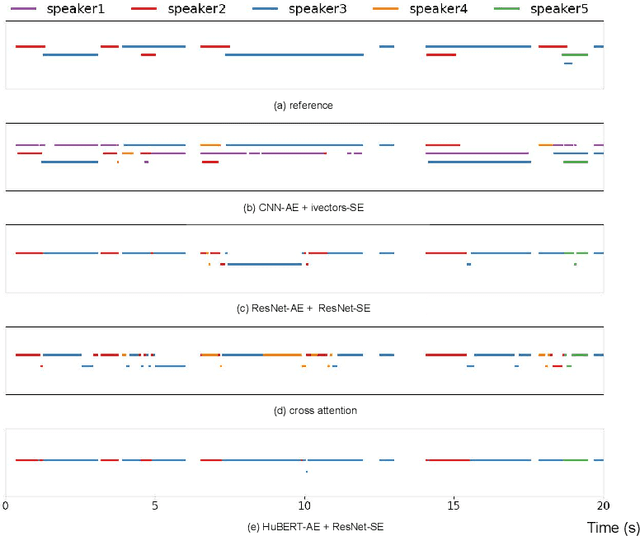
The scarcity of labeled audio-visual datasets is a constraint for training superior audio-visual speaker diarization systems. To improve the performance of audio-visual speaker diarization, we leverage pre-trained supervised and self-supervised speech models for audio-visual speaker diarization. Specifically, we adopt supervised~(ResNet and ECAPA-TDNN) and self-supervised pre-trained models~(WavLM and HuBERT) as the speaker and audio embedding extractors in an end-to-end audio-visual speaker diarization~(AVSD) system. Then we explore the effectiveness of different frameworks, including Transformer, Conformer, and cross-attention mechanism, in the audio-visual decoder. To mitigate the degradation of performance caused by separate training, we jointly train the audio encoder, speaker encoder, and audio-visual decoder in the AVSD system. Experiments on the MISP dataset demonstrate that the proposed method achieves superior performance and obtained third place in MISP Challenge 2022.
The FlySpeech Audio-Visual Speaker Diarization System for MISP Challenge 2022
Jul 28, 2023
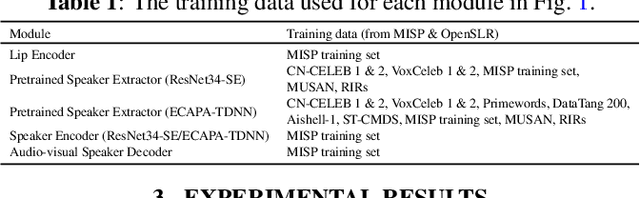
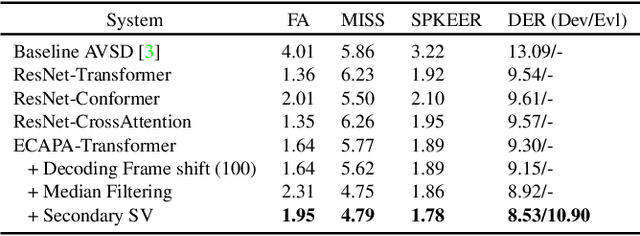
This paper describes the FlySpeech speaker diarization system submitted to the second \textbf{M}ultimodal \textbf{I}nformation Based \textbf{S}peech \textbf{P}rocessing~(\textbf{MISP}) Challenge held in ICASSP 2022. We develop an end-to-end audio-visual speaker diarization~(AVSD) system, which consists of a lip encoder, a speaker encoder, and an audio-visual decoder. Specifically, to mitigate the degradation of diarization performance caused by separate training, we jointly train the speaker encoder and the audio-visual decoder. In addition, we leverage the large-data pretrained speaker extractor to initialize the speaker encoder.
MC-SpEx: Towards Effective Speaker Extraction with Multi-Scale Interfusion and Conditional Speaker Modulation
Jun 28, 2023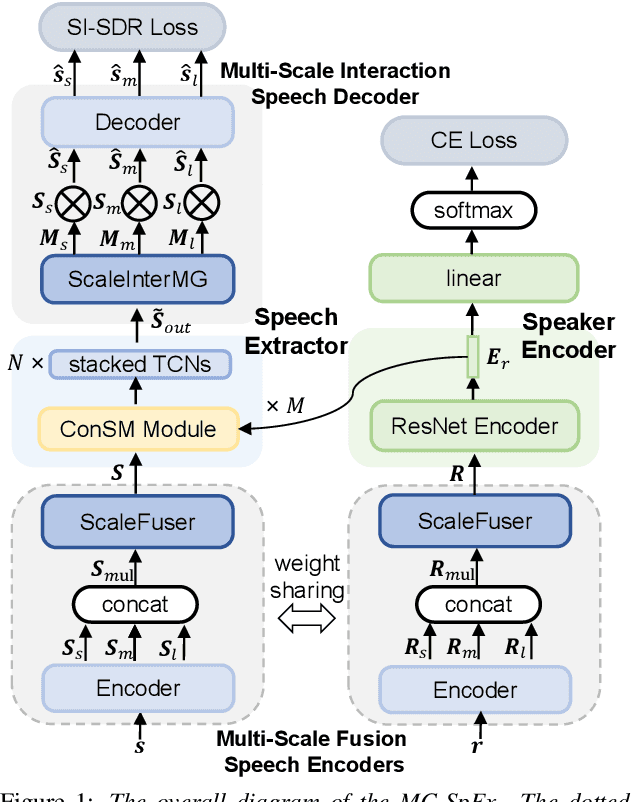
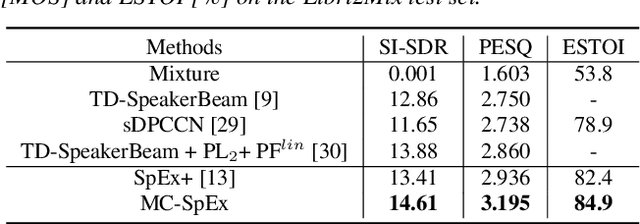
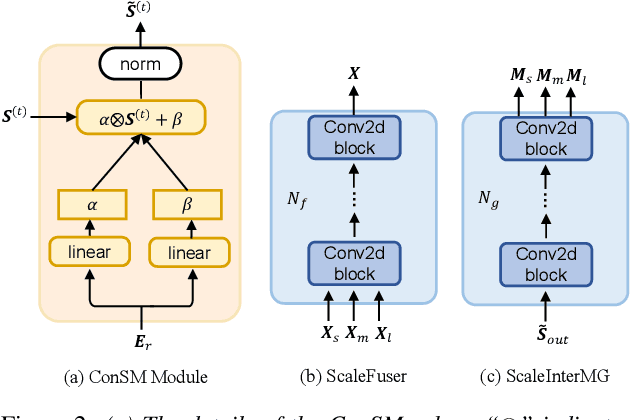
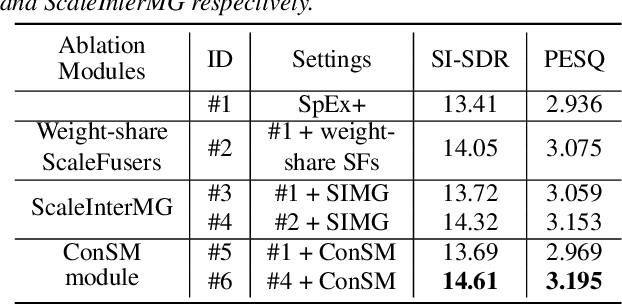
The previous SpEx+ has yielded outstanding performance in speaker extraction and attracted much attention. However, it still encounters inadequate utilization of multi-scale information and speaker embedding. To this end, this paper proposes a new effective speaker extraction system with multi-scale interfusion and conditional speaker modulation (ConSM), which is called MC-SpEx. First of all, we design the weight-share multi-scale fusers (ScaleFusers) for efficiently leveraging multi-scale information as well as ensuring consistency of the model's feature space. Then, to consider different scale information while generating masks, the multi-scale interactive mask generator (ScaleInterMG) is presented. Moreover, we introduce ConSM module to fully exploit speaker embedding in the speech extractor. Experimental results on the Libri2Mix dataset demonstrate the effectiveness of our improvements and the state-of-the-art performance of our proposed MC-SpEx.
Gesper: A Restoration-Enhancement Framework for General Speech Reconstruction
Jun 14, 2023This paper describes a real-time General Speech Reconstruction (Gesper) system submitted to the ICASSP 2023 Speech Signal Improvement (SSI) Challenge. This novel proposed system is a two-stage architecture, in which the speech restoration is performed, and then cascaded by speech enhancement. We propose a complex spectral mapping-based generative adversarial network (CSM-GAN) as the speech restoration module for the first time. For noise suppression and dereverberation, the enhancement module is performed with fullband-wideband parallel processing. On the blind test set of ICASSP 2023 SSI Challenge, the proposed Gesper system, which satisfies the real-time condition, achieves 3.27 P.804 overall mean opinion score (MOS) and 3.35 P.835 overall MOS, ranked 1st in both track 1 and track 2.
Inter-SubNet: Speech Enhancement with Subband Interaction
May 09, 2023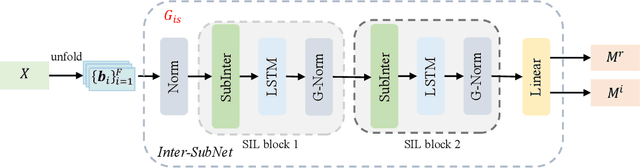

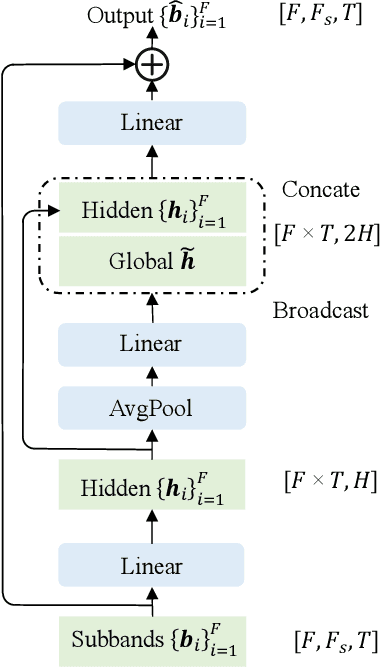

Subband-based approaches process subbands in parallel through the model with shared parameters to learn the commonality of local spectrums for noise reduction. In this way, they have achieved remarkable results with fewer parameters. However, in some complex environments, the lack of global spectral information has a negative impact on the performance of these subband-based approaches. To this end, this paper introduces the subband interaction as a new way to complement the subband model with the global spectral information such as cross-band dependencies and global spectral patterns, and proposes a new lightweight single-channel speech enhancement framework called Interactive Subband Network (Inter-SubNet). Experimental results on DNS Challenge - Interspeech 2021 dataset show that the proposed Inter-SubNet yields a significant improvement over the subband model and outperforms other state-of-the-art speech enhancement approaches, which demonstrate the effectiveness of subband interaction.